


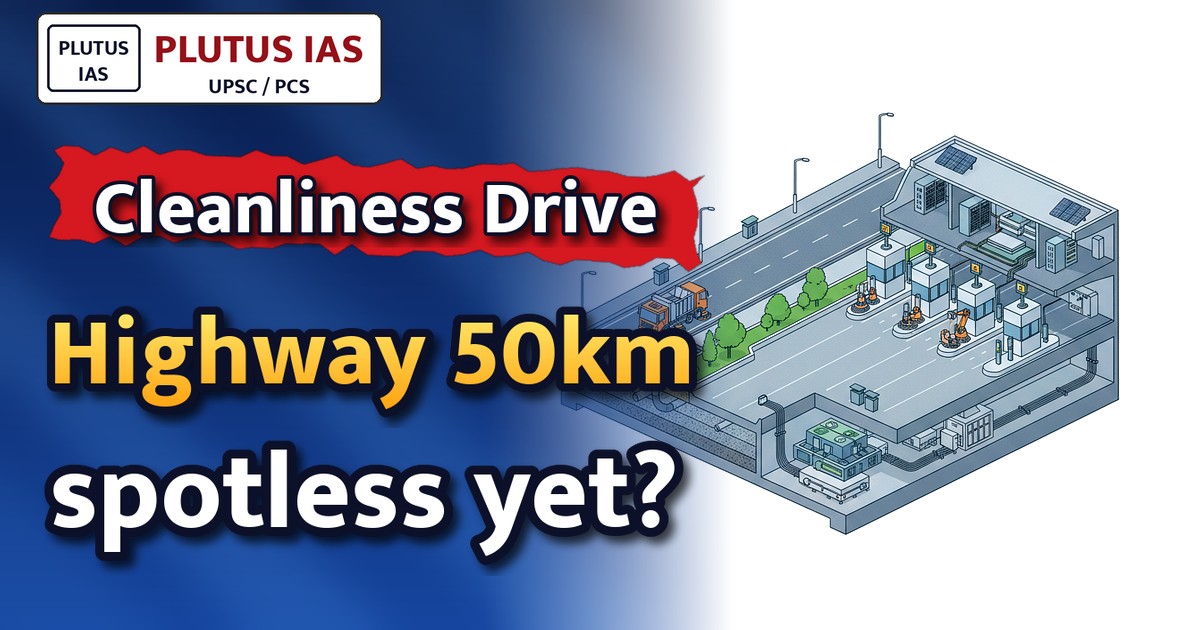
29 Sep Ministry Launches Swachhata Abhiyan 6.0 for National Highways & Toll Plazas
✎ Special Campaign 6.0 by MoRTH (2–31 Oct 2026) aims to enhance cleanliness, maintenance, and efficiency of national highways and toll plazas through geospatial monitoring, e-waste management, and targeted infrastructure upgrades.
Subject Relevance — Where This Topic Fits
- GS Paper II — Governance, Transparency and Accountability | GS Paper III — Infrastructure Development
- Prelims: National Highways Authority of India (NHAI), Toll Plaza Management, Swachh Bharat Mission 2.0, E-waste Management Rules 2022, Geospatial Mapping of Infrastructure Deficiencies
- Essay: The Role of Governance in Ensuring Sustainable Infrastructure: A Case Study of Special Campaign 6.0
Quick Revision: Special Campaign 6.0 by MoRTH (2–31 Oct 2026) aims to enhance cleanliness, maintenance, and efficiency of national highways and toll plazas through geospatial monitoring, e-waste management, and targeted infrastructure upgrades.
Why is this in the news?
The Ministry of Road Transport and Highways (MoRTH) has launched Special Campaign 6.0 from 2 to 31 October 2026 to address cleanliness, maintenance, and efficiency in the management of national highways and toll plazas. This initiative underscores the government’s commitment to improving public infrastructure through systematic governance reforms, including waste management, record digitization, and spatial monitoring of deficiencies. The campaign is significant as it integrates environmental sustainability, administrative efficiency, and citizen-centric service delivery in a sector critical to economic connectivity.
Background
- The maintenance and cleanliness of national highways and toll plazas are essential for ensuring seamless transportation, reducing accidents, and enhancing user experience.
- The Government of India has progressively institutionalized Special Campaigns to improve cleanliness, record management, and disposal of obsolete items in government offices and public spaces.
- The National Highways Authority of India (NHAI), under MoRTH, is the nodal agency responsible for the development, maintenance, and operation of national highways, including toll plazas.
- E-waste management has gained prominence due to the rapid proliferation of electronic toll collection systems and digital infrastructure along highways.
- Geospatial technologies are increasingly used by government agencies to map and monitor infrastructure deficiencies for targeted interventions.
What is Special Campaign 6.0?
- Special Campaign 6.0 is a time-bound governance initiative launched by the Ministry of Road Transport and Highways (MoRTH) to improve cleanliness, maintenance, and operational efficiency of national highways and toll plazas.
- The campaign is structured in two phases: a preparation phase (15–30 September 2026) and a main implementation phase (2–31 October 2026).
- Key objectives include reducing pending cases, strengthening record management, promoting responsible e-waste disposal, and optimizing the use of office spaces under MoRTH’s administrative control.
- The campaign focuses on targeted cleanliness drives, disposal of obsolete items, renovation of toilet blocks at toll plazas, and overall improvement of highway infrastructure, particularly in urban areas.
- Activities include painting and repainting of toll plazas, installation and improvement of road signs, enhanced lighting, adoption of solar energy, and ensuring pothole-free roads.
- A 50-kilometre stretch of national highway, including a toll plaza, has been identified for intensive monitoring and improvement under the campaign.
- Designated nodal officers at headquarters, regional offices, and field units are responsible for coordinating implementation, conducting inspections, and ensuring timely resolution of identified deficiencies.
- Progress is reviewed weekly by senior officials, including the Secretary of the Ministry, to ensure accountability and measurable outcomes.
Key Features
| Feature | Significance |
|---|---|
| National Highways and Toll Plaza Cleanliness Drive (Campaign 6.0) | A targeted initiative by the Ministry of Road Transport and Highways to improve cleanliness, sanitation, and maintenance across national highways and toll plazas, ensuring a safer and more user-friendly road infrastructure. |
| Phased Implementation (Preparation + Main Campaign) | A two-phase approach—preparation (15–30 Sep 2026) followed by the main campaign (2–31 Oct 2026)—to systematically identify, plan, and execute cleanliness and maintenance activities. |
| Geotagging of Deficiencies | Designated officers will conduct field inspections, identify deficiencies (e.g., potholes, waste accumulation), and geotag them for real-time monitoring and prioritized resolution. |
| E-Waste Disposal Protocol | Promotion of responsible e-waste management practices within the ministry’s administrative control, aligning with environmental sustainability and circular economy principles. |
| Record Management Strengthening | Digitization and streamlining of administrative records to reduce pendency, enhance transparency, and improve operational efficiency in governance. |
Why it Matters
Infrastructure Governance
- Enhances the operational efficiency of national highways and toll plazas, which are critical arteries for economic connectivity and trade.
- Improves user experience by ensuring clean, safe, and well-maintained road infrastructure, reducing travel time and vehicle wear.
- Aligns with the broader national objective of sustainable infrastructure development under the *National Infrastructure Pipeline (NIP)* and *Gati Shakti Master Plan*.
Environmental Sustainability
- Promotes responsible waste management, including e-waste disposal, reducing environmental pollution along highways.
- Encourages the use of solar energy at toll plazas and other locations, contributing to the reduction of carbon footprints.
- Supports the *Swachh Bharat Mission 2.0* by integrating cleanliness into routine highway maintenance.
Administrative Reforms
- Strengthens record management and reduces pendency in government processes, improving transparency and accountability.
- Facilitates better utilization of office spaces and resources within the ministry’s administrative control.
- Establishes a framework for continuous monitoring and corrective action through geotagging and field inspections.
Public Health and Safety
- Ensures the availability of functional and clean toilet blocks at toll plazas, addressing sanitation challenges in high-traffic areas.
- Reduces health hazards associated with improper waste disposal and stagnant water in roadside areas.
- Improves road safety by addressing potholes, poor signage, and inadequate lighting, which are common causes of accidents.
Challenges
1. Geographical Spread and Logistics
- National highways span thousands of kilometers across diverse terrains, making uniform cleanliness and maintenance a logistical challenge.
- Toll plazas in remote or hilly regions may face additional difficulties in waste collection, disposal, and infrastructure upkeep.
- Coordination between multiple stakeholders (contractors, local bodies, state agencies) is essential but often fragmented.
UPSC Link: Geographical Spread of Infrastructure Projects
2. Behavioral and Cultural Factors
- Public littering and improper waste disposal along highways remain persistent challenges, requiring sustained awareness campaigns.
- Resistance to change among local contractors or staff accustomed to traditional maintenance practices may hinder adoption of new protocols.
- Lack of community participation in waste management initiatives can undermine long-term sustainability.
UPSC Link: Public Participation in Governance
3. Resource Constraints
- Limited financial and human resources for large-scale cleanliness drives, especially in underdeveloped regions.
- Delays in procurement of materials (e.g., solar panels, signage) or equipment for maintenance activities can stall progress.
- Budgetary allocations for maintenance are often prioritized for new projects over routine upkeep.
UPSC Link: Resource Allocation in Infrastructure Projects
4. Technological Integration
- Ensuring seamless integration of digital tools (e.g., geotagging apps, waste tracking systems) across all field offices and contractors.
- Addressing data privacy and security concerns when digitizing administrative records and geospatial data.
- Training staff and contractors to use new technologies effectively for monitoring and reporting.
UPSC Link: Digital Governance and e-Governance
5. Regulatory and Compliance Hurdles
- Navigating environmental regulations for waste disposal, especially for hazardous or e-waste, can be complex and time-consuming.
- Ensuring compliance with multiple overlapping regulations (e.g., *Solid Waste Management Rules 2016*, *E-Waste Management Rules 2022*).
- Legal ambiguities in liability for waste management failures may delay corrective actions.
UPSC Link: Environmental Laws and Policies
Challenges — UPSC Perspective
| Issue | Concern |
|---|---|
| Public Littering | Persistent challenge due to lack of awareness and enforcement; requires behavioral change campaigns. |
| Remote Area Access | Difficulties in waste collection and maintenance in hilly or sparsely populated regions. |
| Contractor Accountability | Fragmented responsibility among multiple contractors leading to inconsistent service delivery. |
| Data Accuracy in Geotagging | Risk of incorrect or incomplete geotagging, which can misdirect resources and delay resolutions. |
| E-Waste Disposal | Complex regulatory framework and lack of specialized infrastructure for safe disposal. |
| Seasonal Variations | Monsoon-related damage (e.g., potholes, waterlogging) and increased littering during festivals or holidays. |
Way Forward
- Constitute **district-level task forces** comprising local authorities, contractors, and community representatives to oversee cleanliness drives and ensure accountability.
- Leverage **Swachhagrahis** (under *Swachh Bharat Mission*) and **NYKS volunteers** for community engagement and awareness campaigns along national highways.
- Develop a **real-time monitoring dashboard** integrating geotagged data, waste disposal records, and maintenance progress for transparent tracking.
- Introduce **performance-based incentives** for contractors and field staff, linking payments to measurable cleanliness and maintenance outcomes.
- Collaborate with **corporate CSR initiatives** (e.g., *Companies Act, 2013*) to fund high-impact projects like solar-powered toll plazas or waste recycling units.
- Standardize **maintenance protocols** across all national highways, including seasonal checklists and emergency response plans for extreme weather events.
- Conduct **quarterly audits** by independent agencies to assess the effectiveness of the campaign and identify systemic gaps.
- Integrate **citizen feedback mechanisms** (e.g., mobile apps, toll-free numbers) to report deficiencies and track resolutions in real time.
UPSC Value Addition
Keywords for Mains Answer-Writing
National Highways · Toll plazas · Swachh Bharat Mission · Special Campaign 6.0 · Ministry of Road Transport and Highways · Public infrastructure maintenance · E-waste management · Record management · Administrative efficiency · Sustainable infrastructure · Urban sanitation · Geotagging of deficiencies · Nodal officers · Solar energy in highways · Road safety infrastructure
Concept Flow
National Highways and Toll Plazas → Poor Maintenance and Sanitation → Public Health and Safety Risks, Economic Disruptions → Ministry of Road Transport and Highways Launches Campaign 6.0 → Phased Implementation (Preparation + Main Campaign) → Geotagging of Deficiencies and Real-Time Monitoring → Corrective Actions (Cleanup, Repairs, Waste Management) → Improved Infrastructure Governance and User Experience → Alignment with National Infrastructure and Environmental Goals.
Prelims Practice Questions
Q1. Consider the following statements regarding the Special Campaign 6.0 launched by the Ministry of Road Transport and Highways:
1. The campaign aims to improve cleanliness and maintenance of National Highways and Toll plazas.
2. It includes the disposal of e-waste and strengthening of record management.
3. The campaign is limited to rural areas and excludes urban National Highways.
4. Geotagging of deficiencies is a key component of the campaign.
How many of the above statements are correct?
- Only one
- Only two
- Only three
- All four
Answer: Only three — Statements 1, 2, and 4 are correct. Statement 3 is incorrect as the campaign specifically targets urban areas for waste removal and sanitation improvements.
Q2. Assertion (A): The Special Campaign 6.0 includes the renovation of toilet blocks at Toll plazas.
Reason (R): The campaign aims to enhance public infrastructure and sanitation standards across National Highways.
Options:
A. Both A and R are true, and R is the correct explanation of A.
B. Both A and R are true, but R is not the correct explanation of A.
C. A is true but R is false.
D. A is false but R is true.
Answer: ? — Both Assertion (A) and Reason (R) are true, and Reason (R) correctly explains Assertion (A) as the renovation of toilet blocks is part of the broader sanitation and infrastructure improvement goals of the campaign.
Q3. Match the following activities with their corresponding objectives under Special Campaign 6.0:
Column I (Activity) | Column II (Objective)
———————————————|————————————
1. Geotagging of deficiencies | A. Strengthening administrative efficiency
2. Disposal of e-waste | B. Enhancing road safety infrastructure
3. Installation of solar lighting | C. Promoting sustainable practices
4. Improvement of road signage | D. Facilitating targeted corrective actions
Choose the correct match:
- 1-D, 2-A, 3-C, 4-B
- 1-A, 2-C, 3-B, 4-D
- 1-D, 2-C, 3-A, 4-B
- 1-B, 2-A, 3-C, 4-D
Answer: 1-D, 2-A, 3-C, 4-B — The correct match is: 1 (Geotagging of deficiencies) – D (Facilitating targeted corrective actions), 2 (Disposal of e-waste) – C (Promoting sustainable practices), 3 (Installation of solar lighting) – A (Strengthening administrative efficiency), 4 (Improvement of road signage) – B (Enhancing road safety infrastructure).
Mains Practice Question
✍ The Ministry of Road Transport and Highways has launched ‘Special Campaign 6.0’ to address sanitation and maintenance challenges on National Highways and Toll plazas. Critically examine the administrative and governance dimensions of this campaign. Also, assess its potential impact on public infrastructure sustainability and road safety. (15 Marks)
Approach: MODEL-ANSWER SKELETON:
I. Introduction (2 marks)
– Briefly define Special Campaign 6.0 and its objectives as outlined by the Ministry of Road Transport and Highways.
– Contextualise the campaign within broader public infrastructure governance and the Swachh Bharat Mission framework.
II. Administrative and Governance Dimensions (5 marks)
– **Coordination Mechanism**: Role of nodal officers, joint secretaries, and field offices in ensuring implementation and monitoring.
– **Process Reforms**: Strengthening of record management, disposal of e-waste, and geotagging of deficiencies for targeted corrective actions.
– **Institutional Accountability**: Weekly reviews by senior officials and progress reporting mechanisms to ensure transparency and efficiency.
– **Sustainable Practices**: Promotion of solar energy use, efficient lighting, and waste management as part of administrative efficiency.
III. Impact on Public Infrastructure Sustainability (4 marks)
– **Sanitation and Cleanliness**: Renovation of toilet blocks, waste removal in urban areas, and improved maintenance of Toll plazas.
– **Environmental Sustainability**: E-waste disposal and adoption of solar energy to reduce carbon footprint.
– **Urban-Rural Synergy**: Focus on both urban and rural National Highways to ensure equitable infrastructure development.
– **Long-term Viability**: Potential for the campaign to set a precedent for future public infrastructure maintenance initiatives.
IV. Impact on Road Safety (3 marks)
– **Infrastructure Upgrades**: Installation and improvement of road signage, better lighting, and maintenance of pothole-free roads.
– **User Experience**: Enhanced safety and convenience for commuters through improved public infrastructure.
– **Regulatory Compliance**: Alignment with national and international standards for road safety and sanitation.
V. Conclusion (1 mark)
– Summarise the administrative and governance strengths of the campaign.
– Highlight its potential to serve as a model for sustainable public infrastructure development in India.
Key Themes to Cover:
– Administrative efficiency and coordination.
– Sustainability in public infrastructure.
– Road safety and user experience.
– Governance mechanisms and accountability.
Source: PIB (Press Information Bureau)
Generated by AanyaAi for educational purpose.
Related guides on our sites
- Anthropology VS PSIR
- Best PSIR optional coaching
- Best PSIR optional coaching online
- Best PSIR optional teacher

- NAMASTE Scheme: Enhancing Sanitation Workers’ Livelihoods & Safety - November 14, 2026
- एमएसएमई का विशेष अभियान 6.0: स्वच्छता और लंबित मामलों का निपटारा - November 14, 2026
- Sea Vigil-26: Coastal Defence Drills Off Visakhapatnam - November 14, 2026

No Comments