


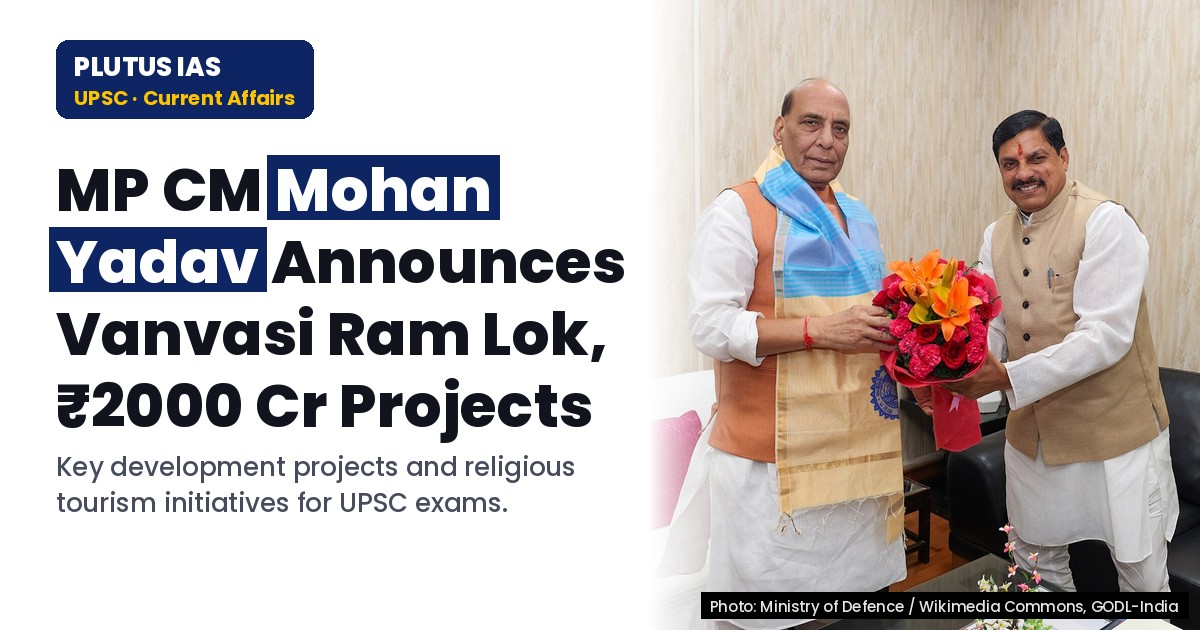
07 Nov MP CM Announces Vanvasi Ram Lok, ₹2000 Cr Projects in Chitrakoot
✎ The Madhya Pradesh government is undertaking significant development projects in religious tourism, rural property rights through the SVAMITVA scheme, and animal welfare, centered around sites like Chitrakoot and Orchha.
Subject Relevance — Where This Topic Fits
- GS Paper I — Art and Culture | GS Paper I — Geography of India | GS Paper II — Government Policies and Interventions | GS Paper III — Indian Economy
- Prelims: Vanvasi Ram Lok, Chitrakoot, Orchha, Mandakini River, SVAMITVA Scheme, Property Rights, Religious Tourism, Rural Development
- Essay: The role of cultural heritage in national development and identity, Sustainable rural development through land reforms and economic empowerment
Quick Revision: The Madhya Pradesh government is undertaking significant development projects in religious tourism, rural property rights through the SVAMITVA scheme, and animal welfare, centered around sites like Chitrakoot and Orchha.
Why is this in the news?
The Chief Minister of Madhya Pradesh visited Chitrakoot, a significant pilgrimage site, where he announced development projects exceeding ₹2,000 crore. Key initiatives include the creation of ‘Vanvasi Ram Lok’ connecting Orchha and Chitrakoot to promote religious tourism, and an expansion of the SVAMITVA scheme to grant property rights to rural residents, alongside an increase in financial assistance for gaushalas.
Background
- Chitrakoot holds immense spiritual significance in Hindu mythology, particularly as the place where Lord Rama spent a considerable period of his exile (Vanvasa).
- Orchha is historically renowned for its palaces and temples, including the Raja Ram Temple, where Lord Rama is worshipped as a king.
- The concept of ‘Lok’ (e.g., Mahakal Lok, Ram Path Gaman Nyas) involves creating comprehensive pilgrimage corridors and cultural zones around significant religious sites to enhance visitor experience and promote regional development.
- The SVAMITVA (Survey of Villages And Mapping with Improvised Technology in Village Areas) scheme is a Central Sector Scheme of the Ministry of Panchayati Raj, launched to provide rural household owners with a ‘Record of Rights’ to their property.
- Gaushalas (cow shelters) play a crucial role in the preservation and welfare of cattle, often receiving governmental and philanthropic support for their operations.
Key Development Initiatives and Their Implications
- The ‘Vanvasi Ram Lok’ project aims to establish a dedicated religious tourism circuit connecting Chitrakoot and Orchha, leveraging their shared association with Lord Rama.
- This initiative is designed to enhance infrastructure, facilities, and accessibility for pilgrims and tourists, thereby boosting the local economy through increased footfall.
- The SVAMITVA scheme’s expansion in Madhya Pradesh focuses on providing legal ownership documents (registries) to rural property owners, thereby formalizing land holdings.
- Formal property rights empower rural citizens by enabling them to use their land as collateral for bank loans, facilitate property transactions, and resolve land-related disputes.
- The state government’s commitment to bearing the registration costs under SVAMITVA underscores its intent to remove financial barriers for rural beneficiaries.
- An increase in financial assistance to gaushalas from ₹20 to ₹40 per cow per day is intended to improve the welfare of cattle and support the sustainability of these institutions.
- These development projects collectively aim to foster religious tourism, empower rural communities economically, and promote animal husbandry, reflecting a multi-sectoral approach to regional development.
Key Features
| Feature | Significance |
|---|---|
| Vanvasi Ram Lok Project | Aims to connect Orchha and Chitrakoot, enhancing religious tourism and cultural preservation by highlighting locations associated with Lord Rama’s exile. |
| Development Projects (₹2,000 Crore) | Encompasses infrastructure upgrades for pilgrimage sites such as Kamtanath Parikrama Marg and Gupt Godavari, aiming for holistic regional development. |
| SVAMITVA Scheme Implementation | Facilitates property registration for rural households, granting legal ownership and empowering beneficiaries with asset-based economic opportunities. |
| Increased Gaushala Assistance | Enhances financial support for cow shelters from ₹20 to ₹40 per cow, promoting livestock welfare and indigenous cattle conservation. |
Why it Matters
Cultural and Religious Tourism
- The ‘Vanvasi Ram Lok’ project is poised to significantly boost religious tourism by integrating key pilgrimage sites associated with Lord Rama, thereby attracting a larger influx of devotees and tourists.
- Development of pilgrimage infrastructure, including the Kamtanath Parikrama Marg and Gupt Godavari, will enhance the spiritual experience for visitors and ensure better accessibility to sacred sites.
Economic Empowerment and Rural Development
- The extensive implementation of the SVAMITVA Scheme provides legal property rights to rural residents, enabling them to leverage their assets for credit access, business ventures, and secure inter-generational transfers.
- The substantial investment in development projects, exceeding ₹2,000 crore, is expected to stimulate local economies through job creation, improved infrastructure, and enhanced public services.
Animal Husbandry and Environmental Conservation
- The increased financial assistance to Gaushalas underscores the government’s commitment to animal welfare, particularly for indigenous cattle breeds, and supports sustainable dairy farming practices.
- Promotion of indigenous cattle rearing aligns with broader goals of biodiversity conservation and the preservation of traditional agricultural practices.
Challenges
1. Inter-departmental Coordination
- Effective implementation of large-scale projects like ‘Vanvasi Ram Lok’ requires seamless coordination among multiple government departments, local bodies, and cultural organizations.
- Potential for delays and inefficiencies if inter-agency communication and resource allocation are not optimally managed.
UPSC Link: Governance: Mechanisms, Laws, Institutions and Bodies
2. Land Acquisition and Resettlement
- Infrastructure development projects often necessitate land acquisition, which can lead to social displacement and resistance from affected communities.
- Ensuring fair compensation, rehabilitation, and community engagement is crucial for the timely and equitable execution of projects.
UPSC Link: Land Reforms in India
3. Sustainability of Tourism Infrastructure
- Maintaining the ecological balance and cultural sanctity of pilgrimage sites while accommodating increased tourist footfall poses a significant challenge.
- Developing robust waste management systems, preserving natural landscapes, and regulating commercial activities are essential for long-term sustainability.
UPSC Link: Conservation, Environmental Pollution and Degradation
4. Financial Viability of Gaushalas
- While increased assistance is beneficial, ensuring the long-term financial self-sufficiency of Gaushalas remains a challenge.
- Exploring alternative revenue streams, promoting value-added products from cattle, and fostering community participation are necessary for sustained operations.
UPSC Link: Economics of Animal-Rearing
Challenges — UPSC Perspective
| Issue | Concern |
|---|---|
| Project Implementation Delays | Complexities in planning, funding, and execution of multi-faceted projects can lead to cost overruns and delayed benefits. |
| Environmental Impact | Increased tourism and infrastructure development may exert pressure on local ecosystems, necessitating stringent environmental safeguards. |
| Equitable Distribution of Benefits | Ensuring that the economic benefits of tourism and development projects reach all sections of the local population, especially marginalized communities. |
| Maintenance of Cultural Authenticity | Balancing modernization with the preservation of the historical and spiritual essence of pilgrimage sites to avoid commercialization. |
Government Initiatives — Must-Memorise for Prelims
- SVAMITVA Scheme
Way Forward
- Establish a dedicated project monitoring unit for the ‘Vanvasi Ram Lok’ to ensure timely execution and inter-agency coordination.
- Develop a comprehensive master plan for sustainable tourism in Chitrakoot and Orchha, integrating ecological conservation and local community participation.
- Implement robust environmental impact assessments and mitigation strategies for all infrastructure projects to preserve natural heritage.
- Strengthen the capacity of local self-governing bodies in project management and resource utilization for grassroots development.
- Promote public-private partnerships for the development and maintenance of tourism infrastructure and ancillary services.
- Introduce skill development programs for local youth to capitalize on employment opportunities generated by enhanced tourism.
- Formulate a long-term strategy for Gaushala sustainability, including promotion of organic farming and cow-based products.
- Conduct regular audits and impact assessments of the SVAMITVA Scheme to address implementation challenges and maximize its benefits for rural populations.
UPSC Value Addition
Keywords for Mains Answer-Writing
Religious Tourism Development · Cultural Heritage Preservation · Swamitva Scheme · Rural Property Rights · Gau Sanrakshan · Sustainable Rural Economy · Public-Private Partnerships · Infrastructure Development · State Government Initiatives · Socio-economic Empowerment
Constitutional & Policy Linkages
- Article 48: Organisation of agriculture and animal husbandry
- Article 49: Protection of monuments and places and objects of national importance
Concept Flow
Government announces ‘Vanvasi Ram Lok’ project and development works. → Increased investment in religious tourism infrastructure. → Enhanced visitor footfall and economic activity in pilgrimage sites. → Implementation of SVAMITVA Scheme provides property rights to rural citizens. → Rural economic empowerment through asset monetization and credit access. → Increased assistance to Gaushalas promotes animal welfare and indigenous cattle conservation.
Prelims Practice Questions
Q1. Consider the following statements regarding the ‘Swamitva Scheme’:
1. The scheme aims to provide a record of rights to village household owners in rural areas.
2. It is a Central Sector Scheme of the Ministry of Panchayati Raj.
3. The scheme utilizes drone technology for mapping land parcels.
How many of the above statements are correct?
- Only one
- Only two
- All three
- None
Answer: All three — Statement 1 is correct: The Swamitva (Survey of Villages and Mapping with Improvised Technology in Village Areas) Scheme aims to provide rural household owners with a ‘Record of Rights’ to their property. Statement 2 is correct: It is a Central Sector Scheme launched by the Ministry of Panchayati Raj. Statement 3 is correct: The scheme employs drone technology for accurate mapping of land parcels in rural inhabited areas, thereby reducing property disputes and enabling financial leverage.
Q2. Which of the following regions is historically associated with Lord Rama’s exile (Vanvas) and is a significant pilgrimage site?
- Ayodhya
- Rameshwaram
- Chitrakoot
- Dwarka
Answer: Chitrakoot — Chitrakoot is widely revered as the place where Lord Rama, Sita, and Lakshmana spent a significant portion of their fourteen-year exile (Vanvas). It holds immense religious and cultural significance in the Hindu epic Ramayana.
Mains Practice Question
✍ Discuss the multi-faceted approach adopted by state governments in India to promote religious tourism and preserve cultural heritage. Critically examine the potential socio-economic benefits and challenges associated with such initiatives, with particular reference to the ‘Vanvasi Ram Lok’ project. (15 Marks)
Approach: MODEL-ANSWER SKELETON:
1. Introduction: Define religious tourism and cultural heritage preservation. Briefly mention the growing focus of state governments in this area.
2. Multi-faceted Approach (Examples from the news and general knowledge):
a. Infrastructure Development: Connectivity (roads, railways, airports), pilgrim facilities (accommodation, sanitation), site restoration (temples, historical structures).
b. Project-based Development: Specific ‘Lok’ or ‘Corridor’ projects (e.g., Vanvasi Ram Lok, Kashi Vishwanath Corridor, Ujjain Mahakal Lok).
c. Financial Incentives and Schemes: State-level schemes for tourism promotion, public-private partnerships.
d. Digital Promotion: Online platforms, virtual tours, social media campaigns.
e. Community Engagement: Local participation in tourism activities, skill development for local communities.
3. Potential Socio-economic Benefits:
a. Economic Growth: Increased tourist footfall, local employment generation (guides, vendors, hospitality), revenue generation for state exchequer.
b. Cultural Preservation: Restoration and maintenance of heritage sites, promotion of local arts and crafts, revival of traditional practices.
c. Infrastructure Improvement: Overall development of the region beyond tourism needs.
d. Regional Development: Balanced growth, reducing urban-rural disparities.
4. Challenges:
a. Environmental Impact: Increased pollution, waste management issues, ecological degradation in sensitive areas.
b. Over-commercialization: Loss of spiritual sanctity, commodification of culture.
c. Infrastructure Strain: Overburdening existing infrastructure, especially during peak seasons.
d. Social Impact: Displacement of local communities, cultural clash, loss of traditional livelihoods.
e. Funding and Sustainability: Ensuring long-term financial viability and maintenance of projects.
5. Critical Examination of ‘Vanvasi Ram Lok’:
a. Benefits: Potential for regional development, promotion of specific cultural narrative, boosting local economy in Orchha and Chitrakoot.
b. Challenges: Ensuring sustainable development, managing environmental impact, maintaining authenticity, equitable distribution of benefits.
6. Conclusion: Summarize the importance of a balanced approach, emphasizing sustainable development, community participation, and preservation of the core spiritual and cultural essence while promoting tourism.
Source: amarujala.com
Generated by AanyaAi for educational purpose.
Related guides on our sites
- How to prepare for GS paper 1 for UPSC CSE mains exam
- Best UPSC coaching for IFOS exam
- Best mentorship programme for upsc
- UPSC+BA degree

- NGT Notice: Tamirabharani Fish Species Under Threat - November 7, 2026
- चक्रवात मुरुसु: आंध्र प्रदेश में बिजली बहाली व मूल्य नियंत्रण के निर्देश - November 7, 2026
- MP CM Announces Vanvasi Ram Lok, ₹2000 Cr Projects in Chitrakoot - November 7, 2026

No Comments