


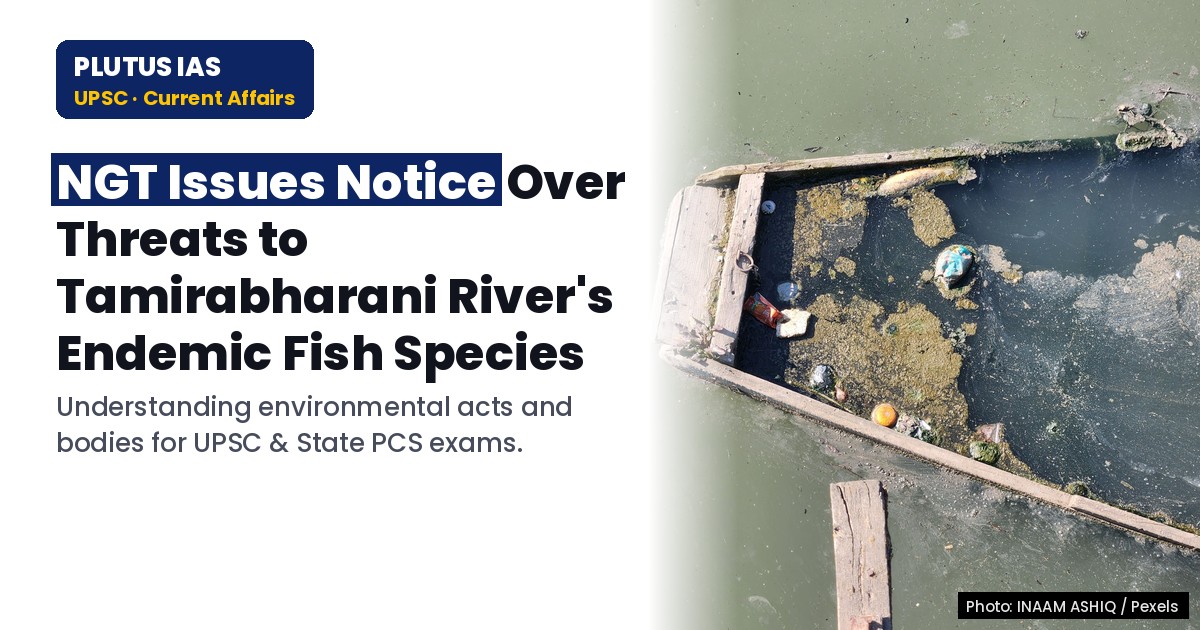
07 Nov NGT Notice: Tamirabharani Fish Species Under Threat
✎ The National Green Tribunal (NGT) is a statutory body established for the expeditious disposal of environmental cases, applying principles like sustainable development and the polluter pays principle.
Subject Relevance — Where This Topic Fits
- GS Paper III — Environment and Ecology; Conservation, Environmental Pollution and Degradation, Environmental Impact Assessment | GS Paper II — Statutory, Regulatory and various Quasi-Judicial Bodies
- Prelims: National Green Tribunal (NGT), Tamirabharani River, Endemic fish species, Environment (Protection) Act, 1986, Water (Prevention and Control of Pollution) Act, 1974, Biological Diversity Act, 2002, Suo motu cognisance, Pollution Control Boards
- Essay: Environmental Governance and Sustainable Development in India, The Role of Judicial Activism in Environmental Protection
Quick Revision: The National Green Tribunal (NGT) is a statutory body established for the expeditious disposal of environmental cases, applying principles like sustainable development and the polluter pays principle.
Why is this in the news?
The Principal Bench of the National Green Tribunal (NGT), New Delhi, has initiated suo motu cognisance of a report detailing threats to fish species in the Tamirabharani River. The NGT has issued notices to the Tirunelveli Collector and several other entities, including the Tamil Nadu Pollution Control Board, the Central Pollution Control Board’s Regional Office, Ashoka Trust for Research in Ecology and the Environment (ATREE), and Agasthyamalai Community Conservation Centre (ACCC), directing them to respond to concerns regarding pollution and habitat loss impacting the river’s aquatic biodiversity, particularly its endemic fish species.
Background
- The Tamirabharani River, originating in the Western Ghats of Tamil Nadu, is a significant perennial river system supporting diverse aquatic ecosystems.
- Reports have highlighted the presence of 125 fish species in the river, with seven identified as endemic to the Tamirabharani.
- Threats to these fish populations include pollution from domestic sewage, agricultural runoff, and ritualistic practices, alongside habitat destruction, loss of riparian vegetation, and the proliferation of invasive species.
- The Environment (Protection) Act, 1986, provides for the protection and improvement of the environment and the prevention of hazards to human beings, other living creatures, plants, and property.
- The Water (Prevention and Control of Pollution) Act, 1974, aims to prevent and control water pollution and maintain or restore the wholesomeness of water.
- The Biological Diversity Act, 2002, was enacted to provide for the conservation of biological diversity, sustainable use of its components, and fair and equitable sharing of the benefits arising out of the use of biological resources.
What is the National Green Tribunal (NGT)?
- The National Green Tribunal (NGT) was established in 2010 under the National Green Tribunal Act, 2010, for effective and expeditious disposal of cases relating to environmental protection and conservation of forests and other natural resources.
- It is a specialized body equipped with the necessary expertise to handle environmental disputes, providing a dedicated forum for such matters.
- The NGT has jurisdiction over all civil cases where a substantial question relating to the environment (including enforcement of any legal right relating to the environment) arises and is covered by the enactments specified in Schedule I of the NGT Act.
- These scheduled enactments include the Water (Prevention and Control of Pollution) Act, 1974; the Water (Prevention and Control of Pollution) Cess Act, 1977; the Forest (Conservation) Act, 1980; the Air (Prevention and Control of Pollution) Act, 1981; the Environment (Protection) Act, 1986; the Public Liability Insurance Act, 1991; and the Biological Diversity Act, 2002.
- The Tribunal is mandated to apply the principles of sustainable development, the precautionary principle, and the polluter pays principle while passing any order, decision, or award.
- NGT Benches are located in various cities across India, including the Principal Bench in New Delhi and regional benches in Bhopal, Pune, Kolkata, and Chennai, to address environmental issues arising within their respective territorial jurisdictions.
Key Features
| Feature | Significance |
|---|---|
| National Green Tribunal (NGT) | A specialized judicial body established for effective and expeditious disposal of cases relating to environmental protection and conservation of forests and other natural resources. |
| Suo Motu Cognisance | The NGT’s power to initiate proceedings on its own accord, without a formal petition, based on reports or public interest, demonstrating its proactive role in environmental governance. |
| Tamirabharani River | A perennial river in Tamil Nadu, significant for its ecological diversity, including endemic fish species, and its role in regional water security and cultural heritage. |
| Endemic Fish Species | Species found exclusively in a particular geographical area, highlighting the unique biodiversity of the Tamirabharani River and the imperative for their conservation. |
| Pollution and Habitat Loss | Primary anthropogenic threats to aquatic ecosystems, leading to biodiversity decline and ecological imbalance, necessitating regulatory intervention and sustainable management practices. |
Why it Matters
Environmental Significance
- The NGT’s intervention underscores the critical importance of preserving riverine ecosystems and their unique biodiversity, particularly endemic species, which are irreplaceable components of natural heritage.
- Protection of the Tamirabharani River directly contributes to maintaining ecological balance, supporting aquatic food webs, and ensuring the health of associated terrestrial ecosystems.
- Addressing river pollution mitigates risks to human health, as contaminated water sources can lead to various water-borne diseases and impact agricultural productivity.
Governance and Legal Significance
- The NGT’s exercise of suo motu powers reinforces its role as a vigilant environmental watchdog, ensuring accountability of administrative authorities in upholding environmental laws.
- The case highlights the enforceability of key environmental legislations, including the Environment (Protection) Act, 1986, the Water (Prevention and Control of Pollution) Act, 1974, and the Biological Diversity Act, 2002, in safeguarding natural resources.
- It sets a precedent for prompt action against environmental degradation, encouraging local administrations to proactively address issues of pollution and habitat destruction.
Socio-Cultural Significance
- The Tamirabharani River holds deep cultural and spiritual significance for local communities, and its degradation impacts traditional practices and the well-being of riparian populations.
- Conservation efforts around such rivers contribute to preserving traditional ecological knowledge and fostering community participation in environmental stewardship.
- Maintaining the ecological integrity of the river ensures the availability of clean water for various human uses, including drinking, agriculture, and livelihood activities.
Challenges
1. Anthropogenic Pollution
- Discharge of untreated sewage, industrial effluents, and agricultural runoff introduces harmful chemicals and organic matter into river systems.
- Practices such as bathing with soaps and shampoos, dumping of puja materials, and clothes contribute to chemical and solid waste pollution, altering water quality and aquatic habitats.
UPSC Link: Environmental Pollution and Degradation
2. Habitat Degradation and Loss
- Physical alterations to river morphology, including sand mining, encroachment, and construction, destroy natural breeding grounds and shelter for fish species.
- Loss of riparian vegetation reduces bank stability, increases erosion, and diminishes the availability of essential organic matter and shade for aquatic life.
UPSC Link: Conservation, Environmental Impact Assessment
3. Invasive Species
- Introduction of non-native fish and aquatic plant species outcompetes indigenous species for resources, disrupts food webs, and can introduce diseases, leading to population declines of native and endemic species.
- Invasive species can alter ecosystem functions, making it challenging for native flora and fauna to thrive.
UPSC Link: Biodiversity and Conservation
4. Enforcement and Compliance Gaps
- Despite existing environmental laws, inadequate monitoring, insufficient enforcement mechanisms, and lack of stringent penalties often lead to continued non-compliance by polluters and individuals.
- Coordination challenges among various governmental agencies and local bodies can impede integrated river management and pollution control efforts.
UPSC Link: Environmental Governance
Challenges — UPSC Perspective
| Issue | Concern |
|---|---|
| Untreated Sewage Discharge | Increases biochemical oxygen demand (BOD), reduces dissolved oxygen, and introduces pathogens, harming aquatic life and rendering water unsafe for human use. |
| Loss of Riparian Vegetation | Leads to increased soil erosion, sedimentation, loss of habitat for aquatic and terrestrial species, and reduced water quality due to lack of natural filtration. |
| Invasive Aquatic Species | Disrupts native ecosystems by outcompeting indigenous species, altering food webs, and potentially introducing diseases, leading to a decline in native biodiversity. |
| Dumping of Ritual Materials | Introduces non-biodegradable waste, plastics, and harmful chemicals into the river, contributing to pollution and physical obstruction of aquatic habitats. |
| Lack of Public Awareness | Contributes to unsustainable practices such as direct discharge of pollutants and habitat destruction, exacerbating environmental degradation. |
Way Forward
- Implement comprehensive wastewater treatment infrastructure to ensure that no untreated sewage or industrial effluent is discharged into the Tamirabharani River.
- Promote community-based river management initiatives, fostering local participation in conservation efforts and raising awareness about sustainable practices.
- Strengthen regulatory enforcement mechanisms and conduct regular monitoring of water quality parameters to ensure compliance with environmental standards.
- Undertake extensive afforestation and restoration of riparian vegetation along the river banks to enhance ecological integrity and prevent soil erosion.
- Develop and implement a robust action plan for the control and eradication of invasive aquatic species, prioritizing the protection of endemic fish populations.
- Integrate traditional ecological knowledge with modern scientific approaches for holistic river basin management and biodiversity conservation.
- Impose stringent penalties for environmental violations and ensure timely prosecution to deter illegal activities contributing to river pollution and habitat destruction.
UPSC Value Addition
Keywords for Mains Answer-Writing
National Green Tribunal · Environmental Protection Act 1986 · Water Prevention and Control of Pollution Act 1974 · Biological Diversity Act 2002 · Suo Motu Cognisance · Riverine Ecosystems · Endemic Fish Species · Habitat Degradation · Pollution Control · Riparian Vegetation · Invasive Species · Sustainable River Management
Constitutional & Policy Linkages
- Article 48A: Protection and improvement of environment
- Article 51A(g): Duty to protect and improve natural environment
Concept Flow
News report highlights threats to Tamirabharani fish species. → NGT takes suo motu cognisance of the environmental issue. → NGT issues notice to concerned authorities for response. → Environmental Acts (Water, Environment, Biodiversity) are invoked. → Pollution and habitat loss are identified as primary causes. → Endemic fish species face decline due to these threats. → Judicial intervention aims to ensure environmental protection.
Prelims Practice Questions
Q1. Consider the following statements regarding the National Green Tribunal (NGT):
1. The NGT was established under Article 21 of the Constitution of India.
2. It has jurisdiction over all civil cases involving substantial questions relating to the environment.
3. The NGT is mandated to dispose of applications and appeals within six months.
How many of the above statements are correct?
- Only one
- Only two
- Only three
- None
Answer: Only two — Statement 1 is incorrect: The NGT was established under the National Green Tribunal Act, 2010, not Article 21. Statement 2 is incorrect: The NGT’s jurisdiction is limited to civil cases involving substantial questions relating to the environment arising out of the implementation of the enactments specified in Schedule I to the NGT Act, 2010. It does not cover all civil cases. Statement 3 is correct: The NGT Act, 2010, mandates the Tribunal to dispose of applications and appeals finally within six months of their filing.
Q2. Which of the following Acts are explicitly mentioned as being attracted by the NGT’s suo motu cognisance in the context of threats to the Tamirabharani River’s fish species?
1. Environment (Protection) Act, 1986
2. Wildlife (Protection) Act, 1972
3. Water (Prevention and Control of Pollution) Act, 1974
4. Biological Diversity Act, 2002
Select the correct answer using the code given below:
- 1 and 3 only
- 1, 3 and 4 only
- 2, 3 and 4 only
- 1, 2, 3 and 4
Answer: 1, 3 and 4 only — The news report explicitly states that the NGT order mentioned the Environment (Protection) Act, 1986, the Water (Prevention and Control of Pollution) Act, 1974, and the Biological Diversity Act, 2002. The Wildlife (Protection) Act, 1972, while relevant to environmental conservation, was not explicitly mentioned in the NGT’s order as reported.
Mains Practice Question
✍ Examine the role and significance of the National Green Tribunal (NGT) in upholding environmental jurisprudence in India. Discuss the challenges it faces in ensuring effective implementation of environmental laws. (15 Marks)
Approach: INTRODUCTION: Briefly introduce the NGT, its establishment under the NGT Act, 2010, and its mandate.
ROLE AND SIGNIFICANCE:
1. Specialised Environmental Justice: Discuss its role as a specialised body for expeditious disposal of environmental cases.
2. Enforcement of Environmental Laws: Highlight its jurisdiction over key environmental statutes (e.g., EPA 1986, Water Act 1974, Air Act 1981, BD Act 2002).
3. Suo Motu Powers: Explain the importance of its suo motu cognisance in addressing environmental degradation, citing examples like the present case.
4. Polluter Pays Principle and Sustainable Development: Mention its application of environmental principles like ‘Polluter Pays,’ ‘Precautionary Principle,’ and ‘Sustainable Development.’
5. Accessibility and Expediency: Note its role in providing accessible and time-bound justice.
CHALLENGES:
1. Jurisdictional Limitations: Discuss limitations regarding specific environmental laws not covered under Schedule I of the NGT Act.
2. Enforcement Mechanisms: Address challenges in ensuring compliance with its orders by various authorities and polluters.
3. Manpower and Infrastructure: Highlight issues related to the availability of expert members and adequate infrastructure.
4. Overlapping Jurisdictions: Discuss potential overlaps or conflicts with High Courts and the Supreme Court.
5. Financial Constraints: Mention limitations in funding and resources.
6. Public Awareness and Participation: Address the need for greater public awareness and participation in environmental protection.
CONCLUSION: Summarise the NGT’s critical role while suggesting measures for strengthening its effectiveness and addressing the identified challenges for robust environmental governance.
Source: The Hindu
Generated by AanyaAi for educational purpose.

- दिल्ली में दीपावली पर ‘बहुत खराब’ वायु गुणवत्ता, GRAP 3 प्रतिबंध जारी - November 8, 2026
- Haryana Pollution Crisis: Panchgaon AQI Exceeds Delhi’s 400 Mark - November 8, 2026
- बस्तर में पीएम: नक्सलवाद पर विजय और आंतरिक सुरक्षा का महत्व - November 8, 2026

No Comments