


19 Aug MPC Unanimously Keeps Repo Rate Unchanged at 5.25% in August 2026
✎ The MPC’s neutral stance and unchanged policy repo rate (5.25 per cent) reflect a balanced approach to support growth while mitigating inflation risks amid global uncertainties.
Subject Relevance — Where This Topic Fits
- GS Paper III — Indian Economy: Issues relating to planning, resource mobilisation, growth, development and employment; Inclusive growth and issues arising from it; Government Budgeting
- Prelims: Monetary Policy Committee (MPC), Repo Rate, Standing Deposit Facility (SDF), Marginal Standing Facility (MSF), Bank Rate, Neutral Stance, Liquidity Adjustment Facility (LAF), Inflation Targeting, Fiscal-Monetary Coordination
- Essay: The Role of Institutions in Economic Governance: RBI’s Monetary Policy Framework, Balancing Growth and Price Stability: India’s Macro-Economic Policy Dilemmas
Quick Revision: The MPC’s neutral stance and unchanged policy repo rate (5.25 per cent) reflect a balanced approach to support growth while mitigating inflation risks amid global uncertainties.
Why is this in the news?
The Reserve Bank of India (RBI) published the minutes of the 62nd meeting of the Monetary Policy Committee (MPC) held from August 3 to 5, 2026, under Section 45ZL of the Reserve Bank of India Act, 1934. The minutes provide a detailed assessment of the global and domestic macroeconomic outlook, the rationale behind the unanimous decision to maintain the policy repo rate at 5.25 per cent, and the continued neutral stance of monetary policy. The document also highlights risks to growth and inflation, including geopolitical tensions, volatile commodity prices, and evolving policy expectations in major economies.
Background
- The Monetary Policy Committee (MPC) is a statutory body constituted under Section 45ZB of the Reserve Bank of India Act, 1934, with the primary objective of determining the policy interest rate required to achieve the medium-term target for consumer price index (CPI) inflation of 4 per cent within a band of +/- 2 per cent.
- The MPC operates under a flexible inflation-targeting framework, wherein the RBI is mandated to publish the minutes of its meetings 14 days after the conclusion, including individual member statements and voting records, as per Section 45ZL of the RBI Act, 1934.
- The RBI’s monetary policy stance—whether accommodative, neutral, or hawkish—signals its approach to liquidity management and interest rate adjustments, influencing borrowing costs, investment decisions, and inflation dynamics in the economy.
- Global economic conditions in 2026 have been marked by heightened volatility, driven by geopolitical conflicts, persistent inflationary pressures, and shifting monetary policy expectations across major central banks.
- India’s economic resilience amidst global headwinds has been attributed to robust domestic demand, high-frequency indicators such as PMI, GST collections, and credit growth, despite external sector challenges.
- The neutral stance adopted by the MPC reflects a balanced approach, aiming to support growth while remaining vigilant against inflationary pressures and external sector risks.
What is the Monetary Policy Committee (MPC)?
- The MPC is a six-member committee established under the RBI Act, 1934, to determine the policy repo rate required to achieve the inflation target set by the Government of India.
- Its composition includes three RBI officials (including the Governor as Chairperson) and three external members appointed by the Central Government, ensuring a balance between institutional expertise and independent perspectives.
- The MPC meets at least four times a year and publishes its decisions, including voting records and individual member statements, to enhance transparency and accountability in monetary policy formulation.
- The policy repo rate is the rate at which the RBI lends to commercial banks under the Liquidity Adjustment Facility (LAF), serving as the benchmark for short-term interest rates in the economy.
- The neutral stance adopted by the MPC implies that monetary policy is neither biased towards stimulating growth nor towards controlling inflation, allowing for flexibility in responding to evolving economic conditions.
- The RBI’s monetary policy framework operates within the inflation-targeting regime, where the primary objective is to maintain price stability while supporting growth, employment, and financial stability.
- The MPC’s decisions are guided by a comprehensive assessment of macroeconomic indicators, including GDP growth, inflation trends, fiscal developments, global commodity prices, and financial market conditions.
- Transparency in monetary policy is enhanced through the publication of minutes, which include detailed discussions, alternative scenarios, and risk assessments, fostering public understanding and credibility.
Key Features
| Feature | Significance |
|---|---|
| Monetary Policy Committee (MPC) under RBI Act, 1934 | Ensures autonomous, expert-driven monetary policy formulation with statutory backing, balancing growth and inflation objectives. |
| Unanimous decision to maintain repo rate at 5.25% | Signals continuity in monetary policy stance amid global and domestic uncertainties, reinforcing credibility of the inflation-targeting framework. |
| Neutral monetary policy stance | Balances growth support with inflation vigilance, allowing flexibility to respond to evolving macroeconomic conditions without pre-commitment. |
| Publication of MPC minutes under Section 45ZL of RBI Act, 1934 | Enhances transparency, accountability, and predictability in monetary policy, fostering market confidence and informed decision-making. |
| Review of global and domestic macroeconomic projections | Integrates real-time data, survey inputs, and risk scenarios to ensure evidence-based policy adjustments. |
Why it Matters
Monetary Policy Framework
- The MPC’s decision to maintain the repo rate at 5.25% underscores the RBI’s commitment to its inflation-targeting mandate under the Flexible Inflation Targeting Framework (FITF), introduced via the RBI Act, 1934 (amended in 2016).
- A neutral stance allows the RBI to calibrate policy responses dynamically, avoiding pro-cyclical adjustments in an environment of volatile global financial conditions.
- The unanimity in the decision reflects cohesion within the MPC, which is critical for maintaining policy credibility and reducing market uncertainty.
Global Economic Context
- Persistent inflation concerns across major economies, including the US and EU, have led to divergent monetary policy responses, creating spillover risks for emerging markets like India.
- Geopolitical conflicts in West Asia and volatile oil prices introduce supply-side shocks, which can exacerbate inflationary pressures in India, a net importer of crude oil.
- The appreciation of the US dollar, driven by hawkish Fed signals, may impact India’s capital flows and external sector stability, necessitating vigilant forex management.
Domestic Economic Resilience
- India’s economic resilience, as reflected in high-frequency indicators, suggests that domestic demand remains robust despite global headwinds, providing a buffer against external shocks.
- The RBI’s emphasis on steady domestic demand aligns with the need to sustain growth while ensuring that inflation remains within the target range of 4±2%.
- Survey results and stakeholder consultations provide granular insights into sectoral performance, aiding in nuanced policy calibration.
Transparency and Governance
- The publication of MPC minutes under Section 45ZL of the RBI Act, 1934, enhances transparency by documenting the rationale behind policy decisions, including individual member perspectives.
- This practice fosters public trust in the RBI’s decision-making process and aligns with global best practices in central banking governance.
Challenges
1. Volatile Global Financial Conditions
- Frequent market swings and shifting policy expectations in advanced economies can lead to capital flow reversals, impacting India’s financial stability.
- Persistent inflation in systemic economies may prolong tight monetary policies, increasing the cost of borrowing for emerging markets.
UPSC Link: GS III: Indian Economy and issues relating to planning, mobilization of resources
2. Geopolitical and Commodity Price Risks
- Renewed conflicts in West Asia and volatile oil prices pose significant downside risks to India’s inflation outlook and current account balance.
- Supply chain disruptions in critical commodities, such as crude oil and food grains, can exacerbate inflationary pressures.
UPSC Link: GS II: Effect of policies and politics of developed and developing countries on India’s interests
3. Inflation Management Amid Demand-Supply Mismatches
- Sticky inflation expectations, even in a neutral policy stance, require careful monitoring to prevent second-round effects on wages and prices.
- Ensuring that domestic demand growth does not outpace supply-side adjustments remains a key challenge for the RBI.
UPSC Link: GS III: Indian Economy and issues relating to planning, mobilization of resources
4. External Sector Vulnerabilities
- The appreciation of the US dollar and elevated global yields may widen India’s trade deficit and put pressure on the rupee.
- Managing forex reserves and ensuring adequate liquidity in the foreign exchange market are critical to mitigating external sector risks.
UPSC Link: GS III: Indian Economy and issues relating to planning, mobilization of resources
5. Balancing Growth and Price Stability
- Sustaining growth momentum while keeping inflation within the target range requires a delicate balance, particularly in a post-pandemic recovery phase.
- Ensuring that monetary policy does not become pro-cyclical in response to short-term fluctuations is essential for long-term macroeconomic stability.
UPSC Link: GS III: Indian Economy and issues relating to planning, mobilization of resources
Challenges — UPSC Perspective
| Issue | Concern |
|---|---|
| Geopolitical conflicts in West Asia | Supply-side shocks to crude oil and food prices, exacerbating inflationary pressures. |
| Volatile global financial markets | Capital flow reversals and currency volatility, impacting India’s external sector stability. |
| Sticky inflation expectations | Risk of second-round effects on wages and prices, complicating inflation management. |
| US dollar appreciation | Widening trade deficit and pressure on rupee, increasing import costs. |
| Domestic demand-supply mismatches | Potential overheating of the economy, risking inflationary pressures despite a neutral policy stance. |
Way Forward
- Monitor global commodity price trends, particularly crude oil and food grains, to assess their impact on domestic inflation.
- Enhance forex reserve management to mitigate risks from volatile capital flows and currency fluctuations.
- Strengthen coordination between fiscal and monetary policies to ensure macroeconomic stability without compromising growth.
- Leverage high-frequency indicators and survey data to fine-tune policy responses in real time.
- Maintain vigilance on inflation expectations to pre-empt second-round effects on wages and prices.
- Continue publishing detailed MPC minutes to enhance transparency and market confidence in policy decisions.
- Assess the need for structural reforms to improve supply-side resilience, particularly in agriculture and manufacturing.
UPSC Value Addition
Keywords for Mains Answer-Writing
Monetary Policy Committee (MPC) · Repo Rate · Liquidity Adjustment Facility (LAF) · Standing Deposit Facility (SDF) · Marginal Standing Facility (MSF) · Bank Rate · Neutral Monetary Stance · Reserve Bank of India Act, 1934 · Section 45ZB · Section 45ZL · Macroeconomic Projections · Inflation Outlook · Growth Outlook · Global Economic Volatility · Inflation Targeting Framework · Monetary Policy Transmission
Concept Flow
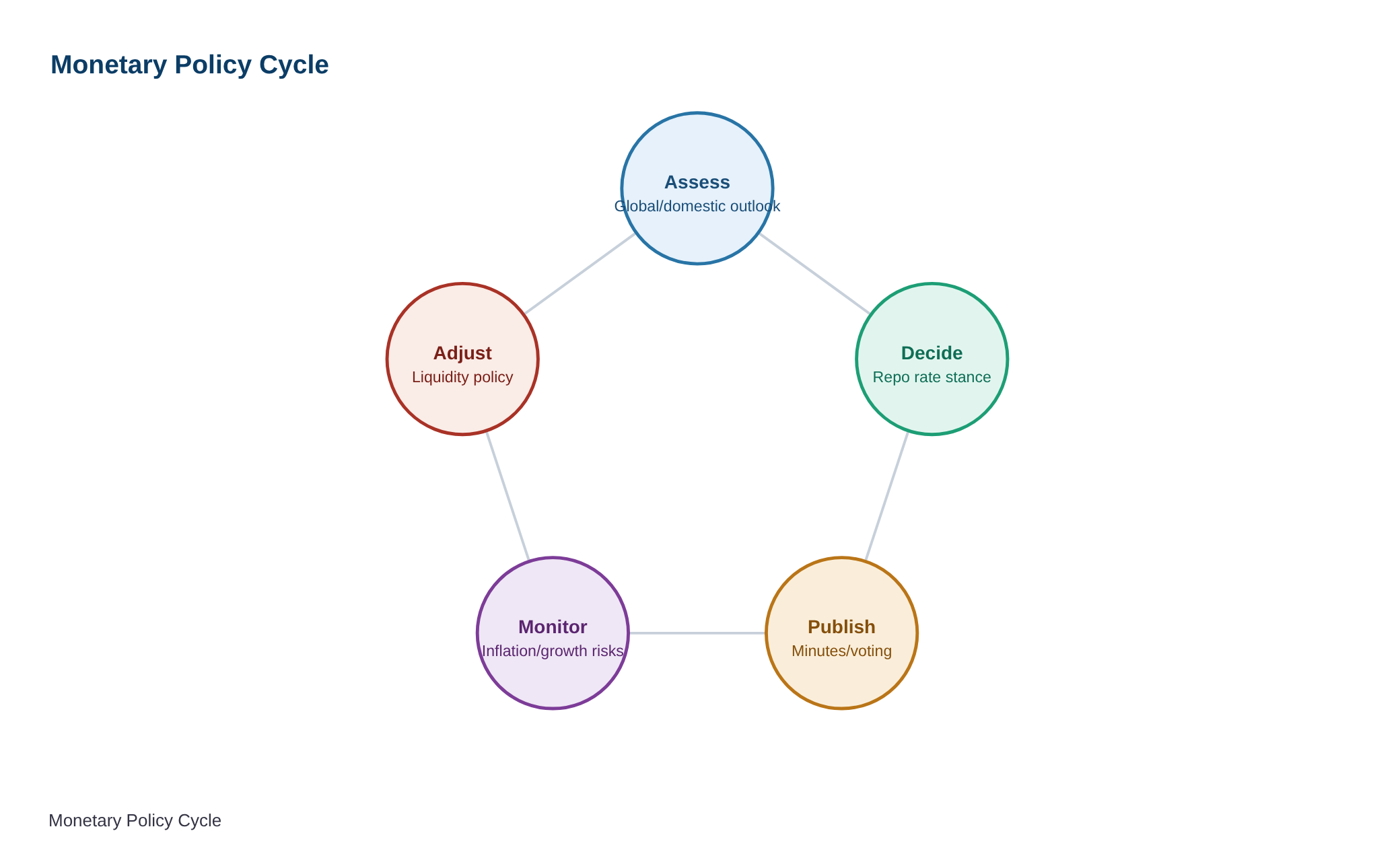
Global economic volatility and geopolitical risks → Spillover effects on commodity prices and capital flows → Impact on India’s inflation and external sector → MPC’s policy response (repo rate and stance) → Transmission to domestic financial markets and economic activity → High-frequency indicators and survey data feedback → Refined policy calibration.
Prelims Practice Questions
Q1. Consider the following statements regarding the Monetary Policy Committee (MPC) of the Reserve Bank of India:
1. The MPC is constituted under Section 45ZB of the Reserve Bank of India Act, 1934.
2. The MPC publishes the minutes of its meetings on the fourteenth day after every meeting, as mandated by Section 45ZL of the RBI Act, 1934.
3. The MPC includes members nominated by the Central Board of the RBI and external experts.
4. The MPC is chaired by the Finance Minister of India.
How many of the above statements are correct?
- Only one
- Only two
- Only three
- All
Answer: Only three — Statements 1, 2, and 3 are correct. Statement 4 is incorrect as the MPC is chaired by the Governor of the RBI, not the Finance Minister.
Q2. Assertion (A): The Reserve Bank of India maintains a neutral stance in its monetary policy to balance growth and inflation objectives.
Reason (R): A neutral stance allows the RBI to adjust policy rates in either direction based on evolving macroeconomic conditions.
Options:
A. Both A and R are true, and R is the correct explanation of A.
B. Both A and R are true, but R is not the correct explanation of A.
C. A is true but R is false.
D. A is false but R is true.
Answer: ? — Both the assertion and reason are correct. The neutral stance of the RBI is designed to provide flexibility to adjust policy rates in response to macroeconomic developments, making R the correct explanation of A.
Mains Practice Question
✍ Examine the constitutional and statutory framework governing the Monetary Policy Committee (MPC) under the Reserve Bank of India Act, 1934. Critically analyse the role of the MPC in maintaining macroeconomic stability, with particular reference to its recent decision to maintain a neutral stance and keep the repo rate unchanged. (15 Marks)
Approach: MODEL-ANSWER SKELETON:
1. **Constitutional and Statutory Framework**:
– MPC constituted under Section 45ZB of the RBI Act, 1934.
– Composition: Governor (Chairperson), Deputy Governor (member), and external experts nominated by the Central Board.
– Mandate: To determine the policy repo rate to achieve the inflation target (4% ± 2%) and support growth.
– Legal backing: Section 45ZL mandates publication of minutes and voting records.
2. **Role in Macroeconomic Stability**:
– **Inflation Targeting**: MPC’s primary objective is to maintain price stability while supporting growth.
– **Policy Transmission**: Repo rate adjustments influence liquidity, credit availability, and inflation expectations.
– **Neutral Stance**: Balances growth and inflation risks; allows flexibility to tighten or ease policy as needed.
– **Recent Decision (August 2026)**: Unanimous vote to keep repo rate at 5.25%, SDF at 5.00%, MSF/Bank Rate at 5.50%, and maintain neutral stance.
3. **Critical Analysis**:
– **Strengths**: Transparent decision-making (minutes published), diverse expertise, and accountability (voting records).
– **Challenges**: Balancing conflicting objectives (growth vs. inflation), global spillovers (e.g., West Asia conflict, oil price volatility), and domestic demand-supply mismatches.
– **Global Context**: Persistent inflation, volatile oil prices, and fragile public finances in systemic economies pose downside risks.
4. **Conclusion**:
– MPC’s framework ensures institutional credibility and data-driven policy. The neutral stance reflects cautious optimism amid global uncertainties, but vigilance is required to address domestic inflationary pressures and growth deceleration risks.
Source: RBI
Generated by AanyaAi for educational purpose.

- KWML’s Feasibility Reports for Water Metro in 18 Cities: UPSC & PCS Insights - October 3, 2026
- ओडिशा में वन्यजीव अनुसंधान अनुदान कार्यक्रम शुरू, सिमिलिपाल में 300 कैमरे और बढ़ेंगे - October 3, 2026
- India Summons Pakistan High Commission Official Over Violation - October 3, 2026

No Comments