


07 Aug MSME Amendment Bill 2026 Passed in Lok Sabha: Key Features for UPSC
✎ The Micro, Small and Medium Enterprises Development (Amendment) Bill, 2026, aims to replace the 2006 Act by introducing a national digital platform for voluntary MSME registration, and strengthening credit access and compliance…
Subject Relevance — Where This Topic Fits
- GS Paper III — Indian Economy and issues relating to Planning, Mobilisation of Resources, Growth, Development and Employment | GS Paper III — Effects of Liberalisation on the Economy, Changes in Industrial Policy and their Effects on Industrial Growth
- Prelims: MSMED Act, 2006, Udyam Registration Portal, Formalisation of MSMEs, Digital public infrastructure for MSMEs, Credit Guarantee Scheme for MSMEs, Priority Sector Lending, SME clusters, Ease of Doing Business for MSMEs
- Essay: The role of digital public infrastructure in transforming India’s informal economy into a formalised growth engine, Formalisation of MSMEs: Balancing regulatory compliance with economic dynamism
Quick Revision: The Micro, Small and Medium Enterprises Development (Amendment) Bill, 2026, aims to replace the 2006 Act by introducing a national digital platform for voluntary MSME registration, and strengthening credit access and compliance mechanisms to formalise and integrate the sector with the formal economy.
Why is this in the news?
The Lok Sabha, during the Monsoon Session of Parliament on 7 August 2026, passed the Micro, Small and Medium Enterprises Development (Amendment) Bill, 2026 without debate. The Bill seeks to replace the Micro, Small and Medium Enterprises Development Act, 2006, introducing provisions for a national digital platform for voluntary registration of MSMEs and aligning the legal framework with contemporary economic realities. This legislative action assumes significance against the backdrop of India’s push for formalisation of the MSME sector, digital public infrastructure integration, and the broader agenda of enhancing ease of doing business while ensuring equitable access to credit and markets.
Background
- The Micro, Small and Medium Enterprises Development Act, 2006, was enacted to address the development, support, and promotion of MSMEs in India, defining micro, small, and medium enterprises based on investment in plant and machinery or equipment.
- The MSME sector contributes approximately 30% to India’s GDP, 45% to manufacturing output, and 40% to exports, making it a critical pillar of the economy, particularly for employment generation and inclusive growth.
- The COVID-19 pandemic exposed vulnerabilities in the MSME sector, necessitating structural reforms to enhance resilience, access to finance, and digital adoption.
- The Government of India launched the Udyam Registration Portal in 2020 to simplify the registration process for MSMEs, replacing the erstwhile Udyog Aadhaar Memorandum system, and aligning with the vision of a ‘Digital India’ and ‘Atmanirbhar Bharat’.
What is the Micro, Small and Medium Enterprises Development (Amendment) Bill, 2026?
- The Bill seeks to amend the Micro, Small and Medium Enterprises Development Act, 2006, to align the legal and regulatory framework with contemporary economic imperatives, including digital transformation and formalisation of the MSME sector.
- A key provision of the Bill is the establishment of a national digital platform for the voluntary registration of MSMEs, replacing the existing Udyam Registration Portal. This platform aims to streamline registration, reduce compliance burdens, and enhance transparency in the sector.
Key Features
| Feature | Significance |
|---|---|
| Replacement of the MSMED Act, 2006 | The Bill seeks to replace the existing Micro, Small and Medium Enterprises Development Act, 2006, to align with contemporary economic realities and policy objectives. |
| National Digital Platform for MSME Registration | Introduction of a voluntary and free digital registration system for MSMEs, aimed at simplifying compliance and enhancing ease of doing business. |
| Amendment to Other Laws (Amendment) Bill, 2026 | Concurrent amendments to allied laws to ensure legal coherence and avoid contradictions with the revised MSME framework. |
| Voluntary Registration Mechanism | The registration system is voluntary, reducing administrative burden while maintaining data integrity for policy formulation. |
| Alignment with ‘Atmanirbhar Bharat’ Vision | The amendments are designed to support the government’s self-reliance agenda by fostering a robust MSME ecosystem. |
Why it Matters
Economic
- Enhances the formalisation of MSMEs, contributing to broader tax base expansion and economic transparency.
- Facilitates credit access for MSMEs by providing verifiable registration records, crucial for financial inclusion.
- Supports the ‘Make in India’ initiative by streamlining regulatory processes for small enterprises.
- Promotes digital governance, reducing bureaucratic delays and improving compliance efficiency.
Policy and Governance
- Demonstrates legislative responsiveness to the evolving needs of the MSME sector, a key driver of employment and innovation.
- Aligns with global best practices in MSME promotion, such as the United Nations’ Sustainable Development Goals (SDG 8 and 9).
- Reflects a shift towards outcome-based policymaking, where digital infrastructure is leveraged for systemic improvements.
Strategic
- Strengthens India’s position in global supply chains by improving the competitiveness of domestic MSMEs.
- Supports the ‘Vocal for Local’ campaign by enabling local enterprises to scale operations efficiently.
Challenges
1. Low MSME Formalisation Rates
- Despite policy incentives, a significant portion of MSMEs remain informal due to lack of awareness or resistance to regulatory compliance.
- Voluntary registration may limit the scope of data collection, potentially undermining policy precision.
UPSC Link: GS3: Ease of Doing Business
2. Digital Divide and Accessibility
- Rural and semi-urban MSMEs may face challenges in accessing digital platforms due to infrastructure gaps.
- Digital literacy barriers could hinder effective utilisation of the registration system.
UPSC Link: GS3: Digital Infrastructure
3. Credit Accessibility for Registered MSMEs
- Even with formal registration, MSMEs may struggle to secure loans due to collateral constraints or risk-averse lending practices.
- Need for complementary financial sector reforms to ensure credit flow to registered enterprises.
UPSC Link: GS3: Financial Inclusion
4. Policy Coherence and Implementation Gaps
- Amendments to allied laws must be synchronised to avoid legal ambiguities or overlapping jurisdictions.
- Effective implementation requires inter-ministerial coordination, which can be challenging in a federal structure.
UPSC Link: GS2: Centre-State Relations
5. Opposition to Regulatory Changes
- Stakeholders accustomed to the 2006 Act may resist amendments, perceiving them as burdensome or unnecessary.
- Lack of debate during passage of the Bill may reflect inadequate stakeholder consultation.
UPSC Link: GS2: Parliament and State Legislatures
Challenges — UPSC Perspective
| Issue | Concern |
|---|---|
| Formalisation Barriers | Informal MSMEs may avoid registration due to perceived costs or lack of incentives. |
| Digital Infrastructure Gaps | Rural MSMEs may lack access to reliable internet or digital literacy. |
| Credit Market Failures | Formal registration may not guarantee improved access to institutional credit. |
| Inter-Ministerial Coordination | Amendments to allied laws may face delays or inconsistencies in implementation. |
| Stakeholder Resistance | Industry associations or state governments may oppose changes to existing frameworks. |
Government Initiatives — Must-Memorise for Prelims
- Micro, Small and Medium Enterprises Development (Amendment) Bill, 2026
- Other Laws (Amendment) Bill, 2026
Way Forward
- Conduct nationwide awareness campaigns to educate MSMEs on the benefits of voluntary registration.
- Strengthen digital infrastructure in rural and semi-urban areas to ensure equitable access.
- Develop targeted financial literacy programs to assist MSMEs in navigating credit application processes.
- Establish a dedicated grievance redressal mechanism for MSMEs facing challenges with registration or compliance.
- Enhance inter-ministerial coordination to ensure seamless implementation of allied amendments.
- Monitor the impact of the Bill on MSME formalisation rates and credit accessibility through periodic reviews.
- Encourage state governments to align their MSME policies with the central framework to avoid fragmentation.
UPSC Value Addition
Keywords for Mains Answer-Writing
Micro, Small and Medium Enterprises Development (Amendment) Bill, 2026 · MSME sector reforms · Digital MSME registration platform · Voluntary compliance in MSME registration · Parliamentary accountability · Role of the Home Minister in Parliament · Constitutional provisions on Ministerial presence in Parliament · Opposition protests in Parliament · Parliamentary Affairs Minister’s role · Chairperson of Rajya Sabha directives · Right to Information and Parliamentary accountability · Federal structure and Centre-State relations
Constitutional & Policy Linkages
- [‘Article 246: Concurrent List (Entry 7: Industries and Boards)’, ‘MSME policy falls under the Concurrent List, necessitating Centre-State coordination.’]
Concept Flow
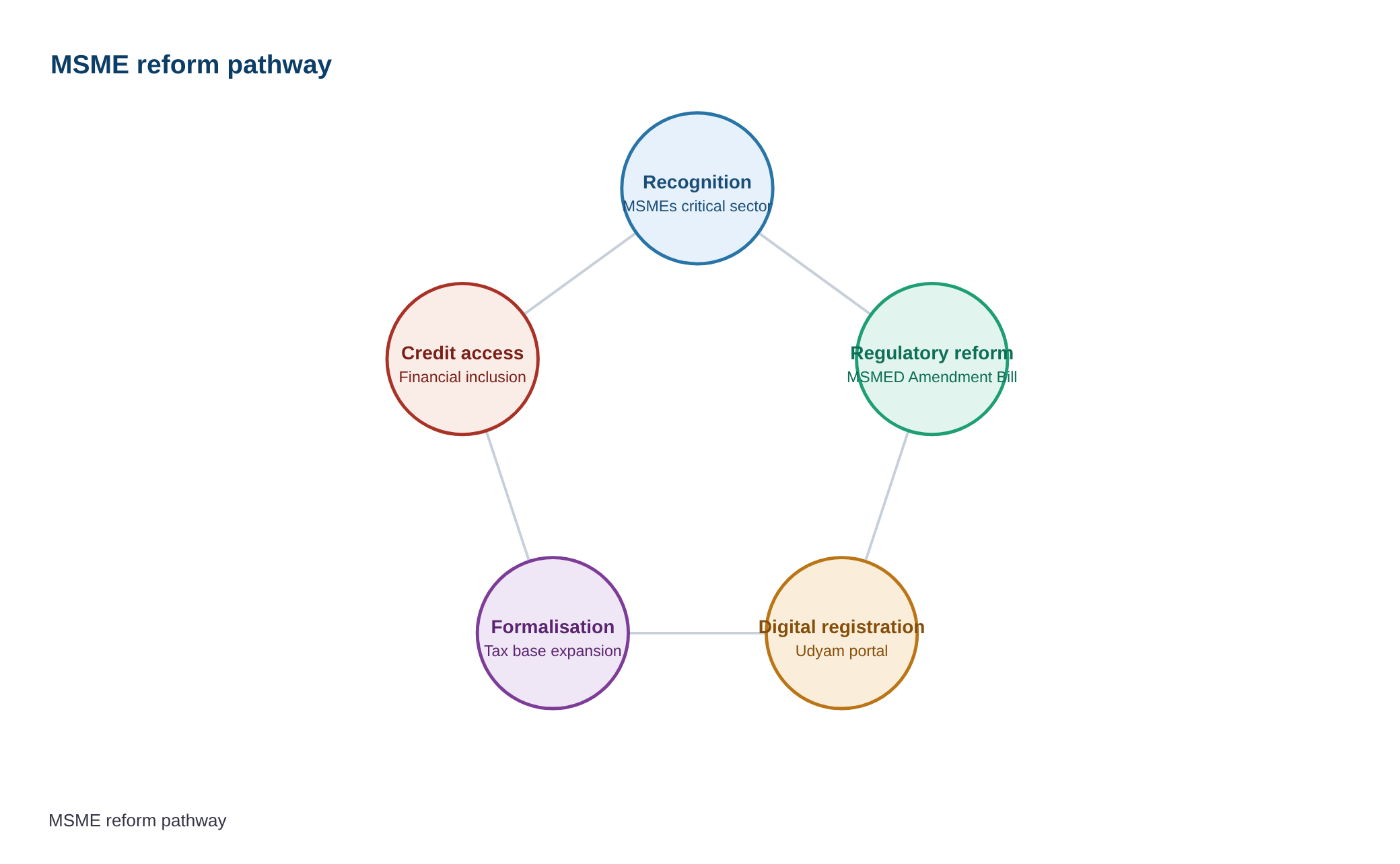
Economic growth and employment generation → Recognition of MSMEs as a critical sector → Need for regulatory reform to align with contemporary challenges → Introduction of the MSMED (Amendment) Bill, 2026 → Voluntary digital registration system → Enhanced formalisation and data availability → Improved policy targeting and credit access → Contribution to ‘Atmanirbhar Bharat’ and global competitiveness.
Prelims Practice Questions
Q1. Consider the following statements regarding the Micro, Small and Medium Enterprises Development (Amendment) Bill, 2026:
1. The Bill replaces the MSME Development Act of 2006.
2. It mandates compulsory registration of all MSMEs through a national digital platform.
3. The Bill introduces provisions for voluntary registration of MSMEs.
4. The Bill was passed in the Lok Sabha without any debate.
How many of the above statements are correct?
- Only one
- Only two
- Only three
- All four
Answer: Only three — Statements 1, 3, and 4 are correct. Statement 2 is incorrect as the Bill provides for free and voluntary registration, not compulsory registration.
Q2. Assertion (A): The Parliamentary Affairs Minister has the authority to direct the Home Minister to attend Parliament sessions.
Reason (R): The Chairperson of the Rajya Sabha can issue directives to Ministers regarding their presence in Parliament.
Options:
A. Both A and R are true, and R is the correct explanation of A.
B. Both A and R are true, but R is not the correct explanation of A.
C. A is true, but R is false.
D. A is false, but R is true.
- A
- B
- C
- D
Answer: D — Assertion (A) is false as the Parliamentary Affairs Minister cannot direct the Home Minister to attend Parliament. Reason (R) is also false as the Chairperson of the Rajya Sabha does not have the authority to issue such directives to Ministers.
Q3. Match the following provisions of the Micro, Small and Medium Enterprises Development (Amendment) Bill, 2026 with their correct descriptions:
Column I (Provision) | Column II (Description)
———————|—————————
A. National digital platform | 1. Compulsory registration of MSMEs
B. Voluntary registration | 2. Free and voluntary registration mechanism
C. Replacement of 2006 Act | 3. Notification of a digital platform for MSME registration
D. Compulsory registration | 4. Repeal of the MSME Development Act, 2006
Options:
A-3, B-2, C-4, D-1
A-2, B-3, C-4, D-1
A-1, B-2, C-3, D-4
A-4, B-3, C-2, D-1
- A
- B
- C
- D
Answer: A — Correct match: A-3 (National digital platform for registration), B-2 (Free and voluntary registration), C-4 (Replacement of the 2006 Act), D-1 (Compulsory registration is not a provision of the Bill).
Mains Practice Question
✍ Critically examine the significance of the Micro, Small and Medium Enterprises Development (Amendment) Bill, 2026, in the context of ease of doing business and MSME sector reforms in India. Also, discuss the implications of the Bill being passed without debate in the Lok Sabha. (15 Marks)
Approach: MODEL-ANSWER SKELETON:
1. **Introduction (2 marks)**
– Brief background of the MSME sector in India: its contribution to GDP (~30%), employment (~11 crore people), and exports (~45% of total exports).
– Reference to the MSME Development Act, 2006, and its limitations (e.g., cumbersome registration process, lack of digital integration).
– Objective of the Amendment Bill: to simplify compliance, promote voluntary registration, and leverage digital platforms.
2. **Key Provisions of the Bill (4 marks)**
– **National Digital Platform**: Notification of a unified digital portal for MSME registration (similar to Udyam Registration but expanded scope).
– **Voluntary Registration**: Shift from compulsory to voluntary registration to reduce compliance burden.
– **Replacement of 2006 Act**: Repeal of the existing Act to align with contemporary needs (e.g., GST integration, ease of credit access).
– **Other Amendments**: Any additional provisions (e.g., simplified definition of MSMEs, credit facilitation mechanisms).
3. **Significance for Ease of Doing Business (4 marks)**
– **Reduction in Compliance Costs**: Voluntary registration reduces bureaucratic hurdles and promotes formalization.
– **Digital Integration**: Aligns with the government’s ‘Digital India’ vision, enabling real-time data for policymaking.
– **Credit Access**: Simplified registration may improve access to formal credit (e.g., via TReDS, Mudra loans).
– **Global Competitiveness**: Streamlined processes enhance India’s ranking in the World Bank’s Ease of Doing Business Index.
– **Formalization of the Informal Sector**: Encourages MSMEs to enter the formal economy, aiding tax compliance and social security coverage.
4. **Critique and Challenges (3 marks)**
– **Voluntary Registration**: Risk of low uptake if incentives (e.g., tax benefits, credit access) are not clearly linked to registration.
– **Digital Divide**: MSMEs in rural/remote areas may face challenges in accessing digital platforms.
– **Implementation Gaps**: Lack of awareness campaigns or inadequate IT infrastructure could undermine the platform’s effectiveness.
– **Data Privacy Concerns**: Centralized digital databases raise questions about data security and misuse.
5. **Passing Without Debate: Democratic Implications (2 marks)**
– **Norms of Parliamentary Democracy**: Passing significant legislation without debate undermines deliberative democracy and parliamentary scrutiny.
– **Accountability Concerns**: Absence of debate raises questions about the government’s commitment to transparency and stakeholder consultation.
– **Precedent for Future Legislation**: Sets a precedent for bypassing parliamentary debate, potentially eroding the checks-and-balances system.
– **Opposition’s Role**: Highlights the need for robust opposition to hold the executive accountable, especially on issues of public interest.
6. **Conclusion (2 marks)**
– Balanced view: While the Bill’s provisions are progressive, their success hinges on effective implementation and stakeholder engagement.
– Recommendations: Conduct pre-legislative consultations, pilot the digital platform in select states, and link registration to tangible benefits (e.g., subsidies, credit access).
– Broader lesson: Parliamentary processes must balance efficiency with democratic norms to ensure legitimacy.
Source: The Hindu
Generated by AanyaAi for educational purpose.

- कुल्लू: NHPC की पार्वती-2 परियोजना के खिलाफ एफआईआर, 12 सदस्यीय जांच समिति गठित - September 21, 2026
- NHPC Tunnel Leak in Kullu: FIR Filed, 5-Day Probe Deadline for Project Failures - September 21, 2026
- भारत ने जी20 ऊर्जा सहमति में किया शामिल, जानिए प्रमुख समझौते - September 21, 2026

No Comments