


10 Nov Mughal Art and Miniature Painting: The Golden Age of Imperial Creativity
Mughal Painting: An Overview
Mughal paintings were created with a distinct vision that set them apart from traditional Islamic art. Although rooted in Islamic aesthetics, Mughal art evolved into something uniquely Indian in spirit and expression. Unlike the Islamic art of the Sultanate or the Deccan, Mughal paintings reflected a harmonious blend of Indian themes, landscapes, and cultural sensibilities presented through refined Persian techniques.
The real pioneer of this artistic synthesis was Emperor Akbar, who established a royal atelier (studio) and even set up a paper factory at Sialkot to support the flourishing art form. His aim was to bring together the finest elements of Indian and Persian traditions, creating a style that represented both worlds. Under Akbar, and later his successors Jahangir and Shah Jahan, Mughal painting matured into a sophisticated art form that reflected the grandeur of the empire.
The Mughal school of painting was thus a fusion of Indian, Persian, and Islamic styles. Its defining features can be summarised as follows:
• Emphasis on landscapes, nature, and realistic portrayal of flora and fauna.
• Use of delicate arabesque borders and fine calligraphic inscriptions.
• High aesthetic and ornamental value, with intricate detailing and rich colours.
• Representation of courtly and aristocratic life rather than overtly religious themes.
• A distinctly secular and refined artistic character.
Mughal paintings were primarily produced as illustrations in manuscripts and later as independent works collected in albums.
The development of this art form is generally divided into four major phases, each named after the emperor under whose patronage it flourished:
1. The Akbar Period: marked by dynamism, diversity, and narrative richness.
2. The Jahangir Period: noted for naturalism, delicate portraits, and love of nature.
3. The Shah Jahan Period: known for elegance, refinement, and decorative splendour.
4. The Aurangzeb Period: witnessed decline as imperial patronage for the arts diminished.
In essence, Mughal painting stands as a testament to cultural synthesis, blending artistic traditions from across regions to create one of the most remarkable visual legacies in Indian history.
Origin of Mughal Painting
The 16th century marked a period of remarkable artistic innovation in India. After the Mughal conquest in 1526, the tradition of miniature painting underwent a significant transformation. Moving away from the abstract and decorative style of Persian art, it began to embrace realism—particularly in portraiture, and the detailed representation of plants and animals.
When Humayun returned from exile in Persia, he brought with him two distinguished Persian painters, Mir Sayyid Ali and Abd al-Samad. Under Humayun’s patronage, they created several notable works, including the famous ‘Khamsa of Nizami’. These paintings introduced new artistic techniques and themes that broke from conventional Persian art, leading to the emergence of a distinct and innovative style known as Mughal Painting. This style was further refined and expanded by Humayun’s successors, especially Akbar, Jahangir, and Shah Jahan.
Mughal Painting represents the most distinguished form of medieval Indian art, flourishing between the 16th and 19th centuries. It stood out for its brilliant colours, precise line work, realism, and rich variety of subjects. Unlike the earlier Delhi Sultanate art, Mughal paintings achieved far greater recognition and popularity.
Several factors contributed to this development—urbanisation, a strong administrative system, imperial patronage, and the cultural synthesis of Indian and Central Asian traditions. The integration of the Mughal economy with the global world also encouraged artistic exchange. As a result, painting became not only a form of royal expression but also a thriving profession during the Mughal era, marking one of the golden ages of art in Indian history.
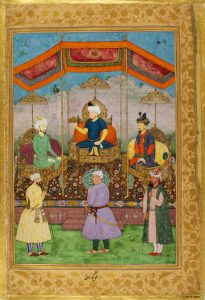
Timur handing the crown to Babur in the presence of Humayun, opaque watercolour on gold paper, by Govardhan, about 1628
The Akbar Period (1556–1605)
The reign of Emperor Akbar (1556–1605) is often regarded as the golden age of Mughal painting. After his father Humayun’s death, Akbar not only inherited his royal library but also expanded it into a thriving centre of art and learning. Trained under the Persian master Abd al-Samad, Akbar possessed deep appreciation for the visual arts and took an active interest in every stage of artistic production.
He established an imperial karkhana (atelier) where artists from across India were invited to work collaboratively. This atelier became a hub for illustrating manuscripts on history, poetry, romance, folklore, and fables from both Indian and Persian traditions. Supervised by Mir Sayyid Ali and Abd al-Samad, the atelier employed around 225 painters, many of whom were Hindu artists. Over time, artists began working individually, allowing their personal styles to emerge while maintaining the unified Mughal aesthetic.
Akbar’s enthusiasm for painting is vividly described by Abul Fazl in the Ain-i-Akbari, which devotes an entire section to the art of painting. Renowned artists such as Farukh Beg, Khusrau Quli, Jamshed, Daswanth, Kesu, Mukund, Lal, Haribans, and Basawan were among those who flourished under Akbar’s patronage.
One of the earliest major projects was the illustration of the Persian fable collection Tutinama (Tales of the Parrot), produced between 1560 and 1577. Comprising 52 episodes and 250 miniature paintings, it was executed under the supervision of Abd al-Samad and Mir Sayyid Ali, taking nearly five years to complete. Today, this remarkable manuscript is preserved at the Cleveland Museum of Art, Ohio.
The paintings created during Akbar’s reign were notable for their vibrant colours, rich detailing, and diverse themes. Artists portrayed scenes of battlefields, royal courts, hunts, wildlife, and portraits, reflecting both imperial grandeur and everyday life. Natural pigments and even precious stones were used to produce luminous colours, adding to the opulence of these artworks.
Under Akbar, Mughal painting achieved its most dynamic and innovative phase, blending Persian finesse with Indian creativity to establish a truly distinctive visual tradition.
Hamzanama
One of the grandest artistic projects under Emperor Akbar’s patronage was the Hamzanama, a visual retelling of the adventurous tales of Amir Hamza, a legendary hero. Akbar, who had grown up listening to these stories, wished to bring them to life through art. The massive project consisted of nearly 1,400 paintings, unusually large for miniatures, each measuring about 25 × 16 inches.
The work was initially supervised by Mir Sayyid Ali and later by Abd al-Samad, involving around 30 leading artists. It took 14 years (1562–1577) to complete and was divided into 14 volumes, of which only about 200 illustrations survive today.
The Hamzanama marked a shift from Persian conventions toward Indian naturalism. The paintings were characterised by bold colours, dynamic compositions, and expressive emotions. Artists skilfully used diagonals to create depth, bringing vitality and energy to each scene. Beyond their artistic brilliance, these paintings also serve as valuable historical documents, depicting the social life, attire, festivals, and occupations of the Mughal period.
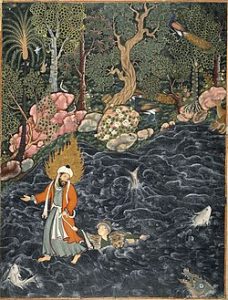
Mir Sayyid Ali, the prophet Elias (Elijah) rescuing Prince Nur ad-Dahr from drowning in a river, from the Akbar Hamzanama
Akbarnama
Another monumental project of Akbar’s reign was the Akbarnama, the illustrated chronicle of his life and rule written by Abul Fazl. These paintings visually represented major events and corresponded closely with the textual narratives, showcasing exceptional historical accuracy.
The Akbarnama illustrations reflect a growing European influence, visible in the treatment of space, light, and shadow. In addition to this manuscript, artists also created individual compositions—portraits, landscapes, scenes of wildlife, and depictions of royal life—which were later compiled into Muraqqa (albums).
The Period of Jahangir (1605–1627)
Under Jahangir, Mughal painting reached new heights of refinement and technical mastery. Unlike his father Akbar, Jahangir preferred portraits and nature studies over grand illustrated manuscripts. His keen artistic sensibility and personal involvement gave this era a distinctive elegance and realism.
Prominent artists of Jahangir’s court included Muhammad Nadir, Muhammad Murad, Mansur, Abul Hasan, Manohar, Bishandas, and Govardhan. Each artist had an individual specialisation—Bishandas excelled in portraits, Abul Hasan captured imperial grace, while Ustad Mansur was celebrated for his lifelike renderings of birds and animals.
Methods and Techniques
The art of Jahangir’s time was marked by soft colours, balanced compositions, and delicate brushwork. Themes shifted toward naturalism, celebrating the beauty of flora and fauna. Jahangir’s fascination with nature is evident in the lifelike portrayal of animals, especially in Mansur’s masterpieces like the Zebra and Falcon.
Painters of this era also focused on royal portraits, often depicting Jahangir as a serene yet powerful ruler, embodying the divine nature of kingship. European motifs such as the globe and hourglass were incorporated to symbolise his universal power and the passage of time.
Manuscript illustration continued but on a smaller scale, such as in the Tuzuk-i-Jahangiri (Jahangir’s Memoirs). Floral and geometric borders, refined detailing, and a sense of quiet grandeur became hallmarks of Jahangir’s artistic vision, making this period one of the most sophisticated in the history of Mughal art.
Conclusion
Mughal painting represents one of the finest achievements of Indian art, blending diverse cultural influences into a single, harmonious tradition. What began under Humayun with Persian inspiration matured under Akbar into a distinct Indo-Persian style, characterised by realism, rich colour, and intricate detail. During Jahangir’s reign, Mughal art reached its pinnacle of naturalism and grace, reflecting his refined aesthetic sense and love for nature.
The Mughal painters not only illustrated royal grandeur but also captured the essence of Indian life—its landscapes, flora, fauna, and people. Their works stand as visual chronicles of history, offering insight into the empire’s politics, society, and culture. Over time, the Mughal school influenced later regional styles such as the Rajput, Deccan, and Pahari schools, leaving a lasting artistic legacy.
In essence, Mughal painting was far more than decoration—it was a cultural dialogue between India and the Islamic world, between imagination and observation. It remains a timeless symbol of artistic excellence, intellectual curiosity, and imperial vision that defined the splendour of the Mughal age.
- Alauddin Khalji’s Revolutionary Price Control Policy: How One Sultan Reinvented the Medieval Indian Economy - November 24, 2025
- From Chains to Crown: The Rise of the Mamluk Sovereigns in Delhi - November 20, 2025
- Reconstructing Medieval India: Chronicles, Narratives, and the People’s Perspective - November 19, 2025

No Comments