


27 Jul MyGov Platform Boosts Citizen Participation in Policy-Making: Key Data & Impact
Subject Relevance — Where This Topic Fits
- GS Paper II — Governance, Constitution, Polity, Social Justice and International Relations | GS Paper III — Science and Technology, Economic Development, and Environmental Ecology
- Prelims: MyGov platform, Citizen participation in governance, Digital India initiatives, Data Protection and Privacy, Aadhaar reforms, National Education Policy (NEP) 2020, Digital Personal Data Protection Act 2022, Policy consultation mechanisms
- Essay: Digital governance and citizen empowerment: The role of technology in participatory democracy, Balancing transparency and efficiency in public policy formulation
Quick Revision: MyGov is a digital citizen engagement platform under MeitY that facilitates participatory governance by enabling structured public consultations on policies, with over 6.32 crore registered users and tools like discussions, polls, and surveys.
Why is this in the news?
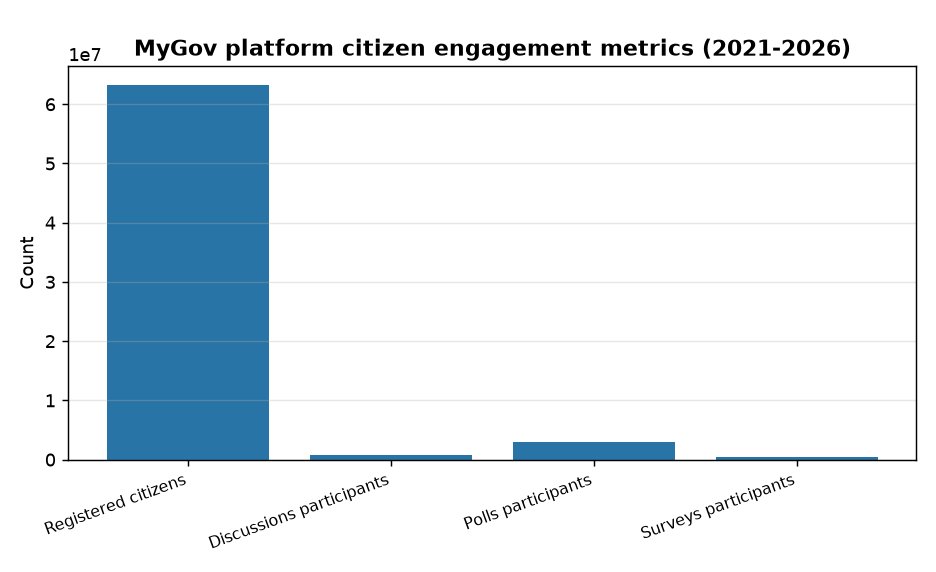
The Press Information Bureau (PIB) of the Government of India, on 27 July 2026, highlighted the significant expansion of citizen participation in policy formulation through the MyGov platform. The platform has facilitated consultations on critical national initiatives such as the National Education Policy (NEP) 2020, the Digital Personal Data Protection Bill 2022, and Aadhaar reforms, with over 6.32 crore citizens registered and 7.77 lakh participating in discussions over the past five years. This development underscores the evolving role of digital platforms in enhancing democratic governance and citizen-centric policymaking in India.
Background
- The platform operates under the Ministry of Electronics and Information Technology (MeitY) and serves as a collaborative space for citizens to contribute to policy discussions across multiple sectors.
- The National Education Policy (NEP) 2020, a landmark reform in the education sector, has been a focal point for public consultations on MyGov, reflecting the government’s commitment to inclusive and participatory policymaking.
- Independent third-party impact assessments conducted in 2017 and 2025 have validated the effectiveness of MyGov in expanding citizen participation and improving governance outcomes.
What is the MyGov Platform?
- MyGov is a citizen engagement platform launched by the Government of India in 2014 to facilitate participatory governance by enabling citizens to contribute to policy discussions, provide feedback, and share suggestions on government initiatives.
- The platform operates under the Ministry of Electronics and Information Technology (MeitY) and is designed to bridge the gap between citizens and policymakers by providing a structured and accessible digital space for dialogue.
- MyGov offers multiple engagement tools, including discussions, polls, surveys, and thematic campaigns, to gather citizen inputs on a wide range of subjects such as education, data protection, budgetary allocations, and administrative reforms.
- As of 10 July 2026, the platform has registered over 6.32 crore citizens, with a significant increase in participation over the past five years, including 7.77 lakh citizens engaging in discussions and 30.39 lakh in polls.
- The platform supports 12 languages, including English and 11 regional languages, to ensure linguistic inclusivity and accessibility for diverse citizen groups across India.
- MyGov also features a dedicated mobile application to enhance accessibility, particularly for users in rural and remote areas where mobile internet penetration is high.
- The platform’s engagement activities are initiated and moderated by various ministries and departments, ensuring that citizen inputs are systematically integrated into policy formulation and review processes.
- Independent impact assessments (2017, 2025) have recognized MyGov’s role in expanding the scope of citizen participation and improving the transparency and responsiveness of governance mechanisms.
Key Features
| Feature | Significance |
|---|---|
| Multi-modal engagement (Discussions, Polls, Surveys) | Enables structured citizen feedback across diverse policy domains, ensuring participatory governance beyond binary responses. |
| Multi-lingual accessibility (12 languages) | Removes linguistic barriers, enhancing inclusivity for non-English-speaking citizens and marginalised linguistic groups. |
| Dedicated mobile application | Leverages India’s high mobile penetration (1.2 billion+ users) to democratise policy consultation beyond desktop users. |
| Third-party impact assessments (2017, 2025) | Validates platform efficacy through independent evaluation, ensuring evidence-based improvements in citizen participation. |
| Integration with sectoral policies (NEP 2020, DPDP Bill 2022, Budget consultations) | Demonstrates real-time linkage between citizen inputs and policy formulation across critical governance areas. |
Why it Matters
Governance & Democratic Participation
- Institutionalises direct citizen engagement in policy cycles, reducing the gap between governance and grassroots stakeholders.
- Enhances transparency by making citizen inputs a formal input to policy drafts, aligning with Article 370(3) of the Constitution (promotion of public welfare).
- Shifts governance from a top-down model to a collaborative framework, reinforcing participatory democracy under Article 371(A)–(J) for specific regions.
Digital Governance & Inclusion
- Demonstrates scalable digital public infrastructure for citizen-state interaction, akin to JAM trinity but extended to policy consultations.
- Bridges the digital divide by prioritising mobile-first design and regional language support, crucial for India’s linguistic diversity.
- Sets a precedent for integrating AI-driven sentiment analysis to categorise and prioritise citizen feedback in real time.
Policy Formulation & Implementation
- Provides a feedback loop for policies like NEP 2020 and DPDP Bill 2022, ensuring iterative refinement based on ground-level inputs.
- Facilitates pre-legislative scrutiny by enabling structured public consultations before parliamentary debates, as envisaged under Article 105 (freedom of speech in Parliament).
- Accelerates policy responsiveness by reducing the time lag between citizen suggestions and administrative action.
Data-Driven Governance
- Generates anonymised datasets of citizen preferences, which can inform evidence-based policymaking and resource allocation.
- Enables longitudinal tracking of public sentiment across policy domains, supporting predictive governance models.
- Supports the Digital Personal Data Protection Framework by demonstrating secure, consent-based data collection mechanisms.
Challenges
1. Digital Divide & Accessibility Gaps
- Urban-rural disparity in internet penetration may exclude marginalised groups, undermining the inclusivity goal.
- Low digital literacy in certain demographics (e.g., elderly, tribal communities) limits effective participation.
- Dependence on mobile/data connectivity exposes the platform to disruptions during natural disasters or network outages.
UPSC Link: GS2/GS3: Digital divide, e-governance
2. Quality & Representativeness of Feedback
- Risk of disproportionate influence by organised groups (e.g., lobbies, NGOs) skewing policy inputs.
- Lack of demographic stratification in feedback may lead to policy biases favouring vocal minorities.
- Potential for misinformation or coordinated campaigns to manipulate poll/survey outcomes.
UPSC Link: GS2: Representative democracy, pressure groups
3. Institutional Capacity & Follow-Through
- Ministries/departments may lack the bandwidth to process voluminous citizen inputs, leading to delays or superficial engagement.
- No statutory mandate compels ministries to act on MyGov suggestions, reducing accountability.
- Absence of a grievance redressal mechanism for citizens whose inputs are ignored.
UPSC Link: GS2: Bureaucratic reforms, policy implementation
4. Data Privacy & Security Risks
- Centralised storage of citizen feedback raises concerns about data breaches or unauthorised access.
- Absence of a clear data retention policy for citizen inputs may violate privacy under the DPDP Act 2023.
- Potential for surveillance concerns if platform metadata (e.g., IP addresses) is misused.
UPSC Link: GS3: Cybersecurity, data protection
5. Language & Cultural Barriers
- Regional language support may not account for dialectal variations, excluding certain linguistic groups.
- Cultural nuances in feedback interpretation (e.g., sarcasm, indirect speech) may lead to misaligned policy responses.
- Limited reach in tribal areas where oral traditions dominate written participation.
UPSC Link: GS1: Cultural diversity, language policy
Challenges — UPSC Perspective
| Issue | Concern |
|---|---|
| Low rural participation | Limited awareness and infrastructure hinder equitable representation. |
| Feedback overload | Ministries struggle to prioritise inputs, risking superficial engagement. |
| Lack of feedback closure | Citizens remain unaware whether their inputs were considered or rejected. |
| Platform dependency on tech giants | Reliance on private cloud providers may raise sovereignty concerns. |
| Seasonal participation trends | Engagement spikes during major policy announcements but wanes otherwise. |
Government Initiatives — Must-Memorise for Prelims
- MyGov Platform (2014)
- Digital India Programme (2015)
- National Education Policy 2020 (NEP 2020)
Way Forward
- Mandate statutory backing for MyGov under the Right to Information (Amendment) Act to ensure ministries act on citizen inputs.
- Integrate AI-driven sentiment analysis to categorise feedback by urgency, sentiment, and demographic groups for prioritised action.
- Expand offline engagement channels (e.g., gram panchayat kiosks, mobile vans) to bridge the rural-urban divide.
- Introduce a feedback closure mechanism where ministries publish anonymised summaries of how inputs were addressed.
- Pilot a ‘Citizen Ombudsman’ role to audit the utilisation of MyGov suggestions and report lapses to Parliament.
- Develop a multi-tiered language support system, including sign language and Braille, for persons with disabilities.
- Establish a National Citizen Participation Index to track engagement trends and policy responsiveness across sectors.
- Partner with educational institutions to train students in digital literacy and encourage youth-led policy consultations.
UPSC Value Addition
Keywords for Mains Answer-Writing
Citizen participation in policy-making · MyGov platform · Digital Personal Data Protection · National Education Policy 2020 · Aadhaar authentication reforms · Public consultation mechanisms · E-governance and transparency · Third-party impact assessment · Multi-lingual accessibility in governance · Citizen-centric governance
Concept Flow
Citizen awareness of policy gaps → Engagement via MyGov platform → Structured feedback collection (Discussions/Polls/Surveys) → Data aggregation and analysis → Policy formulation/revision by ministries → Implementation and monitoring → Outcome assessment via third-party audits → Iterative refinement of platform and policies.
Prelims Practice Questions
Q1. Consider the following statements regarding the MyGov platform in India: 1) It was launched to facilitate citizen participation in policy-making. 2) It operates exclusively in English to maintain uniformity. 3) It has been subject to third-party impact assessments to evaluate its effectiveness. 4) It allows citizens to submit feedback only on budgetary matters. How many of the above statements are correct?
- Only one
- Only two
- Only three
- All four
Answer: Only three — Statements 1 and 3 are correct. Statement 2 is incorrect as MyGov operates in 12 languages. Statement 4 is incorrect as the platform covers a wide range of policy consultations beyond budgetary matters.
Q2. Which of the following initiatives has been subject to public consultation on the MyGov platform as per the given data?
- National Health Policy 2017
- Digital Personal Data Protection Bill 2022
- Pradhan Mantri Kisan Samman Nidhi
- Swachh Bharat Mission
Answer: Digital Personal Data Protection Bill 2022 — The Digital Personal Data Protection Bill 2022 was subject to public consultation on the MyGov platform, as explicitly mentioned in the provided data.
Mains Practice Question
✍ Critically examine the role of citizen participation platforms like MyGov in enhancing democratic governance in India. How do such platforms contribute to transparency, accountability, and inclusivity in policy-making? Substantiate your answer with relevant examples.
Approach: Begin by defining citizen participation platforms and their constitutional significance in India. Discuss the mechanisms through which MyGov facilitates participation, such as consultations, polls, and surveys. Highlight the impact of third-party impact assessments in improving the platform’s effectiveness. Analyze the role of multi-lingual accessibility and mobile applications in ensuring inclusivity. Conclude by evaluating the limitations, such as the final discretion of ministries in incorporating suggestions, and suggest measures for further improvement in citizen engagement.
Source: PIB (Press Information Bureau)
Generated by AanyaAi for educational purpose.


No Comments