


11 Aug NABL Launches India’s First Accreditation Scheme for Mobile Food Testing Labs
✎ NABL’s accreditation scheme for mobile food testing laboratories institutionalises quality infrastructure to enhance food safety surveillance, reduce regulatory delays, and align with international standards under the Integrated…
Subject Relevance — Where This Topic Fits
- GS Paper II — Governance, Transparency and Accountability | GS Paper III — Food Processing and Technology, Food Safety Standards
- Prelims: NABL, FSSAI, Food Safety and Standards Act, 2006, Mobile Food Testing Laboratories, Quality Infrastructure, Accreditation, ISO/IEC 17025, QCI, Integrated Assessment Framework (IAF), Mutual Recognition Agreements (MRAs)
- Essay: The Role of Institutions in Ensuring Public Health and Consumer Safety, Quality as a Catalyst for India’s Development Vision 2047
Quick Revision: NABL’s accreditation scheme for mobile food testing laboratories institutionalises quality infrastructure to enhance food safety surveillance, reduce regulatory delays, and align with international standards under the Integrated Assessment Framework (IAF).
Why is this in the news?
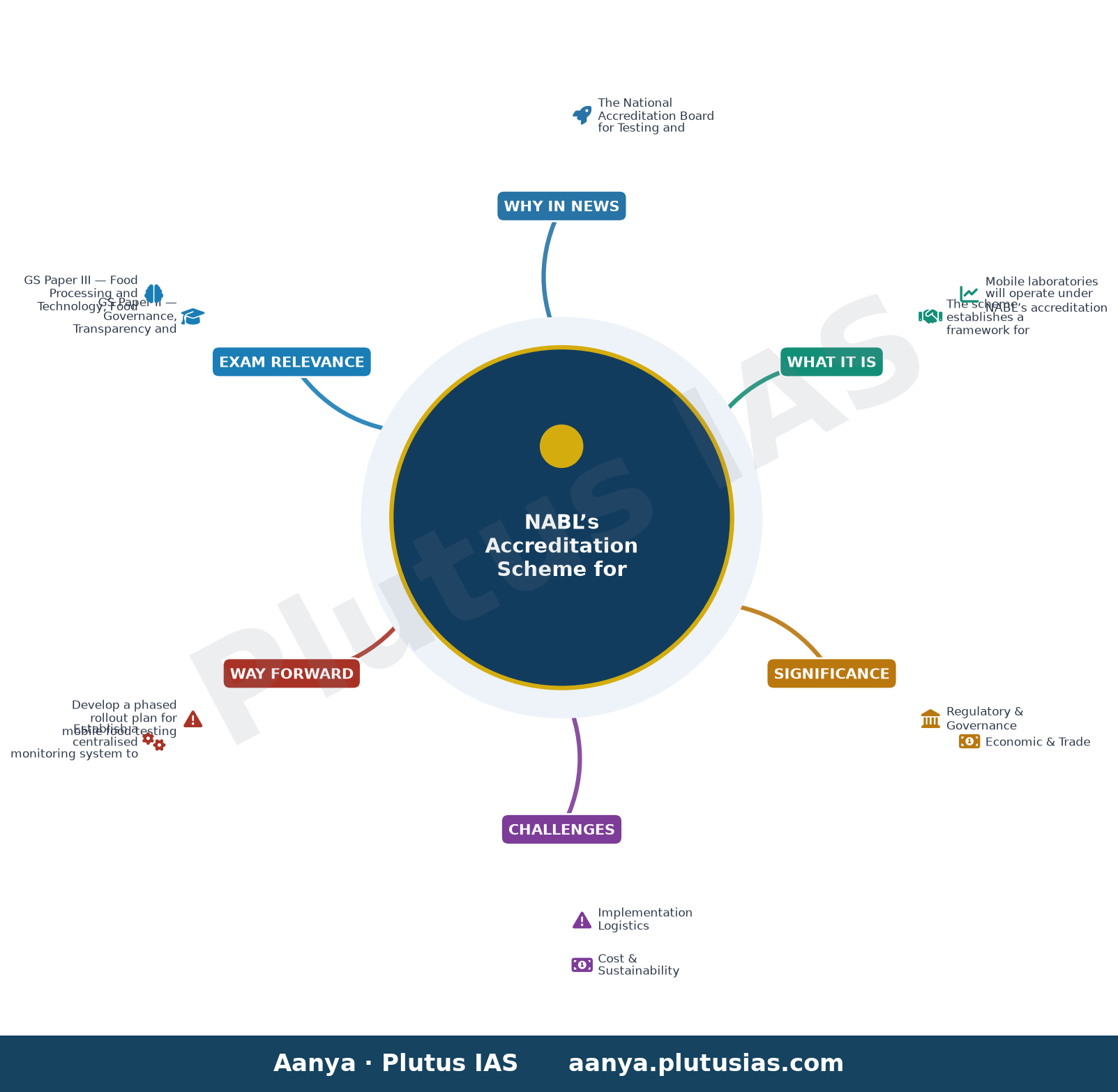
The National Accreditation Board for Testing and Calibration Laboratories (NABL), a constituent board of the Quality Council of India (QCI), launched India’s first accreditation scheme for mobile food testing laboratories on 10 August 2026. This initiative aims to expand reliable, quality-assured food testing services closer to communities while aligning with international standards. The scheme was unveiled during the ‘Quality Coordination – Multilateral MoU Exchange Ceremony’ in New Delhi, where multiple MoUs were exchanged to strengthen regulatory convergence and integrated quality infrastructure under the Integrated Assessment Framework (IAF).
Background
- Food safety is a critical public health concern in India, governed by the Food Safety and Standards Act, 2006, and regulated by the Food Safety and Standards Authority of India (FSSAI).
- Traditional fixed food testing laboratories face challenges in accessibility, especially in remote and rural areas, leading to delays in regulatory interventions and consumer grievances.
- India’s National Quality Policy (2022) emphasises the development of a robust Quality Infrastructure (QI) to enhance global competitiveness and consumer trust.
- The Quality Council of India (QCI), established in 1997, is a non-profit organisation tasked with promoting quality standards across sectors through accreditation, certification, and conformity assessment.
- NABL, a constituent board of QCI, provides accreditation to testing and calibration laboratories in compliance with international standards such as ISO/IEC 17025.
- The Integrated Assessment Framework (IAF) aims to harmonise assessment processes across regulatory authorities to reduce duplication and enhance efficiency in conformity assessments.
What is the NABL Accreditation Scheme for Mobile Food Testing Laboratories?
- The scheme establishes a framework for accrediting mobile food testing laboratories, enabling on-site, reliable, and quality-assured food safety testing near communities.
- Mobile laboratories will operate under NABL’s accreditation criteria, ensuring compliance with international standards such as ISO/IEC 17025 for testing and calibration laboratories.
- The initiative seeks to strengthen food safety surveillance by improving access to testing services, reducing regulatory response times, and enhancing consumer confidence in food products.
- Accredited mobile laboratories will facilitate faster interventions in case of food adulteration, contamination, or non-compliance with FSSAI standards.
- The scheme aligns with India’s broader Quality Infrastructure (QI) goals, including mutual recognition agreements (MRAs) to facilitate global trade and compliance.
- The Integrated Assessment Framework (IAF) underpins this scheme, promoting regulatory convergence and reducing duplication in conformity assessment processes across sectors.
- The accreditation process will involve rigorous evaluation of technical competence, infrastructure, and adherence to standard operating procedures (SOPs) by NABL.
- This initiative complements the ‘One Nation, One Standard’ vision, ensuring uniformity and reliability in food testing across India.
Key Features
| Feature | Significance |
|---|---|
| First-of-its-kind accreditation scheme for mobile food testing laboratories | Establishes a formal framework for quality-assured, on-site food safety testing across communities, reducing dependence on static laboratories. |
| Integration with Integrated Assessment Framework (IAF) | Promotes regulatory convergence, mutual recognition of test results, and reduces duplication in compliance assessments. |
| Multi-lateral MoUs for harmonised standards | Facilitates coordinated policy implementation, strengthens trust among regulators, and supports ease of doing business. |
| Focus on community-level access | Enhances food safety surveillance in remote or underserved areas by bringing accredited testing closer to consumers. |
| Alignment with international standards (ISO/IEC 17025) | Ensures test results are globally acceptable, supporting export competitiveness and consumer confidence. |
Why it Matters
Regulatory & Governance
- Strengthens India’s food safety ecosystem by formalising accreditation for mobile testing units, complementing the Food Safety and Standards Act, 2006.
- Promotes regulatory convergence through the Integrated Assessment Framework (IAF), reducing jurisdictional overlaps in compliance monitoring.
- Enhances transparency and accountability in food testing by mandating accreditation under NABL, a constituent board of the Quality Council of India (QCI).
Economic & Trade
- Supports agricultural and food processing industries by enabling faster, reliable quality testing, reducing delays in market access.
- Facilitates compliance with export requirements by ensuring test results meet international standards (e.g., Codex Alimentarius).
- Boosts consumer confidence in local food markets, potentially reducing reliance on imported food products.
Public Health & Safety
- Expands food safety surveillance to rural and peri-urban areas, addressing gaps in static laboratory coverage.
- Enables rapid regulatory intervention in case of contamination or adulteration, reducing public health risks.
- Aligns with the National Mission on Food Processing and the Eat Right India initiative by promoting safe food practices.
Institutional Collaboration
- Demonstrates the role of QCI and NABL in fostering a culture of quality across sectors through accreditation and standardisation.
- Encourages multi-stakeholder partnerships (regulators, commodity boards, industry) to build an integrated quality infrastructure.
- Serves as a model for extending accreditation schemes to other mobile testing services (e.g., water, air quality).
Challenges
1. Implementation Logistics
- Ensuring consistent availability of accredited mobile laboratories across diverse geographical regions, including hilly and remote areas.
- Training and capacity-building for personnel operating mobile labs to maintain accreditation standards.
- Coordinating with state food safety authorities to integrate mobile lab data into existing surveillance systems.
UPSC Link: GS-III: Food Processing
2. Cost & Sustainability
- Balancing the operational costs of mobile labs with affordability for small and medium enterprises (SMEs) and local governments.
- Securing long-term funding for maintenance, calibration, and upgrades of mobile testing infrastructure.
- Avoiding duplication of efforts between mobile labs and existing static laboratories.
UPSC Link: GS-III: Government Budgeting
3. Regulatory Harmonisation
- Aligning state-level food safety rules with the accreditation scheme to prevent jurisdictional conflicts.
- Ensuring mutual recognition of test results across states and with international bodies to facilitate trade.
- Addressing discrepancies between FSSAI standards and local regulatory practices.
UPSC Link: GS-II: Centre-State Relations
4. Public Awareness & Adoption
- Educating food businesses and consumers about the benefits and availability of accredited mobile testing services.
- Overcoming skepticism among small vendors and farmers regarding the necessity or credibility of mobile lab testing.
- Ensuring transparency in the accreditation process to build trust among stakeholders.
UPSC Link: GS-IV: Ethics in Governance
Challenges — UPSC Perspective
| Issue | Concern |
|---|---|
| Geographical coverage | Limited reach in remote or hilly regions due to terrain and infrastructure constraints. |
| Standardisation gaps | Variations in state-level food safety rules may hinder seamless adoption of mobile lab accreditation. |
| Cost barriers | High operational costs could limit the scalability of mobile testing services for local governments. |
| Skill shortages | Insufficient trained personnel to operate and maintain accredited mobile laboratories. |
| Data integration | Challenges in synchronising mobile lab data with existing food safety surveillance databases. |
| Consumer trust | Lack of awareness among small food businesses and rural communities about the scheme’s benefits. |
Way Forward
- Develop a phased rollout plan for mobile food testing labs, prioritising high-risk zones and underserved areas.
- Establish a centralised monitoring system to track the performance and accreditation status of mobile labs.
- Conduct periodic training programmes for lab technicians and food safety officers on ISO/IEC 17025 standards.
- Formalise MoUs with state food safety authorities to integrate mobile lab data into the FSSAI’s compliance framework.
- Launch targeted awareness campaigns for food businesses, cooperatives, and rural communities to promote adoption.
- Explore public-private partnerships to subsidise operational costs for mobile labs in economically weaker regions.
- Expand the accreditation scheme to other mobile testing services (e.g., water, air quality) based on pilot outcomes.
UPSC Value Addition
Keywords for Mains Answer-Writing
National Accreditation Board for Testing and Calibration Laboratories (NABL) · Food Safety and Standards Authority of India (FSSAI) · Mobile food testing laboratories · Accreditation scheme · Integrated Assessment Framework (IAF) · Quality infrastructure · Regulatory convergence · Food safety monitoring · Consumer trust · International standards · Quality Assurance · Food Safety and Standards Act, 2006 · Quality Council of India (QCI) · Multilateral Memorandum of Understanding (MoU)
Constitutional & Policy Linkages
- [‘Article 21 (Right to Life)’, ‘Implied right to safe food’]
- [‘Article 47 (DPSP)’, ‘State duty to improve public health’]
Concept Flow
Food safety risks in remote areas → Need for on-site testing → NABL develops accreditation scheme for mobile labs → Multi-lateral MoUs for regulatory convergence → Integrated Assessment Framework (IAF) adoption → Enhanced surveillance and compliance → Improved public health outcomes.
Prelims Practice Questions
Q1. Consider the following statements regarding the National Accreditation Board for Testing and Calibration Laboratories (NABL):
1. NABL is a constituent board of the Quality Council of India (QCI).
2. NABL provides accreditation for mobile food testing laboratories under a newly launched scheme.
3. NABL operates under the administrative control of the Ministry of Health and Family Welfare.
4. NABL’s accreditation ensures compliance with international standards for testing and calibration laboratories.
How many of the above statements are correct?
- Only one
- Only two
- Only three
- All
Answer: All — Statements 1, 2, and 4 are correct. Statement 3 is incorrect as NABL operates under the Department for Promotion of Industry and Internal Trade (DPIIT), Ministry of Commerce and Industry.
Q2. Assertion (A): The Integrated Assessment Framework (IAF) aims to reduce duplication in assessment processes and promote mutual recognition among regulatory authorities.
Reason (R): The IAF facilitates regulatory convergence and enhances the efficiency of quality infrastructure by streamlining evaluation mechanisms.
Code:
(A) Both A and R are true, and R is the correct explanation of A.
(B) Both A and R are true, but R is not the correct explanation of A.
(C) A is true but R is false.
(D) A is false but R is true.
- A
- B
- C
- D
Answer: A — Both Assertion (A) and Reason (R) are true, and Reason (R) correctly explains Assertion (A). The IAF is designed to reduce duplication and promote mutual recognition, thereby enhancing regulatory efficiency.
Q3. Match the following pairs related to quality infrastructure in India:
Column I (Institution) Column II (Function)
A. NABL 1. Development of national standards
B. FSSAI 2. Accreditation of testing laboratories
C. QCI 3. Regulation of food safety standards
D. BIS 4. Quality promotion and accreditation ecosystem
Select the correct match:
(A) A-2, B-3, C-4, D-1
(B) A-1, B-2, C-3, D-4
(C) A-3, B-1, C-2, D-4
(D) A-4, B-3, C-2, D-1
- A
- B
- C
- D
Answer: A — Correct matches: A-2 (NABL accredits testing laboratories), B-3 (FSSAI regulates food safety), C-4 (QCI promotes quality infrastructure), D-1 (BIS develops national standards).
Mains Practice Question
✍ The establishment of India’s first accreditation scheme for mobile food testing laboratories by the National Accreditation Board for Testing and Calibration Laboratories (NABL) marks a significant evolution in the country’s quality infrastructure. Critically examine the implications of this initiative for food safety governance, regulatory efficiency, and consumer welfare in India. (15 Marks)
Approach: MODEL-ANSWER SKELETON:
1. **Context and Objective**:
– Briefly explain NABL’s role as a constituent board of the Quality Council of India (QCI) under DPIIT.
– Highlight the purpose of the accreditation scheme: to expand reliable, quality-assured food testing services closer to communities, aligned with international standards (ISO/IEC 17025).
– Reference the Food Safety and Standards Act, 2006, and FSSAI’s mandate to ensure food safety.
2. **Implications for Food Safety Governance**:
– **Enhanced Monitoring**: Mobile labs enable real-time, decentralized testing, reducing delays in detecting adulteration, contamination, or non-compliance.
– **Regulatory Convergence**: The scheme aligns with the Integrated Assessment Framework (IAF) and multilateral MoUs to harmonize standards across jurisdictions, reducing regulatory fragmentation.
– **Compliance and Enforcement**: Strengthens FSSAI’s enforcement by providing credible, third-party validated data for regulatory actions.
3. **Regulatory Efficiency**:
– **Reduction in Duplication**: IAF’s coordinated approach minimizes redundant assessments, improving resource utilization (cite DPIIT Secretary’s remarks on efficiency).
– **Mutual Recognition**: Accreditation under NABL is globally recognized, facilitating trade and reducing barriers for Indian food exporters.
– **Data-Driven Decision Making**: Centralized data from mobile labs supports evidence-based policymaking and targeted interventions.
4. **Consumer Welfare**:
– **Trust and Transparency**: Accredited testing enhances consumer confidence in food safety claims and labels.
– **Accessibility**: Mobile labs serve remote and underserved areas, democratizing access to quality testing services.
– **Preventive Safety**: Early detection of hazards prevents outbreaks and reduces public health risks.
5. **Challenges and Limitations**:
– **Infrastructure Gaps**: Initial setup costs, maintenance of mobile units, and training of personnel may pose hurdles.
– **Regulatory Capacity**: Ensuring consistent implementation across states requires capacity building in local authorities.
– **Public Awareness**: Need for awareness campaigns to educate stakeholders on the scheme’s benefits and processes.
6. **Conclusion**:
– Summarize the transformative potential of the scheme in aligning India’s food safety regime with global best practices.
– Emphasize the need for sustained investment, inter-agency collaboration, and periodic review to address emerging challenges.
Source: PIB (Press Information Bureau)
Generated by AanyaAi for educational purpose.

- KWML’s Feasibility Reports for Water Metro in 18 Cities: UPSC & PCS Insights - October 3, 2026
- ओडिशा में वन्यजीव अनुसंधान अनुदान कार्यक्रम शुरू, सिमिलिपाल में 300 कैमरे और बढ़ेंगे - October 3, 2026
- India Summons Pakistan High Commission Official Over Violation - October 3, 2026

No Comments