


09 Aug Nadda chairs CEO Roundtable on India Medical Devices 2026 for UPSC
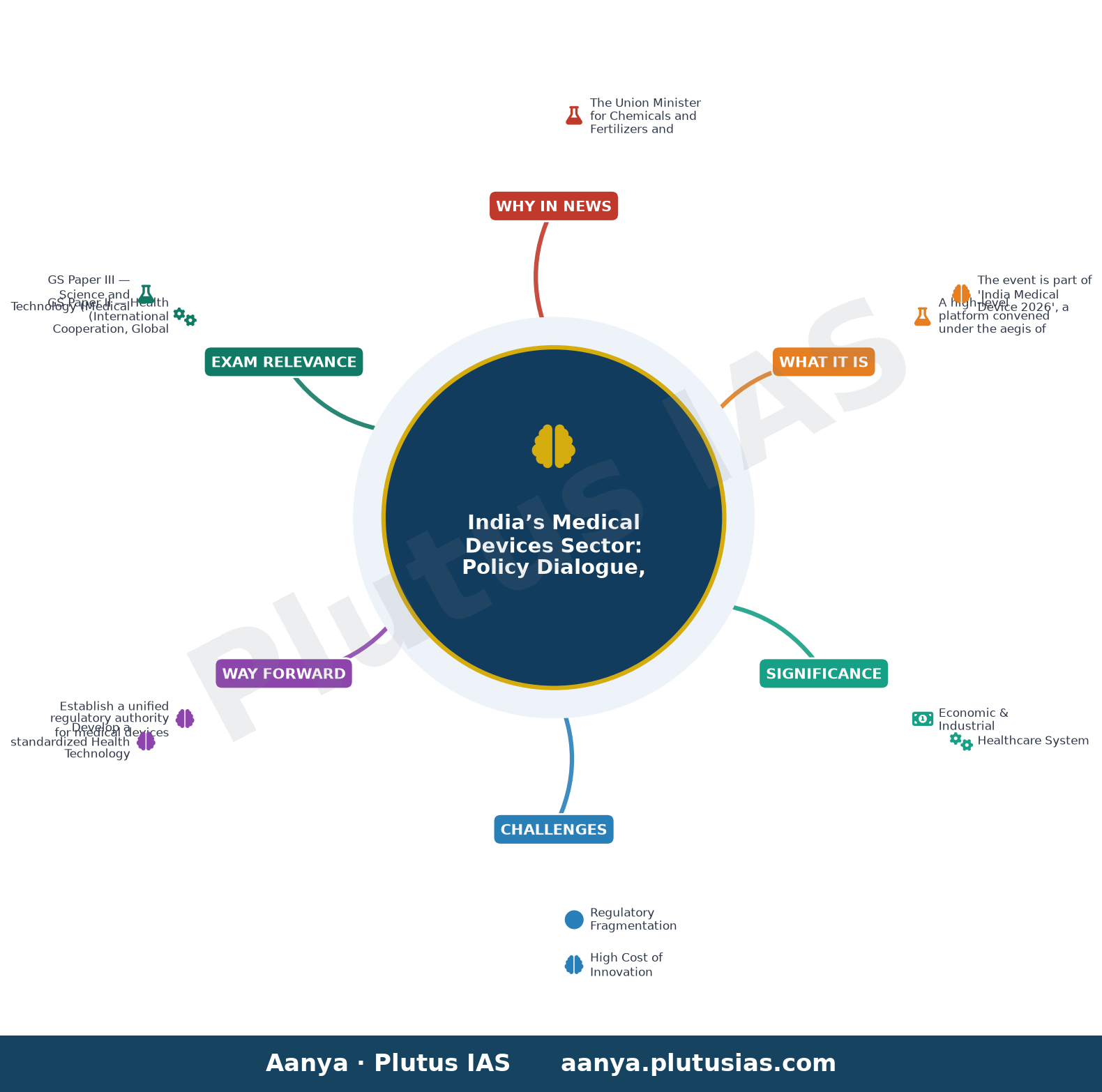
✎ India’s medical devices sector requires a synergistic approach—evidence-based HTA, sustainable reimbursement frameworks, and domestic manufacturing incentives—to achieve Universal Health Coverage and global competitiveness.
Subject Relevance — Where This Topic Fits
- GS Paper II — Health (International Cooperation, Global Health Governance) | GS Paper III — Science and Technology (Medical Technology, Innovation and R&D) | GS Paper III — Economy (Industrial Policy, MSMEs, Manufacturing) | GS Paper III — Environment (Sustainable Healthcare Systems)
- Prelims: Medical Devices Rules 2017, Pharmaceuticals and Medical Devices Bureau of India (PMBI), Universal Health Coverage (UHC), Health Technology Assessment (HTA), Make in India in MedTech, ICMR, NABH, PM-JAY, National Medical Devices Policy 2023, Production-Linked Incentive (PLI) Scheme for Medical Devices
- Essay: The interplay of innovation, affordability, and accessibility in healthcare: Lessons from India’s MedTech sector, Sustainable development and public health: The case of medical device ecosystems
Quick Revision: India’s medical devices sector requires a synergistic approach—evidence-based HTA, sustainable reimbursement frameworks, and domestic manufacturing incentives—to achieve Universal Health Coverage and global competitiveness.
Why is this in the news?
The Union Minister for Chemicals and Fertilizers and Health and Family Welfare, Shri Jagat Prakash Nadda, chaired the CEO Roundtable at ‘India Medical Device 2026’ in New Delhi on 8 August 2026. The event, organized by the Department of Pharmaceuticals under the Ministry of Chemicals and Fertilizers in collaboration with FICCI, convened senior policymakers, industry leaders, and CEOs from global and domestic MedTech firms to deliberate on strengthening India’s medical device ecosystem. The discussions underscored the need for evidence-based decision-making, sustainable reimbursement frameworks, and robust innovation ecosystems to advance India’s Universal Health Coverage (UHC) agenda.
Background
- India’s medical devices sector is a critical component of the healthcare value chain, encompassing diagnostics, implants, consumables, and digital health technologies, with an estimated market size of USD 11 billion in 2023 and projected growth to USD 50 billion by 2030.
- The sector is highly import-dependent, with over 80% of high-end medical devices being imported, highlighting the urgency for domestic manufacturing and innovation.
- The Government of India launched the National Medical Devices Policy 2023 to promote indigenous manufacturing, attract investment, and enhance global competitiveness, aligning with the ‘Atmanirbhar Bharat’ vision.
- The Production-Linked Incentive (PLI) Scheme for Medical Devices, notified in 2021, aims to boost domestic production by incentivizing manufacturers of high-end medical devices, including implants and diagnostic equipment.
- The Indian Council of Medical Research (ICMR), under the Department of Health Research, plays a pivotal role in setting clinical evidence standards and guiding health technology assessment (HTA) processes.
- Universal Health Coverage (UHC) remains a key policy objective, with the Ayushman Bharat Pradhan Mantri Jan Arogya Yojana (PM-JAY) serving as a flagship scheme to provide financial protection and access to quality healthcare services.
What is the ‘India Medical Device 2026’ CEO Roundtable?
- A high-level platform convened under the aegis of the Department of Pharmaceuticals, Ministry of Chemicals and Fertilizers, in partnership with FICCI, to foster dialogue between government policymakers, industry leaders, and CEOs of global and domestic MedTech firms.
- The event is part of ‘India Medical Device 2026’, a multi-stakeholder initiative aimed at positioning India as a global hub for medical device innovation, manufacturing, and export.
- The CEO Roundtable focused on strengthening India’s medical device ecosystem by addressing critical challenges such as innovation, investment, domestic manufacturing, and global market access for Indian MedTech companies.
- Key discussions revolved around creating an enabling environment for the adoption of innovative medical technologies, ensuring affordability, and balancing reimbursement mechanisms with financial sustainability.
- The roundtable emphasized the need for evidence-based decision-making, transparent HTA processes, and robust clinical evidence to justify reimbursement and procurement decisions.
- Participants included senior officials from the Department of Pharmaceuticals, NITI Aayog, ICMR, Department of Health and Family Welfare, DPIIT, National Health Authority (NHA), and industry representatives from FICCI and leading MedTech firms.
- The event highlighted the role of MSMEs in the MedTech sector and their potential to drive innovation and manufacturing at scale, supported by policy frameworks and financial incentives.
Key Features
| Feature | Significance |
|---|---|
| Multi-stakeholder CEO Roundtable | Provides a high-level platform for policy-makers, industry leaders, and innovators to align on strategic priorities for India’s MedTech ecosystem, fostering collaboration between government, regulators, and private sector. |
| Focus on Reimbursement Frameworks | Emphasizes the need for transparent, evidence-based reimbursement policies to ensure affordability and sustainability of innovative medical technologies under Universal Health Coverage (UHC). |
| Evidence-Based Decision Making | Stresses the importance of robust clinical evidence, health technology assessment (HTA), and cost-effectiveness analyses to validate the clinical and economic value of new medical devices. |
| Domestic Manufacturing & Innovation | Aims to strengthen India’s indigenous MedTech manufacturing capabilities, reduce import dependence, and position Indian companies as global players in the sector. |
| Integration of MSMEs | Includes participation from over 40 MSME CEOs, highlighting the government’s intent to integrate small and medium enterprises into the formal MedTech supply chain and innovation ecosystem. |
Why it Matters
Economic & Industrial
- India’s MedTech sector is projected to grow at a CAGR of 15-20% by 2026, presenting a significant opportunity for job creation, export earnings, and import substitution in high-value medical devices.
- Strengthening domestic manufacturing aligns with the ‘Atmanirbhar Bharat’ initiative, reducing reliance on imports for critical medical devices and enhancing supply chain resilience.
- The sector’s growth can attract foreign direct investment (FDI) in R&D and manufacturing, positioning India as a global hub for affordable and innovative medical technologies.
Healthcare System
- Innovative medical devices are pivotal for achieving Universal Health Coverage (UHC) by improving diagnostic accuracy, treatment efficacy, and patient outcomes, particularly in rural and underserved areas.
- A robust reimbursement ecosystem ensures that cutting-edge technologies are accessible to patients without imposing unsustainable financial burdens on the healthcare system.
- Strengthening the MedTech ecosystem supports the government’s goal of reducing out-of-pocket expenditure (OOPE) in healthcare, a key metric for assessing healthcare equity.
Policy & Regulatory
- The roundtable underscores the need for a cohesive regulatory framework that balances innovation, affordability, and patient safety, ensuring timely approvals for life-saving medical technologies.
- Evidence-based reimbursement policies can streamline procurement processes, reduce arbitrariness, and promote transparency in the healthcare system.
- The involvement of entities like ICMR, NITI Aayog, and the National Health Authority (NHA) highlights the cross-sectoral coordination required to integrate MedTech innovations into public health programs.
Strategic Autonomy
- Reducing dependence on imported medical devices enhances India’s strategic autonomy, particularly in critical sectors such as diagnostics, imaging, and surgical instruments.
- Developing indigenous capabilities in high-tech medical devices (e.g., imaging equipment, pacemakers, and robotic surgery systems) aligns with India’s long-term vision of self-reliance in healthcare technology.
Challenges
1. Regulatory Fragmentation
- India’s medical device regulatory ecosystem is fragmented, with multiple agencies (CDSCO, ICMR, NHA) involved in approvals, reimbursements, and HTA, leading to delays and inefficiencies.
- Lack of a unified regulatory pathway for innovative devices hampers their timely adoption and market penetration.
UPSC Link: GS3: Health, Technology
2. High Cost of Innovation
- The cost of R&D for advanced medical devices is prohibitively high, particularly for MSMEs, limiting their ability to innovate and compete globally.
- Limited access to venture capital and angel funding restricts the growth of startups in the MedTech sector.
UPSC Link: GS3: Startups, Innovation
3. Reimbursement Inequities
- Current reimbursement policies are often ad-hoc, leading to inequities in access to innovative technologies across states and socio-economic groups.
- Lack of standardized HTA frameworks results in inconsistent pricing and reimbursement decisions, discouraging investment in high-cost technologies.
UPSC Link: GS2: Health Governance
4. Manufacturing Bottlenecks
- India’s domestic manufacturing capacity for high-end medical devices remains underdeveloped, with most critical components still imported.
- Skilled workforce shortages in areas like biomedical engineering, regulatory affairs, and quality control pose a significant challenge.
UPSC Link: GS3: Manufacturing, Skill Development
5. Data & Evidence Gaps
- Limited real-world evidence (RWE) and clinical data on the effectiveness of medical devices in the Indian context hinder evidence-based decision-making.
- Inadequate post-market surveillance systems undermine patient safety and regulatory oversight.
UPSC Link: GS3: Health Research, Data Governance
Challenges — UPSC Perspective
| Issue | Concern |
|---|---|
| Regulatory Delays | Fragmented approval pathways and multiple agencies lead to prolonged timelines for device certification and market entry. |
| Affordability Gap | High upfront costs of innovative devices limit their adoption, particularly in public health systems with constrained budgets. |
| Skill Shortages | Lack of trained professionals in biomedical engineering, regulatory affairs, and HTA slows ecosystem growth. |
| Data Deficits | Insufficient real-world clinical evidence and post-market surveillance data impede evidence-based policymaking. |
| Import Dependence | Over-reliance on imported components and devices exposes the sector to global supply chain disruptions and currency fluctuations. |
| Reimbursement Inconsistencies | Ad-hoc reimbursement policies create inequities and discourage investment in high-cost technologies. |
Government Initiatives — Must-Memorise for Prelims
- Production-Linked Incentive (PLI) Scheme for Medical Devices (2021)
Way Forward
- Establish a unified regulatory authority for medical devices to streamline approvals, reduce fragmentation, and accelerate market access for innovative technologies.
- Develop a standardized Health Technology Assessment (HTA) framework to ensure evidence-based reimbursement decisions, balancing affordability and clinical efficacy.
- Expand funding mechanisms for R&D in MedTech, including grants, venture capital support, and tax incentives for MSMEs and startups.
- Strengthen domestic manufacturing by incentivizing local production of critical components, components, and high-end devices through PLI schemes and cluster-based approaches.
- Enhance post-market surveillance systems to generate real-world evidence (RWE) on device performance, safety, and cost-effectiveness in the Indian context.
- Promote public-private partnerships (PPPs) for technology transfer, skill development, and capacity building in biomedical engineering and regulatory affairs.
- Integrate MedTech innovations into national health programs (e.g., Ayushman Bharat, PM-JAY) through structured reimbursement pathways and pilot projects.
- Encourage global collaborations and joint ventures to facilitate technology transfer, reduce import dependence, and enhance India’s competitiveness in the MedTech sector.
UPSC Value Addition
Keywords for Mains Answer-Writing
Medical Devices Policy 2023 · MedTech sector in India · Universal Health Coverage (UHC) · Health Technology Assessment (HTA) · Medical Devices Rules 2017 · Federation of Indian Chambers of Commerce and Industry (FICCI) · Pharmaceuticals Department · Clinical evidence in healthcare · Reimbursement mechanisms in healthcare · Ayushman Bharat Digital Mission · Make in India for medical devices · Regulatory sandboxes for medical innovations · Public-Private Partnership (PPP) in healthcare · National Medical Devices Policy · Innovation in healthcare delivery
Concept Flow
Fragmented MedTech ecosystem → Regulatory delays and high costs → Limited innovation and import dependence → High import dependence → Vulnerability to supply chain disruptions and currency fluctuations → Threat to healthcare access and affordability → Lack of evidence-based reimbursement → Inconsistent pricing and inequitable access → Poor adoption of innovative technologies → Skill shortages in biomedical engineering → Underdeveloped domestic manufacturing → Over-reliance on imports → Absence of unified regulatory authority → Prolonged approval timelines → Delayed market entry of life-saving devices → Insufficient post-market surveillance → Limited real-world data → Weak evidence base for HTA and reimbursement → Strengthened MedTech ecosystem → Enhanced domestic manufacturing and innovation → Reduced import dependence and improved healthcare outcomes
Prelims Practice Questions
Q1. Consider the following statements regarding the Medical Devices Rules, 2017:
1. These rules are framed under the Drugs and Cosmetics Act, 1940.
2. They classify medical devices into four risk-based classes: A, B, C, and D.
3. The rules mandate clinical trials for all classes of medical devices before market authorization.
4. The rules apply exclusively to imported medical devices and not to domestically manufactured ones.
How many of the above statements are correct?
- Only one
- Only two
- Only three
- All
Answer: Only three — Statements 1 and 2 are correct as the Medical Devices Rules, 2017 are framed under the Drugs and Cosmetics Act, 1940 and classify devices into four risk-based classes. Statement 3 is incorrect because clinical trials are not mandatory for all classes; only higher-risk classes (C and D) require them. Statement 4 is incorrect as the rules apply to both imported and domestically manufactured medical devices.
Q2. Assertion (A): The National Medical Devices Policy, 2023 aims to position India as a global hub for manufacturing high-quality medical devices.
Reason (R): The policy focuses on reducing the cost of medical devices through subsidies and tax exemptions for domestic manufacturers.
Options:
A. Both A and R are true, and R is the correct explanation of A.
B. Both A and R are true, but R is not the correct explanation of A.
C. A is true, but R is false.
D. A is false, but R is true.
Answer: ? — Assertion (A) is true as the National Medical Devices Policy, 2023 aims to make India a global manufacturing hub for medical devices. Reason (R) is also true but does not directly explain the assertion, as the policy emphasizes innovation, quality, and regulatory reforms rather than merely reducing costs through subsidies.
Q3. Match the following committees/institutions with their respective roles in the medical devices ecosystem:
Column I (Committee/Institution)
1. Department of Pharmaceuticals
2. NITI Aayog
3. ICMR
4. National Health Authority (NHA)
Column II (Role)
A. Formulates the National Medical Devices Policy
B. Provides strategic and policy inputs for healthcare innovation
C. Conducts clinical research and sets standards for medical devices
D. Implements health insurance schemes and reimbursement mechanisms
Options:
A. 1-A, 2-B, 3-C, 4-D
B. 1-B, 2-A, 3-D, 4-C
C. 1-C, 2-D, 3-A, 4-B
D. 1-D, 2-C, 3-B, 4-A
- A
- B
- C
- D
Answer: A — The correct match is: 1-A (Department of Pharmaceuticals formulates the National Medical Devices Policy), 2-B (NITI Aayog provides strategic and policy inputs), 3-C (ICMR conducts clinical research and sets standards), and 4-D (NHA implements health insurance schemes and reimbursement mechanisms).
Mains Practice Question
✍ Critically examine the role of evidence-based decision-making in the adoption and reimbursement of innovative medical technologies in India. How does this approach align with the goal of achieving Universal Health Coverage (UHC)? (15 Marks)
Approach: MODEL-ANSWER SKELETON:
1. **Definition and Importance of Evidence-Based Decision-Making (EBDM)**:
– Explain EBDM as a process integrating clinical evidence, cost-effectiveness, and patient values to guide healthcare decisions.
– Highlight its relevance in medical technology adoption and reimbursement policies.
2. **Regulatory and Policy Framework in India**:
– Discuss the Medical Devices Rules, 2017, and the National Medical Devices Policy, 2023, emphasizing their focus on quality, safety, and innovation.
– Mention the role of the Health Technology Assessment (HTA) in India, including the HTAIn initiative under the Department of Health Research (DHR).
3. **Challenges in Implementing EBDM**:
– **Clinical Evidence Gaps**: Highlight the lack of indigenous clinical data for many medical technologies, particularly those developed abroad.
– **Cost-Effectiveness Concerns**: Discuss the financial constraints in adopting high-cost innovative technologies, especially in public healthcare systems.
– **Regulatory Delays**: Address the time taken for approvals and reimbursement processes, which may delay patient access to critical technologies.
– **Fragmented Ecosystem**: Explain the siloed functioning of regulatory bodies, HTA agencies, and reimbursement authorities, leading to inefficiencies.
4. **Alignment with Universal Health Coverage (UHC)**:
– **Affordability and Accessibility**: Argue that EBDM ensures that only cost-effective and clinically beneficial technologies are adopted, preventing wastage of scarce resources.
– **Equity**: Discuss how EBDM can prioritize technologies that serve underserved populations, aligning with the UHC goal of leaving no one behind.
– **Sustainability**: Explain how evidence-based reimbursement mechanisms ensure long-term financial sustainability of healthcare systems.
5. **Way Forward**:
– **Strengthening HTA Infrastructure**: Propose the expansion of HTAIn and integration of HTA into the Medical Devices Rules.
– **Indigenous Research**: Encourage public-private partnerships to generate clinical evidence for locally developed technologies.
– **Streamlining Processes**: Suggest the establishment of a unified regulatory and reimbursement authority to reduce delays.
– **Capacity Building**: Emphasize the need for training healthcare professionals in evidence-based practices and HTA methodologies.
6. **Conclusion**:
– Summarize that while EBDM is critical for rational healthcare spending and UHC, its implementation in India faces significant challenges. A collaborative approach involving policymakers, industry, and academia is essential to overcome these barriers.
Source: PIB (Press Information Bureau)
Generated by AanyaAi for educational purpose.

- KWML’s Feasibility Reports for Water Metro in 18 Cities: UPSC & PCS Insights - October 3, 2026
- ओडिशा में वन्यजीव अनुसंधान अनुदान कार्यक्रम शुरू, सिमिलिपाल में 300 कैमरे और बढ़ेंगे - October 3, 2026
- India Summons Pakistan High Commission Official Over Violation - October 3, 2026

No Comments