


02 Sep NAMASTE-SUY Scheme Empowers Ex-Sewer Worker to Become Sanitation Entrepreneur
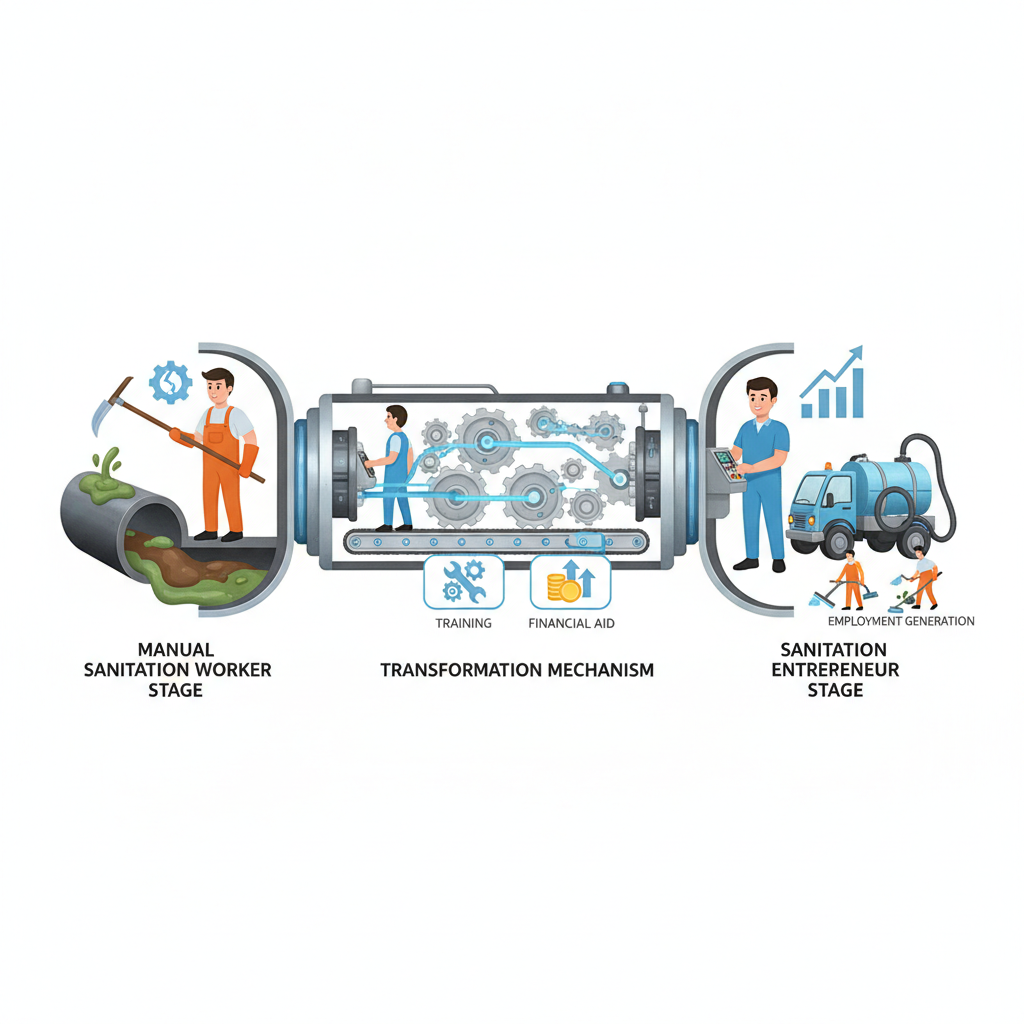
✎ NAMASTE-SUY transforms manual sanitation labour into mechanised entrepreneurship by providing capital subsidy for equipment, coupled with skill training and bank loans, to eliminate hazardous manual scavenging and promote…
Subject Relevance — Where This Topic Fits
- GS Paper II — Social Justice and Empowerment | GS Paper III — Employment, Skill Development and Entrepreneurship | GS Paper IV — Human Values and Professional Ethics
- Prelims: NAMASTE scheme, Swachhta Udyami Yojana (SUY), Mechanised Sanitation Services, Manual Scavenging (Prohibition) Act, 2013, Self-Employment Scheme for Rehabilitation of Manual Scavengers (SRMS), Socially and Economically Disadvantaged Groups (SEDGs), Skill Development for Informal Workers, Financial Inclusion for Marginalised Communities
- Essay: Role of technology in social empowerment and dignity, From exclusion to entrepreneurship: Rehabilitating marginalised communities through inclusive policies
Quick Revision: NAMASTE-SUY transforms manual sanitation labour into mechanised entrepreneurship by providing capital subsidy for equipment, coupled with skill training and bank loans, to eliminate hazardous manual scavenging and promote dignified, sustainable livelihoods for marginalised sanitation workers.
Why is this in the news?
The case of Kailash Chandra, a 63-year-old sanitation worker from Rajasthan’s Jhunjhunu district, illustrates the transformative impact of the NAMASTE-SUY initiative. Under the Swachhta Udyami Yojana (SUY), a component of the National Action for Mechanised Sanitation Ecosystem (NAMASTE), he transitioned from hazardous manual sewer cleaning to owning a mechanised sanitation enterprise, securing stable income, employment for others, and financial independence. This narrative underscores the scheme’s role in addressing occupational hazards, caste-based discrimination, and economic vulnerability among sanitation workers.
Background
- Manual scavenging, historically linked to caste-based occupations, remains a critical social issue despite legal prohibitions under the Prohibition of Employment as Manual Scavengers and their Rehabilitation Act, 2013.
- The Supreme Court of India, in its 2014 judgment in Safai Karamchari Andolan vs. Union of India, directed the identification and rehabilitation of all manual scavengers, emphasising the need for alternative livelihoods and mechanised sanitation solutions.
- The Self-Employment Scheme for Rehabilitation of Manual Scavengers (SRMS), launched in 2007, provided one-time cash assistance and skill training but faced implementation challenges, including limited access to credit and technology.
- The NAMASTE scheme, launched in 2022, integrates mechanisation, skill development, and financial support to eliminate manual scavenging and promote dignified livelihoods for sanitation workers.
- India’s sanitation sector employs over 5 million workers, predominantly from marginalised communities, with high occupational risks and low social mobility.
- The Swachh Bharat Mission (Urban) and Swachh Bharat Mission (Gramin) have accelerated the demand for mechanised sanitation services, creating market opportunities for trained entrepreneurs.
What is the NAMASTE-SUY Initiative?
- The National Action for Mechanised Sanitation Ecosystem (NAMASTE) is a central sector scheme launched in 2022 to eliminate manual scavenging by promoting mechanised sanitation services and providing sustainable livelihoods to sanitation workers.
- The Swachhta Udyami Yojana (SUY) is a sub-scheme under NAMASTE, designed to support sanitation workers in transitioning to self-employment through mechanised sanitation enterprises.
- Eligibility extends to identified manual scavengers, sanitation workers, and their dependents, prioritising those from Scheduled Castes, Scheduled Tribes, and Other Backward Classes.
- The scheme emphasises skill development through training in mechanised sanitation operations, business management, and safety protocols, ensuring workers can operate enterprises independently.
- Financial assistance is disbursed through designated banks and financial institutions, with a focus on digital inclusion and ease of access for marginalised beneficiaries.
- NAMASTE-SUY aligns with the broader goals of the Prohibition of Employment as Manual Scavengers Act, 2013, and the Rights of Persons with Disabilities Act, 2016, by addressing occupational hazards and promoting inclusive growth.
- The initiative fosters community-based enterprises, enabling workers to employ others from their communities, thereby creating multiplier effects on local economies and social mobility.
Key Features
| Feature | Significance |
|---|---|
| Target Beneficiaries | Scheduled Caste (SC) communities, particularly Valmiki sub-caste, engaged in manual scavenging or sewer cleaning with limited formal education and irregular income |
| Capital Subsidy | 50% of total project cost (₹5.93 lakh) provided as upfront subsidy to purchase mechanised sanitation equipment, reducing financial burden |
| Mechanised Equipment | Provision of suction machines mounted on tractors to replace manual sewer cleaning, enhancing occupational safety and efficiency |
| Skill Development Component | Training in operation and maintenance of mechanised sanitation systems, enabling entrepreneurship in sanitation services |
| Employment Generation | Creation of direct and indirect employment opportunities for drivers and helpers, contributing to local livelihoods |
| Financial Inclusion | Linkage with formal credit systems for remaining 50% project cost (₹5.93 lakh) via institutional loans, promoting sustainable business models |
Why it Matters
Economic Empowerment
- Transition from precarious, low-income manual labour to stable, self-employed entrepreneurship in mechanised sanitation services
- Enhanced income stability with potential monthly savings of ₹8,000–10,000 post-operational expenses and EMI repayment
- Reduction in intergenerational poverty by enabling financial independence and asset creation for beneficiaries
- Promotion of local economic growth through micro-enterprise development in sanitation services sector
Social Upliftment
- Mitigation of caste-based occupational segregation by providing dignified, mechanised alternatives to manual scavenging
- Improved social status and self-respect for beneficiaries through ownership of sustainable livelihoods
- Addressing intersectional vulnerabilities of SC communities by combining economic empowerment with dignity of labour
- Enhanced gender equity by enabling women from beneficiary families to engage in safer, skilled roles within the enterprise
Policy and Governance
- Demonstrates the efficacy of targeted welfare schemes in addressing structural socio-economic inequalities
- Highlights the role of inter-departmental coordination (e.g., Ministry of Social Justice and Empowerment, state governments) in scheme implementation
- Showcases the integration of financial inclusion mechanisms (subsidies, loans) with skill development for sustainable outcomes
- Provides a replicable model for other marginalised occupational groups facing similar challenges
Technological Integration
- Leverages mechanisation to eliminate high-risk manual interventions in sanitation, aligning with occupational safety standards
- Facilitates adoption of modern equipment in traditionally informal sectors, bridging the digital and technological divide
- Encourages entrepreneurship in emerging sectors like waste management and sanitation services, fostering innovation
Challenges
1. Occupational Health and Safety Risks
- Prolonged exposure to hazardous conditions in manual sewer cleaning leads to chronic health issues (e.g., respiratory diseases, infections)
- Lack of protective gear and inadequate training exacerbates vulnerability to accidents and long-term morbidity
- Absence of formal occupational safety protocols for informal sanitation workers perpetuates systemic neglect
UPSC Link: GS2: Vulnerable Sections; GS3: Occupational Health
2. Socio-Economic Barriers
- Limited formal education and skill sets restrict access to alternative livelihood opportunities beyond manual labour
- Caste-based discrimination and social stigma impede upward mobility and access to credit or markets
- Irregular income streams and lack of financial literacy hinder long-term financial planning and asset accumulation
UPSC Link: GS1: Social Empowerment; GS2: Poverty Alleviation
3. Access to Credit and Markets
- Informal nature of traditional occupations often excludes workers from formal banking systems and institutional credit
- High collateral requirements and risk aversion among lenders deter investment in micro-enterprises for marginalised groups
- Limited awareness of government schemes and complex application processes act as deterrents to participation
UPSC Link: GS3: Financial Inclusion; GS2: Welfare Schemes
4. Institutional and Implementation Gaps
- Fragmented delivery mechanisms across central and state agencies may lead to delays or exclusion of eligible beneficiaries
- Inadequate monitoring and evaluation frameworks hinder assessment of scheme impact and course correction
- Lack of convergence with other welfare programmes (e.g., skill development, housing) reduces holistic benefits
UPSC Link: GS2: Governance; GS4: Ethics in Public Administration
5. Technological Adoption Barriers
- Resistance to mechanisation due to traditional practices and lack of familiarity with modern equipment
- High upfront costs of mechanised systems despite subsidies, requiring additional financial support for maintenance
- Need for continuous training and capacity-building to ensure efficient and safe operation of equipment
UPSC Link: GS3: Science and Technology; GS2: Skill Development
6. Policy Coherence and Sustainability
- Ensuring long-term viability of micro-enterprises requires stable demand for sanitation services and fair pricing
- Balancing subsidies with market-driven models to prevent dependency while promoting self-sufficiency
- Addressing structural issues like urbanisation and waste management infrastructure gaps that affect sector growth
UPSC Link: GS2: Policy Implementation; GS3: Sustainable Development
Challenges — UPSC Perspective
| Issue | Concern |
|---|---|
| Health Risks | Chronic exposure to hazardous environments in manual scavenging leads to severe health complications |
| Financial Exclusion | Limited access to formal credit systems due to informal employment and lack of collateral |
| Skill Gaps | Inadequate formal education and training restrict transition to mechanised or alternative livelihoods |
| Social Stigma | Caste-based discrimination limits social mobility and access to economic opportunities |
| Market Access | Lack of awareness and networks hinders entry into formal markets for sanitation services |
| Institutional Delays | Complex application processes and bureaucratic hurdles delay scheme benefits for eligible beneficiaries |
Government Initiatives — Must-Memorise for Prelims
- NAMASTE (National Action for Mechanised Sanitation Ecosystem)
- SUY (Swachhta Udyami Yojana) under NAMASTE
Way Forward
- Expand awareness campaigns in local languages to ensure maximum reach among target communities, particularly in rural and semi-urban areas
- Strengthen inter-departmental coordination between the Ministry of Social Justice and Empowerment, state governments, and financial institutions to streamline subsidy disbursal
- Introduce mandatory skill development modules for beneficiaries, focusing on equipment operation, maintenance, and business management
- Establish a grievance redressal mechanism to address delays in subsidy approvals, equipment procurement, and training schedules
- Promote public-private partnerships to create demand for mechanised sanitation services in urban and peri-urban areas, ensuring sustainable revenue streams
- Integrate NAMASTE-SUY with other welfare schemes (e.g., PMKVY, Stand-Up India) to provide holistic support, including credit linkage and market access
- Conduct periodic impact assessments to evaluate the scheme’s effectiveness in reducing manual scavenging and improving livelihoods
- Encourage state governments to replicate successful models by allocating dedicated funds and creating enabling policies for micro-enterprises
UPSC Value Addition
Keywords for Mains Answer-Writing
NAMASTE-SUY scheme · Manual Scavenging (Prohibition) Act, 2013 · Mechanised Sanitation Ecosystem (MSE) · Self-employment for Safai Karamcharis · Social Justice and Empowerment Ministry · Scheduled Castes and Scheduled Tribes (Prevention of Atrocities) Act, 1989 · Skill development for marginalised communities · Financial inclusion of unorganised sector workers · Garima Grihas for manual scavengers · Constitutional provisions for social justice (Articles 17, 46)
Concept Flow
Manual scavenging and sewer cleaning → Limited education and irregular income → Social and economic vulnerability → Targeting by NAMASTE-SUY → Provision of capital subsidy and mechanised equipment → Transition to self-employment in sanitation services → Skill development and financial inclusion → Establishment of micro-enterprises → Generation of stable income → Employment creation for drivers and helpers → Local economic upliftment and poverty reduction → Financial savings and asset accumulation → Enhanced dignity and self-reliance → Long-term socio-economic empowerment
Prelims Practice Questions
Q1. Consider the following statements regarding the NAMASTE-SUY initiative:
1. It is a sub-scheme under the NAMASTE programme aimed at promoting mechanised sanitation services.
2. The scheme provides 100% capital subsidy to Safai Karamcharis for purchasing mechanised sanitation equipment.
3. The scheme is implemented by the Ministry of Social Justice and Empowerment.
4. The scheme mandates the establishment of Garima Grihas for manual scavengers.
How many of the above statements are correct?
- Only one
- Only two
- Only three
- All four
Answer: Only three — Statements 1 and 3 are correct. Statement 2 is incorrect as the scheme provides 50% capital subsidy, not 100%. Statement 4 is incorrect as Garima Grihas are part of the broader NAMASTE programme but not a mandatory component of SUY.
Q2. Assertion (A): The Manual Scavenging (Prohibition) Act, 2013, prohibits the employment of manual scavengers and the construction of dry latrines.
Reason (R): The Act aims to eliminate the practice of manual scavenging by providing for the rehabilitation of manual scavengers.
Options:
A. Both A and R are true, and R is the correct explanation of A.
B. Both A and R are true, but R is not the correct explanation of A.
C. A is true, but R is false.
D. A is false, but R is true.
Answer: ? — Both Assertion (A) and Reason (R) are true, and R correctly explains A. The Act prohibits manual scavenging and mandates rehabilitation measures.
Mains Practice Question
✍ The NAMASTE-SUY initiative represents a transformative approach to addressing the socio-economic vulnerabilities of manual scavengers. Critically examine the scheme’s design, implementation challenges, and its alignment with constitutional and statutory provisions for social justice. Also, analyse how such initiatives contribute to the broader goal of eliminating manual scavenging in India. (15 Marks)
Approach: MODEL-ANSWER SKELETON:
1. **Introduction (2 marks)**
– Briefly define NAMASTE-SUY (Self-Employment for Safai Karamcharis) as a sub-scheme under the National Action for Mechanised Sanitation Ecosystem (NAMASTE) programme.
– State its objective: to transition manual scavengers to mechanised sanitation entrepreneurship.
2. **Scheme Design and Key Features (3 marks)**
– **Capital Subsidy**: 50% subsidy (up to ₹5.93 lakh) for purchasing mechanised equipment (e.g., suction machines, tractors).
– **Skill Development**: Training in mechanised sanitation operations and entrepreneurship.
– **Financial Inclusion**: Linkages with banks for loans and credit facilities.
– **Rehabilitation**: Integration with Garima Grihas (safe housing) and skill certification under the National Skill Development Corporation (NSDC).
3. **Constitutional and Statutory Alignment (3 marks)**
– **Article 17 (Abolition of Untouchability)**: Directly addresses the caste-based discrimination faced by manual scavengers.
– **Article 46 (Directive Principles)**: Mandates state protection for weaker sections, including economic and educational upliftment.
– **Manual Scavenging (Prohibition) Act, 2013**: Prohibits manual scavenging and mandates rehabilitation; SUY aligns with its objectives.
– **Scheduled Castes and Scheduled Tribes (Prevention of Atrocities) Act, 1989**: SUY addresses the socio-economic vulnerabilities that perpetuate atrocities.
4. **Implementation Challenges (3 marks)**
– **Awareness and Outreach**: Limited awareness among target beneficiaries, especially in rural and remote areas.
– **Access to Credit**: Dependence on formal banking systems may exclude marginalised groups without collateral.
– **Technical and Operational Barriers**: Maintenance of mechanised equipment, regulatory compliance, and competition from informal sector.
– **Sustainability**: Ensuring long-term viability of enterprises post-subsidy phase.
5. **Contribution to Eliminating Manual Scavenging (2 marks)**
– **Shift to Mechanised Systems**: Reduces reliance on manual intervention, aligning with the 2013 Act’s prohibition.
– **Economic Empowerment**: Provides dignified livelihoods, reducing the compulsion to engage in hazardous occupations.
– **Social Stigma Reduction**: Mechanised sanitation services challenge caste-based occupational hierarchies.
– **Policy Synergy**: Complements other initiatives like the Swachh Bharat Mission (SBM) and the Prohibition of Employment as Manual Scavengers and their Rehabilitation Act, 2013.
6. **Conclusion (2 marks)**
– SUY is a progressive step but requires strengthening of implementation mechanisms, multi-stakeholder collaboration (government, NGOs, private sector), and continuous monitoring.
– Emphasise the need for a holistic approach combining economic empowerment, social rehabilitation, and legal enforcement to eradicate manual scavenging.
Source: PIB (Press Information Bureau)
Generated by AanyaAi for educational purpose.
Related guides on our sites
- Best PSIR optional coaching for upsc
- Best PSIR optional teacher for upsc
- Best teacher of PSIR optional for upsc
- Best PSIR optional coaching in delhi for UPSC

- गुजरात दंपति ने जीता आईवीएफ का कानूनी युद्ध, जानिए क्या है पूरा मामला - September 4, 2026
- Gujarat HC Allows IVF for Couple After Son’s Suicide: Key UPSC Polity Insight - September 4, 2026
- बिहार में 32 हजार शिक्षकों की भर्ती: मुख्यमंत्री ने दी बड़ी खुशखबरी, जल्द आएगा विज्ञापन - September 4, 2026

No Comments