


11 Aug NASA Invites ISRO to Join Lunar South Pole Moon Base Programme
✎ The Artemis Accords and India’s participation in NASA’s Moon Base programme represent a paradigm shift in lunar exploration, emphasising international cooperation, sustainable resource utilisation, and the long-term governance of…
Subject Relevance — Where This Topic Fits
- GS Paper II — International Relations: Space Cooperation and Bilateral Agreements | GS Paper III — Science and Technology: Space Technology and Space Missions | GS Paper III — Economy: Public-Private Partnerships in Space Sector
- Prelims: Artemis Accords, ISRO-NASA collaborations, NISAR mission, Lunar South Pole, UN COPUOS, India-U.S. Civil Space Joint Working Group, TRUST Initiative, Synthetic Aperture Radar (SAR), Human spaceflight technology, Long-term sustainability of outer space activities
- Essay: The Role of International Collaboration in Advancing Humanity’s Frontiers: Lessons from Space Exploration, Balancing National Sovereignty and Global Public Goods in Space Governance
Quick Revision: The Artemis Accords and India’s participation in NASA’s Moon Base programme represent a paradigm shift in lunar exploration, emphasising international cooperation, sustainable resource utilisation, and the long-term governance of outer space activities.
Why is this in the news?
The invitation extended by NASA to ISRO to join its Moon Base programme, formalised during the ninth meeting of the India-U.S. Civil Space Joint Working Group in Bengaluru, marks a significant milestone in India’s space diplomacy. This collaboration aligns with the Artemis Accords framework and underscores the strategic importance of lunar exploration, scientific data sharing, and the long-term sustainability of outer space activities. For UPSC aspirants, this development offers a critical case study in international space governance, bilateral cooperation, and India’s evolving role in global space missions.
Background
- The lunar South Pole has emerged as a focal point for future missions due to the presence of permanently shadowed regions containing water ice, which is critical for sustained human presence and resource utilisation.
- The United Nations Committee on the Peaceful Uses of Outer Space (COPUOS), established in 1959, provides the primary international forum for the governance of outer space activities, including the Artemis Accords.
- The India-U.S. Civil Space Joint Working Group (CSJWG) serves as a bilateral mechanism to facilitate cooperation in civil space activities, including scientific research, technology development, and data sharing.
What is NASA’s Moon Base Programme?
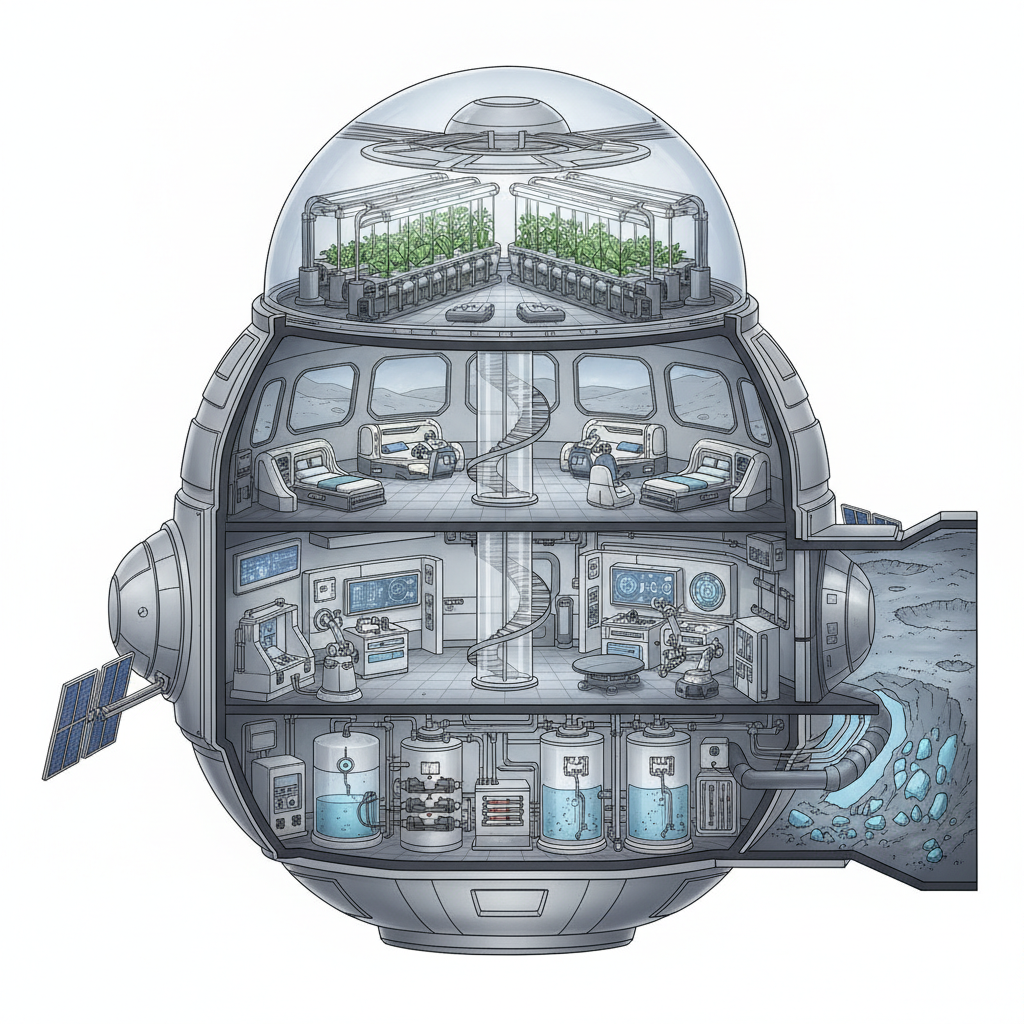
- The Moon Base programme is NASA’s initiative to establish humanity’s first permanent outpost on the Moon, specifically near the lunar South Pole, by leveraging the Artemis programme and international partnerships.
- The programme aims to utilise lunar resources, such as water ice, for life support, fuel production, and scientific research, thereby reducing dependency on Earth for supplies.
- The Moon Base will serve as a testbed for technologies required for future missions to Mars and other deep-space destinations, including advanced life support systems, radiation shielding, and in-situ resource utilisation (ISRU).
- The programme is designed to be inclusive, inviting international partners to contribute to its various components, such as habitat modules, power systems, and scientific instruments.
- The Artemis Accords, signed by 40+ countries, provide the legal and operational framework for international collaboration in lunar exploration, emphasising transparency, interoperability, and the peaceful use of space.
- The programme aligns with the principles of the Outer Space Treaty (1967) and the Artemis Accords, which prohibit national appropriation of the Moon and ensure the sharing of scientific data and discoveries.
- The collaboration with ISRO is expected to enhance the programme’s scientific and technological capabilities, particularly in areas such as robotics, lunar geology, and sustainable habitat design.
Key Features
| Feature | Significance |
|---|---|
| Artemis Accords | A non-binding multilateral agreement establishing principles for civil space exploration, including transparency, peaceful purposes, and resource-sharing, to guide international cooperation on the Moon and beyond. |
| Moon Base Programme | NASA’s initiative to establish a sustainable human presence near the lunar South Pole, leveraging international partnerships for scientific, technological, and exploratory objectives. |
| India-U.S. Civil Space Joint Working Group (CSJWG) | A bilateral mechanism to advance cooperation in civil space activities, including joint missions, data sharing, and long-term sustainability of outer space activities. |
| NISAR Mission | A joint NASA-ISRO Earth observation satellite using synthetic aperture radar to monitor ecosystem changes, ice-sheet collapse, and natural hazards, demonstrating bilateral technological collaboration. |
| UN Committee on the Peaceful Uses of Outer Space (COPUOS) | A UN body that formulates international guidelines for the peaceful exploration and use of outer space, including the Long-term Sustainability Guidelines to mitigate space debris and ensure equitable access. |
Why it Matters
Scientific & Technological
- Enhances India’s capability in deep-space exploration through access to NASA’s advanced lunar infrastructure, including habitats, power systems, and life-support technologies.
- Facilitates joint research in lunar geology, in-situ resource utilisation (ISRU), and human physiology in low-gravity environments, aligning with ISRO’s Gaganyaan and Chandrayaan programmes.
- Promotes the development of interoperable standards for lunar communication, navigation, and power systems, reducing fragmentation in global space missions.
- Strengthens India’s role in the global space community by contributing to humanity’s first off-world settlement, enhancing its soft power in science diplomacy.
Economic
- Opportunities for Indian industries to participate in the supply chain for lunar infrastructure, including robotics, construction materials, and life-support systems, fostering high-tech manufacturing.
- Potential for commercial ventures in lunar resource extraction (e.g., water ice for fuel) and space tourism, aligning with India’s growing private space sector.
- Cost-sharing and risk distribution among international partners reduce the financial burden on individual nations, making large-scale space exploration economically viable.
Geopolitical
- Reinforces strategic partnerships between India and the U.S. in high-technology domains, complementing broader Indo-Pacific cooperation and countering unilateral dominance in space exploration.
- Demonstrates India’s ability to collaborate with leading spacefaring nations while maintaining autonomy in decision-making, balancing partnerships with national interests.
- Sets a precedent for inclusive governance of lunar activities, ensuring equitable access and preventing the militarisation of the Moon under the Artemis Accords framework.
Institutional
- Strengthens ISRO’s institutional capacity through knowledge transfer, joint R&D, and access to NASA’s test facilities, accelerating India’s transition from Earth-centric to deep-space missions.
- Encourages the establishment of India-specific protocols for lunar operations, including safety, environmental protection, and conflict resolution in shared lunar infrastructure.
- Promotes the integration of India’s space sector with global standards, enhancing its credibility in international space governance bodies like the International Astronautical Federation (IAF).
Challenges
1. Technological Integration
- Differences in technical standards between ISRO and NASA may require extensive harmonisation of systems for interoperability in lunar habitats and communication networks.
- ISRO’s limited experience in human-rated lunar missions necessitates rapid upskilling in life-support systems, radiation shielding, and emergency protocols.
- Ensuring compatibility between ISRO’s autonomous systems (e.g., Chandrayaan) and NASA’s crewed missions (e.g., Artemis) requires rigorous testing and validation.
UPSC Link: Science & Technology – Space Technology
2. Resource Allocation
- Balancing domestic priorities (e.g., Gaganyaan, Chandrayaan-4) with international commitments under the Moon Base programme may strain ISRO’s budget and human resources.
- Funding for lunar infrastructure development requires long-term fiscal commitments, which may compete with other national development priorities.
- Ensuring equitable return on investment for Indian industries participating in the programme demands clear contractual and intellectual property frameworks.
UPSC Link: Economic Development – Resource Mobilisation
3. Regulatory & Legal Framework
- India lacks a dedicated national legislation governing participation in international lunar missions, necessitating the formulation of a Space Activities Act to address liability, jurisdiction, and resource rights.
- Compliance with the Artemis Accords’ principles (e.g., transparency, resource-sharing) requires alignment with India’s domestic laws, which may involve constitutional and policy adjustments.
- Ensuring compliance with the Outer Space Treaty (1967) and COPUOS guidelines demands robust institutional mechanisms for monitoring and reporting.
UPSC Link: Constitution & Polity – Fundamental Duties
4. Geopolitical Risks
- Over-reliance on a single partner (the U.S.) for critical lunar technologies may expose India to geopolitical leverage or supply chain disruptions in case of bilateral tensions.
- Participation in a U.S.-led programme could limit India’s ability to collaborate with other spacefaring nations (e.g., Russia, China) on parallel lunar initiatives.
- Ensuring strategic autonomy in decision-making while adhering to the Artemis Accords’ principles requires careful negotiation to avoid compromising national interests.
UPSC Link: International Relations – Bilateral Agreements
5. Public & Ethical Concerns
- Addressing ethical questions surrounding lunar resource exploitation (e.g., water ice mining) and the potential militarisation of lunar infrastructure under the guise of scientific research.
- Ensuring inclusivity in the benefits of lunar exploration, particularly for developing nations, to prevent a new form of space colonialism.
- Managing public expectations regarding the timeline and feasibility of the Moon Base programme, given the technical and financial challenges involved.
UPSC Link: Ethics – Space Ethics
Challenges — UPSC Perspective
| Issue | Concern |
|---|---|
| Technological Interoperability | Differences in ISRO’s and NASA’s systems may hinder seamless integration in lunar habitats and communication networks. |
| Budgetary Constraints | Long-term funding for lunar infrastructure may compete with domestic priorities like Gaganyaan and Chandrayaan missions. |
| Legal Ambiguity | India lacks a dedicated Space Activities Act to govern participation in international lunar missions and address liability issues. |
| Geopolitical Dependence | Over-reliance on the U.S. for critical technologies may expose India to geopolitical leverage or supply chain risks. |
| Ethical Governance | Need to address concerns about lunar resource exploitation and equitable access to benefits for all nations. |
Way Forward
- Formulate a dedicated **Space Activities Act** to provide a legal framework for India’s participation in international lunar missions, addressing liability, jurisdiction, and resource rights.
- Establish a **National Lunar Mission Coordination Committee** under the Department of Space to oversee ISRO’s integration with the Moon Base programme and align it with domestic priorities.
- Invest in **human-rated lunar technology development**, including life-support systems, radiation shielding, and autonomous navigation, through public-private partnerships.
- Enhance **ISRO’s deep-space communication infrastructure** to ensure seamless data transmission and real-time monitoring of lunar operations.
- Develop **standard operating procedures (SOPs)** for lunar habitat construction, in-situ resource utilisation, and emergency protocols in collaboration with NASA.
- Strengthen **India’s role in COPUOS and the Artemis Accords** by proposing guidelines for equitable resource sharing and environmental protection on the Moon.
- Promote **R&D in lunar geology and ISRU** through joint missions with NASA, focusing on water ice extraction and fuel production for sustainable lunar operations.
- Engage **Indian industries** in the supply chain for lunar infrastructure, offering incentives for participation in high-tech manufacturing and innovation.
UPSC Value Addition
Keywords for Mains Answer-Writing
International space cooperation · Artemis Accords · Lunar South Pole exploration · NASA-ISRO collaboration · Outer Space Treaty · United Nations Committee on the Peaceful Uses of Outer Space (COPUOS) · Long-term sustainability of outer space activities · India-U.S. Civil Space Joint Working Group (CSJWG) · Scientific data sharing in space missions · Human spaceflight technology · Multilateral space governance · Lunar outpost construction
Concept Flow
India-U.S. Civil Space Joint Working Group identifies lunar exploration as a priority area for bilateral cooperation. → NASA extends invitation to ISRO to join the Moon Base programme under the Artemis Accords framework. → ISRO evaluates technical, financial, and legal implications of participation, aligning with domestic space missions (Gaganyaan, Chandrayaan). → Negotiations on interoperability standards, resource-sharing, and governance frameworks commence between ISRO and NASA. → India ratifies necessary legal and institutional changes (e.g., Space Activities Act) to formalise participation. → Joint missions and technology transfers are executed, with ISRO contributing to lunar habitats, communication, and life-support systems. → Sustainable lunar operations commence, with India playing a key role in humanity’s first off-world settlement.
Prelims Practice Questions
Q1. Consider the following statements regarding the Artemis Accords:
1. The Artemis Accords are a set of principles for cooperation among nations in the civil exploration and use of the Moon, Mars, comets, and asteroids.
2. India is a founding member of the Artemis Accords.
3. The Accords emphasize the extraction and utilization of space resources in compliance with international law.
4. The Accords prohibit all forms of military activity on the Moon.
How many of the above statements are correct?
- Only one
- Only two
- Only three
- All four
Answer: Only three — Statements 1, 2, and 3 are correct. The Artemis Accords outline principles for peaceful and cooperative exploration of celestial bodies, including resource utilization under international law. India formally joined the Accords in 2023. Statement 4 is incorrect as the Accords do not prohibit all military activity but emphasize peaceful purposes.
Q2. Assertion (A): The United Nations Committee on the Peaceful Uses of Outer Space (COPUOS) is the primary international body responsible for governing space activities.
Reason (R): COPUOS formulates and recommends principles for international cooperation in the peaceful uses of outer space, including the Long-term Sustainability Guidelines.
In the context of the above two statements, which one of the following is correct?
- Both A and R are true, and R is the correct explanation of A
- Both A and R are true, but R is not the correct explanation of A
- A is true, but R is false
- A is false, but R is true
Answer: Both A and R are true, but R is not the correct explanation of A — COPUOS is indeed the primary UN body for governing space activities, and its Long-term Sustainability Guidelines (2019) provide a framework for responsible space operations. The Reason correctly explains the Assertion.
Q3. Which of the following best describes the primary objective of NASA’s Moon Base programme?
A. Establishing a permanent human settlement on the lunar equator
B. Building humanity’s first outpost on another celestial body near the lunar South Pole
C. Creating a commercial mining hub for rare earth elements on the Moon
D. Developing a lunar space station exclusively for robotic exploration
- A
- B
- C
- D
Answer: B — NASA’s Moon Base programme aims to construct humanity’s first outpost on another celestial body, specifically near the lunar South Pole, to facilitate long-term lunar exploration and scientific research.
Mains Practice Question
✍ The collaboration between ISRO and NASA under the Artemis Accords represents a significant milestone in India’s engagement with global space governance frameworks. Critically examine the implications of this partnership for India’s space diplomacy, technological sovereignty, and adherence to multilateral space governance norms. (15 Marks)
Approach: MODEL-ANSWER SKELETON:
1. **Context & Framework**: Define the Artemis Accords (2020) as a U.S.-led initiative under the Outer Space Treaty (1967) to govern civil exploration of the Moon and beyond; highlight India’s accession in 2023.
2. **India’s Strategic Engagement**: Analyze how participation in the Artemis Accords aligns with India’s space diplomacy (e.g., balancing ties with the U.S. and Russia/China in space), and its domestic priorities (e.g., Gaganyaan, Chandrayaan-4).
3. **Technological Sovereignty**: Discuss the dual-use nature of space technology, India’s gains in human spaceflight (e.g., astronaut training, lunar lander/rover tech), and risks of dependency on U.S. systems (e.g., Artemis Human Landing System).
4. **Multilateral Governance**: Evaluate the Accords’ compliance with COPUOS principles (e.g., resource utilization, transparency, non-appropriation) and India’s role in shaping these norms.
5. **Challenges & Balancing Act**: Critique potential conflicts with India’s traditional stance on equitable resource sharing (e.g., Moon Agreement 1979) and the need to reconcile bilateral cooperation with multilateral commitments.
6. **Conclusion**: Summarize that while the partnership enhances India’s global standing, it requires careful navigation of sovereignty, equity, and strategic autonomy in space.
Source: The Hindu
Generated by AanyaAi for educational purpose.

- KWML’s Feasibility Reports for Water Metro in 18 Cities: UPSC & PCS Insights - October 3, 2026
- ओडिशा में वन्यजीव अनुसंधान अनुदान कार्यक्रम शुरू, सिमिलिपाल में 300 कैमरे और बढ़ेंगे - October 3, 2026
- India Summons Pakistan High Commission Official Over Violation - October 3, 2026

No Comments