


11 Aug National Agricultural Mechanization Policy 2026: UPSC & State PCS Key Highlights
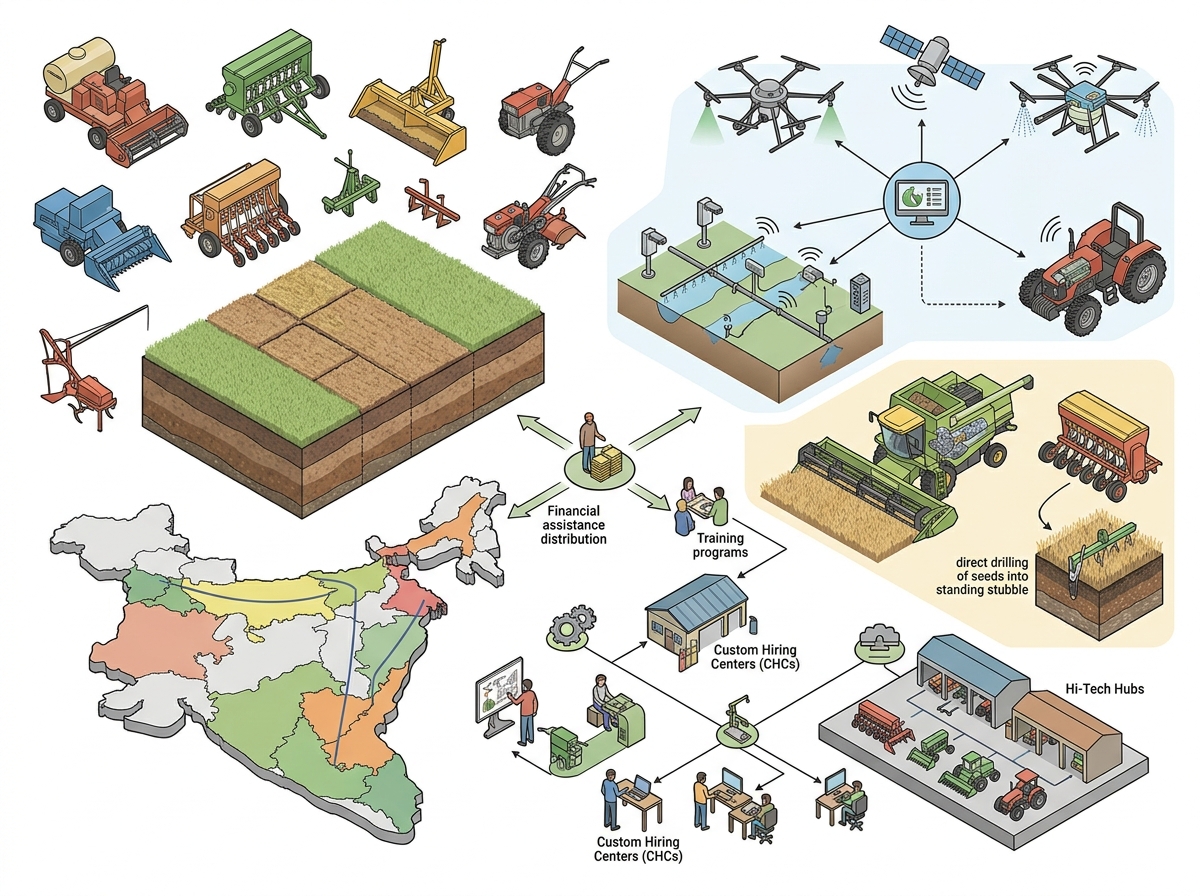
Financial incentivesAdvanced technologiesInstitutional mechanismsCrop residue managementFarm efficiency tools✎ The Sub-Mission on Agricultural Mechanisation (SMAM), implemented under RKVY, provides financial assistance (40–50% subsidy) for machinery purchase, 40% subsidy for CHCs (up to ₹2.5 million), and 80–95% subsidy for FMBs to…
Subject Relevance — Where This Topic Fits
- GS Paper III — Agriculture | GS Paper III — Science and Technology
- Prelims: Sub-Mission on Agricultural Mechanisation (SMAM), Custom Hiring Centres (CHC), Farm Machinery Banks (FMB), Agriculture Infrastructure Fund (AIF), ICAR’s All India Coordinated Research Projects (AICRP), Crop Residue Management (CRM) Scheme, National Agricultural Development Scheme (RKVY), Precision Agriculture, Agri-drones
- Essay: Technological transformation in Indian agriculture: Challenges and opportunities, Balancing productivity, equity, and sustainability in farm mechanisation
Quick Revision: The Sub-Mission on Agricultural Mechanisation (SMAM), implemented under RKVY, provides financial assistance (40–50% subsidy) for machinery purchase, 40% subsidy for CHCs (up to ₹2.5 million), and 80–95% subsidy for FMBs to enhance farm mechanisation, particularly for small and marginal farmers.
Why is this in the news?
The Union Minister of Agriculture and Farmers’ Welfare, in response to a parliamentary question on 11 August 2026, outlined the government’s ongoing initiatives under the Sub-Mission on Agricultural Mechanisation (SMAM) and related schemes to promote agricultural mechanisation in India. The response highlighted the integration of advanced technologies, financial incentives, and institutional mechanisms to enhance farm efficiency, reduce drudgery, and address environmental concerns such as crop residue burning. This underscores the evolving policy framework aimed at transforming Indian agriculture through mechanisation while ensuring inclusivity and sustainability.
Background
- Agricultural mechanisation is a critical lever for enhancing farm productivity, reducing labour intensity, and improving input-use efficiency in India, where small and marginal holdings dominate the agrarian landscape.
- India’s farm power availability (2.02 kW/ha in 2020) remains significantly lower than global averages (e.g., 4.0 kW/ha in China), necessitating targeted interventions to bridge the gap.
- Crop residue burning, particularly in Punjab, Haryana, and Uttar Pradesh, has been a major environmental and health concern, prompting the integration of the Crop Residue Management (CRM) Scheme under RKVY-SMAM to incentivise sustainable residue utilisation.
- The Agriculture Infrastructure Fund (AIF), launched in 2020, provides financial support for post-harvest infrastructure, including Custom Hiring Centres (CHC) and Farm Machinery Banks (FMB), to improve access to mechanisation services.
- The Indian Council of Agricultural Research (ICAR) serves as the apex body for agricultural research and development, including mechanisation, through a network of institutions and coordinated research projects.
What is the National Agricultural Mechanisation Policy and its institutional framework?
- The National Agricultural Mechanisation Policy is an overarching framework aimed at accelerating the adoption of modern farm machinery and technologies to enhance productivity, reduce drudgery, and improve sustainability in Indian agriculture.
- The policy is operationalised through the Sub-Mission on Agricultural Mechanisation (SMAM), a centrally sponsored scheme implemented by the Department of Agriculture and Farmers’ Welfare in collaboration with state governments under the National Agricultural Development Scheme (RKVY).
- SMAM’s primary objectives include increasing access to farm machinery for small and marginal farmers, promoting Custom Hiring Centres (CHC) to overcome high capital costs, and supporting the establishment of Farm Machinery Banks (FMB) to provide machinery on a rental basis.
- Financial assistance under SMAM is provided for the purchase of agricultural machinery (40–50% subsidy), establishment of CHCs (40% subsidy for projects up to ₹2.5 million), and FMBs (80% subsidy for projects up to ₹3 million; 95% for projects in the North-Eastern States).
- The scheme incentivises the adoption of advanced technologies such as precision agriculture tools, drones, and women-friendly farm equipment, alongside capacity-building initiatives including training, demonstrations, and certification of agricultural machinery.
- The Crop Residue Management (CRM) Scheme, now integrated with SMAM under RKVY, aims to reduce stubble burning by promoting residue utilisation through subsidised machinery, CHCs, and awareness campaigns, with a 60:40 funding ratio between the Centre and states.
- The Agriculture Infrastructure Fund (AIF) complements SMAM by providing interest subsidies, credit guarantees, and long-term financing for eligible agricultural infrastructure projects, including CHCs and FMBs.
- Research and development in agricultural mechanisation is coordinated by the Indian Council of Agricultural Research (ICAR).
Key Features
| Feature | Significance |
|---|---|
| Sub-Mission on Agricultural Mechanization (SMAM) | A centrally sponsored scheme under RKVY aimed at enhancing farm mechanization access for small and marginal farmers, particularly in regions with low farm power availability. |
| Custom Hiring Centres (CHCs) | Promotes shared use of high-cost agricultural machinery, mitigating adverse scale economies for small landholders through 40-50% financial assistance. |
| Agricultural Machinery Banks (AMBs) | Provides 80-95% financial support for establishing AMBs, enabling collective ownership and access to machinery for resource-constrained farmers. |
| Precision Agriculture & Drone Adoption | Encourages adoption of advanced technologies like drones and precision tools under SMAM to improve input efficiency and reduce drudgery. |
| Women-Friendly Agricultural Tools | Promotes gender-inclusive mechanization through subsidized procurement and training to reduce physical labor burden on women farmers. |
| Crop Residue Management (CRM) Scheme | Integrated with SMAM to promote sustainable residue management, reducing stubble burning through subsidized machinery and CHC establishment. |
Why it Matters
Economic
- Enhances farm productivity and input-use efficiency, reducing post-harvest losses and improving profitability for smallholders.
- Reduces drudgery and improves working conditions, particularly for women and marginal farmers, through mechanization of labor-intensive tasks.
- Stimulates demand for agricultural machinery, fostering growth in the rural machinery manufacturing and service sectors.
Social
- Improves livelihoods by reducing manual labor, especially in regions with labor shortages or high migration trends.
- Promotes gender equity by providing women-friendly tools and reducing gender disparities in agricultural operations.
- Enhances rural employment through the establishment of CHCs and AMBs, creating local service providers.
Environmental
- Reduces stubble burning and associated air pollution through mechanized residue management and CRM integration.
- Promotes precision agriculture, minimizing overuse of water, fertilizers, and pesticides, thus reducing environmental degradation.
- Encourages adoption of energy-efficient and low-emission machinery, contributing to sustainable agricultural practices.
Institutional
- Strengthens the agricultural machinery ecosystem by fostering public-private partnerships and skill development initiatives.
- Facilitates technology transfer and collaborative research through ICAR’s network of research institutions and global partnerships.
- Integrates multiple schemes (SMAM, CRM, MIDH) under RKVY, ensuring coherent policy implementation and resource allocation.
Challenges
1. High Capital Cost of Machinery
- Small and marginal farmers face affordability barriers due to high upfront costs of agricultural machinery.
- Limited access to formal credit for machinery purchase, despite subsidies and loan guarantees under AIF.
UPSC Link: Economics: Agricultural Finance
2. Fragmented Land Holdings
- Small and scattered land parcels reduce the economic viability of owning machinery individually.
- CHCs and AMBs mitigate this but require robust local governance and community participation for effectiveness.
UPSC Link: Geography: Land Reforms
3. Skill Gaps and Training Deficits
- Lack of technical skills among farmers and rural youth limits adoption of advanced machinery and precision tools.
- Inadequate training infrastructure and extension services hinder mechanization uptake in remote and tribal areas.
UPSC Link: Agriculture: Extension Services
4. Infrastructure and Logistics Bottlenecks
- Poor rural road connectivity and storage facilities impede the efficient movement and utilization of machinery.
- Limited availability of repair and maintenance services increases downtime and operational costs.
UPSC Link: Rural Development: Infrastructure
5. Environmental and Regulatory Constraints
- Stringent emission norms and safety regulations for machinery increase compliance costs for manufacturers and users.
- Balancing mechanization with ecological sustainability, particularly in ecologically fragile regions, poses policy challenges.
UPSC Link: Environment: Sustainable Agriculture
6. Digital Divide and Technology Adoption
- Limited internet connectivity and digital literacy in rural areas hinder the adoption of precision agriculture and IoT-enabled tools.
- High cost of advanced technologies like drones and AI-based solutions restricts their widespread use.
UPSC Link: Science & Tech: Digital Divide
Challenges — UPSC Perspective
| Issue | Concern |
|---|---|
| Affordability | High machinery costs deter small farmers despite subsidies; limited access to credit exacerbates the problem. |
| Land Fragmentation | Small, scattered holdings reduce the economic feasibility of individual machinery ownership. |
| Skill Deficits | Lack of technical training limits effective use of advanced machinery and precision tools. |
| Infrastructure Gaps | Poor rural connectivity and maintenance services increase operational costs and downtime. |
| Regulatory Hurdles | Compliance with emission and safety norms increases costs for farmers and manufacturers. |
| Technology Access | Digital divide and high costs limit adoption of precision agriculture and IoT-enabled tools. |
Government Initiatives — Must-Memorise for Prelims
- Sub-Mission on Agricultural Mechanization (SMAM)
- Crop Residue Management (CRM) Scheme
- Mission for Integrated Development of Horticulture (MIDH)
- Agriculture Infrastructure Fund (AIF)
- Rashtriya Krishi Vikas Yojana (RKVY)
Way Forward
- Strengthen the network of Custom Hiring Centres (CHCs) and Agricultural Machinery Banks (AMBs) with enhanced financial support and local governance mechanisms.
- Expand skill development programs through ICAR, agricultural universities, and vocational training institutes to bridge the technical skill gap.
- Improve rural infrastructure, including roads, storage facilities, and repair centers, to support efficient machinery deployment and maintenance.
- Promote public-private partnerships for technology transfer, collaborative research, and affordable financing options for farmers.
- Enhance extension services by leveraging digital platforms (e.g., Kisan Call Centers, mobile apps) to disseminate best practices and training.
- Encourage the development and adoption of low-cost, energy-efficient, and women-friendly agricultural machinery tailored to smallholders.
- Integrate climate-smart and precision agriculture technologies into SMAM to improve resource-use efficiency and reduce environmental impact.
- Establish a dedicated research and innovation fund under ICAR to accelerate indigenous machinery development and global best practice adoption.
UPSC Value Addition
Keywords for Mains Answer-Writing
Agricultural Mechanisation Sub-Mission · Custom Hiring Centres · Farm Machinery Bank · Precision Agriculture · Agriculture Infrastructure Fund · Crop Residue Management · Mission for Integrated Development of Horticulture · Indian Council of Agricultural Research · Sub-Mission on Agricultural Mechanisation · Sustainable Agriculture · Farm Power Availability · Women-friendly Agricultural Tools · Intelligent Agricultural Robots · Agricultural Research and Development · National Agricultural Development Scheme
Concept Flow
Declining farm labor availability and rising input costs → Need for mechanization to enhance productivity and reduce drudgery → Policy response: Sub-Mission on Agricultural Mechanization (SMAM) under RKVY → Implementation via CHCs, AMBs, and subsidies → Adoption of precision tools and women-friendly machinery → Improved farm efficiency, reduced stubble burning, and gender equity → Challenges: affordability, skill gaps, infrastructure gaps → Way forward: skill development, infrastructure, PPPs, and technology integration
Prelims Practice Questions
Q1. Consider the following statements regarding the Sub-Mission on Agricultural Mechanisation (SMAM):
1. SMAM is implemented under the Rashtriya Krishi Vikas Yojana (RKVY).
2. It provides financial assistance of up to 50% of the cost of agricultural machinery for small and marginal farmers.
3. The scheme supports the establishment of Custom Hiring Centres (CHCs) with project costs up to ₹250 lakh at 40% financial assistance.
4. Financial assistance for Farm Machinery Banks (FMBs) is capped at 80% of the project cost for projects up to ₹30 lakh.
How many of the above statements are correct?
- Only one
- Only two
- Only three
- All four
Answer: All four — Statements 1, 2, and 3 are correct. Statement 4 is incorrect as financial assistance for FMBs is 80% of the project cost for projects up to ₹30 lakh, and 95% for projects in the Northeastern states.
Q2. Assertion (A): The Crop Residue Management (CRM) scheme is implemented to reduce stubble burning in Punjab, Haryana, Uttar Pradesh, Madhya Pradesh, and the National Capital Region.
Reason (R): The CRM scheme integrates financial incentives, establishment of Custom Hiring Centres, and other measures to promote sustainable crop residue management.
In the context of the above two statements, which one of the following is correct?
- Both A and R are true, and R is the correct explanation of A.
- Both A and R are true, but R is not the correct explanation of A.
- A is true, but R is false.
- A is false, but R is true.
Answer: Both A and R are true, but R is not the correct explanation of A. — Both the Assertion (A) and Reason (R) are true, and the Reason (R) correctly explains the Assertion (A) as the CRM scheme directly targets stubble burning through financial incentives, CHCs, and other measures in the specified states.
Q3. Match the following schemes with their respective objectives:
Column I (Scheme) | Column II (Objective)
—————–|——————-
A. Sub-Mission on Agricultural Mechanisation (SMAM) | 1. Promotes precision agriculture, drones, and advanced machinery adoption
B. Mission for Integrated Development of Horticulture (MIDH) | 2. Provides interest subsidies and long-term financing for agricultural infrastructure
C. Agriculture Infrastructure Fund (AIF) | 3. Focuses on mechanisation in horticulture to reduce manual labour
D. Crop Residue Management (CRM) | 4. Enhances farm power availability and reduces stubble burning
Choose the correct match:
- A-1, B-3, C-2, D-4; A-4, B-1, C-3, D-2; A-2, B-4, C-1, D-3; A-3, B-2, C-4, D-1
- answer_string_map_indexes_to_letters_above
- answer_indexes_to_letters_above
Answer: ? — The correct matching is: A (SMAM) with 1 (promotes precision agriculture, drones, and advanced machinery), B (MIDH) with 3 (mechanisation in horticulture), C (AIF) with 2 (provides interest subsidies and long-term financing), and D (CRM) with 4 (enhances farm power availability and reduces stubble burning).
Mains Practice Question
✍ The Government of India has been progressively enhancing agricultural mechanisation through schemes such as the Sub-Mission on Agricultural Mechanisation (SMAM) and the Agriculture Infrastructure Fund (AIF). Critically examine the role of these schemes in addressing the challenges of small and marginal farmers, farm power scarcity, and sustainable agriculture. (15 Marks)
Approach: 1. **Introduction**: Define agricultural mechanisation and its significance for small and marginal farmers, highlighting issues like low farm power availability, high costs of machinery, and adverse economies of scale.
2. **SMAM’s Role**:
– **Financial Assistance**: Explain the 40-50% subsidy for machinery purchase, 40% support for CHCs (up to ₹250 lakh), and 80-95% for FMBs (up to ₹30 lakh), including NE states.
– **Technology Adoption**: Discuss promotion of precision agriculture, drones, and women-friendly tools under SMAM.
– **Capacity Building**: Highlight training, demonstration, and certification of agricultural machinery.
– **Limitations**: Critique the scheme’s reach, administrative delays, and challenges in technology adoption among small farmers.
3. **AIF’s Role**:
– **Infrastructure Financing**: Explain how AIF provides interest subsidies, credit guarantees, and long-term loans for eligible projects like CHCs and FMBs.
– **Sustainability Focus**: Discuss how AIF supports sustainable agriculture by enabling access to modern machinery and reducing manual labour.
– **Limitations**: Critique the scheme’s accessibility for marginal farmers due to stringent eligibility criteria and collateral requirements.
4. **Synergy and Gaps**:
– **Complementarity**: Explain how SMAM and AIF complement each other in addressing farm power scarcity and promoting sustainable practices.
– **Gaps**: Identify gaps such as inadequate awareness, high initial costs despite subsidies, and regional disparities in mechanisation.
5. **Conclusion**: Summarise the schemes’ contributions and propose measures like targeted awareness campaigns, simplified subsidy disbursement, and public-private partnerships to enhance their effectiveness.
Source: PIB (Press Information Bureau)
Generated by AanyaAi for educational purpose.

- KWML’s Feasibility Reports for Water Metro in 18 Cities: UPSC & PCS Insights - October 3, 2026
- ओडिशा में वन्यजीव अनुसंधान अनुदान कार्यक्रम शुरू, सिमिलिपाल में 300 कैमरे और बढ़ेंगे - October 3, 2026
- India Summons Pakistan High Commission Official Over Violation - October 3, 2026

No Comments