


11 Aug Nepal Parliament to Revisit Hindu Nation & Monarchy Debate: RPP’s Push
 Hindu stateMonarchyConstitutional identityReligious symbolism
✎ The 2015 Constitution of Nepal declares the state as secular (Article 4), making the restoration of a Hindu state contingent upon a constitutional amendment requiring a two-thirds majority in Parliament.
Subject Relevance — Where This Topic Fits
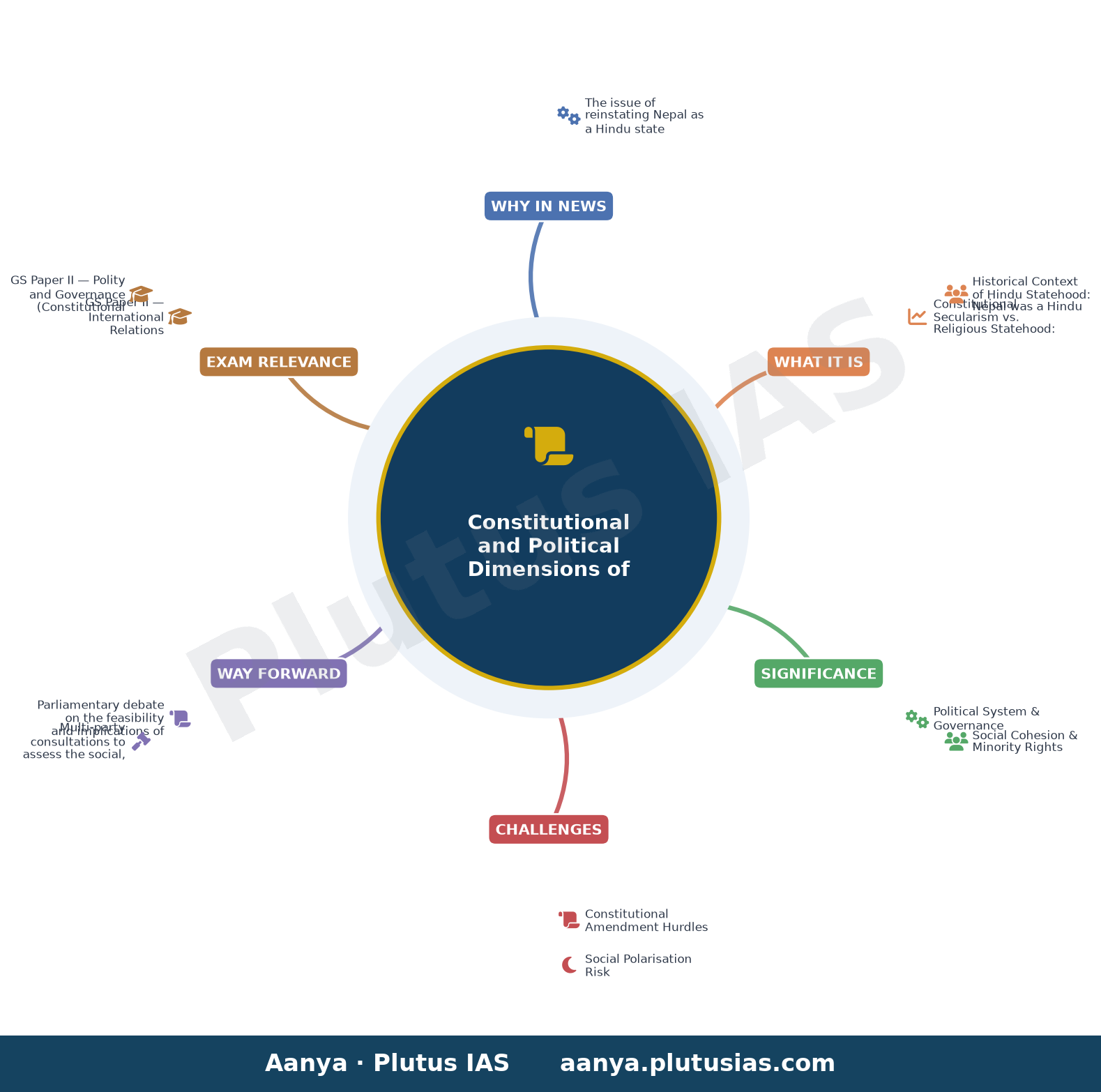
- GS Paper II — International Relations (India-Nepal relations, regional geopolitics) | GS Paper II — Polity and Governance (Constitutional provisions, secularism vs. religious state)
- Prelims: Nepal’s Constitution (2015), secularism, Article 4, Hindu state, monarchy, Rastriya Prajatantra Party (RPP), Rastriya Swatantra Party, 2008 abolition of monarchy, Nepal as Hindu state (pre-2008), Constituent Assembly of Nepal
- Essay: Religion and State: Balancing Identity, Pluralism, and Governance, Sovereignty and Constitutionalism: The Case of Nepal
Quick Revision: The 2015 Constitution of Nepal declares the state as secular (Article 4), making the restoration of a Hindu state contingent upon a constitutional amendment requiring a two-thirds majority in Parliament.
Why is this in the news?
The issue of reinstating Nepal as a Hindu state alongside the restoration of monarchy has resurfaced in the Nepalese Parliament, driven by the Rastriya Prajatantra Party (RPP). Following a 13-point dialogue in Janakpur involving the Home Minister and Hindu organisations, the RPP has intensified its campaign to place this demand on the legislative agenda, citing historical precedents and cultural identity as justification. This development reflects ongoing debates over Nepal’s constitutional identity post-2008 and the interplay between religious symbolism and state governance.
Background
- Nepal was the world’s only officially Hindu state from 1962 until 2008, when the monarchy was abolished and the country was declared a secular federal democratic republic.
- The Rastriya Prajatantra Party (RPP), a right-of-centre political party, has consistently advocated for the restoration of both constitutional monarchy and Hindu statehood as part of its core ideological platform.
- The 2015 Constitution of Nepal, adopted after prolonged political negotiations, enshrines secularism (Article 4) as a fundamental feature.
- The RPP has historically drawn support from segments of the population that associate Hindu identity with cultural continuity and national cohesion, particularly in regions with significant Hindu-majority demographics.
- Recent communal tensions in Nepal have reignited debates over religious identity, with some groups arguing that secularism has exacerbated social fragmentation and eroded traditional values.
- The demand for a Hindu state is framed not only as a religious issue but also as a question of national sovereignty, cultural preservation, and historical continuity.
What constitutes the debate over a Hindu state and monarchy in Nepal?
- Constitutional Secularism vs. Religious Statehood: The 2015 Constitution of Nepal explicitly declares the state as secular (Article 4). This provision is central to the current debate, as it legally separates religion from governance.
- Historical Context of Hindu Statehood: Nepal was a Hindu kingdom under the Shah dynasty, with the king as the protector of Hindu religion. The monarchy’s abolition in 2008 marked a paradigm shift toward republicanism and secularism.
- RPP’s Ideological Position: The Rastriya Prajatantra Party (RPP) represents a political faction that seeks to restore both the monarchy and Hindu statehood, arguing that these institutions provide cultural and moral continuity to the nation.
- Legal and Institutional Framework: Any amendment to the Constitution to reintroduce a Hindu state or monarchy would require a two-thirds majority in the federal Parliament, as per Article 274 of the Constitution.
- Cultural and Social Dimensions: Proponents of a Hindu state often cite Nepal’s deep-rooted Hindu traditions, festivals, and social structures as evidence of its historical and cultural identity, while opponents argue that secularism promotes inclusivity and religious freedom.
- Geopolitical Implications: The debate has implications for India-Nepal relations, given the shared cultural and religious heritage, and for regional stability, as Nepal’s constitutional identity may influence its foreign policy orientation.
- Political Mobilisation: The RPP’s renewed campaign, including parliamentary interventions and public mobilisation, reflects its strategy to leverage cultural sentiment to regain political relevance in Nepal’s evolving democratic landscape.
Key Features
| Feature | Significance |
|---|---|
| Revival of Hindu State Demand | Reintroduces a long-standing constitutional debate in Nepal, challenging the secular republican framework established in 2008. |
| Rastriya Prajatantra Party (RPP) Mobilisation | The party, advocating for constitutional monarchy and Hindu statehood, is accelerating efforts to raise the issue in Parliament. |
| Dialogue in Janakpur | A 13-point discussion between the Home Minister and Hindu organisations underscored the urgency of a parliamentary debate on Hindu statehood. |
| Historical Context of Nepal’s Hindu State | Nepal was the world’s only officially declared Hindu state until the abolition of monarchy in 2008, shaping its cultural and political identity. |
| Sectarian Tensions and Identity Politics | Recent communal violence has intensified demands for reasserting religious identity, linking it to broader governance and social cohesion debates. |
Why it Matters
Political System & Governance
- Represents a potential constitutional amendment to redefine Nepal’s secular status, requiring a two-thirds majority in Parliament.
- Highlights the tension between majoritarian religious identity and secular constitutionalism, a recurring theme in post-monarchy Nepal.
- RPP’s agenda reflects a broader ideological divide between traditionalist and progressive political forces in Nepal.
Social Cohesion & Minority Rights
- The debate risks exacerbating communal divisions, particularly concerning non-Hindu communities such as Buddhists, Muslims, and indigenous groups.
- Underscores the challenge of balancing majority religious sentiment with constitutional protections for minority rights under international law.
Constitutional Framework & Legal Process
- Any move to restore Hindu statehood would require amending the 2015 Constitution, which explicitly declares Nepal a secular republic.
- The process involves multi-party consensus, public consultation, and adherence to constitutional amendment procedures.
Regional Implications
- India-Nepal relations could be influenced by domestic political developments in Nepal, particularly given cultural and religious ties.
- Potential shifts in Nepal’s foreign policy alignment if religious identity becomes a central governance principle.
Challenges
1. Constitutional Amendment Hurdles
- Requires a two-thirds majority in Parliament, making consensus-building across political parties a critical challenge.
- Public opinion remains divided, with secular and minority groups opposing the restoration of Hindu statehood.
UPSC Link: Constitutional amendment process (Article 274)
2. Social Polarisation Risk
- The issue could deepen communal tensions, particularly in regions with significant non-Hindu populations.
- Historical precedents of sectarian violence in Nepal highlight the potential for escalation.
UPSC Link: Communal harmony and secularism
3. Political Fragmentation
- RPP’s demand faces opposition from secular parties, including the Nepali Congress and Maoist Centre, complicating legislative progress.
- Internal divisions within RPP over strategy and priorities may weaken its advocacy.
UPSC Link: Multi-party democracy in Nepal
4. Legal and International Implications
- Restoring Hindu statehood may conflict with Nepal’s obligations under international human rights treaties, including the ICCPR.
- Potential scrutiny from global human rights bodies and regional organisations.
UPSC Link: Secularism and international law
Challenges — UPSC Perspective
| Issue | Concern |
|---|---|
| Constitutional Amendment | Achieving the required two-thirds majority in Parliament is uncertain due to political fragmentation. |
| Social Cohesion | The debate risks exacerbating communal divisions, particularly for non-Hindu minorities. |
| Legal Compliance | Restoring Hindu statehood may conflict with Nepal’s secular constitutional framework and international obligations. |
| Political Consensus | Secular parties and minority groups oppose the move, making consensus-building difficult. |
| Public Sentiment | Divided public opinion could lead to protests, polarisation, or political instability. |
Way Forward
- Parliamentary debate on the feasibility and implications of restoring Hindu statehood, ensuring adherence to constitutional amendment procedures.
- Multi-party consultations to assess the social, legal, and political ramifications of the proposal.
- Public awareness campaigns to foster informed discourse on secularism, religious identity, and minority rights.
- Strengthening institutional mechanisms to protect minority rights and prevent communal violence.
- Engagement with civil society and religious leaders to mediate between competing identity-based demands.
- Review of Nepal’s constitutional framework to ensure alignment with international human rights standards.
- Diplomatic dialogue with regional partners to address potential spillover effects on regional stability.
UPSC Value Addition
Keywords for Mains Answer-Writing
Nepalese Constitution · Hindu Rashtra · Secularism in Nepal · Monarchy in Nepal · National Proletarian Party (Rashtriya Prajatantra Party) · Nepalese Parliament · Nepalese Constitutional Framework · Religious Identity and State · Nepalese Political Parties · Nepalese Governance Structure
Constitutional & Policy Linkages
- Article 4: Sovereignty and secular republic declaration
- Article 274: Constitutional amendment process
- Article 26: Freedom of religion and cultural practices
Concept Flow
Abolition of monarchy in 2008 → Nepal declared a secular republic → Cultural and religious identity debates resurface → Recent communal violence → Political mobilisation by RPP → Demand for restoration of Hindu statehood → RPP’s advocacy → Parliamentary debate initiation → Constitutional amendment proposal → Potential amendment → Two-thirds majority requirement → Political consensus challenge → Restoration of Hindu statehood → Legal and international compliance scrutiny → Social cohesion risks → Implementation → Impact on minority rights → Regional and bilateral relations implications
Prelims Practice Questions
Q1. Consider the following statements regarding Nepal’s constitutional framework:
1. Nepal was declared a Hindu Rashtra (Hindu Nation) in its 2015 Constitution.
2. The 2015 Constitution of Nepal explicitly abolished the monarchy.
3. Nepal transitioned from a Hindu Rashtra to a secular republic in 2008.
How many of the above statements are correct?
- Only one
- Only two
- All three
- None
Answer: Only two — Statement 1 is incorrect because the 2015 Constitution declares Nepal a secular state, not a Hindu Rashtra. Statement 2 is correct as the 2015 Constitution abolished the monarchy. Statement 3 is correct as Nepal transitioned from a Hindu Rashtra to a secular republic in 2008.
Q2. Assertion (A): The National Proletarian Party (Rashtriya Prajatantra Party) in Nepal advocates for the restoration of monarchy and the establishment of a Hindu Rashtra.
Reason (R): The party’s ideological stance is rooted in the preservation of Nepal’s religious and cultural identity as a Hindu nation.
In the context of the above statements, which of the following is correct?
- Both A and R are true, and R is the correct explanation of A.
- Both A and R are true, but R is not the correct explanation of A.
- A is true, but R is false.
- A is false, but R is true.
Answer: Both A and R are true, and R is the correct explanation of A. — Both Assertion (A) and Reason (R) are true. The Rashtriya Prajatantra Party (RPP) has historically advocated for the restoration of monarchy and the establishment of a Hindu Rashtra, viewing it as a means to preserve Nepal’s religious and cultural identity.
Q3. Match the following political developments in Nepal with their respective years:
Column I (Development) | Column II (Year)
1. Nepal declared a Hindu Rashtra | A. 2008
2. Nepal adopted a new secular Constitution | B. 2015
3. Abolition of monarchy in Nepal | C. 1962
Select the correct match:
- 1-A, 2-B, 3-C
- 1-C, 2-B, 3-A
- 1-B, 2-A, 3-C
- 1-C, 2-A, 3-B
Answer: 1-C, 2-B, 3-A — Nepal was declared a Hindu Rashtra in 1962 under the Panchayat system. The monarchy was abolished in 2008, and a new secular Constitution was adopted in 2015.
Mains Practice Question
✍ Critically examine the constitutional and political implications of the debate surrounding the restoration of monarchy and the establishment of a Hindu Rashtra in Nepal. In your answer, discuss the provisions of the 2015 Constitution of Nepal and the role of political parties in shaping this discourse. (15 Marks)
Approach: MODEL-ANSWER SKELETON:
1. **Constitutional Provisions**:
– Article 4 of the 2015 Constitution declares Nepal a ‘secular federal democratic republic,’ explicitly ending the previous status as the world’s only Hindu Rashtra.
– Article 269(1) abolishes the monarchy, transferring sovereign powers to the people.
– The Constitution guarantees freedom of religion under Article 26, prohibiting discrimination based on religious grounds.
2. **Political and Ideological Context**:
– The Rashtriya Prajatantra Party (RPP) and allied groups argue that Nepal’s Hindu identity and monarchy are integral to its cultural sovereignty and social cohesion.
– Critics, including secular and progressive factions, contend that such demands undermine Nepal’s constitutional secularism and risk exacerbating communal tensions.
3. **Legal and Governance Implications**:
– Restoring monarchy would require a constitutional amendment, which necessitates a two-thirds majority in Parliament—a significant political hurdle.
– The debate reflects broader tensions between traditional identity and modern constitutionalism, particularly in post-conflict Nepal.
4. **Comparative Perspective**:
– Contrast Nepal’s secularism with India’s constitutional secularism (Articles 25-28), where the state maintains equidistance from all religions while protecting religious freedoms.
5. **Conclusion**:
– The debate underscores the challenges of reconciling identity politics with constitutional democracy, emphasizing the need for inclusive dialogue to preserve Nepal’s pluralistic fabric.
Source: amarujala.com
Generated by AanyaAi for educational purpose.

- KWML’s Feasibility Reports for Water Metro in 18 Cities: UPSC & PCS Insights - October 3, 2026
- ओडिशा में वन्यजीव अनुसंधान अनुदान कार्यक्रम शुरू, सिमिलिपाल में 300 कैमरे और बढ़ेंगे - October 3, 2026
- India Summons Pakistan High Commission Official Over Violation - October 3, 2026

No Comments