


08 Aug New Motor Vehicle Aggregator Policy: Key Features for UPSC & State PCS
✎ The Motor Vehicle Aggregator Policy 2026 mandates aggregators to ensure passenger safety, fare transparency, and environmental sustainability through mandatory permits, fare regulations, and digital monitoring, while addressing…
Subject Relevance — Where This Topic Fits
- GS Paper II — Governance, Transparency and Accountability | GS Paper III — Infrastructure, Transport and Logistics, Environmental Pollution and Degradation
- Prelims: Motor Vehicle Aggregator Policy 2026, Digital Monitoring of Transport Services, Fare Transparency Mechanisms, Electric Vehicle Promotion in Aggregator Services, Permit and Insurance Compliance for Aggregators, Women’s Safety in Public Transport, Grievance Redressal in Digital Platforms
- Essay: The Role of Technology in Enhancing Public Safety and Governance: Lessons from India’s Transport Sector Reforms, Sustainability and Equity in Urban Mobility: Balancing Economic Growth with Environmental and Social Justice
Quick Revision: The Motor Vehicle Aggregator Policy 2026 mandates aggregators to ensure passenger safety, fare transparency, and environmental sustainability through mandatory permits, fare regulations, and digital monitoring, while addressing driver welfare via standardized contracts and social security provisions.
Why is this in the news?
The Union Minister for Road Transport and Highways, Shri Ponnam Prabhakar, announced on August 6, 2026, the imminent rollout of a comprehensive Motor Vehicle Aggregator Policy aimed at regulating app-based transport services. This policy emerges from extensive stakeholder consultations and seeks to address critical gaps in passenger safety, driver welfare, fare transparency, and environmental sustainability within India’s rapidly expanding digital mobility sector. The initiative reflects a proactive approach to integrating technological innovation with regulatory oversight, ensuring that the benefits of digital transport are equitably distributed while mitigating associated risks.
Background
- India’s digital transport ecosystem has witnessed exponential growth with the proliferation of app-based aggregators such as Uber, Ola, and Rapido, which now serve millions of users daily across urban and semi-urban areas.
- The absence of a unified regulatory framework for aggregators has led to inconsistencies in safety standards, fare structures, and driver welfare across states, creating challenges for both passengers and platform operators.
- The Motor Vehicles (Amendment) Act, 2019, introduced provisions for aggregators under Section 93, mandating state governments to regulate them through permits and compliance mechanisms, but implementation has been fragmented.
- The COVID-19 pandemic highlighted vulnerabilities in the sector, including inadequate safety protocols for women passengers and insufficient grievance redressal mechanisms, necessitating a robust policy response.
- Global precedents, such as the European Union’s Regulation (EU) 2018/1139 on ground-handling and transport services, and Singapore’s Private Hire Car Driver’s Vocational Licence, provide comparative frameworks for regulating digital transport platforms.
What is the Motor Vehicle Aggregator Policy 2026?
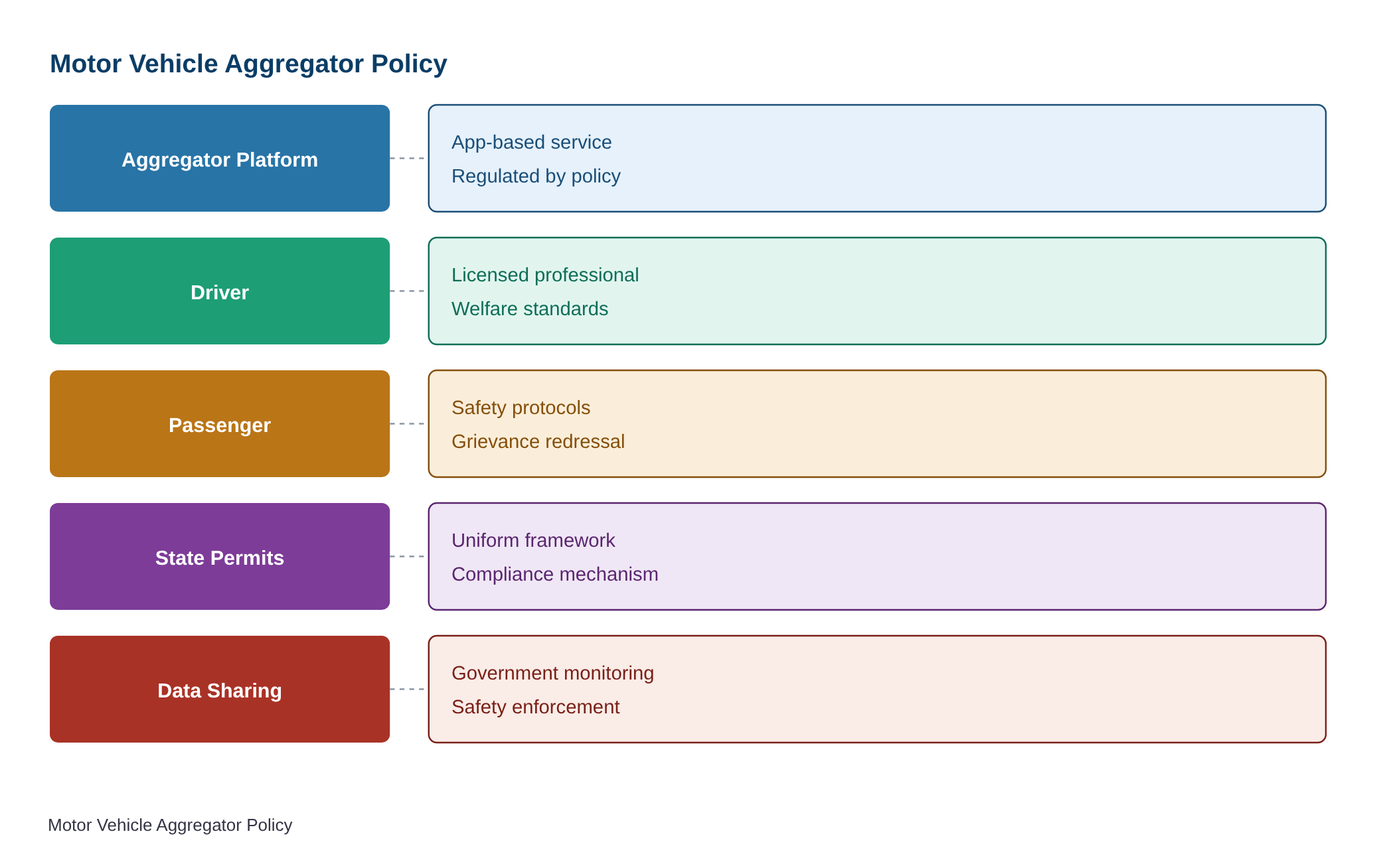
- A comprehensive regulatory framework designed to govern app-based transport aggregators, ensuring passenger safety, fare transparency, and environmental sustainability through mandatory compliance mechanisms.
- The policy mandates aggregators to register with state transport authorities and obtain permits, thereby formalising their operations and subjecting them to regulatory oversight.
- Fare transparency is enforced through dynamic pricing regulations, mandatory display of fare structures, and real-time fare calculation tools to prevent surge pricing exploitation and ensure fairness for passengers.
- Passenger safety is prioritised through stringent vehicle fitness norms, mandatory insurance coverage for drivers and vehicles, and the implementation of women-specific safety protocols, including panic buttons and real-time tracking.
- Driver welfare is addressed via standardized contracts, fair commission structures, grievance redressal mechanisms, and provisions for social security benefits, including health insurance and provident fund contributions.
- The policy promotes the integration of electric and hybrid vehicles into aggregator fleets by offering incentives such as reduced permit fees, priority access to charging infrastructure, and tax benefits for operators transitioning to green mobility.
- Digital monitoring and data-sharing protocols are established to enable real-time tracking of aggregator operations, ensuring compliance with safety and environmental standards while facilitating evidence-based policymaking.
- The policy includes provisions for the phased introduction of a national aggregator registry, enabling seamless inter-state operations and reducing regulatory arbitrage while maintaining state-specific autonomy in enforcement.
Key Features
| Feature | Significance |
|---|---|
| Passenger safety and security protocols | Mandates real-time tracking, emergency response systems, and background verification of drivers to mitigate risks of harassment, assault, or accidents. |
| Driver welfare measures | Includes provisions for fair wage structures, insurance coverage, and grievance redressal mechanisms to address exploitation and improve livelihood conditions. |
| Fare transparency mechanisms | Requires aggregators to display dynamic pricing, base fares, and additional charges upfront to prevent surge pricing abuses and ensure consumer trust. |
| Vehicle fitness and permit compliance | Enforces mandatory periodic inspections, valid permits, and insurance coverage for all vehicles registered with aggregators to ensure roadworthiness. |
| Environmental sustainability incentives | Promotes adoption of electric and hybrid vehicles through subsidies, preferential permits, or tax benefits to reduce carbon emissions. |
Why it Matters
Economic
- Enhances consumer confidence in app-based mobility services, potentially increasing market penetration and revenue for aggregators.
- Standardises fare structures, reducing price volatility and fostering fair competition among aggregators.
- Encourages investment in green mobility solutions, aligning with India’s climate commitments and reducing long-term fuel import dependency.
Regulatory
- Establishes a uniform regulatory framework for aggregators, addressing the current patchwork of state-level policies and reducing compliance burdens.
- Strengthens data-sharing protocols between aggregators and government agencies to improve monitoring and enforcement of safety norms.
- Creates a precedent for regulating gig-economy platforms, setting a model for future labour and consumer protection policies.
Social
- Prioritises safety for women passengers, a critical concern in urban mobility, through mandatory driver verification and real-time monitoring.
- Improves driver livelihoods by addressing wage disparities and providing social security benefits, reducing exploitation in the gig economy.
- Enhances transparency in fare structures, reducing disputes and building trust between service providers and consumers.
Challenges
1. Implementation and Enforcement
- Risk of regulatory arbitrage where aggregators bypass state-specific rules by operating in less stringent jurisdictions.
- High compliance costs for aggregators, particularly small and medium enterprises, may deter market entry or force consolidation.
- Need for robust digital infrastructure to support real-time monitoring, data sharing, and grievance redressal systems.
UPSC Link: GS-II: Regulatory bodies and challenges
2. Driver Welfare and Labour Rights
- Aggregators may resist wage standardisation or social security contributions, citing operational flexibility as a competitive advantage.
- Unionisation of gig workers could lead to industrial disputes, disrupting service continuity and increasing costs for aggregators.
- Ensuring fair remuneration without compromising affordability for consumers remains a delicate balance.
UPSC Link: GS-II: Labour reforms and gig economy
3. Technology and Data Governance
- Aggregators may resist sharing proprietary data with government agencies, citing competitive sensitivity or privacy concerns.
- Cybersecurity risks associated with real-time tracking and data sharing could expose vulnerabilities to hacking or misuse.
- Interoperability challenges between aggregator platforms and government databases may hinder seamless implementation.
UPSC Link: GS-III: Digital infrastructure and cybersecurity
4. Environmental Sustainability
- High upfront costs for aggregators to transition to electric fleets may deter adoption without sufficient financial incentives.
- Limited charging infrastructure in urban and rural areas could constrain the expansion of electric vehicle services.
- Balancing environmental goals with affordability for consumers remains a key challenge.
UPSC Link: GS-III: Environmental governance and climate change
Challenges — UPSC Perspective
| Issue | Concern |
|---|---|
| Regulatory fragmentation | Inconsistent state-level policies may create loopholes or compliance burdens for aggregators. |
| Driver exploitation | Lack of standardised wages and social security may perpetuate precarious working conditions. |
| Data privacy and security | Aggregators may resist sharing data due to concerns over misuse or competitive disadvantage. |
| Infrastructure gaps | Inadequate charging stations and digital networks may hinder the adoption of sustainable mobility solutions. |
| Consumer affordability | Higher operational costs from compliance and sustainability measures may lead to increased fares. |
Way Forward
- Constitute a national-level nodal agency to oversee policy implementation and resolve inter-state coordination issues.
- Develop a phased transition plan for aggregators to adopt electric vehicles, including subsidies and tax incentives.
- Establish a grievance redressal portal with multi-channel access (app, call centre, in-person) for passengers and drivers.
- Mandate real-time GPS tracking and panic buttons in all vehicles registered with aggregators, with penalties for non-compliance.
- Conduct periodic audits of aggregator platforms to ensure adherence to fare transparency, driver welfare, and safety norms.
- Launch public awareness campaigns to educate passengers on their rights and the benefits of regulated aggregator services.
- Collaborate with state transport departments to harmonise permit and registration processes for aggregator vehicles.
- Promote public-private partnerships to expand charging infrastructure and digital monitoring systems.
UPSC Value Addition
Keywords for Mains Answer-Writing
Motor Vehicle Aggregator Policy · app-based transport services · passenger safety and security · fare transparency · grievance redressal mechanisms · electric and sustainable mobility · regulatory mechanisms for aggregators · digital monitoring of transport services · permit and insurance compliance · Stakeholder consultations in policy formulation · Ministry of Road Transport and Highways · environmental sustainability in transport · driver welfare in gig economy · data sharing between aggregators and government · women’s safety in public transport
Concept Flow
Increased urbanisation and demand for app-based mobility → Rise of unregulated aggregator services → Passenger safety incidents and driver exploitation → Government constitutes a committee to study regulatory gaps → Policy draft mandates safety, transparency, and welfare measures → Aggregators adapt to compliance requirements → Improved passenger trust and driver livelihoods → Enhanced urban mobility ecosystem.
Prelims Practice Questions
Q1. Consider the following statements regarding the newly proposed Motor Vehicle Aggregator Policy in India:
1. The policy aims to mandate fare transparency for app-based transport aggregators.
2. It includes provisions for the welfare of drivers associated with aggregator platforms.
3. The policy proposes a complete ban on non-electric vehicles by 2026.
4. Digital monitoring of transport services is envisaged under the policy.
How many of the above statements are correct?
- Only one
- Only two
- Only three
- All four
Answer: Only three — Statements 1, 2, and 4 are correct as per the policy’s stated objectives. Statement 3 is incorrect; the policy promotes electric and environmentally sustainable vehicles but does not propose a complete ban on non-electric vehicles.
Q2. Assertion (A): The Motor Vehicle Aggregator Policy seeks to enhance passenger safety through mandatory insurance and vehicle fitness checks.
Reason (R): The policy includes provisions for the welfare of drivers and digital monitoring of transport services.
In the context of the above two statements, which one of the following is correct?
- Both A and R are true, and R is the correct explanation of A
- Both A and R are true, but R is not the correct explanation of A
- A is true but R is false
- A is false but R is true
Answer: A is true but R is false — Assertion (A) is true as the policy addresses passenger safety through insurance and vehicle fitness checks. Reason (R) is also true but does not directly explain the assertion, as it pertains to driver welfare and digital monitoring rather than passenger safety.
Q3. Match the following provisions of the Motor Vehicle Aggregator Policy with their respective objectives:
Column I (Provision)
A. Fare transparency
B. Grievance redressal systems
C. Promotion of electric vehicles
D. Data sharing with government departments
Column II (Objective)
1. Enhancing passenger safety and security
2. Ensuring regulatory compliance and transparency
3. Promoting environmental sustainability
4. Facilitating efficient governance and monitoring
Select the correct match:
- A-2, B-1, C-3, D-4
- A-1, B-2, C-3, D-4
- A-3, B-4, C-1, D-2
- A-4, B-3, C-2, D-1
Answer: A-2, B-1, C-3, D-4 — The correct matches are: A (Fare transparency) with 2 (Ensuring regulatory compliance and transparency), B (Grievance redressal systems) with 1 (Enhancing passenger safety and security), C (Promotion of electric vehicles) with 3 (Promoting environmental sustainability), and D (Data sharing with government departments) with 4 (Facilitating efficient governance and monitoring).
Mains Practice Question
✍ The Motor Vehicle Aggregator Policy represents a paradigm shift in the regulation of app-based transport services in India. Critically analyse the policy’s provisions for enhancing passenger safety, fare transparency, and environmental sustainability. Also, examine the challenges in its implementation, particularly in ensuring driver welfare and data-sharing compliance with government departments. (15 Marks)
Approach: MODEL-ANSWER SKELETON:
1. **Introduction (2 Marks)**
– Contextualise the rise of app-based transport services and the need for regulation.
– Briefly outline the objectives of the Motor Vehicle Aggregator Policy as stated by the Ministry of Road Transport and Highways.
2. **Passenger Safety and Fare Transparency (4 Marks)**
– **Passenger Safety**: Discuss provisions such as mandatory vehicle fitness checks, insurance requirements, and grievance redressal mechanisms.
– **Fare Transparency**: Explain how the policy mandates transparent fare structures and real-time tracking to prevent overcharging.
– **Women’s Safety**: Highlight measures like emergency buttons and driver verification systems.
3. **Environmental Sustainability (3 Marks)**
– Analyse the policy’s push for electric and environmentally sustainable vehicles, including incentives or mandates.
– Discuss the role of aggregators in promoting shared mobility and reducing carbon footprints.
4. **Driver Welfare and Data Sharing (4 Marks)**
– **Driver Welfare**: Evaluate provisions for fair wages, social security, and dispute resolution mechanisms for drivers.
– **Data Sharing**: Examine the challenges in ensuring seamless data sharing between aggregators and government departments, including privacy concerns and technological barriers.
5. **Challenges in Implementation (2 Marks)**
– Discuss potential hurdles such as resistance from aggregators, lack of uniform enforcement across states, and the need for inter-ministerial coordination.
6. **Conclusion (2 Marks)**
– Summarise the policy’s significance in balancing innovation with regulation.
– Offer a balanced view on its potential impact on passengers, drivers, and the environment.
Source: The Hindu
Generated by AanyaAi for educational purpose.

- KWML’s Feasibility Reports for Water Metro in 18 Cities: UPSC & PCS Insights - October 3, 2026
- ओडिशा में वन्यजीव अनुसंधान अनुदान कार्यक्रम शुरू, सिमिलिपाल में 300 कैमरे और बढ़ेंगे - October 3, 2026
- India Summons Pakistan High Commission Official Over Violation - October 3, 2026

No Comments