


16 Sep NGT Directs Strict Silence Zone Compliance in Pune & Pimpri-Chinchwad
✎ The Noise Pollution (Regulation and Control) Rules, 2000, framed under the Environment (Protection) Act, 1986, regulate noise levels in silence zones and prohibit the use of loudspeakers or public address systems without prior…
Subject Relevance — Where This Topic Fits
- GS Paper II — Governance, Constitution, Polity, Social Justice and International Relations (Environmental Governance)
- Prelims: Noise Pollution (Regulation and Control) Rules, 2000, National Green Tribunal (NGT), Silence Zones, Environmental Protection Act, 1986, Constitution of India (Article 48A, Directive Principles of State Policy), Public Nuisance, Environmental Impact Assessment, Polluter Pays Principle
- Essay: Environmental governance and judicial activism in India, Balancing development and environmental protection: The role of institutions
Quick Revision: The Noise Pollution (Regulation and Control) Rules, 2000, framed under the Environment (Protection) Act, 1986, regulate noise levels in silence zones and prohibit the use of loudspeakers or public address systems without prior permission, with violations punishable under the Act.
Why is this in the news?
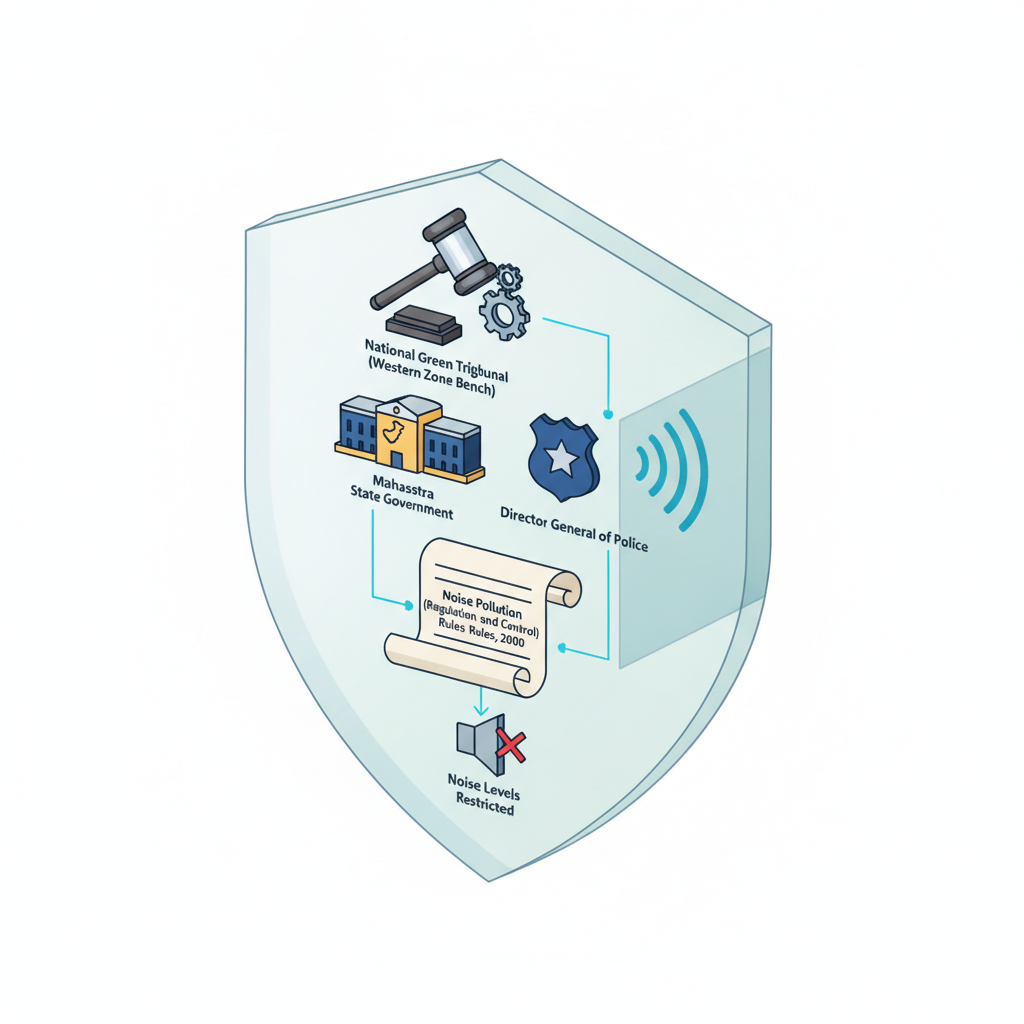
The National Green Tribunal (Western Zone Bench) has recently directed the Maharashtra State Government and the Director General of Police to strictly enforce the Noise Pollution (Regulation and Control) Rules, 2000 in silence zones of Pune and Pimpri-Chinchwad. This directive follows a petition highlighting persistent violations of noise pollution norms in designated silence areas, underscoring the challenges in implementing environmental regulations despite existing legal frameworks.
Background
- The Noise Pollution (Regulation and Control) Rules, 2000 were notified under the Environment (Protection) Act, 1986 to regulate and control noise levels in various zones, including silence zones.
- Silence zones are areas declared by competent authorities where noise levels are restricted to minimise disturbance to public peace and tranquillity, such as residential areas, hospitals, educational institutions, and religious places.
- The National Green Tribunal (NGT), established in 2010 under the National Green Tribunal Act, 2010, is a specialised judicial body for the effective and expeditious disposal of cases relating to environmental protection and conservation of forests.
- The NGT has repeatedly emphasised the importance of strict adherence to noise pollution norms, particularly in urban areas with high population density and competing land-use demands.
- The Constitution of India, through Article 48A and the Directive Principles of State Policy (Part IV), imposes a duty on the State to protect and improve the environment.
- Urbanisation and commercialisation have led to an increase in noise pollution, necessitating robust enforcement mechanisms to safeguard public health and well-being.
What are Noise Pollution (Regulation and Control) Rules, 2000?
- The Rules were framed under the Environment (Protection) Act, 1986, to regulate noise levels in different zones across India.
- The Rules prohibit the use of loudspeakers or public address systems in silence zones, except with prior written permission from the competent authority.
- Violations of the Rules are punishable with penalties, including fines and imprisonment, under the Environment (Protection) Act, 1986.
- The Rules empower State Pollution Control Boards (SPCBs) and local authorities to monitor and enforce noise pollution norms.
- The NGT has the jurisdiction to hear appeals against orders passed by SPCBs or other authorities under the Rules.
- The Rules also mandate the use of sound-absorbing materials in construction and the adoption of noise-reduction technologies in industrial and commercial establishments.
- The Rules apply uniformly across India, with specific provisions for metropolitan cities and other urban areas.
Key Features
| Feature | Significance |
|---|---|
| Noise Pollution (Regulation and Control) Rules, 2000 | Establishes legal framework for regulating noise levels in designated zones, including silence zones, to protect public health and environmental tranquillity. |
| Silence Zones | Geographically demarcated areas where noise levels are strictly regulated to ensure minimal disturbance, typically around hospitals, educational institutions, and religious places. |
| National Green Tribunal (NGT) | Specialised judicial body with jurisdiction over environmental disputes, empowered to enforce environmental laws and issue binding directives to government agencies. |
| Director General of Police (DGP) | Chief law enforcement officer responsible for implementing noise pollution regulations through police enforcement and record-keeping of violations. |
| Record Maintenance and Reporting | Mandatory documentation of enforcement actions under the Noise Pollution Rules, ensuring transparency and accountability in compliance monitoring. |
Why it Matters
Environmental Protection
- Ensures compliance with statutory noise limits in silence zones, thereby safeguarding public health from adverse effects of excessive noise pollution such as stress, sleep disturbance, and cognitive impairment in vulnerable populations.
- Demonstrates the role of judicial oversight in environmental governance, reinforcing the principle of ‘polluter pays’ and the precautionary approach in environmental law.
- Highlights the intersection of environmental justice and urban governance, particularly in rapidly urbanising cities like Pune and Pimpri-Chinchwad.
Public Health and Well-being
- Noise pollution is recognised by the World Health Organization (WHO) as a significant environmental health risk, with chronic exposure linked to cardiovascular diseases and mental health disorders.
- Strict enforcement in silence zones protects the well-being of patients in hospitals, students in educational institutions, and residents in sensitive areas from avoidable noise-induced disturbances.
- Aligns with the constitutional directive under Article 48A to protect and improve the environment, read with Article 21 (right to life and personal liberty) as interpreted by the Supreme Court.
Institutional Role of NGT
- Reaffirms the NGT’s constitutional mandate under the National Green Tribunal Act, 2010, to adjudicate environmental disputes and enforce environmental laws through suo motu or citizen-initiated petitions.
- Demonstrates the NGT’s proactive stance in environmental governance, issuing directives to executive authorities for strict compliance with statutory provisions.
- Sets a precedent for judicial intervention in environmental enforcement, particularly where executive agencies may lack capacity or political will for stringent implementation.
Urban Governance and Compliance
- Exposes systemic gaps in urban governance, particularly in the enforcement of environmental regulations in rapidly expanding metropolitan regions.
- Underscores the need for inter-agency coordination between municipal bodies, police authorities, and pollution control boards to ensure holistic enforcement of noise pollution norms.
- Illustrates the challenges of balancing developmental pressures with environmental safeguards in urban planning and public space management.
Challenges
1. Enforcement Gaps in Urban Areas
- Persistent non-compliance with noise pollution norms in silence zones despite statutory provisions, indicating systemic weaknesses in monitoring and enforcement mechanisms.
- Lack of real-time noise monitoring infrastructure in Pune and Pimpri-Chinchwad, limiting the ability to detect and penalise violations promptly.
- Inadequate awareness among citizens, local authorities, and enforcement agencies regarding the legal provisions and penalties under the Noise Pollution Rules, 2000.
UPSC Link: GS-III: Environmental Pollution & Urban Governance
2. Inter-Agency Coordination Deficits
- Fragmented responsibility among municipal corporations, police departments, and pollution control boards, leading to dilution of enforcement efforts.
- Absence of a unified enforcement protocol for noise pollution, resulting in ad-hoc and inconsistent application of penalties across jurisdictions.
- Delays in inter-departmental communication and action, particularly in cases involving public events or religious activities, where enforcement is politically sensitive.
UPSC Link: GS-II: Centre-State Relations & Local Governance
3. Public Awareness and Behavioural Challenges
- Cultural and social norms that normalise loudspeaker use in public spaces, particularly during religious, cultural, or political events, creating resistance to enforcement.
- Limited public participation in reporting violations due to fear of retaliation or lack of trust in enforcement agencies.
- Inadequate dissemination of information regarding silence zones and permissible noise levels among citizens, leading to unintentional violations.
UPSC Link: GS-IV: Ethics in Governance & Public Participation
4. Technological and Resource Constraints
- Insufficient deployment of noise monitoring devices and sound level meters in silence zones, hindering accurate detection and measurement of violations.
- Limited financial and human resources allocated to pollution control boards and municipal bodies for sustained enforcement and awareness campaigns.
- Dependence on manual reporting and complaints, which is resource-intensive and prone to delays in action.
UPSC Link: GS-III: Science & Technology in Governance
5. Legal and Procedural Delays
- Lengthy legal processes for adjudicating noise pollution cases, leading to prolonged violations and erosion of public confidence in enforcement mechanisms.
- Ambiguities in the definition of ‘silence zones’ and ‘public address systems’, creating loopholes for exploitation by violators.
- Inconsistent application of penalties across states and jurisdictions, undermining the deterrent effect of the Noise Pollution Rules, 2000.
UPSC Link: GS-II: Judiciary & Legal Framework
Challenges — UPSC Perspective
| Issue | Concern |
|---|---|
| Non-compliance with Noise Pollution Rules | Systemic failure to enforce statutory noise limits in silence zones despite clear legal provisions. |
| Fragmented Enforcement | Lack of coordination among municipal, police, and pollution control authorities leading to diluted enforcement efforts. |
| Public Resistance to Enforcement | Cultural and social norms that normalise loudspeaker use, creating resistance to strict compliance with silence zone regulations. |
| Inadequate Monitoring Infrastructure | Absence of real-time noise monitoring systems in urban areas, limiting the ability to detect and penalise violations promptly. |
| Legal Ambiguities | Unclear definitions and procedural delays in adjudicating noise pollution cases, undermining enforcement effectiveness. |
| Resource Constraints | Limited financial and human resources allocated to pollution control boards and municipal bodies for sustained enforcement. |
Way Forward
- Establish a dedicated Noise Pollution Monitoring Cell in Pune and Pimpri-Chinchwad, equipped with real-time noise level meters and automated reporting systems to enhance enforcement efficiency.
- Conduct large-scale awareness campaigns in collaboration with civil society organisations to educate citizens, religious institutions, and event organisers about silence zones and permissible noise levels.
- Strengthen inter-agency coordination by formalising a protocol for joint inspections and enforcement actions between municipal corporations, police departments, and the Maharashtra Pollution Control Board (MPCB).
- Develop a graded penalty system for violations, with escalating fines for repeat offenders and mandatory community service for non-compliance, to enhance deterrence.
- Introduce mandatory noise impact assessments for public events and religious gatherings in silence zones, with prior approval from local authorities and the MPCB.
- Leverage technology by deploying mobile applications for citizens to report noise violations, coupled with a centralised grievance redressal system for prompt action.
- Conduct periodic audits of silence zones to redefine boundaries and ensure alignment with urban development plans and environmental sensitivities.
- Provide capacity-building programmes for enforcement officers, including training on legal provisions, use of monitoring equipment, and community engagement techniques.
UPSC Value Addition
Keywords for Mains Answer-Writing
Noise Pollution (Regulation and Control) Rules, 2000 · National Green Tribunal (NGT) · silence zones · loudspeaker regulation · environmental governance · Noise Pollution Act, 2002 · public nuisance · environmental justice · pollution control mechanisms · constitutional provisions for environment · judicial activism in environmental law · Maharashtra Pollution Control Board · right to clean environment · Article 21 · precautionary principle · polluter pays principle
Constitutional & Policy Linkages
- Article 48A (Directive Principles of State Policy) — Protection and improvement of environment and safeguarding of forests and wildlife
- Article 21 (Right to Life and Personal Liberty) — Interpreted to include the right to a healthy environment and freedom from noise pollution
Concept Flow
Urbanisation and developmental pressures → Increased noise pollution in silence zones → Public health risks and environmental degradation → Citizen petitions to NGT → Judicial intervention and directives for enforcement → Identification of systemic gaps in governance → Need for inter-agency coordination, technological solutions, and public awareness → Sustainable enforcement mechanisms → Long-term environmental protection and public well-being
Prelims Practice Questions
Q1. Consider the following statements regarding the Noise Pollution (Regulation and Control) Rules, 2000:
1. The Rules define ‘silence zones’ as areas within 100 meters of hospitals, educational institutions, and courts.
2. The Rules prohibit the use of loudspeakers or public address systems in silence zones between 10 PM and 6 AM.
3. The Rules are framed under the provisions of the Air (Prevention and Control of Pollution) Act, 1981.
How many of the above statements are correct?
- Only one
- Only two
- All three
- None
Answer: All three — Statements 1 and 2 are correct as per Rule 3 of the Noise Pollution (Regulation and Control) Rules, 2000. Statement 3 is incorrect; the Rules are framed under the Noise Pollution (Regulation and Control) Act, 2002, not the Air Act, 1981.
Q2. Assertion (A): The National Green Tribunal (NGT) has the power to issue directions for the enforcement of environmental laws, including noise pollution regulations.
Reason (R): The NGT was established under the National Green Tribunal Act, 2010, which empowers it to adjudicate matters related to environmental protection and conservation.
Options:
A. Both A and R are true, and R is the correct explanation of A.
B. Both A and R are true, but R is not the correct explanation of A.
C. A is true, but R is false.
D. A is false, but R is true.
Answer: ? — Both Assertion (A) and Reason (R) are true. The NGT, established under the National Green Tribunal Act, 2010, has the jurisdiction to enforce environmental laws, including noise pollution regulations, as evident in its directives to state authorities.
Q3. Match the following provisions of the Noise Pollution (Regulation and Control) Rules, 2000 with their corresponding descriptions:
Column I (Provision)
1. Rule 3
2. Rule 5
3. Rule 7
4. Rule 8
Column II (Description)
A. Definition of silence zones
B. Standards for ambient air quality in respect of noise
C. Prohibition of use of loudspeakers or public address systems in silence zones
D. Power of entry, inspection, and seizure by authorities
Answer: ? — 1-A, 2-B, 3-C, 4-D. The correct pairing aligns Rule 3 (definition of silence zones), Rule 5 (ambient air quality standards for noise), Rule 7 (prohibition of loudspeakers in silence zones), and Rule 8 (powers of authorities for enforcement).
Mains Practice Question
✍ The National Green Tribunal (NGT) has recently directed the State Government and the Director General of Police to strictly enforce the Noise Pollution (Regulation and Control) Rules, 2000 in silence zones of Pune and Pimpri-Chinchwad. Critically examine the legal and institutional framework governing noise pollution in India, with reference to the constitutional provisions, statutory rules, and judicial interventions. Also, analyse the challenges in effective implementation of these regulations. (15 Marks)
Approach: MODEL-ANSWER SKELETON:
1. **Constitutional Framework**:
– Article 21 (Right to Life and Personal Liberty) as interpreted by the Supreme Court in Subhash Kumar v. State of Bihar (1991) and subsequent judgments to include the right to a clean environment.
– Article 48A (Directive Principle of State Policy) and Article 51A(g) (Fundamental Duty) emphasizing environmental protection.
– The doctrine of ‘precautionary principle’ and ‘polluter pays principle’ as judicial innovations.
2. **Statutory Framework**:
– Noise Pollution (Regulation and Control) Act, 2002: Objective, scope, and key provisions.
– Noise Pollution (Regulation and Control) Rules, 2000: Definition of silence zones (Rule 3), ambient noise standards (Rule 5), prohibition of loudspeakers (Rule 7), and enforcement powers (Rule 8).
– Role of State Pollution Control Boards (SPCBs) and local authorities in monitoring and enforcement.
3. **Judicial Interventions**:
– NGT’s suo motu and petition-driven orders (e.g., recent directives to Pune and Pimpri-Chinchwad authorities).
– Supreme Court’s emphasis on the NGT’s role in environmental governance (e.g., in Vellore Citizens Welfare Forum v. Union of India, 1996).
– High Court directives in noise pollution cases (e.g., Delhi High Court’s orders on firecrackers).
4. **Challenges in Implementation**:
– **Institutional**: Lack of adequate manpower and resources with SPCBs and local authorities; overlapping jurisdictions.
– **Societal**: Public apathy, cultural practices (e.g., religious processions, festivals), and resistance to enforcement.
– **Legal**: Delayed adjudication, weak penalties, and lack of deterrent effect.
– **Technological**: Limited use of noise monitoring systems and real-time data collection.
– **Political**: Pressure from local bodies or influential groups to relax enforcement.
5. **Way Forward**:
– Strengthening institutional capacity (e.g., training, technology adoption).
– Public awareness campaigns and community participation.
– Strict adherence to NGT directives and suo motu monitoring.
– Harmonisation of state and central regulations for uniformity.
Balance of views: Highlight the judiciary’s proactive role (e.g., NGT directives) versus the executive’s sluggishness in implementation. Conclude with a balanced assessment of the framework’s strengths and weaknesses.
Source: The Indian Express
Maharashtra PCS (MPSC) — State PCS Practice
Prelims: As per the recent directive of the National Green Tribunal (NGT) regarding noise pollution in silence zones of Pune and Pimpri-Chinchwad, which authority has been specifically directed to ensure compliance with the order?
- A. Municipal Corporation of Greater Mumbai
- B. Maharashtra State Pollution Control Board (MPCB)
- C. Director General of Police (DGP), Maharashtra
- D. Pune Metropolitan Region Development Authority (PMRDA)
Answer: C. Director General of Police (DGP), Maharashtra — The NGT directed the Director General of Police (DGP), Maharashtra, to ensure strict compliance with noise pollution norms in silence zones of Pune and Pimpri-Chinchwad.
Mains: Discuss the significance of the National Green Tribunal’s (NGT) directive to the Maharashtra DGP regarding noise pollution control in silence zones of Pune and Pimpri-Chinchwad. Analyze the challenges in enforcement and suggest measures for effective implementation, with a focus on Maharashtra’s administrative and legal framework.
Generated by AanyaAi for educational purpose.
Related guides on our sites
- Current affairs for upsc 2026
- How to prepare for GS paper 1 for UPSC CSE mains exam
- Best UPSC coaching for IFOS exam
- Best geography optional coaching

- NGT Directs Strict Silence Zone Compliance in Pune & Pimpri-Chinchwad - September 16, 2026
- अमेरिकी संसद में रूस प्रतिबंध विधेयक: भारत पर 100% शुल्क लगाने का प्रस्ताव, जानिए पूरा मामला - September 16, 2026
- US House Advances Russia Sanctions Bill: 100% Tariffs on India Threatened - September 16, 2026

No Comments