


16 Sep US House Advances Russia Sanctions Bill: 100% Tariffs on India Threatened
✎ The Lindsey-Graham Sanctions Bill 2026 exemplifies the growing use of secondary sanctions and tariff escalation as instruments of coercive economic statecraft, with potential implications for global energy markets, trade…
Subject Relevance — Where This Topic Fits
- GS Paper II — International Relations: Bilateral and Multilateral Agreements, Sanctions, and Trade Policies | GS Paper III — Economy: Trade Barriers, Tariffs, and Economic Sanctions
- Prelims: CAATSA (Countering America’s Adversaries Through Sanctions Act), Most Favoured Nation (MFN) status, Primary and secondary sanctions, Shadow fleet in maritime trade, Tariff escalation mechanisms
- Essay: The interplay of national sovereignty and global economic interdependence in the 21st century, Sanctions as instruments of foreign policy: efficacy, collateral damage, and ethical considerations
Quick Revision: The Lindsey-Graham Sanctions Bill 2026 exemplifies the growing use of secondary sanctions and tariff escalation as instruments of coercive economic statecraft, with potential implications for global energy markets, trade relations, and the rules-based international order.
Why is this in the news?
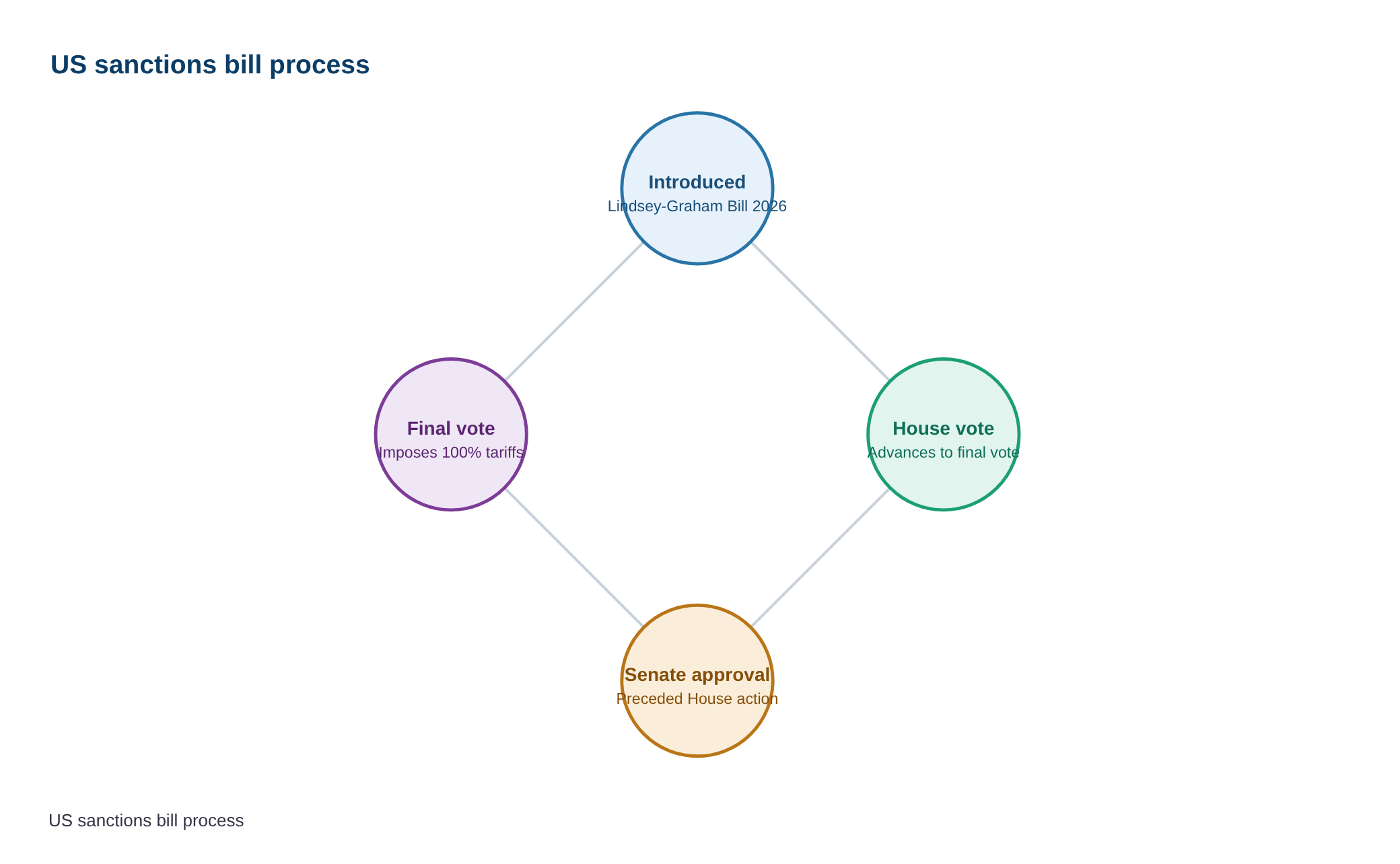
The advancement of the Lindsey-Graham Sanctions Bill 2026 in the US House of Representatives has drawn international attention due to its potential to impose 100% tariffs on countries, including India, for purchasing oil and gas from Russia. This legislative development occurs amid heightened geopolitical tensions and reflects the evolving architecture of global economic statecraft, particularly the use of secondary sanctions to influence third-country behaviour. The bill’s progression, following Senate approval, underscores the growing recourse to trade policy as a tool of coercive diplomacy, with significant implications for energy security, trade relations, and the rules-based international order.
Background
- The United States has historically employed economic sanctions as a primary instrument of foreign policy, particularly against adversarial states such as Russia, Iran, and North Korea, under frameworks like the Countering America’s Adversaries Through Sanctions Act (CAATSA) of 2017.
- Secondary sanctions, which target third countries facilitating transactions with sanctioned entities, have gained prominence in recent years, expanding the extraterritorial reach of US sanctions regimes.
- The Russian invasion of Ukraine in 2022 triggered a global sanctions regime, with Western nations imposing restrictions on Russian energy exports to curtail Moscow’s financial capacity to sustain military operations.
- India, as a major importer of Russian crude oil, has navigated the geopolitical landscape by balancing energy security needs with adherence to international norms, often invoking the principle of strategic autonomy.
- The concept of a ‘shadow fleet’—a network of vessels used to evade sanctions and transport sanctioned oil—has emerged as a critical challenge in enforcing energy-related sanctions, necessitating coordinated international responses.
- The bill’s timing coincides with the Ukraine Action Summit in the US, reflecting sustained lobbying efforts by pro-Ukraine groups to maintain and expand support for Kyiv amid evolving global dynamics.
What is the Lindsey-Graham Sanctions Bill 2026?
- The Lindsey O Graham Sanctioning Russia and Iran Act of 2026 is a proposed US legislative measure aimed at intensifying economic pressure on Russia and Iran through expanded sanctions and tariff mechanisms.
- A key provision of the bill authorises the US President to impose a 100% tariff on imports of Russian oil and gas, as well as on countries that continue to purchase such energy resources, including India, China, and others identified as major importers.
- The bill seeks to address the circumvention of sanctions through the use of a ‘shadow fleet’—vessels that operate outside traditional regulatory frameworks to transport sanctioned oil, thereby undermining the effectiveness of existing sanctions.
- In addition to targeting Russia’s energy sector, the bill proposes sanctions on Iran, reflecting broader US objectives to curb Tehran’s regional influence and nuclear ambitions through economic coercion.
- The legislation expands the scope of primary sanctions (directly targeting Russian and Iranian entities) and secondary sanctions (targeting third-country actors facilitating transactions with sanctioned entities), thereby extending the extraterritorial reach of US sanctions policy.
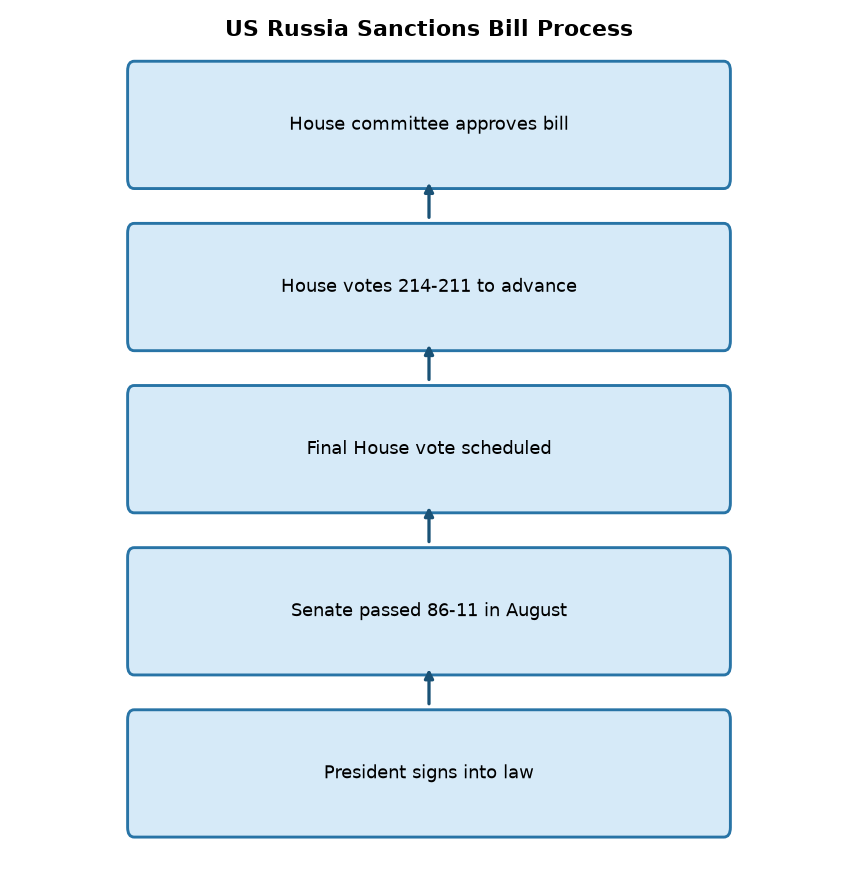
- If enacted, the bill would require the President’s signature to become law, with the House set to vote on final passage before entering recess, followed by potential reconciliation with the Senate version.
Key Features
| Feature | Significance |
|---|---|
| Procedural Advancement in US House | The bill cleared a procedural hurdle in the House of Representatives with a narrow 214-211 vote, indicating bipartisan support despite initial party-line opposition, reflecting shifting legislative dynamics. |
| Sanctions on Russia’s Energy Sector | The bill targets Russia’s energy sector, including the ‘shadow fleet’ of vessels used to evade sanctions on oil deliveries, directly addressing loopholes in existing sanctions regimes. |
| 100% Tariffs on Oil Importers | The bill authorises the US President to impose 100% tariffs on countries importing Russian oil and gas, including India, China, and others, as a coercive economic measure. |
| Senate Passage with Overwhelming Majority | The US Senate passed the bill with an 86-11 majority, demonstrating broad bipartisan consensus on the need for stringent measures against Russian energy trade. |
| Lobbying by Pro-Ukraine Groups | The timing of the vote coincides with the Ukraine Action Summit, where pro-Ukraine lobbyists are advocating for continued US support to Ukraine, linking the bill to broader geopolitical objectives. |
Why it Matters
Economic Implications for India
- Potential economic impact: A 100% tariff on Indian imports of Russian oil and gas could significantly increase energy costs, affecting domestic inflation and fiscal stability.
- Trade diversification challenges: India may face pressure to reduce reliance on Russian energy, necessitating accelerated diversification of energy sources.
- Currency and balance of payments: Higher import costs could strain foreign exchange reserves and impact the current account deficit.
- Supply chain disruptions: Disruptions in energy supply chains could affect industrial output and economic growth.
Geopolitical and Strategic Considerations
- Strategic autonomy vs. global alignment: The bill tests India’s ability to balance strategic autonomy with global economic pressures, particularly in the context of its energy security needs.
- Multilateral diplomacy: India may need to engage in high-level diplomatic efforts to mitigate the economic fallout and seek exemptions or alternative arrangements.
- Alliance dynamics: The bill underscores the evolving nature of US-India relations, particularly in the context of shared interests in countering Russian aggression in Ukraine.
- Global energy markets: The bill could reshape global energy trade dynamics, with potential long-term implications for energy security and pricing.
Legal and Policy Framework for Sanctions
- Extraterritorial sanctions: The bill exemplifies the use of extraterritorial economic measures by the US, raising questions about sovereignty and international law.
- Compliance and enforcement: Countries like India may face legal and regulatory challenges in complying with US sanctions while maintaining energy security.
- Precedent for future sanctions: The bill sets a precedent for the use of economic coercion in international relations, with potential implications for other geopolitical conflicts.
- International institutions: The bill highlights the role of international institutions like the UN and WTO in addressing disputes arising from unilateral sanctions.
Domestic Policy and Energy Security
- Energy transition strategies: India may need to accelerate its transition to renewable energy sources to reduce dependence on fossil fuel imports.
- Domestic energy production: Policies to boost domestic oil and gas production, such as the Discovered Small Fields (DSF) Policy, could gain renewed urgency.
- Subsidy rationalisation: The government may need to rationalise fuel subsidies to offset the impact of higher energy costs on the fisc.
Challenges
1. Economic Costs of Energy Diversification
- High transition costs: Shifting from Russian oil to alternative sources could involve significant capital expenditure and logistical challenges.
- Price volatility: Alternative energy sources may be subject to price volatility, affecting economic stability.
- Infrastructure bottlenecks: Limited refining capacity for alternative crude oils could pose challenges in the short term.
UPSC Link: GS III: Infrastructure – Energy
2. Diplomatic Balancing Act
- Maintaining strategic partnerships: India must balance its relationship with the US while preserving ties with Russia, a key defence and energy partner.
- Avoiding economic coercion: The risk of secondary sanctions or trade restrictions could complicate India’s foreign policy calculus.
- Multilateral negotiations: Coordinating with like-minded countries to counterbalance US unilateral measures may be necessary.
UPSC Link: GS II: International Relations
3. Legal and Regulatory Compliance
- Sanctions compliance: Indian entities trading with Russia may face legal risks under US extraterritorial sanctions, requiring robust compliance frameworks.
- Contractual obligations: Existing long-term contracts for Russian oil and gas may need renegotiation or restructuring to mitigate risks.
- Dispute resolution: Legal disputes arising from sanctions compliance could strain commercial relationships and supply chains.
UPSC Link: GS II: International Law
4. Impact on Domestic Inflation and Fiscal Health
- Inflationary pressures: Higher energy costs could spill over into broader inflation, affecting household purchasing power and economic growth.
- Fiscal strain: Increased subsidy burdens or tax cuts to offset inflation could widen the fiscal deficit.
- Monetary policy challenges: The Reserve Bank of India may face dilemmas in balancing inflation control with growth support.
UPSC Link: GS III: Indian Economy
5. Geopolitical Repercussions
- Erosion of strategic autonomy: Over-reliance on US-led economic measures could limit India’s policy space in global affairs.
- Regional dynamics: The bill could strain India’s relations with other energy-importing countries in Asia and beyond.
- Global supply chains: Disruptions in energy trade could have cascading effects on global supply chains and economic stability.
UPSC Link: GS II: Global Groupings
Challenges — UPSC Perspective
| Issue | Concern |
|---|---|
| Energy Security | Risk of supply disruptions and increased costs due to reduced access to Russian oil and gas. |
| Trade Relations | Potential deterioration of trade ties with the US if India resists compliance with sanctions. |
| Defence Cooperation | Possible impact on India-Russia defence ties, which are critical for India’s military modernisation. |
| Economic Growth | Slowdown in industrial activity due to higher energy costs and inflationary pressures. |
| Diplomatic Isolation | Risk of alienating key partners if India is perceived as undermining US-led sanctions against Russia. |
| Legal Risks | Exposure of Indian entities to secondary sanctions and legal penalties under US law. |
Way Forward
- Conduct a comprehensive energy security audit to assess vulnerabilities and identify alternative supply sources.
- Engage in high-level diplomatic dialogues with the US to seek exemptions or mitigations for Indian energy imports from Russia.
- Accelerate the implementation of domestic energy production policies, such as the Discovered Small Fields (DSF) Policy and strategic petroleum reserves expansion.
- Diversify energy sources by increasing imports from the Middle East, Africa, and the US, while leveraging long-term contracts and hedging strategies.
- Strengthen domestic refining capacity to process alternative crude oils and reduce dependence on specific suppliers.
- Formulate contingency plans to manage inflationary pressures, including targeted subsidies and monetary policy adjustments.
- Enhance compliance frameworks for Indian entities to mitigate legal risks under extraterritorial sanctions.
- Collaborate with like-minded countries to advocate for multilateral solutions to unilateral sanctions, including through forums like the UN and WTO.
UPSC Value Addition
Keywords for Mains Answer-Writing
United States Congress · sanctions regime · tariff policy · Russia-Ukraine conflict · energy trade · multilateral sanctions · extraterritorial jurisdiction · WTO rules · economic statecraft · geopolitical leverage · trade-offs in foreign policy · strategic autonomy · India-US relations · international law on sanctions
Concept Flow
US House advances sanctions bill targeting Russian oil imports → Potential 100% tariffs on India and other importers → India faces economic and geopolitical challenges → Need for energy diversification and diplomatic balancing → Impact on domestic inflation, fiscal health, and trade relations → Policy responses include audits, diversification, and compliance frameworks → Long-term implications for strategic autonomy and global energy markets.
Prelims Practice Questions
Q1. Consider the following statements regarding the legislative process in the United States:
1. A bill passed by the House of Representatives must also be passed by the Senate before it can be sent to the President for signature.
2. The House of Representatives can override a presidential veto with a two-thirds majority vote.
3. The Senate can confirm presidential appointments through a simple majority vote.
How many of the above statements are correct?
- Only one
- Only two
- All
- None
Answer: All — Statement 1 is correct: A bill must pass both chambers (House and Senate) before being sent to the President. Statement 2 is correct: A two-thirds majority in both chambers is required to override a presidential veto. Statement 3 is incorrect: Certain appointments require a simple majority, but others (e.g., Supreme Court justices) require a supermajority in the Senate.
Q2. Assertion (A): The United States Congress can impose tariffs on imports from countries trading with Russia under its domestic legislation.
Reason (R): The US Constitution grants Congress the exclusive power to regulate foreign commerce and impose tariffs.
Options:
A. Both A and R are true, and R is the correct explanation of A.
B. Both A and R are true, but R is not the correct explanation of A.
C. A is true, but R is false.
D. A is false, but R is true.
Answer: ? — Assertion (A) is true: Congress can legislate tariffs under its commerce power. Reason (R) is also true: Article I, Section 8 of the US Constitution grants Congress exclusive authority over foreign commerce. However, R does not fully explain A, as tariffs under the bill are tied to foreign policy objectives (sanctions), not merely commerce regulation.
Q3. Match the following terms related to international sanctions with their correct descriptions:
Column I
1. Extraterritorial sanctions
2. Shadow fleet
3. Multilateral sanctions
4. WTO rules on tariffs
Column II
A. Vessels used to evade sanctions on oil shipments
B. Sanctions imposed by multiple countries acting in coordination
C. Sanctions applied to third-country entities for dealing with sanctioned states
D. Provisions that limit tariffs to bound rates agreed in trade agreements
Select the correct match:
- 1-A, 2-B, 3-C, 4-D
- 1-C, 2-A, 3-B, 4-D
- 1-D, 2-A, 3-B, 4-C
- 1-B, 2-C, 3-A, 4-D
Answer: 1-C, 2-A, 3-B, 4-D — 1-C: Extraterritorial sanctions target third-country entities for engaging with sanctioned states. 2-A: The ‘shadow fleet’ refers to vessels used to bypass sanctions on oil shipments. 3-B: Multilateral sanctions involve coordinated action by multiple countries. 4-D: WTO rules limit tariffs to bound rates agreed in trade agreements.
Mains Practice Question
✍ Critically analyse the implications of extraterritorial sanctions imposed by a major power on third countries engaged in legitimate trade. Also, examine the potential conflicts between such sanctions and the rules-based multilateral trading system. (15 Marks)
Approach: MODEL-ANSWER SKELETON:
1. **Definition and Context**: Define extraterritorial sanctions (e.g., secondary sanctions) and their linkage to the Russia-Ukraine conflict. Cite the US bill as a recent example.
2. **Mechanism**: Explain how such sanctions operate—targeting financial systems, trade partners, or vessels (e.g., ‘shadow fleet’) to disrupt sanctioned trade.
3. **Legal and Multilateral Dimensions**:
– **WTO Rules**: Article I (MFN) and Article XI (prohibition of quantitative restrictions) of the GATT; bound tariff rates under the WTO.
– **Extraterritoriality vs. Sovereignty**: Jurisdictional assertions under domestic law (e.g., US Congress) vs. principles of state sovereignty (UN Charter, Article 2(1)).
– **International Law**: ICJ Advisory Opinion on ‘Legal Consequences of the Construction of a Wall in the Occupied Palestinian Territory’ (2004) on extraterritorial jurisdiction.
4. **Economic and Geopolitical Trade-offs**:
– **For Targeted Countries**: Impact on energy security, inflation, and strategic autonomy (e.g., India’s stance on discounted Russian oil).
– **For Imposing Power**: Effectiveness in achieving foreign policy goals (e.g., cutting off funding for wars) vs. erosion of multilateral trust.
5. **Countermeasures and Responses**:
– **EU Blocking Statute**: Mechanism to nullify extraterritorial sanctions.
– **Diversification Strategies**: Countries reducing reliance on sanctioned commodities (e.g., India’s energy mix diversification).
6. **Balanced View**: Weigh the arguments for national security-driven sanctions against the risks of undermining the rules-based order and escalating trade wars.
7. **Conclusion**: Emphasise the need for multilateral frameworks to address such conflicts, citing initiatives like the UN Global Counter-Terrorism Strategy or proposals for a ‘sanctions code of conduct’.
Source: orissapost.com
Generated by AanyaAi for educational purpose.
Related guides on our sites
- Current affairs for upsc 2026
- Best PSIR optional coaching for upsc
- Best PSIR optional teacher for upsc
- Best teacher of PSIR optional for upsc

- एनजीटी का आदेश: पुणे-पिंपरी में साइलेंस जोन में लाउडस्पीकर पर पूर्ण प्रतिबंध लागू करें सरकार - September 16, 2026
- NGT Directs Strict Silence Zone Compliance in Pune & Pimpri-Chinchwad - September 16, 2026
- अमेरिकी संसद में रूस प्रतिबंध विधेयक: भारत पर 100% शुल्क लगाने का प्रस्ताव, जानिए पूरा मामला - September 16, 2026

No Comments