


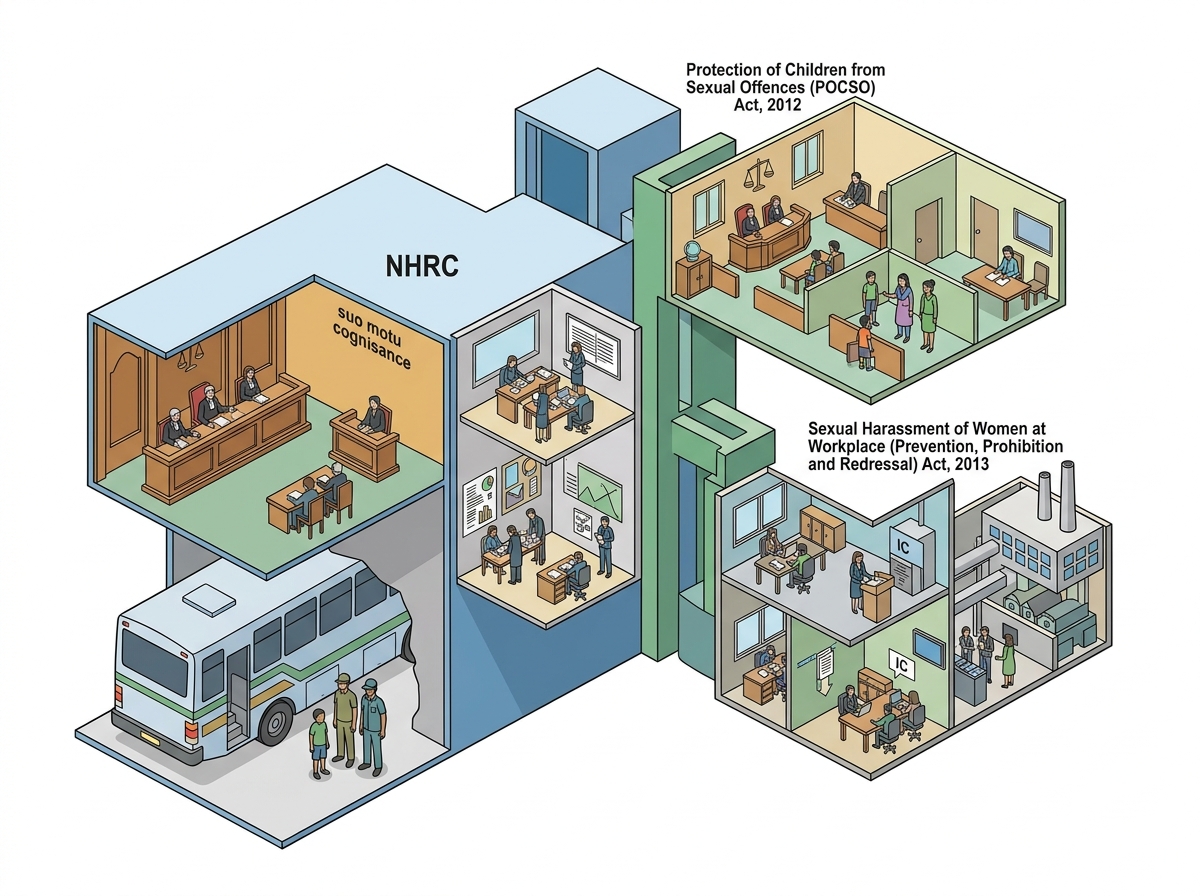
01 Sep NHRC Takes Suo Motu Cognizance of Minor Girl’s Alleged Rape in Greater Noida Bus
✎ The NHRC’s suo motu cognisance in the Greater Noida bus assault case exemplifies its constitutional role as a guardian of human rights, ensuring institutional accountability and timely redressal for victims of sexual violence.
Subject Relevance — Where This Topic Fits
- GS Paper II — Fundamental Rights and DPSP (Articles 14, 15, 21, 39A, 41) | GS Paper III — Internal Security (Protection of Women from Sexual Offences Act, 2012) | GS Paper IV — Ethics and Human Interface (Accountability of Public Institutions)
- Prelims: Protection of Children from Sexual Offences (POCSO) Act, 2012, National Human Rights Commission (NHRC), Sexual Harassment of Women at Workplace (Prevention, Prohibition and Redressal) Act, 2013, Criminal Law (Amendment) Act, 2018, Juvenile Justice (Care and Protection of Children) Act, 2015
- Essay: The Role of Institutions in Upholding Human Dignity: A Case Study of NHRC’s Proactive Intervention, Balancing Justice and Compassion: Institutional Responses to Gender-Based Violence in India
Quick Revision: The NHRC’s suo motu cognisance in the Greater Noida bus assault case exemplifies its constitutional role as a guardian of human rights, ensuring institutional accountability and timely redressal for victims of sexual violence.
Why is this in the news?
The National Human Rights Commission (NHRC) has taken suo motu cognisance of an alleged case of sexual violence involving a 16-year-old girl by a bus driver and conductor in Greater Noida, Uttar Pradesh. The NHRC’s intervention underscores the importance of institutional accountability in ensuring timely justice, rehabilitation, and deterrence against such crimes.
Background
- The Protection of Children from Sexual Offences (POCSO) Act, 2012, was enacted to address the heinous nature of sexual offences against children, mandating stringent punishments and child-friendly procedures for investigation and trial.
- The Sexual Harassment of Women at Workplace (Prevention, Prohibition and Redressal) Act, 2013, provides a legal framework to prevent and redress sexual harassment, though its applicability in public transport scenarios remains a grey area requiring institutional vigilance.
- The Criminal Law (Amendment) Act, 2018, introduced stringent provisions for sexual offences, including gang rape and punishment for repeat offenders, reflecting the state’s commitment to deterrence.
- The National Human Rights Commission (NHRC), established under the Protection of Human Rights Act, 1993, acts as a watchdog for human rights violations, with suo motu powers to intervene in cases of grave public concern.
- Institutional mechanisms such as the Juvenile Justice (Care and Protection of Children) Act, 2015, aim to protect children in conflict with the law while ensuring their rehabilitation and reintegration.
- Public transport systems, particularly in urban areas, have been identified as high-risk zones for crimes against women and children, necessitating robust surveillance, reporting, and accountability mechanisms.
What is the National Human Rights Commission (NHRC)?
- The NHRC is a statutory body established under the Protection of Human Rights Act, 1993, with the mandate to protect and promote human rights as enshrined in the Indian Constitution and international covenants.
- It is vested with suo motu powers to take cognisance of human rights violations, including those reported in the media, without the need for a formal complaint.
- The Commission comprises a Chairperson (a former Chief Justice of India) and members including former judges, human rights activists, and experts in social, economic, and cultural rights.
- The NHRC’s functions include inquiring into complaints of human rights violations, intervening in court proceedings, reviewing safeguards for human rights, and recommending remedial measures to the government.
- It has the authority to summon witnesses, requisition documents, and direct the payment of interim or final compensation to victims or their families in cases of grave violations.
- The NHRC operates under the principle of ‘procedure established by law’ and its recommendations, while not legally binding, carry significant moral and administrative weight.
- The Commission’s jurisdiction extends to matters concerning the rights of women, children, Scheduled Castes, Scheduled Tribes, and other marginalised groups, ensuring a holistic approach to human rights protection.
- The NHRC’s interventions are guided by constitutional principles such as Article 14 (Right to Equality), Article 21 (Right to Life and Personal Liberty), and Article 39A (Equal Justice and Free Legal Aid).
Key Features
| Feature | Significance |
|---|---|
| Automatic Suo Motu Cognizance | Demonstrates NHRC’s proactive role in protecting human rights without requiring a formal complaint, ensuring swift intervention in grave violations. |
| Notice to Police Authorities | Directs senior police officials (Commissioners and Superintendent) to submit detailed reports within two weeks, reinforcing accountability in criminal investigations. |
| Focus on Minor Victim | Highlights the vulnerability of minors in public transport systems and the need for stringent safeguards against sexual violence. |
| Inter-State Coordination | Involves police authorities from Delhi and Gautam Buddh Nagar (Uttar Pradesh), underscoring the need for seamless coordination in trans-jurisdictional crimes. |
| Compensation and Rehabilitation | Mandates inclusion of compensation details in reports, aligning with NHRC’s mandate to ensure victim support and justice. |
Why it Matters
Legal and Institutional
- Reinforces the constitutional and statutory obligation of NHRC under the Protection of Human Rights Act, 1993, to safeguard fundamental rights, particularly of vulnerable groups such as minors.
- Exemplifies the role of quasi-judicial bodies in addressing systemic failures in law enforcement and victim protection.
- Emphasizes the need for robust institutional mechanisms to prevent sexual violence in public spaces, including public transport.
Social and Humanitarian
- Underscores the gravity of sexual violence against minors, a heinous crime that violates multiple fundamental rights (Articles 14, 15, 21, and 39(f) of the Constitution).
- Highlights the societal responsibility to ensure safety in public infrastructure, particularly for women and children.
- Calls for a victim-centric approach in criminal justice, prioritizing rehabilitation and justice over procedural delays.
Governance and Policy
- Demonstrates the importance of inter-agency coordination between state and central authorities in addressing crimes with trans-jurisdictional implications.
- Serves as a catalyst for policy review to strengthen public transport security, including surveillance, staff training, and emergency response systems.
- Reinforces the need for periodic audits of public transport infrastructure to identify and mitigate risks to commuter safety.
Challenges
1. Delayed Justice for Minor Victims
- Sexual violence cases involving minors often face prolonged investigations due to procedural complexities, leading to secondary victimization.
- Delays in forensic examinations, medical reports, and legal proceedings exacerbate trauma for the victim and family.
- Requires expedited trials under the Protection of Children from Sexual Offences (POCSO) Act, 2012, to ensure timely justice.
UPSC Link: GS II: Judiciary and Legal Reforms
2. Lack of Robust Public Transport Safety Mechanisms
- Public transport systems, including buses, often lack adequate surveillance, emergency communication systems, and trained staff to prevent and respond to crimes.
- Inadequate background checks for transport staff contribute to risks of exploitation and abuse.
- Need for mandatory safety audits, CCTV installations, and whistle-blower protection in transport agencies.
UPSC Link: GS III: Infrastructure and Security
3. Inter-State Coordination Gaps in Criminal Investigations
- Trans-jurisdictional crimes, such as the one reported, require seamless coordination between state police forces, often hindered by bureaucratic delays.
- Lack of standardized protocols for sharing evidence and conducting joint investigations across states.
- Need for a national-level framework to streamline inter-state criminal investigations.
UPSC Link: GS II: Centre-State Relations
4. Victim Support and Rehabilitation Deficits
- Minor victims of sexual violence often lack access to psychological counseling, medical care, and legal aid, exacerbating long-term trauma.
- Inadequate implementation of schemes like the ‘One-Stop Centre’ (Sakhi) and ‘Child Protection Services’ (CPS) under the Integrated Child Protection Scheme (ICPS).
- Need for a dedicated victim compensation fund and rehabilitation programs tailored to minors.
UPSC Link: GS II: Social Justice and Welfare
5. Public Awareness and Reporting Barriers
- Underreporting of sexual violence cases due to societal stigma, fear of retaliation, and lack of trust in law enforcement.
- Need for community sensitization programs to encourage reporting and support for victims.
- Role of media in responsibly reporting such incidents without sensationalism or victim-blaming.
UPSC Link: GS II: Social Issues and Governance
Challenges — UPSC Perspective
| Issue | Concern |
|---|---|
| Procedural Delays in Justice | Prolonged investigations and trials exacerbate trauma for minor victims. |
| Inadequate Public Transport Safety | Lack of surveillance and emergency systems increases vulnerability to crimes. |
| Inter-State Coordination Gaps | Bureaucratic delays hinder seamless investigations across jurisdictions. |
| Victim Support Deficits | Limited access to counseling, medical care, and legal aid post-incident. |
| Underreporting of Cases | Stigma and fear deter victims from reporting crimes to authorities. |
| Policy Implementation Gaps | Schemes like POCSO and ICPS often face poor execution on the ground. |
Way Forward
- Strengthen inter-state coordination mechanisms for trans-jurisdictional crimes through standardized protocols and joint investigation teams.
- Mandate safety audits and CCTV installations in all public transport systems, with regular compliance checks.
- Enhance victim support systems by ensuring mandatory access to psychological counseling, medical care, and legal aid under POCSO and ICPS.
- Implement strict background verification and periodic training for transport staff to prevent exploitation.
- Accelerate trials in POCSO cases through dedicated fast-track courts and digital evidence management systems.
- Launch community awareness campaigns to reduce stigma, encourage reporting, and promote bystander intervention.
- Establish a national-level fund for victim compensation and rehabilitation, with transparent disbursement mechanisms.
- Conduct periodic reviews of NHRC guidelines and state-level human rights commissions to assess efficacy and address gaps.
UPSC Value Addition
Keywords for Mains Answer-Writing
National Human Rights Commission (NHRC) · Protection of Human Rights Act, 1993 · Suo Motu cognizance · Protection of Children from Sexual Offences (POCSO) Act, 2012 · Juvenile Justice (Care and Protection of Children) Act, 2015 · Right to Life and Personal Liberty (Article 21) · Directive Principles of State Policy (Article 39(f)) · Criminal Law Amendment Act, 2013 · Child Protection Mechanisms in India · Judicial Activism in Human Rights · Socio-legal framework for child safety · Role of NHRC in enforcing constitutional guarantees
Constitutional & Policy Linkages
- Article 21 (Right to Life and Personal Liberty) — Ensures protection from sexual violence and access to justice.
- Article 15 (Prohibition of Discrimination) — Mandates special protection for minors and vulnerable groups.
- Article 39(f) (Directive Principles of State Policy) — Calls for the protection of children from abuse and exploitation.
- Article 51A (Fundamental Duties) — Obliges citizens to renounce practices derogatory to the dignity of women and children.
Concept Flow
Incident of alleged sexual violence against a minor in public transport → Media report triggers NHRC’s suo motu cognizance → NHRC issues notices to police authorities for detailed reports → Focus on inter-state coordination and victim support → Challenges in delayed justice, safety gaps, and underreporting → Need for policy reforms, institutional strengthening, and public awareness → Long-term goal: Zero tolerance for sexual violence and robust victim protection systems.
Prelims Practice Questions
Q1. Consider the following statements regarding the National Human Rights Commission (NHRC) in India:
1. The NHRC is a constitutional body established under Article 338 of the Constitution.
2. The Chairperson of the NHRC must be a retired Chief Justice of the Supreme Court.
3. The NHRC can suo motu take cognizance of human rights violations.
4. The NHRC has the power to enforce its recommendations through judicial proceedings.
How many of the above statements are correct?
- Only one
- Only two
- Only three
- All
Answer: Only three — Statements 2 and 3 are correct. The NHRC is a statutory body established under the Protection of Human Rights Act, 1993 (not constitutional). The Chairperson must be a retired Chief Justice of the Supreme Court or a former Chief Justice of a High Court. The NHRC can suo motu take cognizance of human rights violations. The NHRC does not have the power to enforce its recommendations through judicial proceedings; it can only recommend actions to the government.
Q2. Assertion (A): The Protection of Children from Sexual Offences (POCSO) Act, 2012, mandates the establishment of Special Courts for the trial of offences under the Act.
Reason (R): The POCSO Act, 2012, aims to provide a child-friendly system for the trial of offences, including the establishment of Special Courts to ensure speedy and sensitive trial of cases involving child victims.
In the context of the above two statements, which one of the following is correct?
- Both A and R are true, and R is the correct explanation of A.
- Both A and R are true, but R is not the correct explanation of A.
- A is true, but R is false.
- A is false, but R is true.
Answer: Both A and R are true, and R is the correct explanation of A. — Both the Assertion (A) and Reason (R) are true. The POCSO Act, 2012, mandates the establishment of Special Courts for the trial of offences under the Act to ensure speedy and sensitive trial of cases involving child victims. The Reason (R) correctly explains the Assertion (A).
Q3. Match the following legal provisions with their respective objectives:
Column I
A. Article 21 of the Constitution
B. Protection of Children from Sexual Offences (POCSO) Act, 2012
C. Juvenile Justice (Care and Protection of Children) Act, 2015
D. Criminal Law Amendment Act, 2013
Column II
1. Ensures the right to life and personal liberty
2. Provides for stringent punishment for offences against children
3. Regulates the care, protection, and rehabilitation of children in conflict with law
4. Amends the Indian Penal Code to enhance punishment for sexual offences
Select the correct match:
- A-1, B-2, C-3, D-4
- A-2, B-1, C-4, D-3
- A-3, B-4, C-1, D-2
- A-4, B-3, C-2, D-1
Answer: A-1, B-2, C-3, D-4 — The correct match is: A-1 (Article 21 ensures the right to life and personal liberty), B-2 (POCSO Act provides for stringent punishment for offences against children), C-3 (Juvenile Justice Act regulates the care, protection, and rehabilitation of children in conflict with law), and D-4 (Criminal Law Amendment Act enhances punishment for sexual offences).
Mains Practice Question
✍ The National Human Rights Commission (NHRC) has taken suo motu cognizance of the alleged sexual assault of a minor in Greater Noida, Uttar Pradesh. In this context, critically examine the role of the NHRC in protecting and promoting human rights in India, with particular reference to its constitutional and statutory mandate, powers, and limitations. Also, discuss the effectiveness of existing child protection mechanisms in India in addressing such incidents. (15 Marks)
Approach: MODEL-ANSWER SKELETON:
1. **Introduction (2 marks)**: Briefly define the NHRC, its constitutional/statutory basis (Protection of Human Rights Act, 1993), and its role as a watchdog for human rights violations in India.
2. **Constitutional and Statutory Mandate (3 marks)**:
– NHRC is a statutory body (not constitutional) established under the Protection of Human Rights Act, 1993.
– Functions: inquiry into complaints, suo motu cognizance, monitoring implementation of human rights instruments, and recommending measures for their effective implementation.
– Chairperson and members: qualifications and appointment process.
3. **Powers of NHRC (3 marks)**:
– Power to investigate complaints (including suo motu cognizance).
– Power to summon witnesses and documents.
– Power to recommend interim relief, including compensation to victims.
– Power to review safeguards provided under the Constitution or any law for the protection of human rights.
– Limitations: NHRC cannot enforce its recommendations; it relies on the executive and judiciary for compliance.
4. **Role in Protecting Child Rights (3 marks)**:
– NHRC has actively intervened in cases involving child rights violations, including sexual offences.
– Collaboration with state commissions and civil society organizations.
– Monitoring implementation of the POCSO Act, 2012, and Juvenile Justice Act, 2015.
– Issuing guidelines for child-friendly procedures in courts and police stations.
5. **Limitations and Challenges (2 marks)**:
– NHRC lacks punitive powers; its recommendations are advisory.
– Delay in implementation of recommendations.
– Limited jurisdiction over private actors (e.g., non-state entities).
– Resource constraints and lack of awareness among victims.
6. **Effectiveness of Child Protection Mechanisms (2 marks)**:
– **Strengths**: POCSO Act provides for stringent punishment and child-friendly procedures; establishment of Special Courts; mandatory reporting of offences.
– **Challenges**: Delay in trials, lack of sensitization of stakeholders, underreporting of cases, and inadequate implementation of protective measures.
– **Way Forward**: Strengthening institutional mechanisms, enhancing awareness, and ensuring timely justice.
7. **Conclusion (2 marks)**: Summarize the role of NHRC and the need for a multi-stakeholder approach to address child rights violations effectively.
Source: PIB (Press Information Bureau)
Uttar Pradesh PCS (UPPSC) — State PCS Practice
Prelims: With reference to the recent incident in Greater Noida, Uttar Pradesh, where the National Human Rights Commission (NHRC) took suo motu cognizance of alleged sexual harassment of a minor girl by a bus driver and conductor, which of the following statements is correct regarding NHRC’s role in such cases?
- A. NHRC can only intervene if a formal complaint is filed by the victim or their family.
- B. NHRC can take suo motu cognizance of human rights violations, including those reported in media or through other sources.
- C. NHRC’s recommendations are binding on state governments and must be implemented within a stipulated timeframe.
- D. NHRC has no jurisdiction over cases involving minors and refers them to the National Commission for Protection of Child Rights (NCPCR).
Answer: B. NHRC can take suo motu cognizance of human rights violations, including those reported in media or through other sources. — NHRC has the authority to take suo motu cognizance of human rights violations, including those reported in media or through other credible sources, as per its mandate under the Protection of Human Rights Act, 1993.
Mains: Discuss the role of the National Human Rights Commission (NHRC) in addressing human rights violations in Uttar Pradesh, with special reference to its suo motu powers. How can NHRC’s interventions in cases like the Greater Noida incident contribute to strengthening child protection mechanisms in the state? Suggest measures to enhance coordination between NHRC, state authorities, and local administration for effective implementation of child rights in Uttar Pradesh.
Generated by AanyaAi for educational purpose.
Related guides on our sites
- Current affairs for upsc 2026
- Best PSIR optional coaching for upsc
- Best PSIR optional teacher for upsc
- Best teacher of PSIR optional for upsc

- India-Australia AUSTRAHIND 2026 Exercise: Key Highlights for UPSC & State PCS - October 22, 2026
- एससीओ बैठक में भारत का आतंकवाद विरोध: क्षेत्रीय सहयोग पर जोर - October 22, 2026
- SEC Directs Strict SC Order Compliance for Andhra ULB Polls - October 22, 2026

No Comments