


31 Aug Nirmala Sitharaman Leads India at G20 Finance Meet in US
✎ The G20 Finance Track is the primary multilateral forum for coordinating macroeconomic policies, financial regulations, and debt sustainability among the world’s largest economies, with outcomes that shape global economic…
Subject Relevance — Where This Topic Fits
- GS Paper II — International Relations (Global Economic Governance, Multilateral Institutions) | GS Paper III — Economy (Global Economic Issues, Sovereign Debt, Supply Chains, Trade Policies)
- Prelims: G20, Finance Track, Sovereign Debt Crisis, Strait of Hormuz, Supply Chain Resilience, Multilateral Diplomacy, US-India Strategic Partnership
- Essay: Global Economic Governance in the 21st Century: Challenges and Opportunities, India’s Role in Shaping Multilateral Economic Frameworks
Quick Revision: The G20 Finance Track is the primary multilateral forum for coordinating macroeconomic policies, financial regulations, and debt sustainability among the world’s largest economies, with outcomes that shape global economic governance.
Why is this in the news?
Union Finance Minister Nirmala Sitharaman’s participation in the G20 Finance Ministers and Central Bank Governors Meeting in Asheville, North Carolina (September 1st, 2026) underscores India’s engagement in global economic governance amid evolving geopolitical and macroeconomic challenges. The meeting, chaired by the US Treasury Secretary, is expected to deliberate on critical issues such as global growth, sovereign debt sustainability, supply chain resilience, and the economic fallout of regional conflicts, including the Iran crisis.
Background
- The G20 was established in 1999 in response to financial crises to serve as a premier forum for international economic cooperation, comprising 19 countries, the European Union, and the African Union.
- The G20 Finance Track, led by finance ministers and central bank governors, focuses on macroeconomic policies, financial regulation, tax cooperation, and infrastructure investment.
- The US holds the G20 presidency for 2026, with economic growth as its central theme, reflecting a shift toward domestic economic revival as a global priority.
- Sovereign debt crises in emerging markets, exacerbated by post-pandemic fiscal strains and geopolitical tensions, remain a persistent challenge for global financial stability.
- The Strait of Hormuz, a critical chokepoint for global oil trade, has witnessed heightened geopolitical tensions, impacting energy prices and supply chain security.
- India’s G20 presidency in 2023 emphasized themes such as ‘One Earth, One Family, One Future,’ with a focus on inclusive growth and sustainable development.
What is the G20 Finance Track?
- The G20 Finance Track is a segment of the G20 process dedicated to macroeconomic and financial policy coordination among member countries and invited institutions.
- It is led by finance ministers and central bank governors, who convene at least twice a year to discuss issues such as global growth, financial stability, tax cooperation, and infrastructure financing.
- The track operates through working groups and ministerial meetings, culminating in a joint communiqué or declaration outlining policy commitments and recommendations.
- Key deliverables include the G20 Action Plan on Sustainable Finance, the G20/OECD Principles on Corporate Governance, and initiatives on digital taxation and debt transparency.
- The Finance Track collaborates closely with other G20 tracks, such as the Sherpa Track (socioeconomic issues) and the Engagement Groups (e.g., Business 20, Labour 20), to ensure policy coherence.
- The G20’s effectiveness is constrained by the absence of a formal secretariat, relying instead on the rotating presidency and the troika system (current, past, and future presidencies) for continuity.
- The 2026 US presidency emphasizes ‘stronger growth’ as a cross-cutting theme, aligning with domestic economic priorities and global expectations for inclusive recovery.
- Outcomes from the Finance Track often influence broader multilateral processes, including the IMF, World Bank, and OECD, due to the G20’s collective economic weight.
Key Features
| Feature | Significance |
|---|---|
| G20 Finance Track Presidency of the United States (2026) | Sets the thematic agenda for global economic policy discussions, prioritising economic growth and addressing structural imbalances. |
| Indian delegation led by Union Finance Minister | Represents India’s economic priorities, including manufacturing, innovation, and global supply chain resilience. |
| Focus on sovereign debt and global economic imbalances | Addresses systemic risks to financial stability, particularly in emerging and developing economies. |
| Discussion on Iran conflict’s economic impact | Examines disruptions to energy markets and trade routes, with implications for inflation and supply chain security. |
| Bilateral engagements on investment and innovation | Highlights India’s push for foreign direct investment (FDI) and technology transfer to bolster domestic manufacturing. |
Why it Matters
Economic/Strategic
- The G20 Finance Track serves as a platform for coordinating macroeconomic policies among major economies, influencing global financial governance.
- India’s participation underscores its role as a key player in shaping discussions on trade, debt sustainability, and supply chain resilience.
- The emphasis on economic growth aligns with India’s domestic priorities, including the ‘Make in India’ initiative and the Production-Linked Incentive (PLI) schemes.
- The meeting’s focus on sovereign debt is critical for countries with high external debt burdens, including several African and Latin American nations.
Diplomatic/Institutional
- The G20 acts as a forum for crisis management, where major economies collaborate on responses to geopolitical and economic shocks.
- Bilateral engagements on the sidelines of the G20 facilitate deeper economic partnerships, particularly in technology and manufacturing.
- The participation of the African Union reflects efforts to integrate developing economies into global economic decision-making processes.
- The meeting’s outcomes may influence future IMF and World Bank policies, particularly on debt restructuring and fiscal sustainability.
Policy/Regulatory
- Discussions on trade tariffs and industrial policies highlight the challenges of balancing protectionism with global economic integration.
- The focus on supply chain resilience underscores the need for diversified and secure trade routes, especially in the context of geopolitical tensions.
- Sovereign debt discussions may lead to calls for multilateral frameworks to address debt distress in vulnerable economies.
Challenges
1. Geopolitical Tensions and Economic Fragmentation
- The Iran conflict and related sanctions regimes create volatility in energy markets and trade routes, complicating global economic stability.
- Divergent national policies on sanctions and trade tariffs may hinder consensus on key economic issues during the meeting.
- Geopolitical rivalries, particularly between major economies, could limit the scope of cooperative policy responses.
UPSC Link: GS Paper 2: Effect of policies of developed and developing countries
2. Sovereign Debt and Financial Instability
- High levels of sovereign debt in several developing economies pose risks to global financial stability and growth prospects.
- The lack of a unified framework for debt restructuring exacerbates crises, particularly in low-income countries.
- Inflationary pressures and rising interest rates in advanced economies may worsen debt burdens in vulnerable nations.
UPSC Link: GS Paper 3: Indian Economy and issues relating to planning
3. Supply Chain Disruptions and Resilience
- Persistent supply chain bottlenecks, exacerbated by geopolitical conflicts, threaten global trade and economic recovery.
- Over-reliance on specific trade routes or suppliers increases vulnerability to disruptions, necessitating diversification.
- The transition to resilient supply chains may require significant investment and policy coordination across borders.
UPSC Link: GS Paper 3: Infrastructure and Investment models
4. Balancing Growth with Structural Reforms
- Achieving sustainable growth requires addressing structural imbalances, such as income inequality and productivity gaps.
- Reforms in labour markets, education, and innovation ecosystems are critical but often face domestic political constraints.
- The trade-off between short-term growth stimulus and long-term fiscal sustainability remains a persistent challenge.
UPSC Link: GS Paper 3: Indian Economy and issues relating to mobilisation of resources
5. Climate Change and Economic Policies
- The intersection of climate policies and economic growth poses challenges for countries reliant on fossil fuels.
- Carbon border taxes and green industrial policies may create trade distortions, requiring multilateral coordination.
- Investments in renewable energy and sustainable infrastructure are essential but require substantial financing.
UPSC Link: GS Paper 3: Conservation, environmental pollution and degradation
Challenges — UPSC Perspective
| Issue | Concern |
|---|---|
| Iran conflict and sanctions | Volatility in energy prices and disruptions to trade routes like the Strait of Hormuz. |
| Sovereign debt crises | Risk of financial instability in developing economies with high external debt burdens. |
| Supply chain vulnerabilities | Exposure to disruptions due to over-reliance on specific trade routes or suppliers. |
| Geopolitical fragmentation | Divergent national policies on trade and sanctions hinder consensus on global economic issues. |
| Climate change and economic policies | Trade-offs between growth, industrial policies, and environmental sustainability. |
Way Forward
- Enhance multilateral frameworks for sovereign debt restructuring to address crises in vulnerable economies.
- Promote diversification of global supply chains to reduce reliance on single trade routes or suppliers.
- Strengthen coordination among G20 members to mitigate the economic fallout from geopolitical conflicts.
- Invest in green infrastructure and renewable energy to align economic growth with climate goals.
- Encourage technology transfer and innovation partnerships to boost domestic manufacturing in developing economies.
- Develop policy tools to balance short-term growth stimulus with long-term fiscal sustainability.
- Foster dialogue on carbon border taxes and green industrial policies to avoid trade distortions.
- Support capacity-building initiatives in low-income countries to enhance debt management and financial resilience.
UPSC Value Addition
Keywords for Mains Answer-Writing
G20 Finance Track · global economic governance · sovereign debt challenges · supply chain resilience · Iran conflict and energy prices · Strait of Hormuz · international financial institutions · multilateral economic diplomacy · G20 presidency priorities · India’s macroeconomic stance · FDI and manufacturing in India · global growth imbalances
Concept Flow
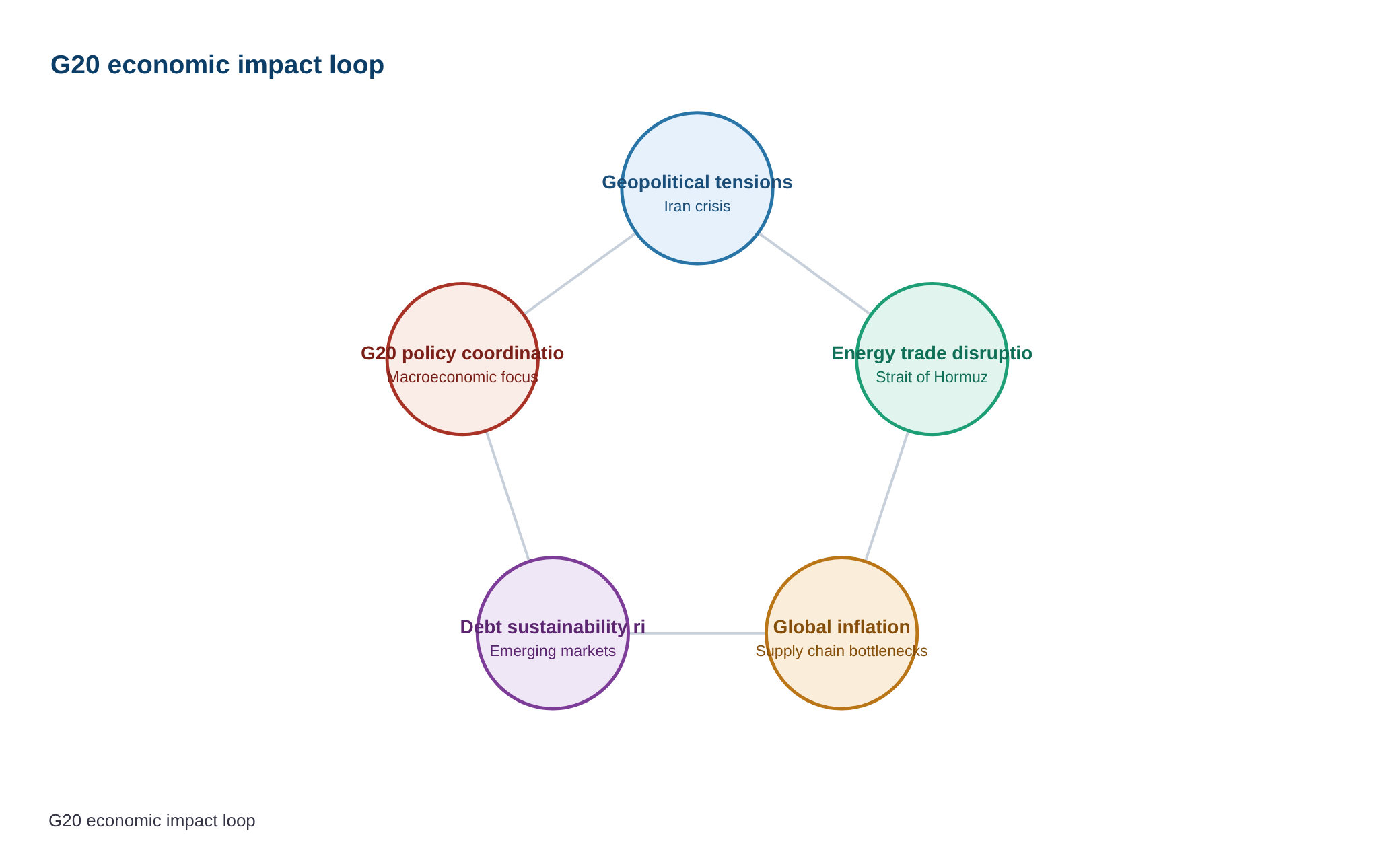
Geopolitical tensions (e.g., Iran conflict) → Disruptions in energy markets and trade routes → Inflation and supply chain bottlenecks → Global economic instability. → High sovereign debt levels in developing economies → Financial instability risks → Need for multilateral debt restructuring frameworks. → Over-reliance on specific trade routes → Vulnerability to disruptions → Push for supply chain diversification. → Divergent national policies on trade and sanctions → Fragmentation of global economic governance → Challenges in consensus-building. → Climate change policies (e.g., carbon border taxes) → Potential trade distortions → Need for multilateral coordination. → India’s domestic priorities (e.g., ‘Make in India’, PLI schemes) → Foreign investment and technology partnerships → Enhanced manufacturing and innovation. → G20 Finance Track Presidency → Thematic agenda on growth and structural reforms → Influence on IMF and World Bank policies.
Prelims Practice Questions
Q1. Consider the following statements regarding the G20 Finance Track:
1. The G20 Finance Track is chaired by the host country’s finance minister.
2. The African Union is a permanent member of the G20.
3. The G20 Finance Track focuses exclusively on monetary policy coordination.
4. Sovereign debt challenges and supply chain resilience are key agenda items.
How many of the above statements are correct?
- Only one
- Only two
- Only three
- All four
Answer: Only three — Statements 1 and 4 are correct. The G20 Finance Track is chaired by the host country’s finance minister (Statement 1). Sovereign debt challenges and supply chain resilience are highlighted agenda items (Statement 4). Statement 2 is incorrect as the African Union is not a permanent member of the G20. Statement 3 is incorrect as the G20 Finance Track addresses broader macroeconomic issues, not exclusively monetary policy.
Q2. Assertion (A): The Strait of Hormuz is a critical chokepoint for global oil trade.
Reason (R): Approximately 20% of the world’s oil supply passes through the Strait of Hormuz.
- Both A and R are true, and R is the correct explanation of A
- Both A and R are true, but R is NOT the correct explanation of A
- A is true, but R is false
- A is false, but R is true
Answer: A is true, but R is false — Assertion (A) is true: the Strait of Hormuz is a critical chokepoint for global oil trade. Reason (R) is also true: approximately 20% of the world’s oil supply passes through the Strait. However, (R) does not explain (A) as the assertion pertains to the Strait’s strategic importance, while (R) provides a quantitative detail unrelated to the assertion’s causal claim.
Q3. Match the following international financial institutions with their primary functions:
Column I (Institution) Column II (Primary Function)
A. International Monetary Fund (IMF) 1. Provides long-term loans for infrastructure projects
B. World Bank 2. Monitors global financial stability and provides policy advice
C. Bank for International Settlements (BIS) 3. Acts as a lender of last resort for countries in financial crisis
D. Asian Infrastructure Investment Bank (AIIB) 4. Facilitates international monetary cooperation and exchange rate stability
- A-4, B-1, C-2, D-3
- A-2, B-1, C-4, D-3
- A-3, B-4, C-2, D-1
- A-2, B-1, C-3, D-4
Answer: A-2, B-1, C-4, D-3 — Correct match: A (IMF) – 4 (facilitates international monetary cooperation and exchange rate stability), B (World Bank) – 1 (provides long-term loans for infrastructure projects), C (BIS) – 2 (monitors global financial stability and provides policy advice), D (AIIB) – 3 (acts as a lender for infrastructure projects, though not a lender of last resort).
Mains Practice Question
✍ The G20 Finance Track, under the presidency of the United States, is prioritising global growth as its central agenda. Critically examine the efficacy of multilateral economic forums like the G20 in addressing persistent global economic imbalances and sovereign debt challenges. Also, assess the implications for India’s macroeconomic policy in this context. (15 Marks)
Approach: MODEL-ANSWER SKELETON:
1. **Introduction**: Define the G20 Finance Track and its mandate; highlight the US presidency’s emphasis on growth.
2. **Role of G20 in addressing global economic imbalances**:
– Discuss the G20’s origins (post-2008 financial crisis) and its mandate to coordinate macroeconomic policies.
– Evaluate mechanisms: Mutual Assessment Process (MAP), peer reviews, and surveillance reports (cite IMF’s role).
– Critique: Limited enforcement power; reliance on voluntary compliance; divergence in national interests (e.g., US-China trade tensions, sanctions on Iran).
– Reference: G20 communiqués post-2010 (Seoul Summit) and their limited success in reducing imbalances.
3. **Sovereign debt challenges**:
– Define sovereign debt crises (e.g., Eurozone crisis, Sri Lanka 2022) and the G20’s initiatives (Common Framework for Debt Treatment beyond DSSI).
– Assess efficacy: Slow implementation, lack of participation from major creditors (e.g., China), and moral hazard concerns.
– Role of IMF: Conditionality and structural adjustment programs; critique of austerity measures.
4. **Implications for India’s macroeconomic policy**:
– India’s stance in G20: Advocacy for inclusive growth, debt relief for vulnerable economies, and resilient supply chains.
– Domestic policy adjustments: Fiscal consolidation vs. growth stimulus; RBI’s monetary policy in a global tightening cycle.
– Structural reforms: PLI schemes, FDI liberalisation, and manufacturing push (link to Sitharaman’s Chicago engagements).
5. **Conclusion**: Balance between multilateral cooperation and national sovereignty; India’s strategic positioning as a bridge between developed and developing economies. Highlight the need for reformed global financial governance.
Source: orissapost.com
Generated by AanyaAi for educational purpose.
Related guides on our sites
- Best PSIR optional coaching for upsc
- Best economics optional coaching for upsc
- Best PSIR optional teacher for upsc
- Best teacher of PSIR optional for upsc

- India-Australia AUSTRAHIND 2026 Exercise: Key Highlights for UPSC & State PCS - October 22, 2026
- एससीओ बैठक में भारत का आतंकवाद विरोध: क्षेत्रीय सहयोग पर जोर - October 22, 2026
- SEC Directs Strict SC Order Compliance for Andhra ULB Polls - October 22, 2026

No Comments