


07 Sep NITI Aayog launches PACT & ZET marketplaces for clean freight logistics
✎ PACT and ZET Marketplaces are digital platforms launched to aggregate demand, reduce financing costs, and enable corridor-based electrification of India’s freight logistics, aligning with the net-zero 2070 target and addressing…
Subject Relevance — Where This Topic Fits
- GS Paper III — Economy: Infrastructure, Investment Models, and Environmental Sustainability | GS Paper III — Science and Technology: Electric Mobility and Green Technologies | GS Paper III — Environment: Climate Change Mitigation and Net-Zero Commitments
- Prelims: Electric freight corridors, Zero Emission Trucks (ZET), Platform for Aggregating Clean Transport (PACT), FAME-II scheme, Production Linked Incentive (PLI) for automobile and advanced chemistry cell batteries, PM e-DRIVE scheme, Net-Zero by 2070, 70% of freight transport by road
- Essay: India’s transition to sustainable logistics: Balancing economic growth and climate action, The role of public-private partnerships in achieving net-zero emissions
Quick Revision: PACT and ZET Marketplaces are digital platforms launched to aggregate demand, reduce financing costs, and enable corridor-based electrification of India’s freight logistics, aligning with the net-zero 2070 target and addressing the disproportionate carbon footprint of heavy-duty trucks.
Why is this in the news?
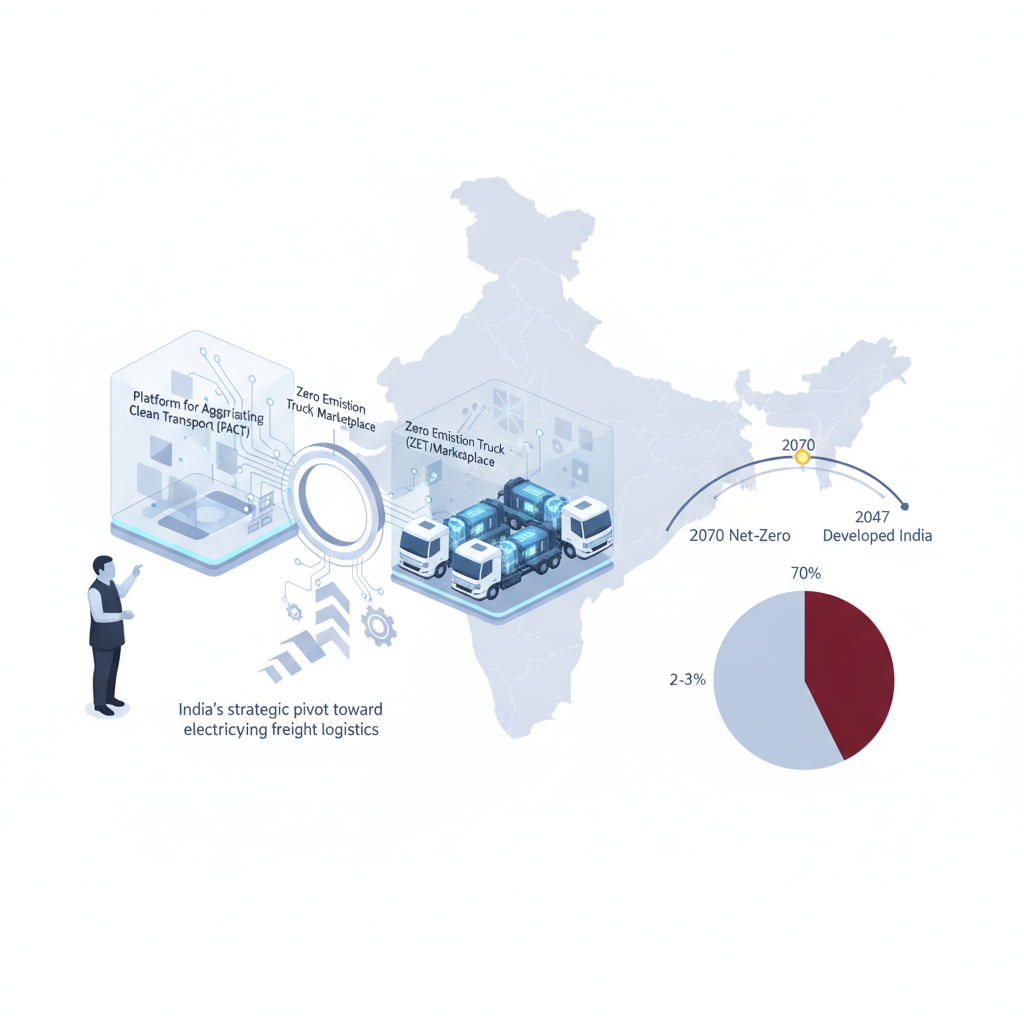
The launch of the Platform for Aggregating Clean Transport (PACT) and Zero Emission Truck (ZET) Marketplaces by NITI Aayog Member Shri Rajiv Gauba at the 5th e-FAST India Summit 2026 underscores India’s strategic pivot toward electrifying freight logistics. This initiative aligns with India’s net-zero commitment by 2070 and the vision of a ‘Developed India’ by 2047, addressing structural bottlenecks in the heavy-duty trucking sector that contributes disproportionately to carbon emissions.
Background
- India’s freight transport sector is dominated by road transport, accounting for approximately 70% of total freight movement, with heavy-duty trucks comprising only 3-4% of the fleet but contributing over one-third of transport-related carbon emissions.
- The Government of India has set a net-zero emissions target by 2070 and aims to achieve a ‘Developed India’ status by 2047, necessitating a transition to clean mobility across sectors, including logistics.
- The e-FAST (Electric Freight Accelerator for Sustainable Transport) initiative has evolved from a dialogue platform to a coordinated action mechanism over four years, reflecting a shift from intent to implementation in India’s clean transport discourse.
- Structural fragmentation in logistics operations, high financing costs, and the absence of coordinated corridor planning have impeded the scaling of electric freight solutions in India.
What are PACT and ZET Marketplaces?
- The **Platform for Aggregating Clean Transport (PACT)** is a digital marketplace designed to aggregate demand for zero-emission freight solutions, facilitate innovative financing models, and enable corridor-based project development, thereby reducing market fragmentation in the logistics sector.
- The **Zero Emission Truck (ZET) Marketplace** serves as a dedicated platform for the procurement, leasing, and deployment of electric heavy-duty trucks, connecting logistics operators, vehicle manufacturers, charging infrastructure providers, and financiers in a unified ecosystem.
- Both platforms are intended to address key barriers in the electric freight ecosystem, including high upfront capital costs, limited access to financing, and the lack of standardized corridor planning for electric truck operations.
- The platforms leverage **mixed financing mechanisms**, **leasing models**, and **data-driven decision-making** to reduce the total cost of ownership of electric trucks to parity with diesel counterparts over time.
- PACT and ZET are expected to catalyze the creation of **electric freight corridors**, where charging infrastructure, battery swapping stations, and logistics hubs are co-located to enable seamless long-haul electric truck operations.
- The initiatives reflect a **market-enabling governance approach**, where the government facilitates systemic solutions rather than dictating outcomes, particularly in capital-intensive and complex sectors like freight electrification.
Key Features
| Feature | Significance |
|---|---|
| Platform for Aggregating Clean Transport (PACT) | A digital marketplace designed to aggregate demand for clean transport solutions, facilitating bulk procurement and reducing transaction costs for logistics operators and fleet owners. |
| Zero Emission Truck (ZET) Marketplace | A dedicated platform for zero-emission heavy commercial vehicles, enabling transparent pricing, financing options, and supply chain integration for electric trucks. |
| Demand Aggregation Mechanism | Systematically consolidates orders from multiple logistics providers to achieve economies of scale, lowering capital expenditure for electric trucks. |
| Corridor-Based Project Development | Encourages the creation of electric freight corridors with integrated charging infrastructure, aligning with India’s 70% road-based freight movement. |
| Blended Financing Framework | Proposes innovative financing models, including leasing and mixed-capital instruments, to reduce the total cost of ownership for electric trucks to parity with diesel equivalents. |
| Data-Driven Decision Support | Provides real-time analytics on fleet performance, charging infrastructure utilisation, and emissions reduction, aiding policy and investment decisions. |
Why it Matters
Economic and Strategic
- Supports India’s commitment to achieve net-zero emissions by 2070 and aligns with the ‘Developed India @2047’ vision through decarbonisation of the logistics sector.
- Enhances energy security by reducing dependence on imported fossil fuels, particularly diesel, which constitutes a significant share of India’s crude oil imports.
- Promotes indigenous manufacturing of electric vehicles and batteries, fostering self-reliance under the Atmanirbhar Bharat initiative.
- Reduces logistics costs by lowering fuel expenses and maintenance overheads for electric fleets, improving India’s global competitiveness.
Environmental
- Targets the heavy-duty truck segment, which contributes over one-third of transport-sector CO₂ emissions despite comprising only 3-4% of the fleet.
- Supports the transition to zero-emission vehicles, directly contributing to particulate matter and NOₓ reduction in urban and peri-urban freight hubs.
- Facilitates the integration of renewable energy sources into freight operations through smart charging and grid-balancing mechanisms.
Institutional and Market-Building
- Demonstrates a shift from government-led procurement to a market-enabling framework, where platforms like PACT and ZET create conditions for private sector-led solutions.
- Encourages multi-stakeholder collaboration among logistics providers, vehicle manufacturers, financiers, and charging infrastructure operators.
- Lays the groundwork for standardised contracts, financing instruments, and performance benchmarks in the electric freight ecosystem.
Challenges
1. High Capital Costs and Financing Gaps
- Electric trucks have a higher upfront cost compared to diesel equivalents, deterring adoption despite lower operating expenses.
- Limited access to affordable financing for small and medium logistics operators, exacerbated by perceived technology risks.
- Need for blended finance models to bridge the cost gap and attract private capital into the sector.
UPSC Link: GS3: Infrastructure – Energy
2. Infrastructure Bottlenecks
- Inadequate public charging infrastructure, particularly for heavy-duty vehicles, leading to range anxiety and operational disruptions.
- Lack of coordinated planning for freight corridors, resulting in fragmented charging networks and inefficient route optimisation.
- Grid capacity constraints in high-density freight corridors, requiring investments in smart grid technologies and energy storage.
UPSC Link: GS3: Infrastructure – Transport
3. Market Fragmentation and Structural Issues
- Dominance of unorganised players in the logistics sector, limiting economies of scale and hindering technology adoption.
- Absence of standardised contracts and performance guarantees for electric fleets, increasing transaction costs.
- Need for robust data systems to track fleet performance, emissions, and charging infrastructure utilisation.
UPSC Link: GS3: Economy – Logistics
4. Policy and Regulatory Hurdles
- Inconsistent state-level policies on vehicle registration, permits, and taxation for electric commercial vehicles.
- Gaps in the regulatory framework for battery recycling, end-of-life management, and safety standards for heavy-duty EVs.
- Need for harmonised standards for charging infrastructure, interoperability, and grid integration.
UPSC Link: GS2: Governance – Policies
5. Technology and Supply Chain Dependencies
- Reliance on imported battery technologies and critical minerals, posing supply chain vulnerabilities.
- Limited domestic manufacturing capacity for high-performance electric drivetrains and battery packs.
- Need for R&D investments in battery swapping, fast-charging technologies, and lightweight materials for heavy trucks.
UPSC Link: GS3: Science & Tech
Challenges — UPSC Perspective
| Issue | Concern |
|---|---|
| Upfront capital cost | Electric trucks are 2-3 times more expensive than diesel trucks, deterring adoption despite lower operating costs. |
| Charging infrastructure deficit | Only ~5,000 public charging stations exist for heavy vehicles, insufficient for 70% road-based freight. |
| Financing access | Logistics SMEs struggle to secure loans due to high perceived risk and lack of collateral. |
| Grid integration | High-power charging demands strain local grids, requiring upgrades and smart energy management. |
| Policy fragmentation | State-level variations in EV policies create compliance burdens for interstate logistics operators. |
| Battery supply chain | Dependence on imported lithium and cobalt raises cost and sustainability concerns. |
Government Initiatives — Must-Memorise for Prelims
- Production-Linked Incentive (PLI) Scheme for Automobile and Advanced Chemistry Cell (ACC) Battery
Way Forward
- Accelerate the deployment of public charging infrastructure along identified freight corridors, prioritising high-traffic routes such as the Golden Quadrilateral and North-South/East-West Corridors.
- Expand blended financing mechanisms, including viability gap funding, green bonds, and concessional loans, to reduce the cost of capital for electric trucks.
- Develop standardised contracts and performance guarantees for electric fleets, ensuring transparency and reducing transaction costs for logistics operators.
- Strengthen R&D in battery technologies, particularly for heavy-duty applications, including solid-state batteries and battery swapping systems.
- Harmonise state-level EV policies to create a uniform regulatory environment for interstate logistics operations.
- Establish a national data platform to track fleet performance, charging infrastructure utilisation, and emissions reduction, enabling evidence-based policymaking.
- Promote public-private partnerships for the development of green freight corridors, integrating charging infrastructure with logistics hubs.
- Enhance skill development programmes to train technicians, drivers, and fleet managers in electric vehicle maintenance and operations.
UPSC Value Addition
Keywords for Mains Answer-Writing
NITI Aayog · Plaform for Aggregating Clean Transport (PACT) · Zero Emission Truck (ZET) Marketplace · strategic electrification of freight logistics · e-FAST India Summit 2026 · National Electric Mobility Mission Plan (NEMMP) · Production-Linked Incentive (PLI) Scheme for Automobiles and Advanced Chemistry Cell (ACC) · FAME-II Scheme · PM-eDrive (DRIVE) · PM-eBus Sewa · carbon emissions from heavy commercial vehicles · National Green Hydrogen Mission · National Logistics Policy 2022 · multi-modal logistics parks · energy security · net-zero emissions by 2070
Concept Flow
Rising diesel dependence in freight → High logistics costs and carbon emissions → Policy push for electric mobility (FAME-II, PLI schemes) → Fragmented logistics market → High transaction costs and limited economies of scale → Need for demand aggregation platforms (PACT) → Inadequate charging infrastructure → Range anxiety and operational disruptions → Development of corridor-based charging networks → High upfront costs for electric trucks → Financing gaps and market barriers → Blended finance models and leasing mechanisms → Regulatory inconsistencies → Compliance burdens for interstate operators → Harmonisation of state-level EV policies → Technology and supply chain dependencies → Import vulnerabilities → R&D in indigenous battery and drivetrain technologies → Market-enabling platforms (PACT, ZET) → Aggregated demand and standardised contracts → Accelerated adoption of zero-emission trucks
Prelims Practice Questions
Q1. Consider the following statements regarding the Platform for Aggregating Clean Transport (PACT) and Zero Emission Truck (ZET) Marketplace:
1. PACT is designed to aggregate demand for clean transport solutions.
2. ZET Marketplace focuses exclusively on electric two-wheelers.
3. Both initiatives were launched during the 5th e-FAST India Summit 2026.
How many of the above statements are correct?
- Only one
- Only two
- All
- None
Answer: All — Statements 1 and 3 are correct. Statement 2 is incorrect as ZET Marketplace focuses on zero-emission trucks (heavy commercial vehicles), not electric two-wheelers.
Q2. Assertion (A): The strategic electrification of freight logistics is essential to achieve India’s net-zero emissions target by 2070.
Reason (R): Heavy commercial vehicles account for over one-third of carbon emissions from the transport sector despite constituting only 3-4% of the fleet.
Options:
A. Both A and R are true, and R is the correct explanation of A.
B. Both A and R are true, but R is not the correct explanation of A.
C. A is true, but R is false.
D. A is false, but R is true.
Answer: ? — Both the assertion and reason are factually correct. The reason correctly explains why strategic electrification of freight logistics is critical for achieving net-zero emissions by 2070.
Q3. Match the following initiatives with their respective objectives:
Column I (Initiative) | Column II (Objective)
1. PLI Scheme for Automobiles | A. Expansion of public charging infrastructure
2. FAME-II Scheme | B. Demand-side incentives for electric vehicles
3. PM-eDrive (DRIVE) | C. Financial incentives for manufacturing electric vehicles and batteries
4. Oil Marketing Companies | D. Promotion of electric vehicle adoption in urban areas
Options:
A. 1-C, 2-B, 3-D, 4-A
B. 1-A, 2-B, 3-C, 4-D
C. 1-D, 2-A, 3-B, 4-C
D. 1-B, 2-D, 3-A, 4-C
Answer: ? — 1-C: PLI Scheme for Automobiles provides financial incentives for manufacturing electric vehicles and batteries. 2-B: FAME-II Scheme offers demand-side incentives for electric vehicles. 3-D: PM-eDrive (DRIVE) promotes electric vehicle adoption in urban areas. 4-A: Oil Marketing Companies have expanded public charging infrastructure.
Mains Practice Question
✍ The strategic electrification of freight logistics in India presents a complex interplay of economic, environmental, and institutional challenges. Critically examine the role of NITI Aayog’s initiatives such as the Platform for Aggregating Clean Transport (PACT) and the Zero Emission Truck (ZET) Marketplace in addressing these challenges. Also, evaluate the effectiveness of existing policy instruments like the National Electric Mobility Mission Plan (NEMMP), FAME-II, and Production-Linked Incentive (PLI) schemes in accelerating this transition. (15 Marks)
Approach: MODEL-ANSWER SKELETON:
1. **Context and Rationale for Strategic Electrification**
– India’s commitment to net-zero emissions by 2070 and the Vision for Developed India by 2047.
– Role of freight logistics: 70% of freight is transported via roads; heavy commercial vehicles (3-4% of fleet) contribute over one-third of transport sector emissions.
– Energy security and quality of life considerations.
2. **NITI Aayog’s Initiatives: PACT and ZET Marketplace**
– **PACT**: Aggregates demand for clean transport, facilitates financing innovations, and promotes corridor-based project development.
– **ZET Marketplace**: Creates a dedicated platform for zero-emission trucks, addressing structural fragmentation and high financing costs.
– **Institutional Mechanism**: Shifts from direct intervention to enabling market-driven solutions.
3. **Existing Policy Instruments**
– **NEMMP**: Outlines vision and targets for electric mobility.
– **FAME-II**: Provides demand-side incentives (subsidies, incentives for buyers).
– **PLI Schemes**: Incentivizes domestic manufacturing of electric vehicles and batteries.
– **PM-eDrive (DRIVE) and PM-eBus Sewa**: Promote adoption in urban and public transport sectors.
4. **Challenges and Gaps**
– Structural fragmentation in logistics operations.
– High capital costs for electric trucks compared to diesel equivalents.
– Need for blended financing, leasing models, and robust data systems.
– Coordination gaps in corridor planning and charging infrastructure.
5. **Effectiveness and Way Forward**
– **Strengths**: Policy coherence, market-enabling platforms, and multi-stakeholder engagement.
– **Limitations**: Fragmented implementation, financing barriers, and lack of standardized data.
– **Recommendations**:
– Strengthen multi-modal logistics parks and green corridors.
– Expand blended financing mechanisms (e.g., viability gap funding, green bonds).
– Enhance data systems for real-time monitoring and decision-making.
– Align state-level policies with national objectives.
6. **Conclusion**
– NITI Aayog’s initiatives mark a paradigm shift toward market-driven solutions.
– Success hinges on coordinated action among logistics operators, manufacturers, financiers, and policymakers.
– The transition is not merely technological but institutional and behavioral.
Source: PIB (Press Information Bureau)
Generated by AanyaAi for educational purpose.
Related guides on our sites
- Anthropology VS PSIR
- Best PSIR optional coaching
- Best PSIR optional coaching online
- Best PSIR optional teacher

- NITI Aayog launches PACT & ZET marketplaces for clean freight logistics - September 7, 2026
- दूसरी पीढ़ी के जीएसटी सुधारों पर राष्ट्रीय सम्मेलन शुरू, जानिए मुख्य बिंदु - September 7, 2026
- Second Generation GST Reforms: Key Insights for UPSC & State PCS Aspirants - September 7, 2026

No Comments