


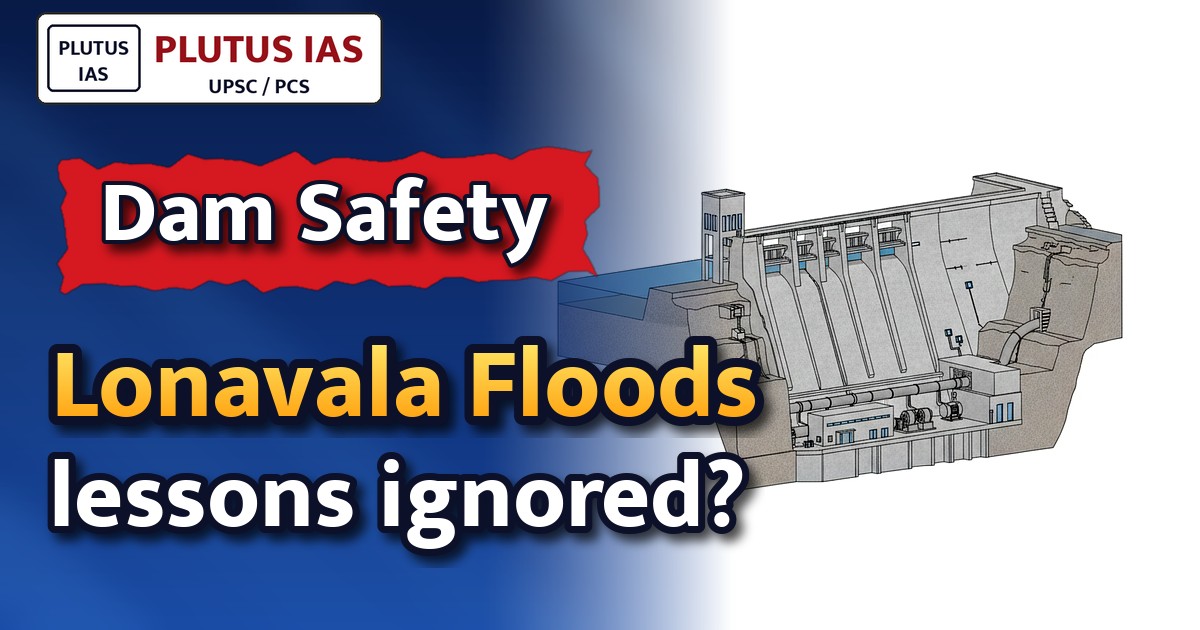
29 Sep NSDA conducts emergency plan review for Lonavala & Bhushi dams
✎ The National Dam Safety Authority (NDSA) is the apex body under the Dam Safety Act, 2021, tasked with ensuring dam safety through regulatory oversight, Emergency Action Plans (EAPs), and community resilience initiatives.
Subject Relevance — Where This Topic Fits
- GS Paper II — Governance, Transparency and Accountability | GS Paper III — Disaster and Disaster Management | GS Paper III — Water Resources
- Prelims: Dam Safety Act, 2021, National Dam Safety Authority (NDSA), Central Water and Power Research Station (CWPRS), Emergency Action Plan (EAP), Cascading Effect in Dam Failures, Early Warning Systems, Seva Sankalp Initiative
- Essay: Balancing Development and Environmental Sustainability: The Case of Dam Safety Management, Disaster Resilience and Community Preparedness in India
Quick Revision: The National Dam Safety Authority (NDSA) is the apex body under the Dam Safety Act, 2021, tasked with ensuring dam safety through regulatory oversight, Emergency Action Plans (EAPs), and community resilience initiatives.
Why is this in the news?
The National Dam Safety Authority (NDSA), under the Ministry of Jal Shakti, organised a stakeholder consultation on 27 September 2026 in Lonavala, Maharashtra, to review and strengthen the Emergency Action Plans (EAPs) for Lonavala and Bhushi Dams. This initiative is part of the broader ‘Seva Sankalp’ campaign aimed at enhancing dam safety and disaster preparedness, particularly in the context of recent flooding events in the region. The meeting underscored the need for robust coordination, timely information dissemination, and effective response mechanisms to safeguard downstream communities.
Background
- The Dam Safety Act, 2021, mandates the establishment of the National Dam Safety Authority (NDSA) to ensure the safety of dams across India, including their operational and structural integrity.
- India has over 5,700 large dams, with many located in high-risk seismic and flood-prone zones, necessitating stringent safety protocols.
- The NDSA, under the Ministry of Jal Shakti, functions as the apex body for dam safety, coordinating with state agencies, dam owners, and technical institutions like the Central Water and Power Research Station (CWPRS).
- Recent extreme weather events, including heavy rainfall and flooding in Maharashtra, have highlighted the vulnerabilities in dam safety and emergency preparedness.
- The ‘Seva Sankalp’ initiative is a multi-pronged campaign by the NDSA to enhance dam safety, environmental sustainability, and community resilience through awareness, training, and technical interventions.
- Lonavala and Bhushi Dams, owned by Tata Power and Central Railway respectively, are critical water storage and hydropower infrastructure in the Western Ghats region.
What is the National Dam Safety Authority (NDSA)?
- The NDSA is a statutory body established under the Dam Safety Act, 2021, to ensure the safety of dams in India by enforcing regulatory standards, conducting inspections, and promoting best practices in dam management.
- It operates under the Ministry of Jal Shakti and works in coordination with state dam safety organisations, dam owners, and technical institutions like the CWPRS and the Central Water Commission (CWC).
- The NDSA’s mandate includes the development and enforcement of Emergency Action Plans (EAPs) for high-risk dams, which outline procedures for warning, evacuation, and response during dam-related emergencies.
- The NDSA conducts regular inspections, risk assessments, and capacity-building exercises to mitigate risks associated with dam failures, particularly in the context of climate change-induced extreme weather events.
- The NDSA also promotes research and technological advancements in dam safety, including the use of early warning systems, real-time monitoring, and simulation modelling for cascading failure scenarios.
- The ‘Seva Sankalp’ initiative is a flagship programme of the NDSA aimed at fostering a culture of safety, sustainability, and community engagement in dam management.
- The NDSA’s role extends to environmental conservation, as seen in the tree-plantation drive conducted during the Lonavala consultation, aligning dam safety with ecological sustainability.
- The NDSA’s Western Regional Office in Pune, led by Director (WR) Mr. Harish Umbarge, plays a key role in coordinating safety measures for dams in Maharashtra and other western states.
Key Features
| Feature | Significance |
|---|---|
| Hazard-specific Emergency Action Plans (EAPs) | Ensures pre-identified, scenario-based responses for dam failures or extreme rainfall, reducing response time and mitigating downstream risks. |
| Multi-stakeholder Consultation Mechanism | Brings together dam owners, regulators (NDSA), technical agencies (CWPRS), and local authorities to align emergency protocols and communication channels. |
| Real-time Information Exchange Framework | Facilitates timely dissemination of flood warnings, rainfall data, and dam status to downstream communities and emergency responders. |
| Cascading Risk Assessment | Evaluates interdependencies between upstream (Lonavala) and downstream (Bhushi) dams to prevent compounded disasters during extreme events. |
| Community-Centric Early Warning Systems | Prioritizes the safety of vulnerable populations in low-lying areas through structured alert dissemination and evacuation drills. |
Why it Matters
Disaster Risk Reduction (DRR)
- Proactive risk mitigation through scenario-based emergency planning reduces human and economic losses from dam-related disasters.
- Strengthens India’s compliance with the Sendai Framework for Disaster Risk Reduction (2015–2030), particularly Target D: reducing disaster damage to critical infrastructure.
- Enhances resilience of downstream communities by integrating dam safety with local disaster preparedness plans.
Institutional Coordination
- Demonstrates the operationalization of the National Dam Safety Authority (NDSA) under the Dam Safety Act, 2021, by convening multi-agency consultations.
- Bridges gaps between technical agencies (CWPRS), dam owners (e.g., Tata Power, Central Railway), and regulatory bodies for unified crisis management.
- Sets a precedent for inter-state and inter-sectoral collaboration in managing transboundary water infrastructure risks.
Technical Safeguards
- Leverages hydro-meteorological data from CWPRS to refine emergency action thresholds for extreme rainfall events.
- Incorporates lessons from recent floods (e.g., 2026 Lonavala deluge) to update dam operation protocols and structural safety audits.
- Promotes adaptive management of dams by linking ecological conservation (tree plantation) with structural resilience.
Sustainable Water Resource Management
- Aligns dam safety with ecological sustainability, as seen in the tree-plantation initiative near Lonavala Dam, to balance infrastructure resilience with environmental stewardship.
- Supports India’s commitments under the National Water Mission (2011) to ensure equitable and sustainable water resource utilization.
Challenges
1. Real-Time Data Integration Gaps
- Delayed or fragmented transmission of hydro-meteorological data between agencies (e.g., IMD, CWPRS, dam operators) can undermine early warning systems.
- Dependence on manual data collection in some regions limits the granularity and timeliness of risk assessments.
UPSC Link: GS-III: Disaster Management
2. Inadequate Community Awareness
- Low awareness among downstream populations about evacuation routes, warning signals, and EAPs reduces the efficacy of emergency responses.
- Language barriers and socio-economic disparities in rural areas exacerbate communication gaps during crises.
UPSC Link: GS-II: Governance
3. Structural Vulnerabilities in Aging Dams
- Many dams in India, including Lonavala and Bhushi, were constructed decades ago and may lack modern safety standards for seismic activity or extreme rainfall.
- Insufficient funding for retrofitting and periodic safety audits delays critical infrastructure upgrades.
UPSC Link: GS-III: Infrastructure
4. Inter-Agency Coordination Bottlenecks
- Overlapping mandates among central (NDSA), state (Water Resources Departments), and local authorities can lead to duplication or gaps in emergency planning.
- Lack of standardized protocols for information sharing during multi-hazard events (e.g., floods + dam failure).
UPSC Link: GS-II: Federalism
5. Climate Change-Induced Extremes
- Increased frequency of extreme rainfall events (e.g., 2026 Lonavala floods) tests the robustness of existing dam safety frameworks.
- Uncertainty in climate projections complicates long-term risk planning for dam operators and policymakers.
UPSC Link: GS-III: Environment
Challenges — UPSC Perspective
| Issue | Concern |
|---|---|
| Data Latency | Delays in hydro-meteorological data transmission reduce the lead time for emergency actions. |
| Public Participation | Limited engagement of local communities in EAP design and drills hampers effective response. |
| Regulatory Gaps | Inconsistent enforcement of the Dam Safety Act, 2021, across states undermines uniform safety standards. |
| Funding Constraints | Insufficient budgetary allocations for dam rehabilitation and modernisation impede structural safety. |
| Technological Obsolescence | Outdated monitoring equipment (e.g., piezometers, spillway gates) increases failure risks during extreme events. |
Way Forward
- Constitute a dedicated task force under NDSA to standardize EAP templates and integrate them with state disaster management plans.
- Expand the use of IoT-based sensors and AI-driven predictive models to enhance real-time monitoring of dam structural health and rainfall thresholds.
- Launch nationwide awareness campaigns in local languages to educate downstream communities about EAPs, warning signals, and evacuation protocols.
- Establish a centralised data repository (e.g., Dam Safety Information System) to facilitate seamless data sharing among NDSA, CWPRS, IMD, and dam operators.
- Prioritise retrofitting of high-risk dams using climate-resilient design standards, with funding from the National Adaptation Fund for Climate Change (NAFCC).
- Mandate annual joint drills between dam owners, NDSA, and local authorities to test EAPs and identify coordination gaps.
- Integrate ecological conservation measures (e.g., afforestation) with dam safety protocols to enhance watershed resilience and reduce sedimentation risks.
- Develop a national framework for cascading risk assessment to evaluate interdependencies between upstream and downstream dams.
UPSC Value Addition
Keywords for Mains Answer-Writing
Dam Safety Act 2021 · National Dam Safety Authority (NDSA) · Dam Safety Organisation (DSO) · Emergency Action Plans (EAPs) · Cascading effects of dam failure · Early Warning Systems (EWS) · Central Water and Power Research Station (CWPRS) · Dam Safety Conventions · Stakeholder consultation in disaster management · Service Sankalp initiative · Environmental sustainability in dam operations · Cascade dam systems · Public safety and disaster preparedness
Concept Flow
Extreme rainfall events → Increased inflows into Lonavala and Bhushi dams → Elevated risk of overtopping or structural failure. → NDSA convenes multi-stakeholder consultation → Development of hazard-specific Emergency Action Plans (EAPs). → Real-time data integration (CWPRS, IMD) → Early warning dissemination to downstream communities. → Implementation of EAPs → Evacuation, relief operations, and coordination among dam owners, NDSA, and local authorities. → Post-event review → Identification of gaps in EAPs, structural vulnerabilities, and community awareness. → Policy feedback loop → Updates to Dam Safety Act, 2021, and state-level disaster management plans. → Long-term resilience → Retrofitting of dams, climate adaptation measures, and sustainable water resource management.
Prelims Practice Questions
Q1. Consider the following statements regarding the Dam Safety Act, 2021:
1. The Act mandates the establishment of a National Dam Safety Authority (NDSA) under the Ministry of Jal Shakti.
2. The Act applies to all dams in India, including those owned by private entities.
3. The Act requires every dam owner to prepare an Emergency Action Plan (EAP) and submit it to the State Dam Safety Organisation.
4. The Act exempts small dams with a height less than 10 metres from its provisions.
How many of the above statements are correct?
- Only one
- Only two
- Only three
- All four
Answer: Only three — Statements 1, 2, and 3 are correct as per the Dam Safety Act, 2021. Statement 4 is incorrect because the Act applies to all dams irrespective of height, though provisions for smaller dams may be relaxed by the State Governments.
Q2. Assertion (A): The National Dam Safety Authority (NDSA) is responsible for the enforcement of dam safety regulations across all states and union territories in India.
Reason (R): The Dam Safety Act, 2021 empowers the NDSA to inspect dams, review safety protocols, and issue directives to dam owners for compliance.
Options:
A. Both A and R are true, and R is the correct explanation of A.
B. Both A and R are true, but R is not the correct explanation of A.
C. A is true, but R is false.
D. A is false, but R is true.
Answer: ? — Both Assertion (A) and Reason (R) are true. The NDSA, established under the Dam Safety Act, 2021, has the mandate to enforce dam safety regulations, inspect dams, and issue directives for compliance, making R the correct explanation of A.
Q3. Match the following institutions with their roles in dam safety management:
Column I
1. National Dam Safety Authority (NDSA)
2. State Dam Safety Organisation (SDSO)
3. Central Water and Power Research Station (CWPRS)
4. Dam Rehabilitation and Improvement Project (DRIP)
Column II
A. Provides technical support and research for dam safety
B. Enforces dam safety regulations at the state level
C. Implements dam safety measures and rehabilitation projects
D. Coordinates dam safety policies and standards at the national level
Options:
1. 1-D, 2-B, 3-A, 4-C
2. 1-A, 2-B, 3-D, 4-C
3. 1-D, 2-A, 3-B, 4-C
4. 1-C, 2-B, 3-A, 4-D
Answer: ? — The correct match is: 1-D (NDSA coordinates national policies), 2-B (SDSO enforces regulations at the state level), 3-A (CWPRS provides technical support), and 4-C (DRIP implements rehabilitation projects).
Mains Practice Question
✍ Critically examine the role of the National Dam Safety Authority (NDSA) in enhancing dam safety and disaster preparedness in India. How far has the NDSA succeeded in fostering inter-agency coordination and updating Emergency Action Plans (EAPs) for cascading dam systems? Substantiate your answer with reference to the Dam Safety Act, 2021, and recent initiatives like the ‘Service Sankalp’ drive. (15 Marks)
Approach: MODEL-ANSWER SKELETON:
1. **Introduction (2 Marks)**
– Brief background on the importance of dam safety in India, citing the Dam Safety Act, 2021, and its objectives.
– Define the NDSA: statutory body under the Ministry of Jal Shakti, established to enforce dam safety regulations.
2. **Role of NDSA in Dam Safety (5 Marks)**
– **Regulatory Functions**: Mandate to inspect dams, review safety protocols, and issue directives (Sections 12-15 of the Act).
– **Standardisation**: Development of dam safety guidelines, manuals, and protocols for uniform implementation.
– **Technical Support**: Collaboration with CWPRS for research, risk assessment, and structural integrity studies.
– **Capacity Building**: Training and awareness programs for dam owners, operators, and state agencies.
3. **Disaster Preparedness and EAPs (4 Marks)**
– **Emergency Action Plans (EAPs)**: Legal requirement under Section 16 of the Act for all dam owners to prepare, update, and test EAPs.
– **Inter-Agency Coordination**: NDSA’s role in facilitating stakeholder consultations (e.g., with Tata Power, Central Railway, and state agencies) to ensure seamless communication and response mechanisms.
– **Cascading Dam Systems**: Focus on interdependencies (e.g., Lonavala and Bhushi dams) to mitigate downstream risks.
– **Early Warning Systems (EWS)**: Integration with IMD and state disaster management authorities for timely alerts.
4. **Critique and Challenges (3 Marks)**
– **Implementation Gaps**: Delays in updating EAPs, lack of uniform compliance across states, and resource constraints.
– **Inter-Agency Coordination**: Challenges in synchronising actions between NDSA, SDSO, CWPRS, and dam owners.
– **Public Awareness**: Limited community engagement in disaster preparedness and evacuation drills.
5. **Recent Initiatives and Way Forward (1 Mark)**
– **Service Sankalp Drive**: NDSA’s commitment to environmental sustainability (e.g., afforestation) and public safety.
– **Recommendations**: Strengthening NDSA’s enforcement powers, leveraging technology (AI/ML for risk prediction), and enhancing state-level capacities.
**Balanced View**: Acknowledge NDSA’s progress in policy formulation and stakeholder engagement while highlighting systemic challenges in implementation and compliance.
Source: PIB (Press Information Bureau)
Generated by AanyaAi for educational purpose.
Related guides on our sites
- Anthropology VS PSIR
- Best PSIR optional coaching
- Best PSIR optional coaching online
- Best PSIR optional teacher

- NSDA conducts emergency plan review for Lonavala & Bhushi dams - September 29, 2026
- एचएएल बाहर, 5वीं पीढ़ी के लड़ाकू विमान परियोजना में निजी क्षेत्र का प्रवेश - September 29, 2026
- Social Justice Dept Launches Quick Speech Contest on Swachhata for UPSC & PCS Prep - September 29, 2026

No Comments