


17 Sep Odisha CM Launches ‘Seva Sankalp Abhiyan’ for Blood Security Mission
✎ The ‘Atal Raktadan Abhiyan’ in Odisha, with a ₹50.54 crore budget for 2026–27, aims to modernise blood banks in medical colleges and ensure self-sufficiency in blood supply through voluntary donations, aligning with the National…
Subject Relevance — Where This Topic Fits
- GS Paper II — Governance, Transparency and Accountability | GS Paper III — Health, Human Resource Development
- Prelims: Blood donation camps, Public Health Policy, State Budget Allocation, Medical College Infrastructure, National Health Mission, National Blood Policy, Universal Health Coverage, Ayushman Bharat
- Essay: Public health as a determinant of national development, The role of state-led social welfare initiatives in achieving Sustainable Development Goals
Quick Revision: The ‘Atal Raktadan Abhiyan’ in Odisha, with a ₹50.54 crore budget for 2026–27, aims to modernise blood banks in medical colleges and ensure self-sufficiency in blood supply through voluntary donations, aligning with the National Blood Policy and SDG 3.8.
Why is this in the news?
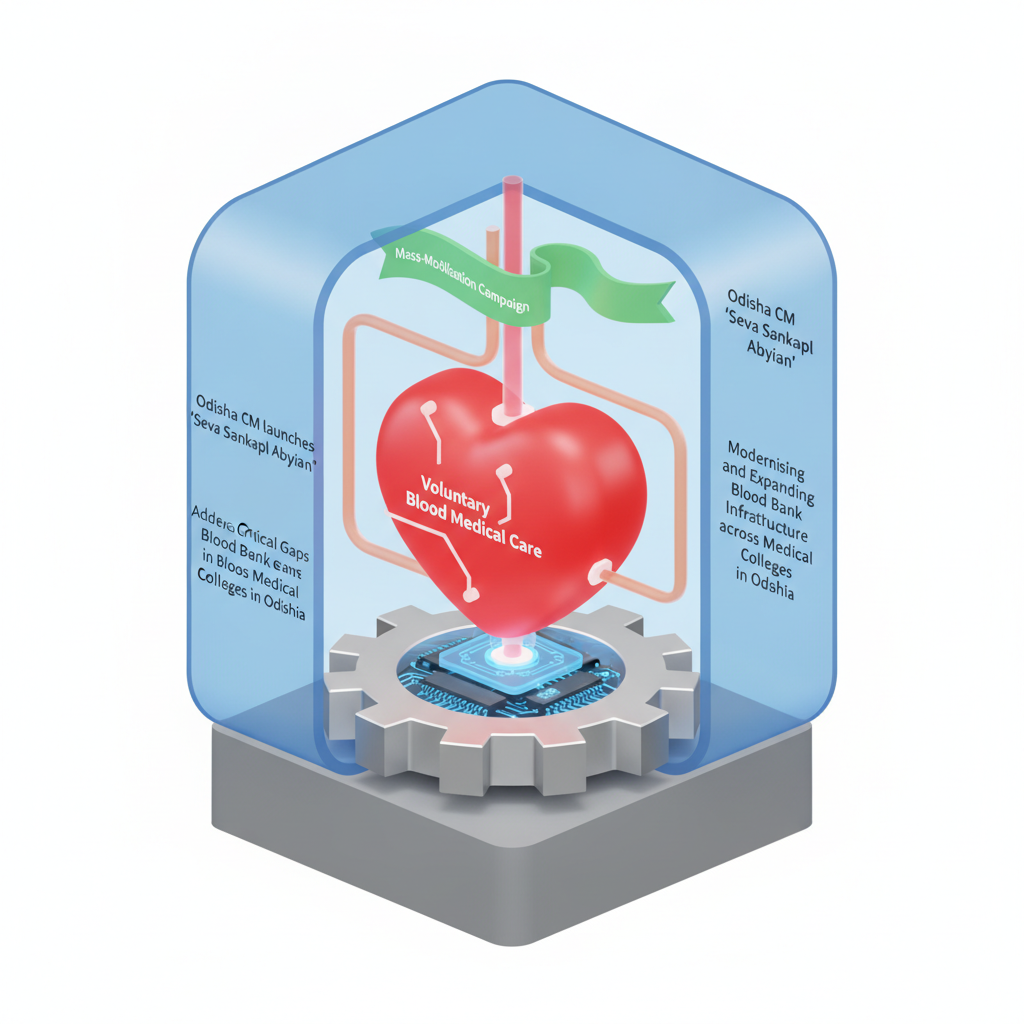
The launch of the month-long ‘Seva Sankalp Abhiyan’ by the Odisha Chief Minister on the occasion of the Prime Minister’s 76th birthday underscores the state’s commitment to addressing critical gaps in blood availability through a mass-mobilisation campaign. This initiative is anchored in the ‘Atal Raktadan Abhiyan’, a state-funded programme with a budgetary allocation of ₹50.54 crore for 2026–27, aimed at modernising and expanding blood bank infrastructure across medical colleges in Odisha. The campaign’s emphasis on voluntary blood donation aligns with national health priorities and highlights the intersection of governance, public health, and community participation in crisis mitigation.
Background
- Blood donation is a non-negotiable component of emergency medical care, trauma management, and surgical interventions, with no synthetic substitute available.
- The National Blood Policy (2002) and subsequent guidelines by the National Blood Transfusion Council (NBTC) mandate that states ensure self-sufficiency in blood supply through voluntary donations.
- Odisha, like other states, faces challenges such as low awareness, seasonal shortages, and logistical gaps in blood collection and storage, exacerbated by infrastructural constraints in rural areas.
- The ‘Atal Raktadan Abhiyan’ is a state-specific adaptation of national frameworks, integrating modernisation of blood banks with the expansion of healthcare infrastructure under the National Health Mission (NHM).
- The 2026–27 Odisha Budget reflects a strategic allocation of ₹50.54 crore for this initiative, signalling prioritisation of public health systems in the state’s fiscal planning.
- Community-driven initiatives, such as blood donation camps, are institutionalised through partnerships between state agencies, medical colleges, and youth organisations to foster a culture of voluntary donation.
What is the ‘Seva Sankalp Abhiyan’ and the ‘Atal Raktadan Abhiyan’?
- The ‘Seva Sankalp Abhiyan’ is a month-long mass-mobilisation campaign launched by the Odisha government to promote voluntary blood donation and address blood security in the state.
- The campaign is structured as a humanitarian service initiative, leveraging community participation to augment blood supply, particularly during periods of heightened demand such as festivals or medical emergencies.
- The ‘Atal Raktadan Abhiyan’ is the state’s flagship programme underpinning the campaign, with a dedicated budgetary allocation of ₹50.54 crore for 2026–27 to modernise and expand blood bank infrastructure.
- Under the initiative, blood banks are being established in newly commissioned medical colleges and existing facilities are being upgraded with advanced equipment, storage systems, and quality control mechanisms.
- The programme aligns with the National Blood Policy’s objective of achieving 100% voluntary blood donation and reducing dependency on replacement donors, thereby improving transfusion safety.
- The campaign includes targeted outreach to youth organisations, educational institutions, and community groups to sustain long-term engagement and address misconceptions about blood donation.
- The initiative also incorporates data-driven monitoring of blood collection targets (e.g., 6,500 units in the inaugural camp) and real-time tracking of inventory to mitigate shortages.
- By integrating blood security with broader healthcare infrastructure development, the programme contributes to Odisha’s progress toward Universal Health Coverage (UHC) and the Sustainable Development Goal (SDG) 3.8.
Key Features
| Feature | Significance |
|---|---|
| Month-long mass campaign (‘Seva Sankalp Abhiyan’) | Mobilises public participation in humanitarian service, particularly blood donation, to address critical shortages. |
| Blood donation camps | Direct engagement with citizens to collect voluntary donations, raising awareness and ensuring immediate supply augmentation. |
| Target of 6,500 units | Quantifies the campaign’s objective, providing a measurable benchmark for success and public accountability. |
| ‘Atal Raktadan Abhiyan’ initiative | State-led programme with dedicated budgetary allocation (₹50.54 crore) to expand and modernise blood banking infrastructure. |
| Modernisation of existing blood banks | Enhances storage capacity, testing protocols, and distribution efficiency to improve blood safety and availability. |
Why it Matters
Public Health
- Addresses the critical gap between blood demand and supply in Odisha, reducing preventable mortality due to blood shortages.
- Strengthens the state’s healthcare system by ensuring timely access to safe blood for emergencies, surgeries, and chronic conditions.
- Promotes voluntary blood donation culture, reducing reliance on replacement donors and mitigating risks of commercial blood trade.
Governance and Policy
- Demonstrates a state-led, structured approach to public health challenges through targeted budgetary allocations and multi-stakeholder coordination.
- Aligns with the National Blood Policy (2002) and WHO guidelines on blood safety, reinforcing Odisha’s commitment to global health standards.
- Highlights the role of political leadership in driving grassroots health initiatives, ensuring sustained public engagement.
Social and Humanitarian
- Fosters community solidarity and collective responsibility towards saving lives, transcending individualistic health-seeking behaviour.
- Encourages youth participation through organised campaigns, leveraging demographic dividends for long-term health outcomes.
- Normalises blood donation as a civic duty, potentially reducing stigma and misinformation associated with the process.
Challenges
1. Voluntary Blood Donation Participation
- Low awareness among rural and tribal populations about the need and process of voluntary blood donation.
- Cultural myths and misconceptions about blood donation persist, deterring potential donors.
- Limited accessibility to donation centres in remote areas, despite infrastructure expansion.
UPSC Link: GS2: Health – Public Health Challenges
2. Infrastructure and Logistics
- Existing blood banks may lack modern equipment for testing and storage, necessitating upgrades.
- Cold chain management for blood transportation remains a challenge, especially in hilly and coastal regions.
- Inadequate staffing and training in blood banks can compromise safety and efficiency.
UPSC Link: GS3: Infrastructure – Healthcare
3. Regulatory and Quality Assurance
- Ensuring compliance with the Drugs and Cosmetics Act, 1940, and National Blood Policy standards across all facilities.
- Monitoring and auditing of blood banks to prevent wastage, contamination, or misuse of donated blood.
- Coordinating with multiple agencies (state, central, NGOs) for seamless blood supply chain management.
UPSC Link: GS2: Health – Regulatory Framework
4. Sustainability and Scalability
- Maintaining momentum beyond the month-long campaign to ensure year-round blood availability.
- Balancing short-term campaign goals with long-term systemic reforms in blood banking.
- Securing consistent funding and resource allocation for sustained programme implementation.
UPSC Link: GS3: Public Service Delivery
Challenges — UPSC Perspective
| Issue | Concern |
|---|---|
| Low voluntary donation rates | Undermines the campaign’s objective of reducing dependency on replacement donors. |
| Geographical disparities in access | Excludes marginalised communities from benefiting equally from blood safety measures. |
| Quality control in blood banks | Risks of unsafe transfusions due to inadequate testing or storage protocols. |
| Public awareness gaps | Limits participation and perpetuates misconceptions about blood donation. |
| Logistical bottlenecks in distribution | Delays in transporting blood from collection centres to hospitals. |
Way Forward
- Expand mobile blood donation units to remote and tribal areas to improve accessibility.
- Launch sustained awareness campaigns in regional languages, addressing local myths and misconceptions.
- Strengthen training programmes for blood bank staff on modern testing and storage techniques.
- Establish a state-level blood transfusion service to centralise coordination and optimise resource utilisation.
- Integrate blood donation drives with existing health programmes (e.g., Ayushman Bharat) for broader reach.
- Enhance public-private partnerships to augment infrastructure and technical expertise in blood banks.
- Implement a real-time blood inventory management system to track supply and demand dynamically.
- Conduct periodic audits of blood banks to ensure compliance with national standards and reduce wastage.
UPSC Value Addition
Keywords for Mains Answer-Writing
Seva Sankalp Abhiyan · Atal Raktadan Abhiyan · blood donation campaigns · blood security · Odisha health infrastructure · public health governance · state-level welfare schemes · budgetary allocation for health · medical college blood banks · voluntary blood donation · public-private partnerships in health · Article 21 right to health · National Blood Policy 2002 · WHO guidelines on blood safety · sustainable health financing
Concept Flow
Public awareness deficit → Low voluntary blood donation → Blood shortages in emergencies → Increased mortality → State intervention via ‘Seva Sankalp Abhiyan’ → Mass blood donation drives → Immediate supply augmentation → Budgetary allocation for ‘Atal Raktadan Abhiyan’ → Expansion and modernisation of blood banks → Improved storage and testing → Policy alignment with National Blood Policy (2002) → Regulatory compliance → Enhanced safety and quality of blood supply → Sustained community engagement → Normalisation of blood donation → Long-term reduction in shortages
Prelims Practice Questions
Q1. Consider the following statements regarding the ‘Atal Raktadan Abhiyan’ launched in Odisha:
1. It is a state-level initiative aimed at ensuring blood security.
2. The scheme includes the establishment of blood banks in new medical colleges.
3. The budgetary allocation for the scheme in 2026-27 is Rs 50.54 crore.
4. The scheme mandates compulsory blood donation by all citizens above 18 years of age.
How many of the above statements are correct?
- Only one
- Only two
- Only three
- All four
Answer: Only three — Statements 1, 2, and 3 are correct as they align with the reported objectives and budgetary allocation of the ‘Atal Raktadan Abhiyan’. Statement 4 is incorrect as the scheme does not mandate compulsory blood donation.
Q2. Assertion (A): The ‘Seva Sankalp Abhiyan’ launched in Odisha is a month-long mass movement dedicated to humanitarian service.
Reason (R): The campaign aims to collect 6,500 units of blood during the month-long period.
Options:
A. Both A and R are true, and R is the correct explanation of A.
B. Both A and R are true, but R is not the correct explanation of A.
C. A is true, but R is false.
D. A is false, but R is true.
Answer: ? — Both the Assertion (A) and Reason (R) are factually accurate. The campaign is indeed a month-long mass movement, and the target of collecting 6,500 units of blood is explicitly stated as its objective.
Q3. Match the following pairs related to blood donation and public health initiatives in India:
Column I
A. National Blood Policy
B. Seva Sankalp Abhiyan
C. Atal Raktadan Abhiyan
D. WHO guidelines on blood safety
Column II
1. Launched in Odisha to ensure blood security
2. Provides framework for blood donation and storage
3. Global standards for safe and quality blood transfusion
4. Month-long mass movement for humanitarian service
Options:
A B C D
1 4 2 3
2 3 1 4
3 1 4 2
4 2 3 1
Answer: ? — A-2: The National Blood Policy provides the framework for blood donation and storage in India. B-4: The ‘Seva Sankalp Abhiyan’ is a month-long mass movement. C-1: The ‘Atal Raktadan Abhiyan’ is Odisha’s initiative for blood security. D-3: WHO guidelines set global standards for safe blood transfusion.
Mains Practice Question
✍ The ‘Seva Sankalp Abhiyan’ and ‘Atal Raktadan Abhiyan’ launched in Odisha exemplify state-led initiatives to address critical public health challenges. Critically examine the role of such campaigns in strengthening India’s healthcare system, with particular reference to blood security. Also, assess the constitutional and policy framework governing public health in India. (15 Marks)
Approach: Introduction: Define blood security and its significance in public health, citing WHO and National Blood Policy 2002.
1. Role of State-led Campaigns:
– Explain the objectives and implementation of ‘Seva Sankalp Abhiyan’ and ‘Atal Raktadan Abhiyan’.
– Discuss how such campaigns enhance public participation and awareness.
– Analyse the impact on blood donation rates and healthcare infrastructure.
2. Constitutional and Policy Framework:
– Article 21: Right to health and its judicial interpretation (e.g., Paschim Banga Khet Mazdoor Samity v. State of West Bengal).
– Article 47: Duty of the State to improve public health.
– National Health Policy 2017 and its emphasis on blood safety.
– Role of the Ministry of Health and Family Welfare and state governments.
3. Challenges and Limitations:
– Issues of sustainability, equitable access, and regional disparities.
– Role of private sector and NGOs in complementing state efforts.
– Data on blood donation trends and gaps in implementation.
4. Comparative Perspective:
– Compare Odisha’s initiatives with similar schemes in other states (e.g., Tamil Nadu’s ‘Thalassemia Prevention Programme’).
5. Conclusion:
– Summarise the importance of state-led campaigns in addressing public health challenges.
– Suggest measures for long-term sustainability and scalability.
Source: orissapost.com
Odisha PCS (OPSC (OAS)) — State PCS Practice
Prelims: Which of the following is NOT a key objective of Odisha CM Naveen Patnaik’s recently launched ‘Seva Sankalp Abhiyan’?
- A. To provide free healthcare services in remote tribal areas
- B. To distribute free smartphones to all rural youth
- C. To strengthen grassroots governance through public participation
- D. To promote skill development among women self-help groups
Answer: B. To distribute free smartphones to all rural youth — The ‘Seva Sankalp Abhiyan’ focuses on grassroots governance, healthcare outreach, and skill development but does not include free smartphone distribution as a stated objective.
Mains: Critically analyze the significance of Odisha CM Naveen Patnaik’s ‘Seva Sankalp Abhiyan’ in enhancing participatory governance and rural development. Suggest measures to ensure its effective implementation across all districts of Odisha.
Generated by AanyaAi for educational purpose.
Related guides on our sites
- Anthropology VS PSIR
- Best PSIR optional coaching
- Best PSIR optional coaching online
- Best PSIR optional teacher

- आंध्र प्रदेश सरकार जल्द शुरू करेगी ‘आदरण-3’ योजना, पारंपरिक कारीगरों को मिलेंगे आधुनिक उपकरण - September 18, 2026
- Adarana-3 Scheme Relaunch: Pensions for Vishwabrahmin Artisans at 50 - September 18, 2026
- डाक विभाग का विशेष अभियान 6: स्वच्छता और ई-कचरे के निपटान पर फोकस - September 18, 2026

No Comments