


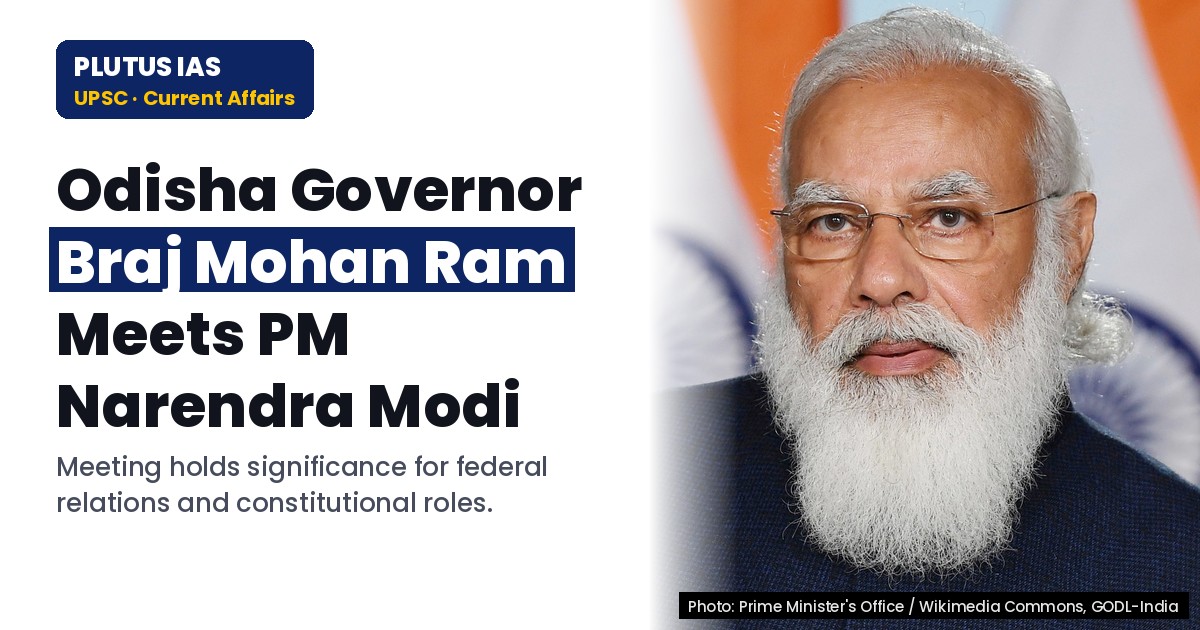
02 Nov Odisha Governor Meets PM Modi: UPSC General Studies
✎ The Governor serves as the constitutional head of a state and a representative of the Union government, embodying a critical link in India's federal structure with both nominal and discretionary powers.
Subject Relevance — Where This Topic Fits
- GS Paper II — Indian Constitution: historical underpinnings, evolution, features, amendments, significant provisions and basic structure. | GS Paper II — Functions and responsibilities of the Union and the States, issues and challenges pertaining to the federal structure, devolution of powers and finances up to local levels and challenges therein. | GS Paper II — Separation of powers between various organs dispute redressal mechanisms and institutions.
- Prelims: Governor’s appointment, Article 153, Article 155, Article 156, Discretionary powers of Governor, Centre-state relations, Sarkaria Commission, Punchhi Commission
- Essay: The evolving dynamics of federalism in India: A critical analysis of the Governor’s role., Constitutional morality and the office of the Governor: Upholding democratic principles.
Quick Revision: The Governor serves as the constitutional head of a state and a representative of the Union government, embodying a critical link in India’s federal structure with both nominal and discretionary powers.
Why is this in the news?
The Governor of Odisha, Shri Braj Mohan Ram, recently met with the Prime Minister, Shri Narendra Modi. Such interactions between constitutional functionaries, while routine, underscore the integral role of the Governor as a vital link between the Union and State governments, necessitating a review of the constitutional provisions and conventions governing this office within India’s federal framework.
Background
- The office of the Governor is a crucial institution in the Indian political system, serving as the constitutional head of a state and a representative of the Union government.
- Articles 153 to 167 in Part VI of the Constitution deal with the state executive, which includes the Governor, the Chief Minister, the Council of Ministers, and the Advocate General of the State.
- The Governor is appointed by the President by warrant under his hand and seal, as stipulated in Article 155, and holds office during the pleasure of the President (Article 156).
- The Governor acts on the ‘aid and advice’ of the Council of Ministers headed by the Chief Minister, except in matters where the Constitution requires him to act in his discretion.
- Over the years, the role of the Governor has been a subject of extensive debate, particularly concerning the balance between their constitutional duties and their function as a representative of the Centre, leading to various recommendations from commissions like Sarkaria and Punchhi.
- Meetings between the Governor and the Prime Minister are part of established protocol, facilitating communication on state affairs and matters of national importance, reinforcing the cooperative federal structure.
The Constitutional Position and Powers of the Governor
- The Governor is the nominal executive head of the state, analogous to the President at the Centre, exercising powers such as appointing the Chief Minister and other ministers, who hold office during the Governor’s pleasure.
- The Governor summons, prorogues, and dissolves the State Legislative Assembly, and addresses the first session after each general election and the first session of each year.
- All executive actions of the government of a state are formally taken in the name of the Governor.
- The Governor has legislative powers, including assenting to bills passed by the state legislature, reserving bills for the consideration of the President, and promulgating ordinances when the state legislature is not in session (Article 213).
- Judicial powers include granting pardons, reprieves, respites, or remissions of punishment or suspending, remitting, or commuting the sentence of any person convicted of any offence against any law relating to a matter to which the executive power of the state extends (Article 161).
- The Governor possesses certain discretionary powers, such as reserving a bill for the President’s consideration, recommending the imposition of President’s Rule in the state, and determining the amount payable by the Government of Assam, Meghalaya, Tripura, and Mizoram to an autonomous Tribal District Council as royalty accruing from mineral exploration.
- The Governor acts as a crucial channel of communication between the state government and the Union government, submitting reports to the President regarding the administration of the state.
- The office is often seen as a guardian of the Constitution in the state, ensuring that the state government functions in accordance with constitutional provisions.
Key Features
| Feature | Significance |
|---|---|
| Governor’s Role | The Governor serves as the constitutional head of a state, acting as a vital link between the Union and State governments, ensuring constitutional propriety. |
| Meeting with Prime Minister | Such interactions facilitate direct communication channels between the state’s constitutional head and the head of the Union government, allowing for discussions on state-specific issues and national policies. |
| Inter-Governmental Relations | These meetings are indicative of the cooperative federalism framework, where dialogue between different levels of government is crucial for effective governance and policy implementation. |
| Discretionary Powers | While largely bound by the aid and advice of the Council of Ministers, the Governor possesses certain discretionary powers, making direct communication with the Prime Minister significant for matters requiring central intervention or guidance. |
| Reporting Mechanism | The Governor is constitutionally mandated to send reports to the President regarding the affairs of the state, and interactions with the Prime Minister can inform these reports or address issues requiring Union attention. |
Why it Matters
Governance and Administration
- Facilitates direct communication between the state’s constitutional head and the Union’s executive head, potentially addressing administrative challenges or policy implementation hurdles.
- Provides an opportunity for the Governor to convey the state’s perspective on national policies or seek Union assistance for state-specific developmental initiatives.
- Reinforces the institutional mechanisms for inter-governmental coordination within India’s federal structure.
Federal Relations
- Underscores the principle of cooperative federalism, where dialogue and collaboration between the Union and states are essential for national progress.
- Allows for the exchange of information and perspectives on matters of mutual interest, strengthening the Union-state partnership.
- Helps in maintaining a harmonious relationship between the Union government and state administrations, crucial for political stability and effective governance.
Constitutional Propriety
- Upholds the constitutional role of the Governor as a representative of the Union in the state and a guardian of the Constitution.
- Demonstrates the functional aspects of the constitutional framework, where various officeholders interact to ensure the smooth functioning of the government.
- Provides a platform for discussing the constitutional duties and responsibilities of the Governor, especially concerning matters of state administration and legislative processes.
Challenges
1. Role Ambiguity of Governor
- The precise scope of the Governor’s discretionary powers and their interaction with the elected state government often leads to debates and constitutional interpretations.
- Balancing the role as a constitutional head and a representative of the Union government can be challenging, particularly during periods of political instability in the state.
UPSC Link: Indian Constitution – Governor’s powers
2. Maintaining Political Neutrality
- The Governor’s office is expected to remain politically neutral, yet appointments are made by the Union government, sometimes leading to perceptions of partisan influence.
- Ensuring that interactions with the Prime Minister are perceived as purely administrative and constitutional, rather than political, is crucial for maintaining public trust.
UPSC Link: Constitutional bodies – independence
3. Effective Communication Mechanisms
- While direct meetings are valuable, establishing consistent and structured communication channels between the Governor’s office, the state government, and the Union government is essential.
- Ensuring that the outcomes of such high-level meetings translate into tangible policy actions or resolutions at the state level requires robust follow-up mechanisms.
UPSC Link: Centre-State relations – administrative
Challenges — UPSC Perspective
| Issue | Concern |
|---|---|
| Governor’s Discretionary Powers | Potential for misuse or overreach, leading to conflicts with the elected state government and undermining democratic principles. |
| Political Appointments | Appointments of Governors by the Union government can sometimes lead to accusations of political bias, affecting the impartiality of the office. |
| Centre-State Tensions | Differences in political ideologies between the Union and state governments can strain the Governor’s position, making their role as a neutral arbiter difficult. |
| Lack of Clear Guidelines | Absence of explicit constitutional guidelines for certain situations can lead to ambiguity in the Governor’s actions and decisions. |
Way Forward
- Strengthen the recommendations of various commissions (e.g., Sarkaria, Punchhi) regarding the appointment and role of the Governor to ensure greater impartiality and constitutional adherence.
- Establish clear conventions and guidelines for the Governor’s interactions with both the state government and the Union government to avoid perceptions of political interference.
- Promote regular, structured inter-state council meetings and other forums for dialogue between Union and state representatives, including Governors, to foster cooperative federalism.
- Enhance transparency in the functioning of the Governor’s office, particularly concerning discretionary decisions, to build public trust and accountability.
- Focus on capacity building for gubernatorial staff to effectively manage the complex administrative and constitutional responsibilities of the office.
- Encourage a culture of mutual respect and constitutional propriety among all stakeholders, ensuring that the Governor’s office serves as a facilitator rather than an impediment to governance.
UPSC Value Addition
Keywords for Mains Answer-Writing
Governor’s role · Constitutional office · Centre-state relations · Federalism · Presidential assent · Discretionary powers · Article 153 · Article 163 · Council of Ministers · Chief Minister
Constitutional & Policy Linkages
- {‘article’: ‘Article 153’, ‘note’: ‘Governor for each State’}
- {‘article’: ‘Article 154’, ‘note’: ‘Executive power of State’}
- {‘article’: ‘Article 155’, ‘note’: ‘Appointment of Governor’}
- {‘article’: ‘Article 156’, ‘note’: “Term of Governor’s office”}
- {‘article’: ‘Article 163’, ‘note’: ‘Aid and advice to Governor’}
- {‘article’: ‘Article 356’, ‘note’: “President’s Rule in states”}
Concept Flow
Governor, as constitutional head, meets Prime Minister. → Discussion on state affairs and national policies ensues. → Information exchange strengthens Union-state coordination. → Potential for addressing state-specific challenges or seeking Union support. → Reinforces cooperative federalism and constitutional governance.
Prelims Practice Questions
Q1. Consider the following statements regarding the office of the Governor in India:
1. The Governor is appointed by the President of India and holds office during the pleasure of the President.
2. The Constitution specifies the procedure for the removal of the Governor.
3. The Governor acts as a nominal head of the state executive and is bound by the aid and advice of the Council of Ministers headed by the Chief Minister, except in matters where the Governor is required to act in his discretion.
How many of the above statements are correct?
- Only one
- Only two
- Only three
- None
Answer: Only two — Statement 1 is correct. Article 155 states that the Governor of a state shall be appointed by the President by warrant under his hand and seal. Article 156 states that the Governor shall hold office during the pleasure of the President.
Statement 2 is incorrect. The Constitution does not specify any procedure or grounds for the removal of the Governor, unlike the President or Supreme Court judges.
Statement 3 is correct. Article 163(1) states that there shall be a Council of Ministers with the Chief Minister at the head to aid and advise the Governor in the exercise of his functions, except insofar as he is by or under this Constitution required to exercise his functions or any of them in his discretion.
Q2. Match the following constitutional provisions with their descriptions:
List I (Constitutional Provision)
1. Article 153
2. Article 155
3. Article 163
4. Article 200
List II (Description)
A. Governor’s discretionary powers
B. Governor’s assent to Bills
C. Appointment of Governor
D. Office of Governor for each state
Which of the following is the correct matching?
- 1-D, 2-C, 3-A, 4-B
- 1-C, 2-D, 3-A, 4-B
- 1-D, 2-C, 3-B, 4-A
- 1-A, 2-B, 3-C, 4-D
Answer: 1-D, 2-C, 3-A, 4-B — Article 153 states that there shall be a Governor for each state.
Article 155 deals with the appointment of the Governor by the President.
Article 163 pertains to the Council of Ministers to aid and advise the Governor, and also mentions the Governor’s discretionary powers.
Article 200 deals with the Governor’s assent to Bills passed by the State Legislature, including reserving Bills for the President’s consideration.
Mains Practice Question
✍ Critically examine the role of the Governor as a crucial link between the Union and State governments in the Indian federal structure. Discuss with reference to the contemporary challenges and judicial pronouncements concerning the office. (15 Marks)
Approach: INTRODUCTION: Briefly introduce the constitutional office of the Governor (Articles 153-167) and its dual role as the constitutional head of the state and a representative of the Union government.
BODY 1: Role as a crucial link:
– Constitutional head of the state: Nominal executive, acts on aid and advice of Council of Ministers (Article 163).
– Representative of the Union: Appointed by President (Article 155), holds office during President’s pleasure (Article 156), reports on state affairs to the President (Article 356).
– Specific functions: Reserving bills for President’s consideration (Article 200), recommending President’s Rule (Article 356), seeking information from CM (Article 167).
BODY 2: Contemporary challenges and judicial pronouncements:
– Challenges: Controversies surrounding appointment and removal, exercise of discretionary powers (e.g., inviting parties to form government, dismissing CMs, assenting to bills), perceived political partisanship.
– Key judicial pronouncements: S.R. Bommai v. Union of India (1994) on Article 356 and limits on Governor’s discretion; Rameshwar Prasad v. Union of India (2006) on the Governor’s role in government formation; Nabam Rebia & Bamang Felix v. Deputy Speaker (2016) on discretionary powers and floor tests.
– Recommendations of various commissions: Sarkaria Commission (1988), M.M. Punchhi Commission (2010) on appointment, removal, and discretionary powers of the Governor.
CONCLUSION: Summarize the delicate balance required for the Governor’s office to function effectively, upholding constitutional propriety and fostering cooperative federalism, while acknowledging the need for reforms to ensure impartiality and accountability.
Source: PIB (Press Information Bureau)
Odisha PCS (OPSC (OAS)) — State PCS Practice
Prelims: Which of the following statements is/are correct regarding the recent meeting of the Governor of Odisha with the Prime Minister?
1. The meeting primarily focused on the administrative challenges faced by the state.
2. Such meetings are part of the routine constitutional duties of a Governor.
3. The Governor represents the state government’s views to the central leadership.
- A. 1 only
- B. 2 only
- C. 1 and 3 only
- D. 2 and 3 only
Answer: B. 2 only — The meeting between the Governor and the Prime Minister is a routine constitutional interaction, where the Governor, as the constitutional head, apprises the central leadership of the state’s affairs.
Mains: Discuss the constitutional role and responsibilities of a Governor in a state like Odisha, particularly in the context of their interactions with the Union government and the Prime Minister. (150 words)
Generated by AanyaAi for educational purpose.
Related guides on our sites
- Current affairs for upsc 2026
- Best PSIR optional coaching for upsc
- Best PSIR optional teacher for upsc
- Best teacher of PSIR optional for upsc

- Odisha Governor Meets PM Modi: UPSC General Studies - November 2, 2026
- सियांग परियोजना: भूमि मालिकों की अनदेखी, राज्य सरकार पर अविश्वास - November 2, 2026
- JPC on FCRA Bill: Foreign Funds to Churches & NGOs - November 2, 2026

No Comments