


08 Sep Odisha Launches AI-Powered OSWAS 3.0 for Paperless Governance
✎ OSWAS 3.0 is Odisha’s AI-powered digital governance platform integrating workflow automation, analytics, and real-time tracking to enhance administrative efficiency and transparency.
Subject Relevance — Where This Topic Fits
- GS Paper II — Governance, Transparency and Accountability | GS Paper III — Science and Technology — AI and Digital Governance | GS Paper III — E-Governance Initiatives in India
- Prelims: OSWAS 3.0, TCS DigiBOLT, Microservices-based architecture, Electronic approvals, Real-time tracking in governance, Odisha Computer Application Centre (OCAC), Paperless governance, AI-enabled decision support
- Essay: The role of artificial intelligence in transforming public administration: opportunities and challenges, Digital governance as a catalyst for inclusive development and administrative efficiency
Quick Revision: OSWAS 3.0 is Odisha’s AI-powered digital governance platform integrating workflow automation, analytics, and real-time tracking to enhance administrative efficiency and transparency.
Why is this in the news?
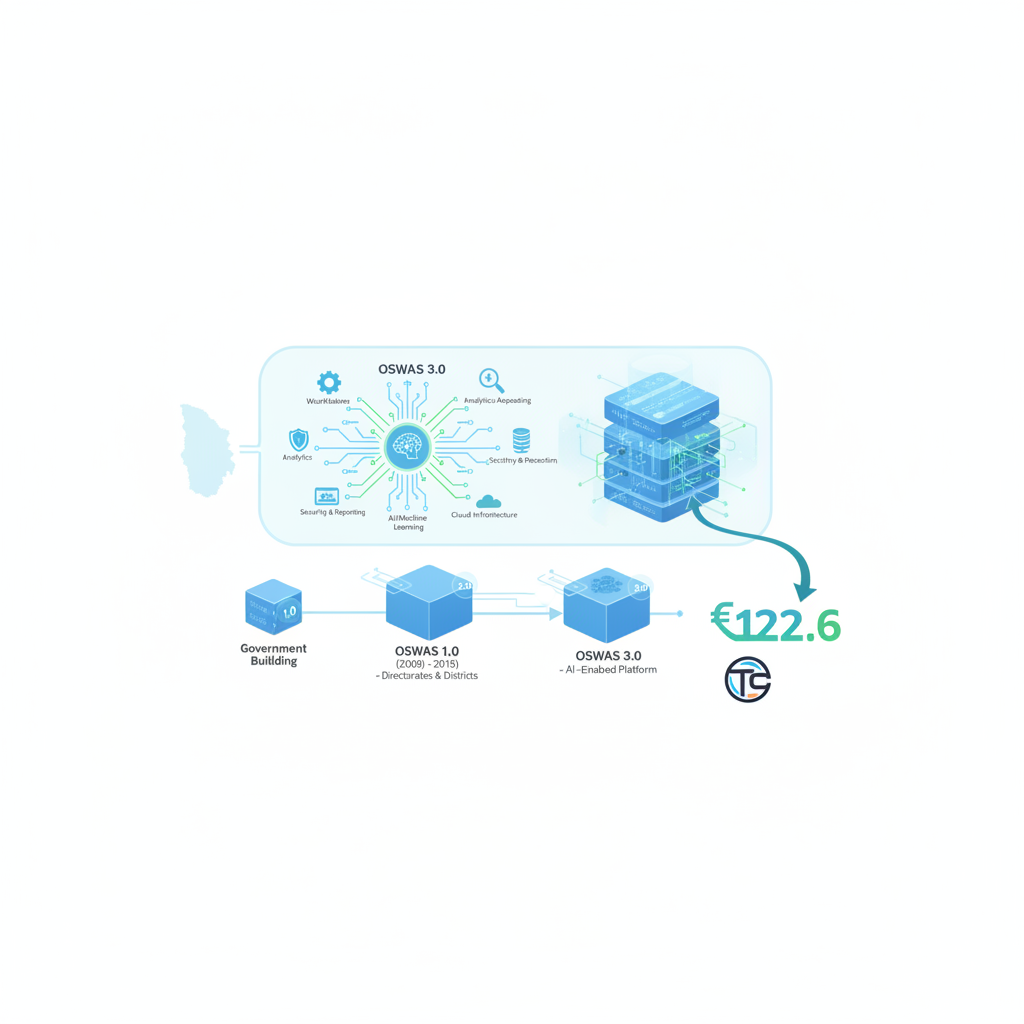
The Odisha government has awarded Tata Consultancy Services (TCS) a ₹122.6 crore contract to implement OSWAS 3.0, an AI-enabled governance platform designed to modernise the state’s paperless governance system. This initiative represents a significant advancement in e-governance, integrating workflow automation, analytics, security, and artificial intelligence to enhance administrative efficiency, transparency, and decision-making across government departments.
Background
- Odisha’s e-governance journey began in 2009 with the introduction of the Odisha State Workflow Automation System (OSWAS) by TCS, initially aimed at digitising file processing and official correspondence within the Odisha Secretariat.
- In 2018, OSWAS 2.0 was launched, expanding the platform to include directorates and districts, thereby extending digital governance to a broader administrative network.
- As of the current phase, OSWAS supports over 4,600 government offices and nearly 50,000 users, demonstrating the scalability and institutionalisation of digital governance in the state.
- The adoption of OSWAS aligns with the broader national agenda of digital governance, as outlined in the Digital India programme, which emphasises the use of technology to improve service delivery and governance efficiency.
- AI integration in governance is a global trend, with several countries leveraging artificial intelligence to automate routine tasks, enhance decision-making, and improve citizen engagement.
- The partnership between the Odisha government and TCS reflects a public-private collaboration model that is increasingly being adopted to accelerate digital transformation in governance.
What is OSWAS 3.0?
- OSWAS 3.0 is the third iteration of the Odisha State Workflow Automation System, an AI-enabled governance platform designed to modernise and streamline administrative processes through digital workflow automation.
- The platform integrates multiple functionalities, including workflow automation, analytics, security, and artificial intelligence, to create a unified digital workplace for government departments.
- Key features include digital file processing, electronic approvals, real-time tracking of administrative tasks, and mobile-first accessibility, enabling officials to perform duties remotely and efficiently.
- The platform is powered by TCS DigiBOLT, a microservices-based architecture that ensures interoperability, scalability, and enhanced security, aligning with modern IT governance standards.
- AI-enabled capabilities within OSWAS 3.0 facilitate faster and more informed decision-making by providing data-driven insights and automating routine administrative tasks.
- The platform supports the Odia language, ensuring accessibility and usability for local stakeholders, thereby promoting inclusivity in governance.
- OSWAS 3.0 is designed to reduce administrative friction, improve accountability, and accelerate the transition from decision to implementation, thereby enhancing the overall efficiency of public service delivery.
- The platform’s architecture is built to integrate seamlessly with existing government applications, ensuring continuity and minimising disruption during the transition phase.
Key Features
| Feature | Significance |
|---|---|
| AI-enabled workflow automation | Reduces manual file processing, minimises delays, and introduces predictive analytics for faster decision-making across government departments. |
| Unified digital workplace (TCS DigiBOLT) | Integrates multiple governance functions—file processing, approvals, tracking—into a single platform, enhancing inter-departmental coordination. |
| Mobile-first design | Enables officials to access and process governance tasks remotely, improving responsiveness and reducing bureaucratic friction. |
| Odia language support | Ensures accessibility for local stakeholders, aligning with the state’s linguistic diversity and promoting inclusive governance. |
| Microservices-based architecture | Facilitates scalability, modular updates, and resilience, allowing the system to evolve with technological advancements and policy needs. |
| Real-time tracking and analytics | Provides data-driven insights for policy evaluation, resource allocation, and performance monitoring, enhancing accountability. |
Why it Matters
Governance Modernisation
- Demonstrates Odisha’s commitment to a paperless, efficient, and citizen-centric administration, aligning with the Digital India vision.
- Reduces turnaround time for citizen services by automating routine tasks and minimising human intervention.
- Enhances transparency through audit trails, digital signatures, and real-time status tracking of government processes.
- Sets a benchmark for other states in adopting AI-driven governance models, particularly in workflow automation and service delivery.
Technological Advancement
- Leverages artificial intelligence to augment human decision-making, enabling predictive analytics and automation of repetitive tasks.
- Adopts a microservices architecture, ensuring flexibility, scalability, and resilience against system failures.
- Integrates security protocols to safeguard sensitive government data, addressing cybersecurity challenges in digital governance.
Economic Impact
- Reduces operational costs by minimising paper usage, physical file movement, and manual labour in administrative processes.
- Potential to improve ease of doing business by streamlining regulatory approvals and reducing bureaucratic bottlenecks.
- Creates opportunities for local IT firms and startups to collaborate with the state government on digital transformation projects.
Capacity Building
- Empowers government officials with digital literacy and tools to adapt to AI-enabled governance systems.
- Encourages a culture of data-driven decision-making within the bureaucracy, fostering innovation and efficiency.
Challenges
1. Digital Divide and Accessibility
- Risk of excluding officials or citizens without access to digital devices or internet connectivity, particularly in rural areas.
- Ensuring the platform’s usability for officials with varying levels of digital literacy requires targeted training programmes.
UPSC Link: GS2: Digital Divide
2. Data Privacy and Security
- Handling sensitive citizen and government data necessitates robust cybersecurity measures to prevent breaches or misuse.
- Compliance with the Personal Data Protection Bill (2023) and other relevant regulations is critical to maintain public trust.
UPSC Link: GS3: Cybersecurity
3. Interoperability with Legacy Systems
- Integrating the new AI-enabled platform with existing government databases and workflows may face compatibility issues.
- Requires phased migration strategies to avoid disruptions in ongoing governance operations.
UPSC Link: GS2: Interoperability
4. Resistance to Change in Bureaucracy
- Traditional governance structures may resist adoption due to inertia, fear of job displacement, or unfamiliarity with digital tools.
- Change management initiatives, including incentives and awareness campaigns, are essential for successful implementation.
UPSC Link: GS4: Organisational Behaviour
5. Cost Overruns and Sustainability
- Long-term maintenance, updates, and scaling of the platform require sustained funding and resource allocation.
- Dependence on a single vendor (TCS) for implementation and support poses risks related to vendor lock-in and cost escalation.
UPSC Link: GS3: Public Expenditure
Challenges — UPSC Perspective
| Issue | Concern |
|---|---|
| Digital literacy among officials | Limited familiarity with AI tools may hinder adoption and utilisation of the platform. |
| Rural-urban digital divide | Unequal access to internet and devices could exclude rural citizens from benefiting equally. |
| Vendor dependency | Over-reliance on TCS for maintenance and updates may limit flexibility and increase costs over time. |
| Data localisation requirements | Compliance with state-specific data storage laws may add complexity to system design. |
| Integration with existing e-governance projects | Ensuring seamless interoperability with schemes like e-District or DigiLocker is critical for holistic governance. |
| Public trust and transparency | Citizens may scepticism about data security and misuse, necessitating clear communication and accountability mechanisms. |
Way Forward
- Conduct capacity-building programmes for government officials to enhance digital literacy and familiarity with AI tools.
- Develop a phased rollout plan to ensure smooth integration with existing e-governance systems and minimise disruptions.
- Establish a dedicated cybersecurity task force to monitor threats, conduct audits, and ensure compliance with data protection norms.
- Create a citizen feedback mechanism to identify pain points and areas for improvement in the platform’s usability.
- Promote public awareness campaigns to build trust, explain the benefits of the platform, and address concerns about data privacy.
- Explore partnerships with local IT firms and academic institutions to foster innovation and reduce vendor dependency.
- Regularly update the platform’s AI models to incorporate feedback, improve accuracy, and adapt to evolving governance needs.
- Monitor key performance indicators (KPIs) such as reduction in processing time, user adoption rates, and citizen satisfaction to evaluate impact.
UPSC Value Addition
Keywords for Mains Answer-Writing
Artificial Intelligence in governance · Digital governance · e-governance · Government workflow automation · Paperless governance · AI-enabled public service delivery · Digital India Mission · State-level digital initiatives · Public sector digital transformation · Odisha State Workflow Automation System (OSWAS) · TCS DigiBOLT · Microservices architecture in government · Interoperability in e-governance · Real-time governance tracking · Odia language support in digital platforms · Public sector accountability through technology
Concept Flow
Inception of OSWAS (2009) → Digitisation of file processing and official correspondence in Odisha Secretariat. → Expansion to OSWAS 2.0 (2018) → Integration with directorates and districts, expanding user base to ~50,000 officials. → Adoption of AI-enabled capabilities (2026) → Implementation of TCS DigiBOLT to automate workflows, introduce predictive analytics, and enhance mobility. → Operationalisation of OSWAS 3.0 → Unified digital workplace with real-time tracking, Odia language support, and enhanced security. → Impact on governance → Reduced bureaucratic delays, improved transparency, and data-driven decision-making for citizens and officials.
Prelims Practice Questions
Q1. Consider the following statements regarding the Odisha State Workflow Automation System (OSWAS) 3.0:
1. OSWAS 3.0 is powered by TCS DigiBOLT and integrates AI-enabled capabilities.
2. The system supports over 4,600 government offices and nearly 50,000 users statewide.
3. OSWAS 3.0 is designed exclusively for the Odisha Secretariat and does not extend to directorates or districts.
4. The platform facilitates digital file processing, electronic approvals, and real-time tracking across the state administration.
How many of the above statements are correct?
- Only one
- Only two
- Only three
- All four
Answer: Only three — Statements 1, 2, and 4 are correct. Statement 3 is incorrect because OSWAS 2.0 (2018) expanded to include directorates and districts, and OSWAS 3.0 builds on this foundation.
Q2. Assertion (A): The Odisha State Workflow Automation System (OSWAS) 3.0 employs a microservices-based architecture to enhance interoperability and scalability.
Reason (R): Microservices architecture allows for modular development, independent deployment, and easier maintenance of digital governance platforms.
In the context of the above two statements, which of the following is correct?
- Both A and R are true, and R is the correct explanation of A.
- Both A and R are true, but R is not the correct explanation of A.
- A is true, but R is false.
- A is false, but R is true.
Answer: Both A and R are true, and R is the correct explanation of A. — Both A and R are true. OSWAS 3.0 uses a microservices-based architecture for modularity and scalability, and R correctly explains why this architecture is beneficial for digital governance systems.
Q3. Match the following initiatives with their respective features:
Initiative:
1. OSWAS 3.0
2. Digital India Mission
3. Aadhaar-enabled Payment System (AePS)
4. Unified Payments Interface (UPI)
Feature:
A. Real-time governance tracking and digital file processing
B. National digital infrastructure for seamless service delivery
C. Biometric authentication for financial inclusion
D. Instant inter-bank fund transfers
Select the correct match:
- 1-A, 2-B, 3-C, 4-D
- 1-B, 2-A, 3-C, 4-D
- 1-D, 2-B, 3-A, 4-C
- 1-A, 2-D, 3-C, 4-B
Answer: 1-A, 2-B, 3-C, 4-D — 1-A (OSWAS 3.0 focuses on real-time governance tracking and digital file processing), 2-B (Digital India Mission aims to create a national digital infrastructure), 3-C (AePS uses biometric authentication), 4-D (UPI enables instant inter-bank fund transfers).
Mains Practice Question
✍ The integration of Artificial Intelligence (AI) and advanced digital technologies into public governance systems represents a paradigm shift toward efficient, transparent, and citizen-centric administration. In this context, critically examine the potential benefits and challenges of AI-enabled governance platforms like Odisha’s OSWAS 3.0. (15 Marks)
Approach: MODEL-ANSWER SKELETON:
1. **Introduction (2 marks)**: Define AI-enabled governance and cite OSWAS 3.0 as a contemporary example. Highlight the broader context of Digital India Mission and e-governance initiatives.
2. **Benefits (5 marks)**:
– **Efficiency and speed**: Reduction in bureaucratic delays through automation (e.g., digital file processing, real-time tracking).
– **Transparency and accountability**: Electronic approvals and audit trails enhance traceability and reduce discretionary powers.
– **Data-driven decision-making**: AI-enabled analytics provide insights for policy formulation and resource allocation.
– **Inclusivity**: Odia language support ensures accessibility for non-English-speaking populations.
– **Interoperability**: Microservices architecture enables seamless integration across departments and legacy systems.
3. **Challenges (5 marks)**:
– **Data privacy and security**: Risks of data breaches, unauthorized access, and compliance with the Digital Personal Data Protection Act, 2023.
– **Digital divide**: Unequal access to technology among citizens and officials, particularly in rural areas.
– **Algorithmic bias**: Potential for AI models to perpetuate existing biases in decision-making processes.
– **High implementation costs**: Significant initial investment and long-term maintenance expenses.
– **Resistance to change**: Bureaucratic inertia and lack of digital literacy among officials.
4. **Way Forward (3 marks)**:
– Strengthen cybersecurity frameworks and conduct regular audits.
– Invest in digital literacy programs for officials and citizens.
– Adopt ethical AI guidelines and ensure transparency in algorithmic decision-making.
– Promote public-private partnerships for sustainable funding and innovation.
5. **Conclusion (2 marks)**: Summarize the transformative potential of AI in governance while acknowledging the need for robust safeguards and inclusive design.
Source: orissapost.com
Odisha PCS (OPSC (OAS)) — State PCS Practice
Prelims: Which company has been awarded the bid by the Odisha government to develop an AI-enabled governance platform aimed at enhancing administrative efficiency in the state?
- A) Tata Consultancy Services (TCS)
- B) Wipro Limited
- C) Infosys Limited
- D) HCL Technologies
Answer: B) Wipro Limited — Wipro Limited has been selected by the Odisha government to build an AI-enabled governance platform for improved administrative services.
Mains: Discuss the potential benefits and challenges of implementing an AI-enabled governance platform in Odisha. How can this initiative align with the state’s digital transformation goals? Elaborate with suitable examples.
Generated by AanyaAi for educational purpose.
Related guides on our sites
- Best PSIR optional coaching for upsc
- Best PSIR optional teacher for upsc
- Best teacher of PSIR optional for upsc
- Best PSIR optional coaching in delhi for UPSC

- आरबीआई द्वारा 91, 182 और 364 दिनीय ट्रेजरी बिलों की नीलामी: प्रमुख तथ्य - October 24, 2026
- Inflation’s Second-Round Effects: RBI Policy & Economic Impact Analysis - October 24, 2026
- ISRO का NVS-03 उपग्रह: NavIC को पुनः सक्रिय करेगा, जानिए कैसे? - October 24, 2026

No Comments