


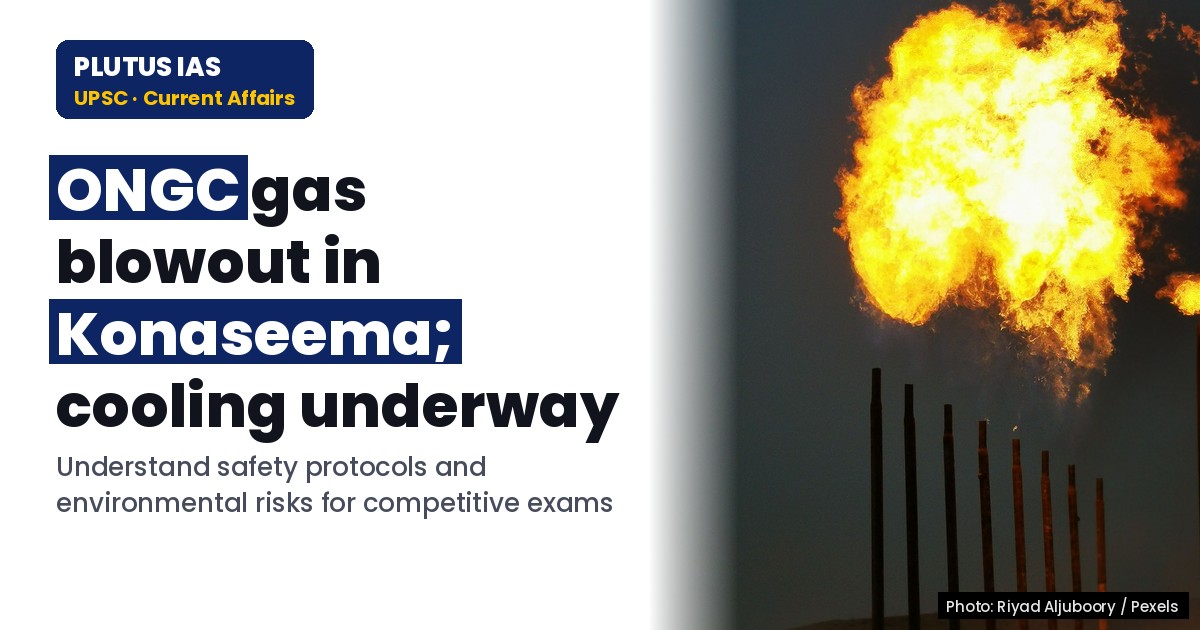
26 Oct ONGC Blowout in Konaseema: Causes, Impact & Lessons for UPSC
✎ A blowout is an uncontrolled release of hydrocarbons from a well due to failure of pressure control systems, necessitating immediate well-control interventions and long-term adherence to safety protocols.
Subject Relevance — Where This Topic Fits
- GS Paper III — Environment and Disaster Management | GS Paper III — Science and Technology (Energy Sector) | GS Paper II — Government Policies and Interventions for Development in various sectors
- Prelims: Blowout, Well control, Natural gas extraction, Disaster management, Environmental impact assessment, Oil and Natural Gas Corporation (ONGC), Drilling hazards
Quick Revision: A blowout is an uncontrolled release of hydrocarbons from a well due to failure of pressure control systems, necessitating immediate well-control interventions and long-term adherence to safety protocols.
Why is this in the news?
A blowout at the ONGC-operated Mori-5 gas well in Dr. B. R. Ambedkar Konaseema district, Andhra Pradesh, has drawn attention to the technical challenges in natural gas extraction, the risks of unplanned hydrocarbon releases, and the institutional mechanisms for crisis response. The incident, occurring during repair operations, underscores the importance of adherence to safety protocols, preparedness for environmental emergencies, and the role of international expertise in mitigating industrial hazards.
Background
- Natural gas extraction involves drilling wells to access underground reservoirs, where high-pressure hydrocarbons are trapped. Blowouts occur when the pressure control mechanisms fail, leading to uncontrolled release of gas or oil.
- The Oil and Natural Gas Corporation (ONGC) is India’s largest public sector undertaking engaged in the exploration and production of hydrocarbons, operating over 11,000 wells across the country.
- The Dr. B. R. Ambedkar Konaseema district in Andhra Pradesh is part of the Krishna-Godavari (KG) basin, a significant geological formation for natural gas reserves in India.
- India’s energy security strategy prioritises domestic production of natural gas to reduce import dependence, making the safe and sustainable operation of gas fields critical.
- Historically, blowouts have occurred globally, including the 2010 Deepwater Horizon disaster in the Gulf of Mexico, highlighting the catastrophic potential of such incidents.
What is a Blowout in Oil and Gas Extraction?
- A blowout is an uncontrolled release of crude oil, natural gas, or other fluids from a well during drilling or production due to failure of pressure control systems.
- Blowouts can result from equipment failure, human error, or geological unpredictability, leading to fires, explosions, environmental contamination, and loss of life.
- Well control systems, such as blowout preventers (BOPs), are critical safety mechanisms designed to seal the wellbore and prevent uncontrolled fluid release.
- The severity of a blowout depends on the type of fluid (gas or oil), reservoir pressure, and proximity to human settlements or sensitive ecosystems.
- Immediate response involves activating emergency shutdown systems, deploying well-control experts, and conducting cooling operations to prevent ignition or escalation.
- Long-term mitigation includes robust well design, regular maintenance, personnel training, and adherence to national and international safety standards.
- The incident at Mori-5 involved a natural gas leak, which, while less likely to cause environmental damage than oil, poses significant fire and explosion risks.
- International well-control experts are often engaged for advanced interventions, such as casing cutting or plugging operations, to regain control of the well.
Key Features
| Feature | Significance |
|---|---|
| Blowout at ONGC well Mori-5 | A blowout is an uncontrolled release of natural gas or crude oil from a well, posing immediate risks to personnel, infrastructure, and the environment. |
| Repair works during incident | The blowout occurred during repair operations to enhance gas flow, highlighting the operational risks associated with maintenance activities in hydrocarbon extraction. |
| Cooling operations underway | Active cooling measures are being deployed to mitigate fire hazards and stabilise the well, demonstrating standard emergency response protocols in oil and gas operations. |
| International well-control experts engaged | The involvement of international experts underscores the technical complexity of well-control operations and the need for specialised expertise in crisis management. |
| No human habitation within 600 metres | The absence of nearby settlements reduces immediate risk to civilian life, though environmental and ecological impacts remain a concern. |
Why it Matters
Economic
- Disruption to natural gas supply may impact regional energy security and industrial operations dependent on ONGC’s output.
- Financial losses for ONGC due to operational downtime, repair costs, and potential penalties for environmental violations.
- Potential impact on investor confidence in India’s hydrocarbon sector, particularly in exploration and production (E&P) activities.
Environmental
- Uncontrolled gas release contributes to greenhouse gas emissions, exacerbating climate change impacts.
- Risk of soil and water contamination from gas condensate or drilling fluids if containment fails.
- Long-term ecological damage to local flora and fauna in the Konaseema region, a biodiversity-rich deltaic ecosystem.
Operational and Safety
- Highlights the criticality of adherence to safety protocols during well intervention and maintenance activities.
- Demonstrates the importance of real-time monitoring and fail-safe mechanisms in high-risk operations.
- Reinforces the need for robust emergency preparedness and crisis management frameworks in the oil and gas sector.
Regulatory and Governance
- Triggers compliance checks under the Petroleum and Natural Gas (Safety in Offshore Operations) Rules, 2016, and state-level environmental regulations.
- May lead to investigations by the Directorate General of Hydrocarbons (DGH) to assess lapses in operational safety.
- Emphasises the role of district administration in coordinating disaster response and public safety measures.
Challenges
1. Technical Challenges in Well Control
- Uncontrolled gas flow complicates capping operations due to high pressure and temperature gradients.
- Risk of secondary blowouts during intervention attempts, requiring precise engineering solutions.
- Need for advanced well-control techniques, including casing cutting and kill operations, to stabilise the well.
UPSC Link: UPSC GS-III: Energy Security
2. Environmental and Ecological Risks
- Potential for methane emissions, a potent greenhouse gas, contributing to climate change.
- Threat to local biodiversity, including mangroves and aquatic ecosystems, in the Godavari delta region.
- Long-term soil and groundwater contamination if gas condensate or drilling fluids infiltrate the environment.
UPSC Link: UPSC GS-III: Environmental Pollution
3. Operational Safety and Risk Management
- Ensuring the safety of on-site personnel during high-risk operations, including fire and explosion hazards.
- Coordinating between multiple agencies (ONGC, PEC Operator, international experts) under emergency conditions.
- Implementing fail-safe protocols to prevent recurrence of such incidents in similar operations.
UPSC Link: UPSC GS-III: Disaster Management
4. Regulatory Compliance and Governance
- Assessing compliance with the Petroleum Act, 1934, and the Oilfields (Regulation and Development) Act, 1948.
- Evaluating adherence to the National Disaster Management Authority (NDMA) guidelines for industrial disasters.
- Ensuring transparency in incident reporting and accountability for lapses in safety protocols.
UPSC Link: UPSC GS-II: Government Policies
5. Public Perception and Trust
- Managing public anxiety and misinformation regarding the safety of nearby communities and environmental impacts.
- Rebuilding trust in ONGC’s operational integrity and regulatory oversight mechanisms.
- Addressing concerns of local stakeholders, including fishermen and farmers, dependent on the region’s ecological balance.
UPSC Link: UPSC GS-IV: Ethics in Governance
Challenges — UPSC Perspective
| Issue | Concern |
|---|---|
| Uncontrolled gas release | Immediate fire and explosion hazards, environmental contamination, and greenhouse gas emissions. |
| Operational complexity | High-pressure conditions and technical challenges in capping the well during intervention. |
| Environmental degradation | Risk to local biodiversity, soil quality, and groundwater resources in the Konaseema region. |
| Regulatory scrutiny | Potential investigations by DGH and state authorities to assess compliance with safety and environmental norms. |
| Public safety concerns | Need for continuous monitoring and communication to address community anxieties and misinformation. |
| Coordination challenges | Managing multi-agency response efforts under emergency conditions to ensure effective crisis mitigation. |
Way Forward
- Conduct a root-cause analysis to identify lapses in operational safety and implement corrective measures to prevent recurrence.
- Engage international well-control experts to stabilise the well and cap the gas flow using advanced techniques.
- Deploy real-time environmental monitoring systems to assess air, water, and soil quality in the affected region.
- Strengthen inter-agency coordination between ONGC, DGH, NDMA, and state disaster management authorities for rapid response.
- Enhance public communication strategies to disseminate accurate information and address community concerns.
- Review and update emergency response plans for hydrocarbon extraction sites with a focus on high-risk operations.
- Collaborate with environmental agencies to conduct ecological impact assessments and initiate restoration measures.
- Initiate training programmes for ONGC personnel on well-control protocols and crisis management.
UPSC Value Addition
Keywords for Mains Answer-Writing
Blowout · Well control · Oil and Natural Gas Corporation (ONGC) · Dr. B. R. Ambedkar Konaseema district · Natural gas leak · Mori-5 well · Well integrity · Hydrocarbon safety · Disaster management · Environmental risk assessment · Energy sector regulation · Industrial safety protocols · National Disaster Management Authority (NDMA) · Hydrocarbon Exploration and Licensing Policy (HELP) · Directorate General of Hydrocarbons (DGH) · Blowout preventer (BOP) · Well-capping operations · International well-control experts · Industrial disaster mitigation · Environmental impact assessment (EIA) for hydrocarbons
Concept Flow
Natural gas extraction → Well intervention for flow enhancement → Loss of well integrity → Uncontrolled gas release (blowout) → Emergency response activation → Cooling and stabilisation operations → International expert intervention → Environmental impact assessment → Regulatory compliance review → Corrective action and safety protocol revision
Prelims Practice Questions
Q1. Consider the following statements regarding blowouts in oil and gas wells:
1. A blowout occurs when formation fluids flow uncontrolled to the surface due to a failure in well integrity.
2. Blowout preventers (BOPs) are designed to detect and control such uncontrolled flows.
3. The Directorate General of Hydrocarbons (DGH) is the nodal agency for regulating blowout incidents in India.
4. The National Disaster Management Authority (NDMA) is mandated to lead the response to industrial disasters such as blowouts.
How many of the above statements are correct?
- Only one
- Only two
- Only three
- All four
Answer: All four — Statements 1, 2, and 4 are correct. Statement 3 is incorrect: the DGH regulates exploration and production but the primary authority for disaster response lies with the NDMA and state authorities.
Q2. Assertion (A): Blowout preventers (BOPs) are critical safety devices in oil and gas drilling operations.
Reason (R): BOPs are designed to seal the wellbore in the event of an unexpected increase in pressure or loss of well control.
In the context of the above two statements, which one of the following is correct?
- Both A and R are true, and R is the correct explanation of A
- Both A and R are true, but R is not the correct explanation of A
- A is true but R is false
- A is false but R is true
Answer: Both A and R are true, and R is the correct explanation of A — Both the assertion and reason are true, and the reason correctly explains the assertion: BOPs are indeed critical safety devices designed to seal the wellbore during pressure surges or loss of control.
Q3. Match the following institutions with their primary functions in the context of hydrocarbon safety and regulation in India:
Column I (Institution) Column II (Function)
A. Directorate General of Hydrocarbons 1. National disaster response coordination
B. National Disaster Management Authority 2. Regulation of exploration and production activities
C. Oil and Natural Gas Corporation (ONGC) 3. Implementation of hydrocarbon projects
D. Ministry of Petroleum and Natural Gas 4. Policy formulation and sectoral oversight
Choose the correct match:
- A-2, B-1, C-3, D-4
- A-1, B-2, C-3, D-4
- A-4, B-1, C-2, D-3
- A-2, B-4, C-1, D-3
Answer: A-2, B-1, C-3, D-4 — The correct match is: A-2 (DGH regulates exploration and production), B-1 (NDMA coordinates disaster response), C-3 (ONGC implements hydrocarbon projects), D-4 (Ministry of Petroleum and Natural Gas formulates policy).
Mains Practice Question
✍ The recent blowout incident at the Mori-5 natural gas well in Dr. B. R. Ambedkar Konaseema district underscores the critical importance of well integrity and blowout prevention in India’s hydrocarbon sector. Critically examine the regulatory and institutional framework governing blowout prevention and disaster response in India. Also, analyse the role of international expertise in managing such incidents. (15 Marks)
Approach: MODEL-ANSWER SKELETON:
1. **Introduction (2 marks)**
– Define blowout and its causes (loss of well integrity, pressure surges, equipment failure).
– Contextualise the Mori-5 incident: location, operator (PEC Operator Deep Industries Limited), and immediate response (cooling operations, international experts).
2. **Regulatory Framework for Blowout Prevention (4 marks)**
– **Hydrocarbon Exploration and Licensing Policy (HELP) 2016**: Emphasise safety protocols, well integrity standards, and mandatory use of blowout preventers (BOPs).
– **Directorate General of Hydrocarbons (DGH)**: Role in granting clearances, monitoring compliance, and enforcing safety norms under the Oilfields (Regulation and Development) Act, 1948.
– **Petroleum and Natural Gas (Safety in Offshore and Onshore Operations) Rules, 2008**: Mandate for safety audits, emergency preparedness plans, and well-control measures.
– **Environmental Impact Assessment (EIA) Notification 2006**: Requirement for disaster risk assessment and mitigation plans for hydrocarbon projects.
3. **Institutional Framework for Disaster Response (4 marks)**
– **National Disaster Management Authority (NDMA)**: Statutory role under the Disaster Management Act, 2005, to coordinate multi-agency response (NDRF, state agencies, local authorities).
– **State Disaster Management Authorities (SDMAs)**: Implementation of NDMA guidelines, local coordination, and evacuation preparedness.
– **Oil Industry Safety Directorate (OISD)**: Industry-led body for safety standards, training, and incident reporting under the Ministry of Petroleum and Natural Gas.
– **Role of ONGC**: Operator’s responsibility for well integrity, emergency response planning, and coordination with regulatory bodies.
4. **International Expertise and Technological Solutions (3 marks)**
– **Well-capping operations**: Use of advanced techniques such as casing cutting, snubbing, and coiled tubing to control blowouts.
– **International well-control experts**: Engagement of firms like Wild Well Control or Boots & Coots for specialised intervention (as in the Mori-5 incident).
– **Global best practices**: Adoption of API (American Petroleum Institute) standards, real-time monitoring systems, and risk-based inspection protocols.
5. **Challenges and Gaps (2 marks)**
– **Regulatory overlaps**: Ambiguity in roles between DGH, NDMA, and state authorities in crisis management.
– **Technological gaps**: Limited indigenous capacity for advanced well-control operations; reliance on international experts.
– **Public perception and trust**: Need for transparent communication and community engagement to mitigate panic (e.g., no habitation within 600 metres in this case).
6. **Conclusion (2 marks)**
– Reiterate the need for a robust, integrated framework combining regulatory oversight, institutional coordination, and technological readiness.
– Emphasise the importance of proactive measures (safety audits, training, and international collaboration) to prevent such incidents and ensure rapid response.
Source: The Hindu
Generated by AanyaAi for educational purpose.
Related guides on our sites
- Current affairs for upsc 2026
- Best PSIR optional coaching for upsc
- Best economics optional coaching for upsc
- Best PSIR optional teacher for upsc

- Swachh Survekshan: MP’s 9 Cities Honored by President - November 8, 2026
- ईपीएफओ का विशेष अभियान 6: जनसेवा, स्वच्छता और रिकॉर्ड प्रबंधन में सफलता - November 8, 2026
- Andhra Pradesh: Drought to Deluge & Cyclones Impact - November 8, 2026

No Comments