


16 Sep Opposition Slams Government’s UPI Merchant Fee: Key Concerns for UPSC Aspirants
✎ This policy shift, ending six years of zero-cost UPI merchant transactions, has been contested in the Parliamentary Standing Committee on Finance, raising concerns over its potential impact on digital payment adoption, financial…
Subject Relevance — Where This Topic Fits
- GS Paper III — Indian Economy and issues relating to Planning, Mobilisation of Resources, Growth, Development and Employment | GS Paper III — Effects of Liberalisation on the Economy, Changes in Industrial Policy and their Effects on Industrial Growth
- Prelims: Merchant Discount Rate (MDR), Unified Payments Interface (UPI), Digital Payment Systems, Reserve Bank of India (RBI), Payment and Settlement Systems Act, 2007
- Essay: The Role of Technology in Transforming Governance and Public Service Delivery
Why is this in the news?
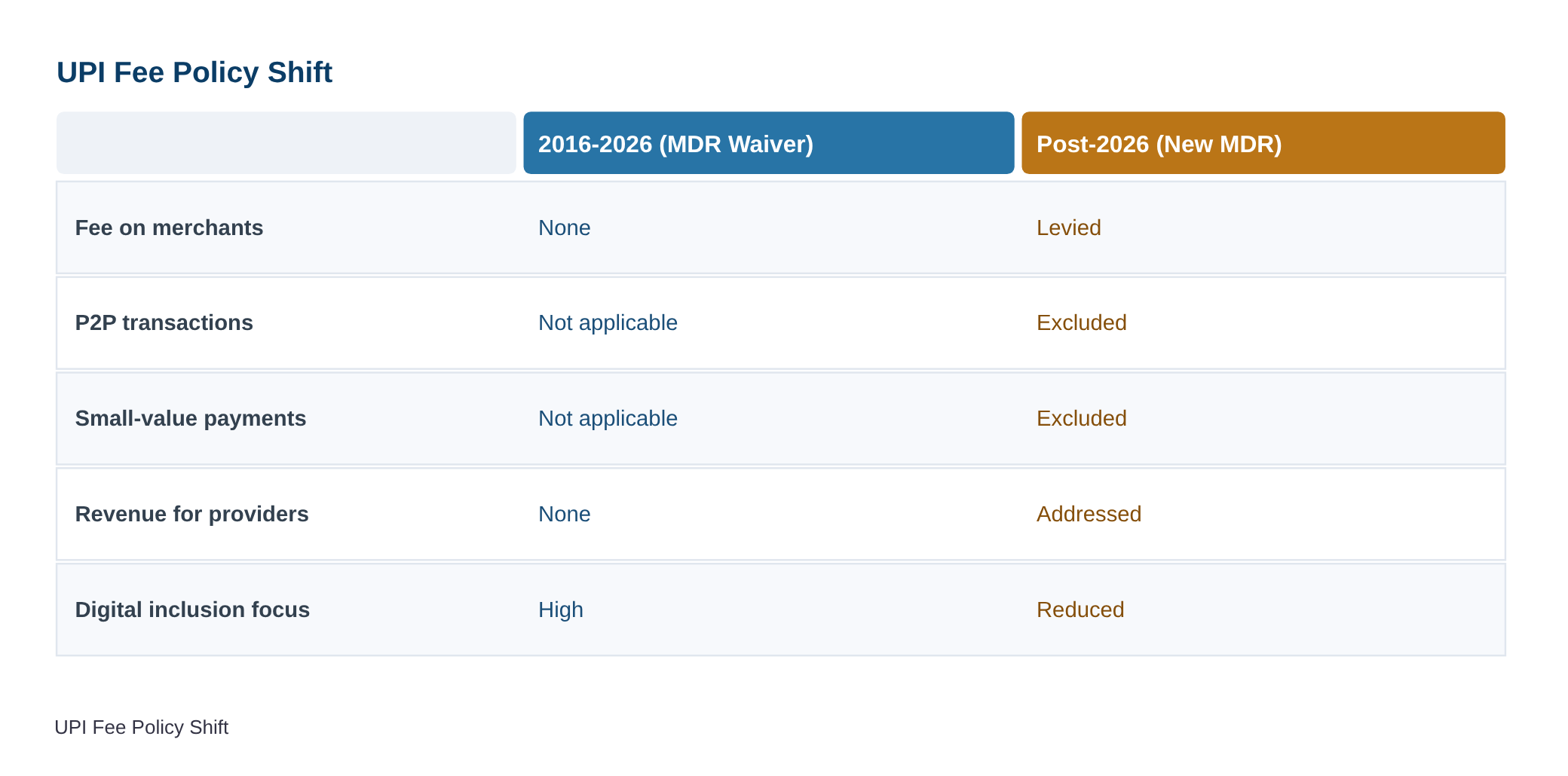
This policy shift, ending six years of zero-cost UPI merchant transactions, has been contested in the Parliamentary Standing Committee on Finance, raising concerns over its potential impact on digital payment adoption, financial inclusion, and the broader digital economy ecosystem.
Background
- The Reserve Bank of India (RBI) had, in 2020, waived MDR for UPI and RuPay transactions to promote digital payments, aligning with the government’s ‘Digital India’ and ‘Cashless Economy’ initiatives.
- UPI, launched in 2016 by the National Payments Corporation of India (NPCI), has witnessed exponential growth, processing over 14 billion transactions monthly in 2026, with merchant transactions forming a critical segment.
- The MDR waiver was a temporary measure to encourage adoption, particularly among small merchants and in rural areas, where digital payments penetration remains uneven.
- The new MDR policy reintroduces a fee structure, albeit selectively, to address concerns of revenue loss to payment service providers and the need for sustainable business models for digital payment infrastructure.
- The policy explicitly excludes person-to-person (P2P) transactions and small-value payments, ensuring that retail consumers remain unaffected.
- The Parliamentary Standing Committee on Finance, chaired by Bhartruhari Mahtab, has taken cognisance of the policy, reflecting parliamentary oversight over fiscal measures impacting digital public infrastructure.
What is Merchant Discount Rate (MDR) on UPI Transactions?
- Merchant Discount Rate (MDR) is the fee charged to merchants by payment service providers for facilitating digital transactions. It is typically a percentage of the transaction value and is borne by the merchant, not the customer.
- MDR is distinct from interchange fees or bank charges and is a key revenue stream for payment aggregators, banks, and fintech entities operating in the digital payments ecosystem.
- The policy excludes P2P transactions, small-value payments (below ₹2,000), and transactions to government entities, ensuring targeted application of the fee structure.
- The MDR revenue is intended to sustain the operational costs of payment service providers, including infrastructure maintenance, fraud prevention, and customer support, thereby ensuring long-term viability of digital payment systems.
- The policy aligns with the Payment and Settlement Systems Act, 2007, which empowers the RBI to regulate payment systems and associated charges to maintain stability and consumer protection.
- The government has clarified that the MDR is not a direct charge on consumers, who will continue to transact without fees, addressing concerns over regressive impacts on retail users.
- The policy reflects a shift from subsidised digital infrastructure to a cost-sharing model, balancing fiscal sustainability with the need to maintain high transaction volumes in the UPI ecosystem.
UPSC Value Addition
Keywords for Mains Answer-Writing
Digital Public Infrastructure · Merchant Discount Rate (MDR) · UPI ecosystem · Financial Inclusion · Digital Payments · Payment Aggregators · Reserve Bank of India (RBI) regulations · Financial Services Department · Parliamentary Standing Committee on Finance · Digital India Mission · Cashless Economy · Financial Accessibility · Payment System Operators · Interchange Fee · Digital Divide
Prelims Practice Questions
Q1. Consider the following statements regarding the Merchant Discount Rate (MDR) in the context of UPI payments:
1. MDR is a fee levied directly on customers making UPI payments.
2. The Reserve Bank of India (RBI) introduced MDR to regulate digital payment systems.
3. MDR is applicable only to merchant transactions above a specified threshold.
4. The fee introduced for UPI payments above ₹2,000 to merchants is 0.4%.
How many of the above statements are correct?
- Only one
- Only two
- Only three
- All four
Answer: Only three — Statements 3 and 4 are correct. MDR is not levied directly on customers but within the merchant payment ecosystem (Statement 1 is incorrect). The RBI does not introduce MDR; it regulates the fee structure set by payment system operators (Statement 2 is incorrect).
Q2. Assertion (A): The introduction of a fee on UPI payments above ₹2,000 to merchants aims to generate revenue for the government.
Reason (R): The fee is part of a broader strategy to promote financial inclusion and digital payment adoption.
Options:
A. Both A and R are true, and R is the correct explanation of A.
B. Both A and R are true, but R is not the correct explanation of A.
C. A is true, but R is false.
D. A is false, but R is true.
Answer: ? — Assertion (A) is false because the fee is not intended to generate revenue for the government but to rationalize the cost structure within the merchant payment ecosystem. Reason (R) is true as the fee is part of efforts to promote digital payments and financial inclusion.
Q3. Which of the following best describes the term ‘Merchant Discount Rate (MDR)’ in the context of digital payments?
- A fee charged to customers for using UPI for transactions
- A fee charged to merchants for accepting digital payments, borne by the payment system operator
- A tax levied by the government on all digital transactions
- A subsidy provided to merchants for promoting digital payments
Answer: A fee charged to merchants for accepting digital payments, borne by the payment system operator — MDR is a fee charged to merchants for accepting digital payments, and it is borne by the payment system operator within the merchant payment ecosystem, not directly by customers.
Mains Practice Question
✍ The Government of India has recently introduced a 0.4% fee on UPI payments above ₹2,000 to merchants, marking a departure from the six-year-old policy of zero MDR. Critically examine the implications of this policy shift on India’s digital payment ecosystem, financial inclusion, and the broader objectives of the Digital India Mission. (15 Marks)
Approach: MODEL-ANSWER SKELETON:
1. **Context and Policy Shift**: Briefly explain the introduction of the fee on UPI merchant payments above ₹2,000, distinguishing it from person-to-person transactions and small payments. Mention the six-year history of zero MDR and the rationale for the change.
2. **Objectives of the Fee**:
– Rationalization of costs within the merchant payment ecosystem.
– Alignment with global practices where MDR is a standard component of digital payment systems.
– Potential to incentivize the adoption of digital payment infrastructure by merchants.
3. **Impact on Digital Payment Ecosystem**:
– **Merchant Perspective**: Discuss how the fee may affect small and medium enterprises (SMEs), particularly in rural and semi-urban areas, where digital payment adoption is still evolving.
– **Consumer Perspective**: Analyze whether the fee could deter consumers from using UPI for merchant transactions, despite the government’s assurance that customers will not bear the cost directly.
– **Payment Aggregators and Banks**: Examine the impact on intermediaries like payment aggregators, banks, and fintech companies, who may face increased operational costs or reduced margins.
4. **Financial Inclusion**:
– **Accessibility**: Assess whether the fee could widen the digital divide, particularly for marginalized communities who rely heavily on digital payments for financial inclusion.
– **Affordability**: Evaluate the long-term affordability of digital payments for low-income groups, given the potential for cascading costs.
– **Government Initiatives**: Link the policy to broader initiatives like the Jan Dhan Yojana, PM-KISAN, and Direct Benefit Transfers (DBT), which rely on seamless digital transactions.
5. **Digital India Mission**:
– **Policy Coherence**: Discuss whether the fee aligns with the goals of the Digital India Mission, which aims to create a cashless economy and promote digital literacy.
– **Innovation and Competition**: Analyze how the fee might influence innovation in the fintech sector and competition among payment service providers.
6. **Alternative Perspectives**:
– **Criticism**: Present arguments against the fee, such as potential discouragement of digital payment adoption, increased informality, and regressive impact on small merchants.
– **Support**: Highlight arguments in favor, such as sustainable growth of the digital payment ecosystem, reduced reliance on cash, and improved transparency.
7. **Way Forward**:
– Suggest measures to mitigate adverse impacts, such as tiered fee structures, subsidies for small merchants, or phased implementation.
– Emphasize the need for robust monitoring and evaluation to assess the fee’s impact on digital payment adoption and financial inclusion.
8. **Conclusion**: Summarize the key trade-offs and emphasize the importance of balancing revenue rationalization with the goals of financial inclusion and digital transformation.
Source: orissapost.com
Generated by AanyaAi for educational purpose.
Related guides on our sites
- Current affairs for upsc 2026
- Best PSIR optional coaching for upsc
- Best PSIR optional teacher for upsc
- Best teacher of PSIR optional for upsc

- यूपीआई व्यापारी भुगतान पर शुल्क लगाने के सरकार के फैसले पर विपक्ष की चिंता - September 16, 2026
- Opposition Slams Government’s UPI Merchant Fee: Key Concerns for UPSC Aspirants - September 16, 2026
- इस्पात मंत्रालय का विशेष अभियान 6.0: ई-कचरे के निपटारे पर केंद्रित पहल - September 16, 2026

No Comments