


19 Aug Parliament Monsoon Session 2026: Lowest Productivity, 11 Bills Passed
✎ Parliamentary productivity is measured by the completion of scheduled business, including Bills passed, time utilised for Question Hour, and extent of debates; low productivity risks undermining legislative scrutiny and executive…
Subject Relevance — Where This Topic Fits
- GS Paper II — Parliament and State Legislatures—Structure, Functioning, Conduct of Business, Powers & Privileges and Issues Arising out of these | GS Paper II — Role of Civil Services in a Democracy | GS Paper III — Government Budgeting and Fiscal Policy
- Prelims: Parliamentary session productivity, Zero Hour, Question Hour, legislative procedure, PRS Legislative Research, 18th Lok Sabha, Monsoon Session 2026
- Essay: The efficacy of parliamentary democracy in India: Challenges and reforms, Role of opposition in legislative scrutiny and governance
Quick Revision: Parliamentary productivity is measured by the completion of scheduled business, including Bills passed, time utilised for Question Hour, and extent of debates; low productivity risks undermining legislative scrutiny and executive accountability.
Why is this in the news?
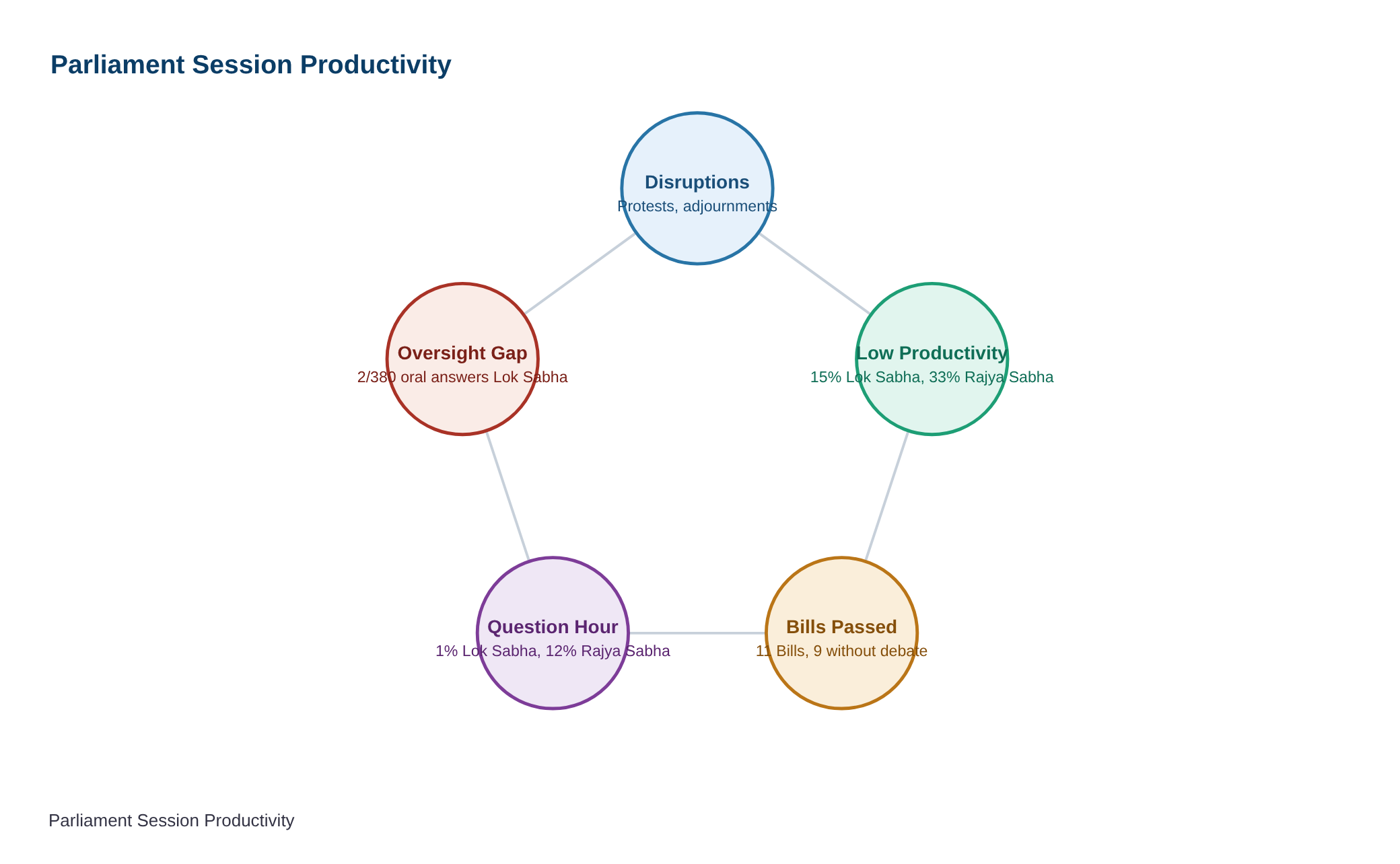
The Monsoon Session of Parliament in 2026 concluded with historically low productivity—15% in the Lok Sabha and 33% in the Rajya Sabha—despite passing 11 Bills, nine of which were enacted without any debate. This session, marked by repeated disruptions, raises critical questions about the functioning of India’s parliamentary institutions, the efficacy of legislative scrutiny, and the implications for democratic governance and accountability.
Background
- Parliamentary sessions in India are constitutionally mandated to conduct legislative, financial, and oversight functions, including the passage of Bills, discussions on budgetary allocations, and addressing public grievances through Question Hour and Zero Hour.
- The 18th Lok Sabha, which began in 2024, has witnessed a trend of declining productivity, with five of seven sessions featuring Bills introduced outside the official agenda, reflecting procedural irregularities.
- The Monsoon Session of 2026 was disrupted by protests over the NEET paper leak and allegations related to the Ram Temple donations, leading to adjournments and reduced time for legislative business.
- Question Hour, a critical mechanism for executive accountability, functioned for less than 1% of the allotted time in the Lok Sabha and 12% in the Rajya Sabha, raising concerns about the oversight role of Parliament.
- The passage of Bills without debate or scrutiny—nine of eleven Bills were enacted without discussion—highlights a departure from established legislative norms, potentially undermining the quality of lawmaking.
- PRS Legislative Research data indicates that 92% of Bills introduced in the Monsoon Session were both introduced and passed, a significant increase from previous sessions, suggesting a shift in legislative efficiency at the expense of deliberation.
What is parliamentary productivity, and why does it matter?
- Parliamentary productivity refers to the effective utilisation of time during a session for legislative, financial, and oversight functions, measured by the proportion of scheduled business completed.
- Key metrics include the number of Bills passed, time spent on Question Hour and Zero Hour, and the extent of debates and discussions on legislative proposals.
- Low productivity undermines Parliament’s constitutional role as the primary forum for debate, scrutiny, and accountability, particularly in holding the executive to account for policy decisions and financial allocations.
- The passage of Bills without debate or discussion contravenes the principle of legislative scrutiny, where Bills are expected to undergo detailed examination by standing committees and through debates in both Houses.
- Question Hour is a procedural device governed by the Rules of Procedure of Parliament for MPs to seek information from ministers on government actions, policies, and decisions, ensuring executive accountability.
- Zero Hour, though not formally part of the Rules of Procedure, allows MPs to raise matters of urgent public importance without prior notice, serving as a platform for immediate grievance redressal and debate.
- The efficiency of parliamentary functioning is influenced by procedural discipline, the number of disruptions, and the availability of time for substantive legislative work, including private members’ business and special mentions.
- Data from PRS Legislative Research and the Lok Sabha/Rajya Sabha Secretariats provides empirical insights into session productivity, helping assess the health of parliamentary democracy.
Key Features
| Feature | Significance |
|---|---|
| Productivity of Lok Sabha (15%) | Lowest since 2016 Winter Session; indicates severe disruption in legislative functioning. |
| Productivity of Rajya Sabha (33%) | Lowest since Budget Session 2023; reflects constrained deliberation despite passage of Bills. |
| Passage of 11 Bills | Nine Bills passed without debate in Lok Sabha; highlights procedural bypass of scrutiny. |
| Question Hour Utilisation | Lok Sabha: <1% (9 minutes); Rajya Sabha: 12% (2 hours); undermines accountability mechanism. |
| Bills Introduced vs. Passed Ratio (92%) | Highest in 18th Lok Sabha sessions; raises concerns about pre-legislative scrutiny and transparency. |
Why it Matters
Legislative Process
- Erosion of parliamentary debate culture: Nine of eleven Bills passed without discussion in Lok Sabha, violating the principle of informed legislation.
- Disproportionate passage time: Seven Bills cleared in Lok Sabha in under five minutes, raising procedural integrity concerns.
- Rajya Sabha as a mitigating forum: Bills received limited but relatively longer debate in Rajya Sabha, though still constrained (e.g., 50 minutes total for 16 speakers on a Bill).
- Pre-legislative scrutiny deficit: 92% Bills introduced and passed in the session indicates inadequate public consultation and expert review.
Parliamentary Accountability
- Question Hour collapse: Less than 1% utilisation in Lok Sabha and 12% in Rajya Sabha undermines ministerial accountability and transparency.
- Oral answers: Only 2 of 380 questions answered orally in Lok Sabha and 16 of 285 in Rajya Sabha; rest deferred or answered in writing, reducing real-time scrutiny.
- Disruption-driven delays: Repeated protests over issues like NEET paper leak and Ram Temple donations diverted focus from legislative work.
Institutional Health
- Erosion of deliberative democracy: Low productivity and minimal debate reflect a broader trend of declining parliamentary engagement in recent sessions.
- Role of Opposition: Absence of structured debate does not equate to absence of concerns; procedural bypass may obscure substantive issues.
- House leadership: Absence of key ministers (e.g., Union Home Minister) during critical sessions further strained institutional functioning.
Challenges
1. DECLINING PARLIAMENTARY PRODUCTIVITY
- Systemic disruption: Frequent adjournments and protests reduce effective working hours, undermining legislative output.
- Scrutiny deficit: Bills passed without debate lack rigorous analysis of implications, risks, and stakeholder feedback.
- Accountability erosion: Near-total collapse of Question Hour diminishes Parliament’s role as a watchdog over the executive.
UPSC Link: Parliamentary functioning and legislative process
2. PROCEDURAL BYPASS OF LEGISLATIVE SCRUTINY
- Fast-tracking Bills: Passage of seven Bills in under five minutes in Lok Sabha indicates procedural shortcuts.
- Lack of pre-legislative consultation: High Bills-passed ratio suggests inadequate public and expert input before introduction.
- Rajya Sabha as a limited check: While Rajya Sabha provides some debate, time constraints and limited participation restrict effectiveness.
UPSC Link: Parliamentary procedures and committees
3. INSTITUTIONAL CREDIBILITY AND PUBLIC TRUST
- Perception of opacity: Passing Bills without debate fuels perceptions of legislative opacity and executive dominance.
- Erosion of democratic norms: Reduced deliberation and accountability mechanisms weaken public confidence in parliamentary institutions.
- Media and stakeholder alienation: Lack of transparency discourages informed public discourse and expert engagement.
UPSC Link: Role of Parliament in Indian democracy
4. MANAGEMENT OF PARLIAMENTARY TIME AND AGENDA
- Disruption management: Frequent adjournments due to protests disrupt scheduled legislative business and waste parliamentary time.
- Agenda control: Introduction of Bills not on agenda in multiple sessions indicates poor planning or deliberate bypass of due process.
- Ministerial presence: Absence of key ministers during critical sessions hampers effective governance and accountability.
UPSC Link: Parliamentary time management and agenda setting
Challenges — UPSC Perspective
| Issue | Concern |
|---|---|
| Low productivity in both Houses | Severe disruption in legislative functioning, undermining Parliament’s primary role. |
| Nine Bills passed without debate | Violation of the principle of informed legislation; risks of poorly vetted laws. |
| Question Hour utilisation <1% | Near-total collapse of accountability mechanism; ministers avoid scrutiny. |
| High Bills-passed ratio (92%) | Indicates inadequate pre-legislative scrutiny and public consultation. |
| Frequent adjournments due to protests | Wastage of parliamentary time and disruption of legislative agenda. |
Way Forward
- Strengthen pre-legislative consultation: Mandate public feedback and expert review for all Bills before introduction.
- Reform Question Hour: Introduce time-bound slots and digital participation to enhance accountability.
- Enhance Rajya Sabha’s role: Allocate dedicated time for detailed scrutiny of Bills passed without debate in Lok Sabha.
- Institutionalise disruption management: Develop protocols for orderly protests to minimise adjournments and maximise productivity.
- Promote structured debates: Encourage thematic discussions on Bills to ensure multi-dimensional analysis.
- Improve agenda planning: Ensure Bills are listed in advance to allow MPs to prepare and participate meaningfully.
- Enhance ministerial presence: Require key ministers to be available during sessions for accountability.
- Leverage digital tools: Use e-consultations and virtual sittings to supplement physical parliamentary processes.
UPSC Value Addition
Keywords for Mains Answer-Writing
Parliamentary productivity · Monsoon Session 2026 · Bill passage without debate · Question Hour utilisation · PRS Legislative Research · Parliamentary disruptions · Legislative process · Institutional efficiency · Parliamentary accountability · Constitutional provisions on Parliament
Constitutional & Policy Linkages
- Article 75(3) – Collective responsibility of ministers to Parliament
- Article 85 – Sessions of Parliament and prorogation
- Article 86 – Right of President to address and send messages to Houses
- Article 105 – Powers and privileges of Parliament
- Article 118 – Rules of procedure in Parliament
Concept Flow
Disruptions due to protests and absences → Low productivity in Lok Sabha (15%) and Rajya Sabha (33%) → Fewer working hours and adjournments → Inadequate time for legislative scrutiny → Nine of eleven Bills passed without debate in Lok Sabha → Procedural bypass of scrutiny → Seven Bills cleared in under five minutes → Fast-tracking without deliberation → Question Hour utilisation <1% → Collapse of accountability mechanism → High Bills-passed ratio (92%) → Inadequate pre-legislative consultation → Erosion of parliamentary debate culture → Weakening of democratic norms and institutional credibility
Prelims Practice Questions
Q1. Consider the following statements regarding the functioning of Parliament in India:
1. The Monsoon Session of Parliament in 2026 recorded the lowest productivity in the Lok Sabha since 2016.
2. Question Hour in the Lok Sabha during the Monsoon Session of 2026 functioned for less than 1% of the allotted time.
3. The Public Examinations (Prevention of Unfair Means) Amendment Bill, 2026 was the only Bill discussed in detail during the session.
How many of the above statements are correct?
- Only one
- Only two
- All three
- None
Answer: All three — Statement 1 is correct as the Lok Sabha’s productivity was 15%, the lowest since 2016. Statement 2 is correct as Question Hour functioned for less than 1% of the allotted time. Statement 3 is correct as the Public Examinations Bill was the only one discussed in detail.
Q2. Assertion (A): The Monsoon Session of Parliament in 2026 saw the passage of 11 Bills despite low productivity.
Reason (R): Nine of the 11 Bills were passed without any discussion or debate by Members of Parliament.
Options:
A. Both A and R are true, and R is the correct explanation of A.
B. Both A and R are true, but R is not the correct explanation of A.
C. A is true, but R is false.
D. A is false, but R is true.
Answer: ? — Both the Assertion (A) and Reason (R) are true. The session did pass 11 Bills despite low productivity, and nine of these were passed without debate, making R the correct explanation for A.
Q3. Match the following columns regarding the productivity metrics of the Monsoon Session of Parliament in 2026:
Column I
1. Lok Sabha productivity
2. Rajya Sabha productivity
3. Bills passed without debate
4. Question Hour utilisation in Lok Sabha
Column II
A. 15%
B. Less than 1%
C. 33%
D. 9 out of 11
Answer: ? —
Mains Practice Question
✍ Critically examine the legislative efficiency of Parliament in contemporary India with reference to the Monsoon Session of 2026. How far does the passage of Bills without debate undermine the principles of deliberative democracy? Also, analyse the implications for parliamentary accountability and governance. (15 Marks)
Approach: MODEL-ANSWER SKELETON:
1. **Context and Data**:
– Reference the Monsoon Session 2026 productivity metrics (Lok Sabha: 15%, Rajya Sabha: 33%).
– Highlight the passage of 11 Bills, with 9 passed without debate.
– Cite PRS Legislative Research data on Question Hour utilisation (<1% in Lok Sabha).
2. **Constitutional and Theoretical Framework**:
– **Deliberative Democracy**: Explain the role of debate and discussion in Parliament as per the Constitution (Articles 79-122, 105, 194).
– **Parliamentary Accountability**: Discuss the functions of Parliament in holding the executive accountable (e.g., debates, Question Hour, Standing Committees).
– **Doctrine of Legislative Necessity**: Reference the need for thorough scrutiny of Bills to ensure their constitutional validity and public interest.
3. **Analysis of Contemporary Issues**:
– **Erosion of Deliberation**: Examine how the passage of Bills without debate undermines the principles of informed legislation.
– **Executive Dominance**: Discuss the trend of Bills being introduced and passed without adequate discussion, reflecting a shift towards executive-led legislation.
– **Institutional Erosion**: Analyse the long-term implications for parliamentary sovereignty and the separation of powers.
4. **Counterarguments and Balancing Views**:
– **Government Perspective**: Acknowledge arguments for expeditious legislation in certain contexts (e.g., urgent reforms, economic crises).
– **Judicial Oversight**: Reference the role of the judiciary in ensuring legislative compliance with constitutional provisions (e.g., judicial review of Bills).
5. **Suggestions for Reform**:
– **Strengthening Parliamentary Processes**: Propose measures such as mandatory debates, time-bound scrutiny, and enhanced use of Standing Committees.
– **Institutional Reforms**: Discuss the need for reforms in parliamentary procedures to ensure greater accountability and transparency.
6. **Conclusion**:
– Summarise the findings and take a reasoned position on the balance between efficiency and deliberation in Parliament.
Source: The Hindu
Generated by AanyaAi for educational purpose.

- KWML’s Feasibility Reports for Water Metro in 18 Cities: UPSC & PCS Insights - October 3, 2026
- ओडिशा में वन्यजीव अनुसंधान अनुदान कार्यक्रम शुरू, सिमिलिपाल में 300 कैमरे और बढ़ेंगे - October 3, 2026
- India Summons Pakistan High Commission Official Over Violation - October 3, 2026

No Comments