


27 Jul Parliament Monsoon Session: Anti-Paper Leak Bill Delayed Over Opposition Protests
Subject Relevance — Where This Topic Fits
- GS Paper II — Parliament and State Legislatures — Structure, Functioning, Conduct of Business, Powers and Privileges | GS Paper III — Issues relating to Education, Human Resource Development, and Skill Development
- Prelims: Public Examinations (Prevention of Unfair Means) Act, 2024, Organised crime under the Unlawful Activities (Prevention) Act (UAPA), Fast Track Courts, Concurrent List (Entry 66), Parliamentary Standing Committees
- Essay: The erosion of institutional credibility in examinations: A crisis of governance and ethics, Balancing legislative urgency with democratic deliberation: The role of Opposition in parliamentary democracy
Quick Revision: The Public Examinations (Prevention of Unfair Means) Amendment Bill, 2026, seeks to tighten penalties for examination malpractice by increasing minimum imprisonment to seven years for organised crime and five years for individuals, while introducing Special Fast Track Courts.
Why is this in the news?
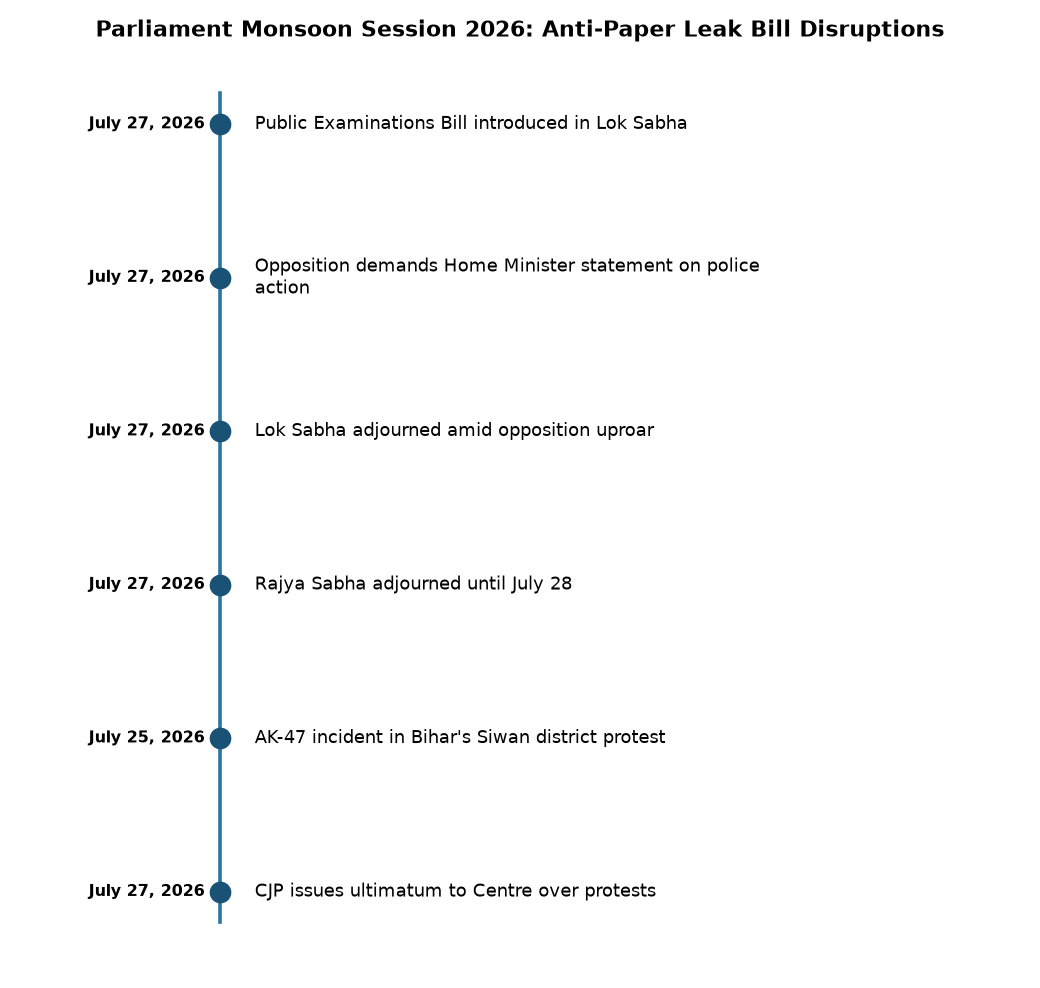
The Monsoon Session of Parliament witnessed significant disruptions following the introduction of the Public Examinations (Prevention of Unfair Means) Amendment Bill, 2026, aimed at strengthening penalties for examination malpractice and paper leaks. Opposition parties disrupted proceedings, demanding a statement from the Union Home Minister on alleged police excesses during student protests, including the purported use of an AK-47 rifle in Bihar’s Siwan district. The legislative impasse underscores broader concerns about institutional accountability, governance deficits, and the intersection of law enforcement with youth-led movements.
Background
- The Public Examinations (Prevention of Unfair Means) Act, 2024, was enacted to address the growing menace of examination malpractice and paper leaks in India, particularly in competitive examinations like the UPSC Civil Services Examination, NEET, and JEE.
- Examination malpractice has escalated into organised crime syndicates, with paper leaks affecting lakhs of aspirants annually, leading to widespread protests and erosion of public trust in the examination system.
- The 2024 Act introduced stringent penalties, including imprisonment up to 10 years and fines up to ₹1 crore, alongside the establishment of Special Courts for expedited trials.
- Student protests against alleged police brutality and examination-related grievances have intensified in recent months, with incidents in states like Bihar, Uttar Pradesh, and Rajasthan drawing national attention.
- The Supreme Court of India, through its Chief Justice, has issued ultimatums to the executive in matters of institutional accountability, reflecting judicial activism in governance issues.
- Parliamentary disruptions during the Monsoon Session highlight the tension between legislative urgency and oppositional scrutiny, a recurring feature in India’s parliamentary democracy.
What is the Public Examinations (Prevention of Unfair Means) Amendment Bill, 2026?
- The Bill seeks to amend the Public Examinations (Prevention of Unfair Means) Act, 2024, to further strengthen provisions against examination malpractice and organised crime related to paper leaks.
- It proposes to increase the minimum punishment for organised crime from five years to seven years, with imprisonment extendable up to 10 years and fines up to ₹10 crore.
- For individual offenders, the imprisonment is proposed to be increased to a minimum of five years, extendable up to 10 years, along with a fine of up to Rs 50 lakh.
- The Bill introduces the provision for Special Fast Track Courts to expedite trials in examination-related offences, aiming to reduce pendency and ensure swift justice.
Key Features
| Feature | Significance |
|---|---|
| Public Examinations (Prevention of Unfair Means) Amendment Bill, 2026 | Proposes stringent penalties, including imprisonment up to 10 years and fines up to ₹10 crore, for organised examination malpractice, aiming to deter paper leaks and malpractices in competitive examinations. |
| Special Fast Track Courts | Establishes dedicated judicial mechanisms for expeditious trial of examination-related offences, reducing delays and ensuring timely justice for affected candidates. |
| Increased Minimum Punishment | Raises the minimum imprisonment for organised examination-related crimes from 5 to 7 years, with individual offences punishable by a minimum of 5 years, extendable to 10 years. |
| Fine Structure | Introduces graded fines: up to ₹50 lakh for individuals and ₹10 crore for organised offences, ensuring proportional deterrence against malpractice. |
| Parliamentary Disruptions | Highlights procedural challenges in legislative functioning, particularly the opposition’s demand for statements on alleged police excesses during student protests. |
Why it Matters
Governance and Institutional Integrity
- The Bill underscores the state’s commitment to preserving the sanctity of competitive examinations, which are critical for merit-based recruitment in public services and educational institutions.
- Institutional trust in examination systems is vital for social cohesion and equitable opportunity, particularly in a system where examinations determine access to education and employment.
- The proposed amendments reflect a zero-tolerance approach toward examination malpractice, aligning with global best practices in maintaining the integrity of assessment systems.
Judicial and Administrative Reforms
- The establishment of Special Fast Track Courts addresses the perennial issue of delayed justice in examination-related cases, ensuring swift resolution and deterrence.
- The Bill’s provisions for stringent penalties are designed to act as a strong deterrent against organised crime syndicates involved in paper leaks and malpractices.
- Administrative reforms, such as the suspension of a police constable for alleged misuse of force, demonstrate the state’s responsiveness to public grievances and accountability mechanisms.
Social and Youth Policy
- The Bill directly impacts the aspirations of millions of young Indians preparing for competitive examinations, whose future prospects are often jeopardised by malpractices.
- The opposition’s demand for a statement on alleged police excesses highlights the tension between law enforcement and youth-led protests, reflecting broader concerns about democratic rights and state accountability.
- The Bill’s introduction amid parliamentary disruptions underscores the need for inclusive dialogue to address systemic issues affecting youth, including examination integrity and protest rights.
Legislative Procedure and Parliamentary Dynamics
- The delay in debating the Bill due to opposition uproar illustrates the challenges in parliamentary functioning, particularly when legislative priorities clash with demands for accountability on unrelated issues.
- The government’s insistence on debating the Bill, despite disruptions, reflects its prioritisation of institutional reforms over procedural delays, though it risks further erosion of consensus-building.
Rule of Law and Human Rights
- The Bill’s stringent provisions must be balanced with due process and human rights safeguards to avoid over-criminalisation and ensure fair trials for accused individuals.
- The alleged use of an AK-47 rifle by a police constable during a student protest raises serious concerns about the proportionality of state response and adherence to human rights standards.
Challenges
1. Parliamentary Disruptions and Legislative Gridlock
- Repeated adjournments of both Houses due to opposition protests hinder the legislative process, delaying critical reforms such as the anti-paper leak Bill.
- The opposition’s demand for a statement from the Union Home Minister on alleged police excesses diverts attention from the Bill’s core objectives, exacerbating partisan tensions.
- The government’s response to disruptions—urging debate while accusing the opposition of deliberate obstruction—risks polarising the discourse and undermining cooperative governance.
UPSC Link: Polity: Parliamentary Procedures, Role of Opposition
2. Balancing Deterrence with Proportionality in Penalties
- The Bill’s proposed penalties, while stringent, must be carefully calibrated to avoid disproportionate punishment for minor infractions or unintended consequences for accused individuals.
- The distinction between organised crime syndicates and individual malpractitioners must be clearly defined to ensure that penalties are commensurate with the severity of the offence.
- Judicial discretion in sentencing under the new framework will be critical to prevent miscarriages of justice and ensure fairness in trial outcomes.
UPSC Link: Polity: Fundamental Rights, Judicial Review
3. Addressing Youth Unrest and Police Excesses
- The alleged police use of an AK-47 rifle during a student protest in Bihar’s Siwan district has escalated tensions, raising questions about the use of force in crowd control and the state’s response to youth-led movements.
- The suspension of a police constable is a necessary but insufficient step; a comprehensive inquiry into the incident and systemic reforms in police training are required to prevent recurrence.
- The opposition’s demand for accountability highlights the need for transparent investigations and dialogue with protesting students to address grievances and restore trust in institutions.
UPSC Link: Society: Youth Aspirations, Police Reforms
4. Ensuring Timely Justice Through Fast Track Courts
- The establishment of Special Fast Track Courts, while commendable, must be accompanied by adequate judicial infrastructure, staffing, and resources to prevent bottlenecks and ensure expeditious trials.
- The Bill’s success hinges on the effective implementation of these courts, which must be insulated from political interference and equipped to handle the volume of cases efficiently.
- Collaboration between the judiciary, executive, and legislature will be essential to monitor the courts’ performance and address any systemic challenges in their functioning.
UPSC Link: Judiciary: Judicial Reforms, Case Disposal Rates
5. Maintaining Public Trust in Examination Systems
- The Bill’s effectiveness will depend on its ability to restore public confidence in the integrity of competitive examinations, which are often marred by allegations of corruption and malpractice.
- The government must ensure that the new provisions are enforced uniformly across all examinations, including those conducted by state agencies and private entities.
- Transparency in investigation and prosecution of paper leaks, as well as public awareness campaigns, will be crucial to demonstrate the state’s commitment to fairness and accountability.
UPSC Link: Governance: Transparency, Accountability in Public Institutions
Challenges — UPSC Perspective
| Issue | Concern |
|---|---|
| Parliamentary Disruptions | Delays in legislative processes due to opposition protests, hindering the passage of critical bills like the anti-paper leak amendment. |
| Police Excesses in Student Protests | Alleged use of disproportionate force by law enforcement during protests, raising concerns about human rights and state accountability. |
| Calibration of Penalties | Risk of over-criminalisation or disproportionate punishment under the new framework, necessitating careful judicial oversight. |
| Implementation of Fast Track Courts | Potential bottlenecks in judicial infrastructure and resources, threatening the expeditious disposal of examination-related cases. |
| Public Trust in Examinations | Need to restore confidence in the integrity of competitive examinations amid recurring allegations of malpractice and corruption. |
| Balancing Deterrence and Fairness | Ensuring that stringent penalties serve as a deterrent without infringing on the rights of accused individuals or leading to miscarriages of justice. |
Way Forward
- Constitute a multi-stakeholder committee comprising representatives from the judiciary, police, student bodies, and examination authorities to review the Bill’s provisions and propose amendments ensuring proportionality and fairness.
- Accelerate the establishment of Special Fast Track Courts with dedicated infrastructure, staffing, and digital case management systems to ensure timely justice delivery.
- Initiate a nationwide awareness campaign to educate candidates, parents, and institutions about the new penalties and the consequences of examination malpractice.
- Strengthen police training programmes on crowd control, de-escalation techniques, and human rights compliance to prevent recurrence of alleged excesses during protests.
- Establish transparent mechanisms for investigating and prosecuting paper leaks, including whistle-blower protections and public disclosure of case statuses.
- Encourage state governments to adopt the Bill’s provisions uniformly across all examinations, including those conducted by state agencies and private entities.
- Foster dialogue between the government and opposition to address procedural disruptions and explore consensus-building measures for legislative priorities.
- Monitor the implementation of the Bill through independent audits and public reports to assess its effectiveness and identify areas for improvement.
UPSC Value Addition
Keywords for Mains Answer-Writing
Public Examinations (Prevention of Unfair Means) Amendment Bill 2026 · examination malpractice · paper leak · Special Fast Track Courts · organised crime in examinations · student protests · Constitutional right to protest · legislative process in Parliament · Monsoon Session of Parliament · Union Minister of State for Parliamentary Affairs · minimum punishment for examination fraud · Constitutional validity of anti-paper leak laws
Concept Flow
Student protests over alleged police excesses → Opposition demands accountability from government → Government introduces anti-paper leak Bill to address examination malpractice → Parliamentary disruptions delay debate on the Bill → CJP threatens to restart protests, escalating tensions → Need for judicial and administrative reforms to balance deterrence with fairness and restore public trust in institutions
Prelims Practice Questions
Q1. Which of the following provisions is NOT included in the Public Examinations (Prevention of Unfair Means) Amendment Bill, 2026?
- A. Imprisonment up to 10 years for organised examination-related offences
- B. Fine up to ₹10 crore for organised examination-related offences
- C. Establishment of Special Fast Track Courts for examination malpractice cases
- D. Mandatory death penalty for examination fraud
Answer: D. Mandatory death penalty for examination fraud — The Bill proposes imprisonment up to 10 years and a fine up to ₹10 crore for organised examination-related offences but does not include a provision for mandatory death penalty.
Q2. The Public Examinations (Prevention of Unfair Means) Amendment Bill, 2026 seeks to amend which existing Act?
- A. The Indian Penal Code, 1860
- B. The Right to Information Act, 2005
- C. The Public Examinations (Prevention of Unfair Means) Act, 2024
- D. The University Grants Commission Act, 1956
Answer: C. The Public Examinations (Prevention of Unfair Means) Act, 2024 — The Amendment Bill seeks to strengthen the existing Public Examinations (Prevention of Unfair Means) Act, 2024, by introducing stricter provisions.
Q3. Which constitutional provision is most relevant to the debate surrounding the anti-paper leak Bill and student protests?
- A. Article 19(1)(a) – Freedom of speech and expression
- B. Article 21 – Right to life and personal liberty
- C. Article 14 – Right to equality
- D. Article 32 – Right to constitutional remedies
Answer: A. Article 19(1)(a) – Freedom of speech and expression — The debate on student protests and legislative action intersects with Article 19(1)(a), which guarantees freedom of speech and expression, including the right to protest.
Mains Practice Question
✍ Critically examine the constitutional validity and socio-legal implications of the Public Examinations (Prevention of Unfair Means) Amendment Bill, 2026. How does the Bill address the challenges posed by examination malpractice while balancing the rights of students and the state’s duty to ensure fair examinations?
Approach: Begin by outlining the objectives and key provisions of the Bill, such as increased punishment and the establishment of Special Fast Track Courts. Analyse the constitutional validity by discussing its alignment with Articles 14, 21, and 19(1)(g) of the Constitution. Evaluate the socio-legal implications, including deterrence effects, access to justice, and potential misuse of provisions. Conclude by assessing whether the Bill strikes a balance between protecting the integrity of examinations and safeguarding fundamental rights.
Source: Times of India
Generated by AanyaAi for educational purpose.

- उत्तराखंड राज्यपाल के 5 वर्ष: पांच मिशन और AI क्रांति का लेखा-जोखा - September 15, 2026
- UPSC Focus: Uttarakhand Governor’s 5-Year Journey & 5 Key Missions Explained - September 15, 2026
- AI का वादा और खतरा: क्या मानवता के लिए खतरा है कृत्रिम बुद्धिमत्ता? - September 15, 2026

No Comments