


11 Aug Parliamentary Panel Flags PMIS Implementation Gaps: UPSC & PCS Insights
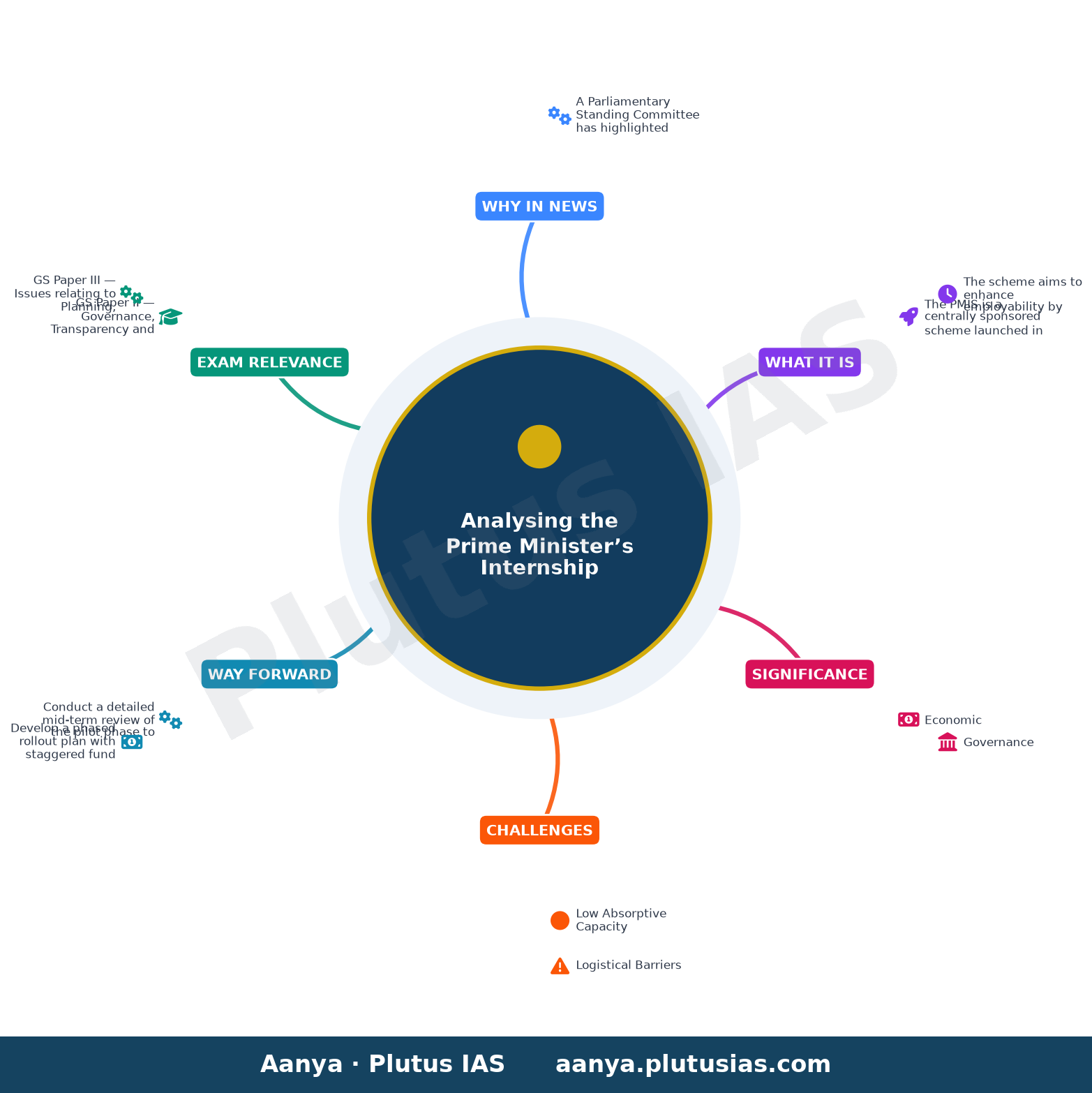
✎ The PMIS, with a ₹63,000 crore outlay, faces implementation challenges including under-utilised funds (₹29.29 crore spent vs ₹2,000 crore in FY25) and a 53.6% dropout rate in its pilot phase, necessitating a recalibrated action…
Subject Relevance — Where This Topic Fits
- GS Paper II — Governance, Transparency and Accountability | GS Paper III — Issues relating to Planning, Mobilisation of Resources, Growth and Development
- Prelims: PMIS, Parliamentary Standing Committee, Budgetary Allocation, Absorptive Capacity, Dropout Rate, Digital Competition Bill, NFRA, Pilot Phase, Budget 2024-25
- Essay: The role of pilot schemes in policy formulation: Lessons from the PMIS, Balancing innovation with fiscal prudence in public policy
Quick Revision: The PMIS, with a ₹63,000 crore outlay, faces implementation challenges including under-utilised funds (₹29.29 crore spent vs ₹2,000 crore in FY25) and a 53.6% dropout rate in its pilot phase, necessitating a recalibrated action plan with performance indicators before full-scale rollout.
Why is this in the news?
A Parliamentary Standing Committee has highlighted critical implementation gaps in the Prime Minister’s Internship Scheme (PMIS), including under-utilisation of allocated funds, high dropout rates, and inadequate support systems for participants. The Committee’s recommendations for a time-bound action plan, performance indicators, and recalibration of the scheme underscore the need for evidence-based policy refinement before full-scale rollout. This scrutiny is particularly relevant given the scheme’s substantial budgetary outlay and its potential to address youth employability, though its current trajectory raises concerns about governance and fiscal efficiency.
Background
- The PMIS was announced in the Union Budget 2024-25 with a total financial outlay of ₹63,000 crore over five years, aimed at providing internship opportunities to youth across sectors.
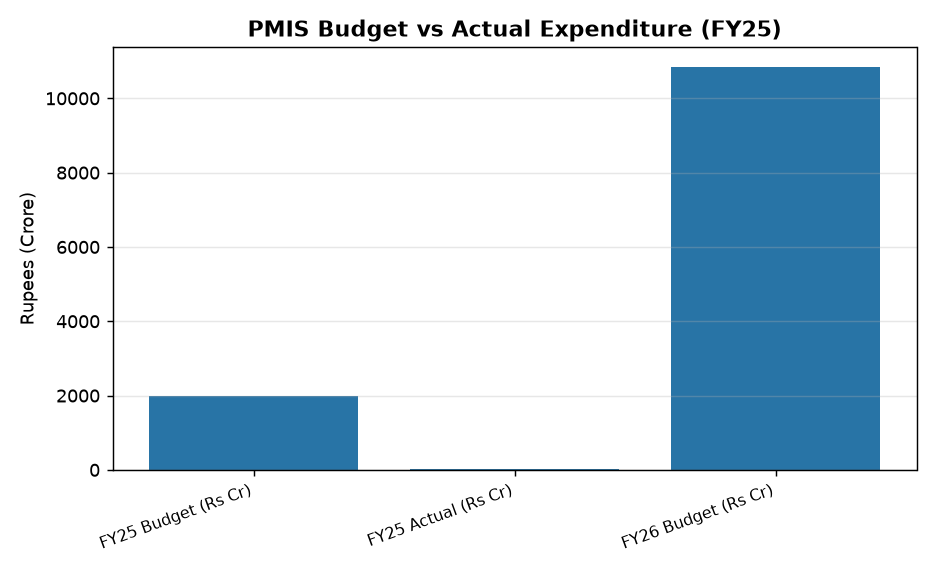
- A pilot phase was launched in FY25 with a budget of ₹2,000 crore, followed by an allocation of ₹10,831.07 crore for FY26 under the main scheme, though funds for the latter remain unutilised.
- The scheme’s guidelines were revised on March 12, 2026, to expand eligibility to 18-25 years, increase monthly assistance to ₹9,000, and allow flexible internship durations of six to nine months.
- The Parliamentary Standing Committee’s report, tabled on August 10, 2026, flagged under-utilisation of funds (only ₹29.29 crore spent against ₹2,000 crore in FY25) and a high dropout rate of 53.6% in the first round of the pilot.
- The Committee emphasised the need for structured support systems, including travel, relocation, and accommodation assistance, particularly for women candidates and rural youth.
- The report also recommended sectoral audits by the National Financial Reporting Authority (NFRA) to address industry-specific audit quality concerns in sectors like oil, energy, and insurance.
What is the Prime Minister’s Internship Scheme (PMIS)?
- The PMIS is a centrally sponsored scheme launched in Budget 2024-25 to provide internship opportunities to youth aged 18-25 years across various sectors, including public and private enterprises.
- The scheme aims to enhance employability by offering structured internships with a monthly stipend of ₹9,000, flexible durations (6-9 months), and support for travel, relocation, and accommodation.
- The total financial outlay is ₹63,000 crore over five years, with a pilot phase in FY25 (₹2,000 crore) and subsequent allocations for FY26 onwards (₹10,831.07 crore proposed for the main scheme).
- Eligibility was expanded in March 2026 to include younger candidates (18-25 years) and reduce the stipend duration to 6-9 months, reflecting a shift towards flexibility and inclusivity.
- The Ministry of Corporate Affairs (MCA) has revised guidelines to address implementation challenges observed during the pilot phase.
- Performance indicators and a time-bound action plan are being demanded by the Parliamentary Standing Committee to ensure efficient utilisation of funds and measurable outcomes.
- The scheme’s design aligns with broader objectives of skill development, youth empowerment, and bridging the employability gap, though its current implementation faces scrutiny.
- The PMIS is distinct from traditional internship programmes by its scale, structured support mechanisms, and integration with broader employment and skill development policies.
Key Features
| Feature | Significance |
|---|---|
| Time-bound action plan | Ensures structured implementation with measurable milestones to prevent fund under-utilisation and delays. |
| Performance indicators | Facilitates real-time monitoring of scheme effectiveness and candidate engagement metrics. |
| Structured support system | Addresses logistical barriers (travel, relocation, accommodation) for women and rural youth, enhancing inclusivity. |
| Pilot phase recalibration | Allows evidence-based refinement of scheme design before full-scale rollout, reducing systemic inefficiencies. |
| Sectoral audit studies | Identifies industry-specific accounting risks, particularly in oil, energy, and insurance sectors, to strengthen financial oversight. |
Why it Matters
Economic
- Enhances youth employability by providing structured internship opportunities, aligning with the demographic dividend.
Governance
- Demonstrates the need for evidence-based policy formulation through rigorous pilot evaluation before scaling up.
Social Inclusion
- Expands access to internships for marginalised groups (women, rural youth) via targeted support mechanisms.
Fiscal Discipline
- Highlights the risks of overestimating absorptive capacity, ensuring judicious allocation of public funds.
Challenges
1. Low Absorptive Capacity
- Only 0.7% of allocated funds utilised in FY25 despite 2.45 lakh opportunities posted.
- Dropout rate of 53.6% in pilot Round I indicates poor candidate retention.
UPSC Link: Governance: Policy Implementation Gaps
2. Logistical Barriers
- Inadequate support for travel, relocation, and accommodation discourages participation, particularly among women and rural youth.
UPSC Link: Social Justice: Inclusivity in Employment Schemes
3. Overestimation of Uptake
- Budget projections for FY26 (Rs 10,831.07 crore) may exceed actual implementation capacity without recalibration.
UPSC Link: Economic Planning: Fiscal Responsibility
4. Governance Delays
- Main scheme (Rs 63,000 crore) remains uninitiated despite pilot phase completion, indicating procedural inefficiencies.
UPSC Link: Administrative Reforms: Time-bound Policy Execution
5. Sectoral Audit Gaps
- Lack of industry-specific financial oversight in high-risk sectors (oil, energy, insurance) could lead to accounting irregularities.
UPSC Link: Financial Governance: Audit Quality Concerns
6. Digital Platform Regulation
- Absence of a clear framework for regulating large digital platforms may exacerbate market distortions.
UPSC Link: Regulatory Governance: Competition Policy
Challenges — UPSC Perspective
| Issue | Concern |
|---|---|
| Fund under-utilisation | Systemic inefficiencies in fund disbursement and utilisation tracking. |
| High dropout rates | Lack of candidate engagement strategies leading to poor retention. |
| Eligibility expansion | Risk of diluting scheme effectiveness by broadening age criteria without capacity building. |
| Logistical bottlenecks | Inadequate infrastructure support for interns, particularly in remote areas. |
| Regulatory lag | Delayed introduction of the Digital Competition Bill hinders timely market corrections. |
Government Initiatives — Must-Memorise for Prelims
- Prime Minister Internship Scheme (PMIS)
Way Forward
- Conduct a detailed mid-term review of the pilot phase to identify implementation bottlenecks and candidate feedback mechanisms.
- Develop a phased rollout plan with staggered fund allocation based on absorptive capacity metrics.
- Establish a dedicated grievance redressal system for interns, including real-time tracking of support requests.
- Collaborate with state governments to enhance logistical support (travel, accommodation) for rural and women candidates.
- Incorporate industry-specific KPIs in the scheme’s performance indicators to align with sectoral needs.
- Strengthen financial oversight by mandating sectoral audit studies for high-risk industries (oil, energy, insurance).
- Accelerate the passage of the Digital Competition Bill with clear timelines for stakeholder consultations.
UPSC Value Addition
Keywords for Mains Answer-Writing
Prime Minister Internship Scheme (PMIS) · Parliamentary Standing Committee · Budget 2024-25 · Pilot phase evaluation · Performance indicators · Time-bound action plan · Absorptive capacity · Dropout rate in internships · Ministry of Corporate Affairs (MCA) · Digital Competition Bill · National Financial Reporting Authority (NFRA) · Fiscal prudence in schemes · Structured support systems for interns
Concept Flow
Announcement of PMIS in Union Budget 2024-25 → Allocation of Rs 63,000 crore over five years → Pilot phase launch with Rs 2,000 crore allocation for FY25 → Under-utilisation of funds (Rs 29.29 crore spent) → Parliamentary panel identifies implementation gaps → Recommendation for time-bound action plan and recalibration → Expansion of eligibility criteria and support mechanisms → Proposed sectoral audit studies and Digital Competition Bill acceleration → Full-scale rollout contingent on performance indicators and logistical readiness.
Prelims Practice Questions
Q1. Consider the following statements regarding the Prime Minister Internship Scheme (PMIS):
1. The PMIS was announced in the Union Budget 2024-25 with a total outlay of Rs 63,000 crore over five years.
2. A budget of Rs 2,000 crore was allocated for FY25 for the pilot stage, while Rs 10,831.07 crore was allocated for FY26 towards the main scheme.
3. The dropout rate in Round I of the pilot phase was reported at 53.6%.
4. The scheme allows internships only for candidates aged 21-24 years.
How many of the above statements are correct?
- Only one
- Only two
- Only three
- All four
Answer: Only three — Statements 1, 2, and 3 are correct. Statement 4 is incorrect as the eligibility criteria were revised to 18-25 years in March 2026.
Q2. Assertion (A): The Parliamentary Standing Committee on Finance has recommended a time-bound action plan for the Prime Minister Internship Scheme (PMIS) to address under-utilisation of funds.
Reason (R): The pilot phase of PMIS witnessed a dropout rate of 53.6% and only 16,060 candidates joined out of 2.45 lakh opportunities posted.
Options:
A. Both A and R are true, and R is the correct explanation of A.
B. Both A and R are true, but R is not the correct explanation of A.
C. A is true, but R is false.
D. A is false, but R is true.
Answer: ? — Both Assertion (A) and Reason (R) are true. The committee’s recommendation for a time-bound action plan is directly linked to the under-performance highlighted in the pilot phase, including the high dropout rate and low uptake.
Q3. Match the following columns related to the Prime Minister Internship Scheme (PMIS):
Column I (Component) | Column II (Description)
1. Total outlay for PMIS | A. Rs 2,000 crore
2. Budget for FY25 pilot | B. Rs 10,831.07 crore
3. Budget for FY26 main scheme | C. Rs 63,000 crore
4. Monthly assistance under revised guidelines | D. Rs 9,000
Options:
A. 1-C, 2-A, 3-B, 4-D
B. 1-A, 2-B, 3-C, 4-D
C. 1-B, 2-C, 3-A, 4-D
D. 1-D, 2-A, 3-B, 4-C
Answer: ? — 1-C (Total outlay: Rs 63,000 crore), 2-A (FY25 pilot: Rs 2,000 crore), 3-B (FY26 main scheme: Rs 10,831.07 crore), 4-D (Monthly assistance: Rs 9,000).
Mains Practice Question
✍ The Prime Minister Internship Scheme (PMIS) aims to bridge the gap between academia and industry by providing structured internship opportunities to youth. Critically examine the challenges faced during the pilot phase of PMIS, highlighting the issues of absorptive capacity, dropout rates, and fiscal prudence. Also, outline the measures recommended by the Parliamentary Standing Committee to address these challenges before full-scale implementation. (15 Marks)
Approach: [‘Define PMIS: Objectives, target beneficiaries (youth aged 18-25), and its announcement in Budget 2024-25 with a total outlay of Rs 63,000 crore over five years.’, ‘Mention the pilot phase: Budget allocations (FY25: Rs 2,000 crore; FY26: Rs 10,831.07 crore), actual expenditure (Rs 29.29 crore), and low uptake (16,060 candidates out of 2.45 lakh opportunities).’] [‘Absorptive capacity: Overestimation of the scheme’s uptake capacity, leading to under-utilisation of funds and delayed implementation.’, ‘High dropout rate (53.6% in Round I): Factors such as lack of structured support (travel, relocation, accommodation), especially for women and rural youth.’, ‘Fiscal prudence: Misalignment between budget projections and realistic uptake, with the Ministry attributing shortfalls to the continuation of the pilot phase without adequate recalibration.’, ‘Eligibility and flexibility: Initial eligibility (21-24 years) and rigid duration (one year) were revised in March 2026 to 18-25 years and 6-9 months, respectively, to address participation barriers.’] [‘Time-bound action plan: Comprehensive recalibration of the scheme based on pilot learnings, incorporating measurable performance indicators.’, ‘Structured support systems: Addressing barriers for women and rural youth through travel, relocation, and accommodation support.’, ‘Phased roll-out: Aligning budget projections with realistic uptake capacity to ensure efficient utilisation of funds.’, ‘Sectoral studies: Directing the National Financial Reporting Authority (NFRA) to conduct studies in industries like oil, energy, and insurance to identify audit quality concerns.’, ‘Digital Competition Bill: Expediting the introduction of the Digital Competition Bill to regulate large digital platforms, including virtual assistants and cloud services.’] [‘Emphasise the need for evidence-based policymaking, stakeholder consultations, and iterative improvements to ensure the success of PMIS.’, ‘Highlight the broader lesson for public policy: The importance of pilot phases, performance monitoring, and adaptive governance in large-scale schemes.’]
Source: Business Standard
Generated by AanyaAi for educational purpose.

- KWML’s Feasibility Reports for Water Metro in 18 Cities: UPSC & PCS Insights - October 3, 2026
- ओडिशा में वन्यजीव अनुसंधान अनुदान कार्यक्रम शुरू, सिमिलिपाल में 300 कैमरे और बढ़ेंगे - October 3, 2026
- India Summons Pakistan High Commission Official Over Violation - October 3, 2026

No Comments