


28 Jul Pesticide Management Bill 2026: Key Features & UPSC Exam Relevance
Subject Relevance — Where This Topic Fits
- GS Paper III — Agriculture, Animal Husbandry and Food Processing; GS Paper III — Environmental Pollution and Degradation; GS Paper II — Government Policies and Interventions for Development in various sectors
- Prelims: Pesticide Management Bill, 2026, Jan Vishwas (Amendment) Act, 2023, Data Protection in Agricultural Regulation, Farmers’ Rights and Liabilities, Central Insecticides Board and Registration Committee (CIBRC), Good Agricultural Practices (GAP), Maximum Residue Limits (MRLs), Integrated Pest Management (IPM)
- Essay: Regulatory frameworks and their role in balancing economic growth with environmental sustainability, The ethical imperative of protecting farmers and consumers in agricultural policy
Quick Revision: The Pesticide Management Bill, 2026, aims to replace the Insecticides Act, 1968, by introducing a modern regulatory framework that ensures data protection, strengthens post-market surveillance, and aligns with the Jan Vishwas (Amendment) Act, 2023, to promote sustainable and safe agricultural practices.
Why is this in the news?
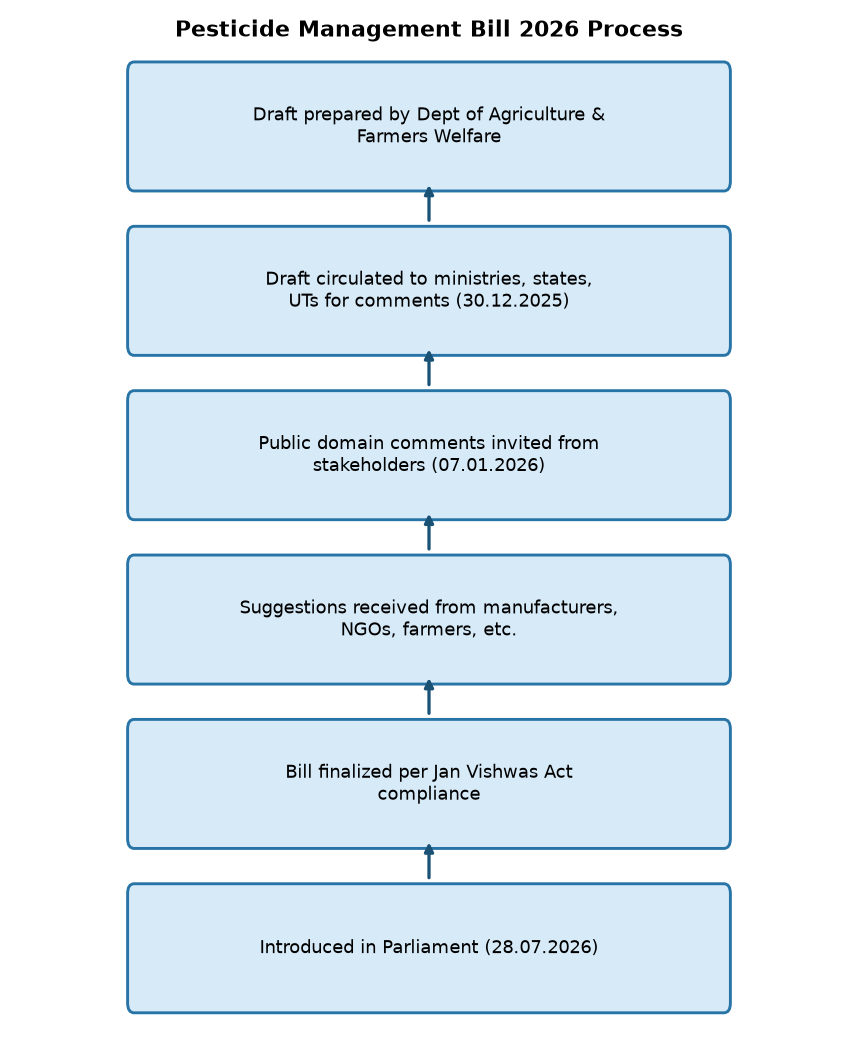
The Pesticide Management Bill, 2026, has been introduced by the Ministry of Agriculture and Farmers’ Welfare to modernise India’s regulatory framework for pesticides, aligning it with contemporary agricultural needs and the provisions of the Jan Vishwas (Amendment) Act, 2023. The draft bill, released for public consultation on 30 December 2025 and subsequently on 7 January 2026, has elicited extensive feedback from stakeholders including state governments, pesticide manufacturers, dealers, farmers, and NGOs. This legislative initiative is significant as it seeks to address gaps in data protection, registration processes, and post-market surveillance, thereby ensuring safer agricultural practices and enhanced consumer protection.
Background
- The regulation of pesticides in India is governed by the Insecticides Act, 1968, which established the Central Insecticides Board and Registration Committee (CIBRC) for registration and regulation of pesticides.
- The existing legal framework has been criticised for outdated provisions, inadequate post-market monitoring, and insufficient provisions for data protection and liability of manufacturers.
- The Jan Vishwas (Amendment) Act, 2023, aims to decriminalise minor offences and streamline regulatory processes across sectors, influencing the drafting of the Pesticide Management Bill, 2026.
- India is one of the largest consumers of pesticides globally, with significant implications for public health, environmental sustainability, and agricultural productivity.
- The bill is part of a broader effort to align India’s agricultural regulations with global best practices, including compliance with Maximum Residue Limits (MRLs) set by the Codex Alimentarius Commission.
- Stakeholder consultations have highlighted the need for a robust regulatory mechanism to address issues such as pesticide resistance, residue contamination, and farmer safety.
What is the Pesticide Management Bill, 2026?
- The Pesticide Management Bill, 2026, is a proposed legislation aimed at replacing and modernising the Insecticides Act, 1968, to address contemporary challenges in pesticide regulation.
- The bill seeks to establish a comprehensive regulatory framework for the manufacture, import, sale, distribution, and use of pesticides in India, ensuring alignment with the Jan Vishwas (Amendment) Act, 2023.
- Key objectives include enhancing data protection for confidential business information, streamlining registration processes, and strengthening post-market surveillance to monitor pesticide residues in food and the environment.
- The bill introduces provisions for the registration of pesticides with a focus on scientific evaluation, risk assessment, and compliance with international standards such as those set by the Food and Agriculture Organization (FAO) and World Health Organization (WHO).
- It mandates the establishment of a National Pesticide Data Repository to centralise information on pesticide usage, residues, and adverse effects, facilitating evidence-based policymaking.
- The bill incorporates provisions for the protection of farmers’ rights, including access to information on pesticide safety, training, and compensation mechanisms for adverse health impacts due to pesticide exposure.
- It introduces stricter penalties for violations, including unauthorised sale, misbranding, and non-compliance with registration conditions, to deter malpractices in the pesticide industry.
- The bill aligns with the principles of Integrated Pest Management (IPM) and Good Agricultural Practices (GAP) to promote sustainable agriculture and reduce dependency on chemical pesticides.
Key Features
| Feature | Significance |
|---|---|
| Public Consultation Process | Ensures inclusivity by inviting feedback from all stakeholders including state governments, manufacturers, dealers, farmers, and NGOs, thereby enhancing regulatory robustness. |
| Alignment with Jan Vishwas Act | Incorporates provisions to decriminalise minor offences and streamline compliance, reducing regulatory burden while maintaining accountability. |
| Data Protection Provisions | Mandates secure handling and storage of pesticide-related data to prevent misuse and ensure transparency in regulatory processes. |
| Risk-Based Classification of Pesticides | Classifies pesticides into categories based on toxicity levels, enabling targeted regulatory measures and risk mitigation strategies. |
| Post-Market Surveillance | Establishes mechanisms for continuous monitoring of pesticide efficacy and safety post-approval to address emerging risks. |
Why it Matters
Regulatory Framework
- Replaces the outdated Insecticides Act, 1968, to address contemporary challenges in pesticide management, including environmental and health concerns.
- Introduces a modern, risk-based regulatory approach to balance agricultural productivity with public health and ecological safety.
- Enhances transparency and accountability in pesticide approval, distribution, and use through stringent compliance mechanisms.
Economic Implications
- Supports sustainable agriculture by promoting the use of safer pesticides, thereby reducing long-term health costs and environmental degradation.
- Facilitates market access for Indian agricultural produce by ensuring compliance with global pesticide residue standards.
Environmental Sustainability
- Aims to reduce soil and water contamination by regulating the use of hazardous pesticides and promoting alternatives like bio-pesticides.
- Encourages the adoption of integrated pest management (IPM) practices to minimise chemical pesticide dependency.
Public Health
- Reduces exposure to toxic pesticides among farmers and consumers, thereby lowering the incidence of pesticide-related illnesses.
- Strengthens food safety standards by ensuring that pesticides used in agriculture meet stringent health and environmental criteria.
Challenges
1. Regulatory Enforcement
- Ensuring uniform enforcement across states with varying administrative capacities and resource constraints.
- Addressing the challenge of illegal pesticide trade and unregulated use in certain regions.
UPSC Link: GS3: Environment & Disaster Management
2. Farmer Awareness and Compliance
- Overcoming low awareness among small and marginal farmers regarding safe pesticide use and alternative practices.
- Ensuring compliance with new regulations without imposing undue economic burden on resource-constrained farmers.
UPSC Link: GS3: Agriculture
3. Data Privacy and Security
- Protecting sensitive data related to pesticide manufacturing, distribution, and use from cyber threats and misuse.
- Balancing transparency requirements with the need to safeguard proprietary information of manufacturers.
UPSC Link: GS3: Science & Technology
4. Market Distortions
- Preventing monopolistic practices by large pesticide manufacturers that could stifle competition and innovation.
- Ensuring affordability of safer pesticides for small-scale farmers to prevent exclusion from regulatory benefits.
UPSC Link: GS3: Economy
5. Inter-Ministerial Coordination
- Facilitating seamless coordination between the Ministry of Agriculture, Ministry of Environment, and state governments for effective implementation.
- Resolving conflicts between agricultural productivity goals and environmental protection mandates.
UPSC Link: GS2: Governance
Challenges — UPSC Perspective
| Issue | Concern |
|---|---|
| Illegal Pesticide Trade | Unregulated sale and use of banned or substandard pesticides pose health and environmental risks. |
| Farmer Resistance to Change | Traditional reliance on chemical pesticides may hinder adoption of safer alternatives despite regulatory incentives. |
| Data Management Systems | Lack of robust digital infrastructure for real-time monitoring and data sharing across stakeholders. |
| Regulatory Arbitrage | Variations in state-level enforcement could lead to regulatory arbitrage and market distortions. |
| Cost of Compliance | High costs associated with adopting safer pesticides and alternative farming practices may deter small farmers. |
| Public Perception and Trust | Distrust in regulatory bodies due to past incidents of pesticide misuse or delayed action on harmful substances. |
Way Forward
- Conduct nationwide awareness campaigns to educate farmers on safe pesticide use, alternative practices, and regulatory compliance.
- Strengthen state-level enforcement agencies with adequate funding, training, and digital tools for real-time monitoring.
- Develop a unified digital platform for pesticide registration, monitoring, and data sharing among stakeholders.
- Promote research and development in bio-pesticides and integrated pest management (IPM) through public-private partnerships.
- Establish a grievance redressal mechanism for farmers and manufacturers to report violations and seek redress.
- Collaborate with agricultural universities and extension services to disseminate best practices and training.
- Incentivise the adoption of safer pesticides through subsidies, tax benefits, or certification schemes.
- Regularly review and update the regulatory framework based on emerging scientific evidence and stakeholder feedback.
UPSC Value Addition
Keywords for Mains Answer-Writing
Pesticide Management Bill 2026 · Pesticide Regulation in India · Jan Vishwas Act compliance · Data protection in agricultural chemicals · Stakeholder consultations in legislation · Pesticide licensing and registration · Environmental and health safeguards · Farmers’ rights and safety · Union Ministry of Agriculture and Farmers’ Welfare · Public feedback in policy formulation · Regulatory framework for agrochemicals · Sustainable agriculture and pest management
Concept Flow
Legacy Regulatory Gaps → Insecticides Act, 1968 → Environmental & Health Risks → Public Consultation → Jan Vishwas Act Alignment → Risk-Based Classification → Post-Market Surveillance → Sustainable Agriculture → Economic & Ecological Benefits
Prelims Practice Questions
Q1. Which of the following is a key objective of the Pesticide Management Bill 2026?
- To deregulate the sale and use of all pesticides in India
- To align India’s pesticide regulations with the Jan Vishwas Act and modern requirements
- To promote the unchecked import of pesticides without safety checks
- To exempt farmers from any liability in case of pesticide misuse
Answer: To align India’s pesticide regulations with the Jan Vishwas Act and modern requirements — The Pesticide Management Bill 2026 aims to modernise pesticide regulation in India while ensuring compliance with the Jan Vishwas (Lok Adalat) Act, 2023, by incorporating provisions for data protection, stakeholder consultations, and balanced regulatory mechanisms.
Q2. Which of the following entities was NOT mentioned as a stakeholder consulted during the formulation of the Pesticide Management Bill 2026?
- State and Union Territory Governments
- Pesticide manufacturers and dealers
- Non-Governmental Organisations (NGOs)
- International pesticide certification bodies
Answer: International pesticide certification bodies — The stakeholders consulted included State/UT Governments, pesticide manufacturers, dealers, farmers, NGOs, and other relevant bodies. International certification bodies were not mentioned in the consultation process.
Mains Practice Question
✍ Critically examine the provisions of the Pesticide Management Bill 2026 in the context of balancing agricultural productivity with environmental and health safeguards. How does the Bill address the concerns of farmers, manufacturers, and public health stakeholders?
Approach: Begin by outlining the key provisions of the Bill, such as licensing, registration, data protection, and stakeholder consultations. Then, analyse how these provisions aim to balance the need for agricultural productivity with environmental and health safeguards. Discuss the role of the Jan Vishwas Act in shaping the Bill’s compliance framework. Finally, evaluate the potential challenges in implementation, including enforcement, farmer awareness, and regulatory capacity, and suggest measures to enhance the Bill’s effectiveness.
Source: PIB (Press Information Bureau)
Generated by AanyaAi for educational purpose.

- उत्तराखंड राज्यपाल के 5 वर्ष: पांच मिशन और AI क्रांति का लेखा-जोखा - September 15, 2026
- UPSC Focus: Uttarakhand Governor’s 5-Year Journey & 5 Key Missions Explained - September 15, 2026
- AI का वादा और खतरा: क्या मानवता के लिए खतरा है कृत्रिम बुद्धिमत्ता? - September 15, 2026

No Comments