


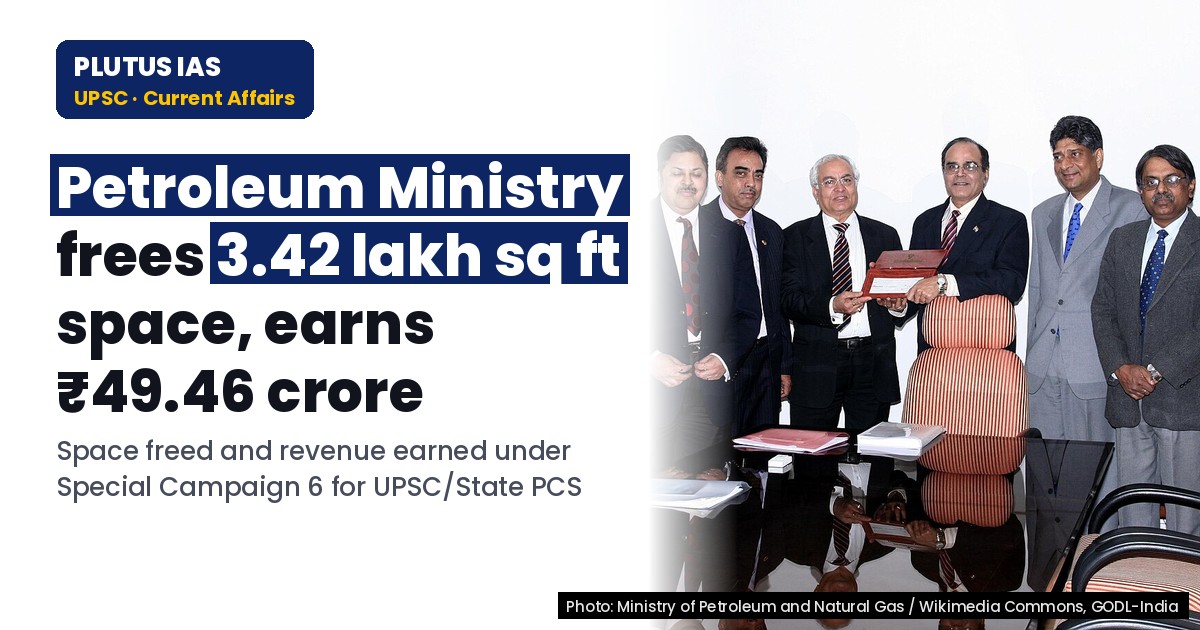
29 Oct Petroleum Ministry’s Special Campaign 6: 3.42 Lakh Sq Ft Space Freed, ₹49.46 Crore Earned
✎ Special Campaign 6 is a government-wide reform initiative aimed at optimizing office spaces, disposing of scrap and e-waste scientifically, and enhancing administrative efficiency in line with sustainability and resource…
Subject Relevance — Where This Topic Fits
- GS Paper III — Environment and Ecology (E-waste management, scrap disposal) | GS Paper III — Economy (Resource optimization, revenue generation from scrap) | GS Paper II — Governance (Administrative reforms, CPSE efficiency)
- Prelims: Special Campaign 6, E-waste (Management) Rules, 2022, CPSEs, Resource efficiency, Space optimization, Scrap disposal, Petroleum and Natural Gas Ministry
- Essay: Administrative Reforms and Sustainable Governance, Resource Efficiency and Circular Economy
Quick Revision: Special Campaign 6 is a government-wide reform initiative aimed at optimizing office spaces, disposing of scrap and e-waste scientifically, and enhancing administrative efficiency in line with sustainability and resource conservation goals.
Why is this in the news?
The Ministry of Petroleum and Natural Gas has reported notable progress under Special Campaign 6, achieving significant outcomes in space optimization, scrap disposal, and e-waste management across its Central Public Sector Enterprises (CPSEs). The campaign, launched as part of the government’s broader administrative reform agenda, demonstrates measurable improvements in administrative efficiency, environmental responsibility, and fiscal prudence within the oil and gas sector.
Background
- The Government of India launched Special Campaign 6 as a pan-government initiative to promote cleanliness, efficient record management, and optimal utilization of office spaces across all ministries and departments.
- The campaign is aligned with the broader ‘Swachh Bharat Mission’ and the ‘LiFE’ (Lifestyle for Environment) initiative, emphasizing sustainable practices in governance.
- Central Public Sector Enterprises (CPSEs) play a pivotal role in India’s economy, particularly in strategic sectors such as petroleum and natural gas, contributing to both economic output and public service delivery.
- Efficient management of scrap and e-waste is critical for environmental sustainability, resource conservation, and compliance with the E-waste (Management) Rules, 2022.
- Space optimization in government offices reduces operational costs, enhances administrative efficiency, and supports the ‘Digital India’ and ‘Paperless Office’ initiatives.
- The Petroleum and Natural Gas Ministry oversees major CPSEs such as ONGC, IOCL, GAIL, and HPCL, which collectively contribute significantly to India’s energy security.
What is Special Campaign 6?
- Special Campaign 6 is a government-wide initiative to drive administrative reforms, focusing on cleanliness, efficient record management, and optimal utilization of office spaces.
- The campaign mandates all ministries, departments, and CPSEs to identify and vacate redundant office spaces, dispose of scrap and e-waste responsibly, and enhance administrative efficiency.
- Key objectives include promoting a culture of cleanliness, ensuring scientific disposal of waste, and generating revenue through the sale of scrap materials.
- The campaign operates on a time-bound basis, with periodic reviews to assess progress and adherence to targets set by the Department of Administrative Reforms and Public Grievances (DARPG).
- Special Campaign 6 builds on the success of previous campaigns (Special Campaign 1.0 to 5.0), which also aimed at improving governance standards and resource efficiency.
- The campaign is part of a broader strategy to align government operations with the principles of sustainability, circular economy, and fiscal responsibility.
- Progress under the campaign is monitored through real-time dashboards, with ministries required to submit monthly reports on space vacated, scrap disposed, and revenue generated.
- The initiative underscores the government’s commitment to reducing the carbon footprint of administrative operations and promoting environmentally responsible practices.
Key Features
| Feature | Significance |
|---|---|
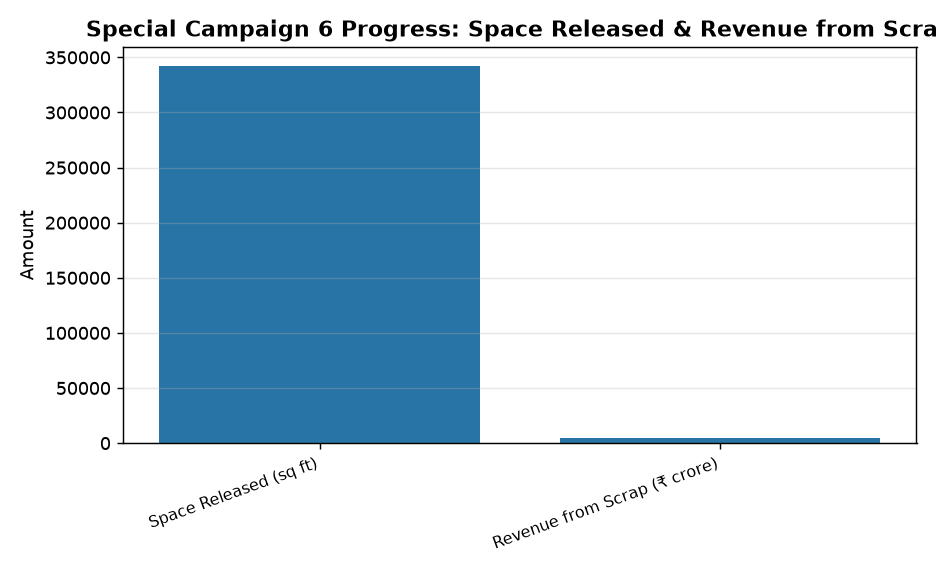
| Space optimization (3.42 lakh sq ft vacated) | Demonstrates efficient utilisation of office infrastructure, reducing redundant space and associated costs in CPSEs under the Ministry of Petroleum and Natural Gas. |
| Scrap and e-waste disposal (₹49.46 crore revenue) | Ensures scientific disposal of non-usable assets, generating revenue while adhering to environmental norms and circular economy principles. |
| Progress monitoring by Ministry | Institutionalises accountability through real-time tracking of campaign milestones across all affiliated organisations. |
| Sustainable sanitation practices | Promotes long-term cleanliness in office premises, aligning with Swachh Bharat Mission objectives and enhancing employee welfare. |
Why it Matters
Economic
- Direct revenue generation (₹49.46 crore) from scrap disposal exceeds targets by 20.63%, indicating efficient asset monetisation.
- Reduction in operational overheads through optimal space utilisation, contributing to fiscal prudence in public sector enterprises.
- Enhanced financial discipline via systematic inventory and asset management, reducing idle resource expenditure.
Environmental
- Scientific disposal of e-waste mitigates hazardous material leakage, aligning with the E-Waste (Management) Rules, 2022.
- Promotion of circular economy principles by repurposing scrap materials, reducing landfill burden and resource depletion.
- Integration of sanitation initiatives with broader environmental sustainability goals under national policies.
Administrative
- Strengthens governance through transparent record-keeping and efficient space management in CPSEs.
- Fosters a culture of accountability and continuous improvement in public sector organisations.
- Demonstrates proactive compliance with directives on cleanliness and resource efficiency.
Strategic
- Enhances operational efficiency in the oil and gas sector, a critical infrastructure domain for national energy security.
- Sets a precedent for other ministries to adopt similar campaigns, amplifying nationwide impact.
- Reinforces the role of public sector enterprises in supporting sustainable development goals.
Challenges
1. Logistical Constraints in Scrap Disposal
- Ensuring adherence to hazardous waste disposal protocols while maximising revenue from scrap sales.
- Coordinating across multiple CPSEs to standardise disposal processes and avoid delays.
- Balancing cost-effectiveness with environmental safeguards in e-waste management.
UPSC Link: Environmental Governance
2. Resistance to Space Rationalisation
- Overcoming institutional inertia in relinquishing underutilised office spaces.
- Addressing concerns of employees regarding relocation or consolidation of workspaces.
- Ensuring minimal disruption to ongoing operations during space optimisation drives.
UPSC Link: Public Administration
3. Data Integrity in Inventory Management
- Maintaining accurate records of assets to prevent misclassification of scrap or e-waste.
- Implementing digital tools for real-time tracking of disposal and revenue generation.
- Training personnel in compliance with evolving waste management regulations.
UPSC Link: Governance & Transparency
4. Sustainability of Campaign Outcomes
- Institutionalising best practices to prevent relapse into pre-campaign inefficiencies.
- Allocating dedicated budgets for maintenance of sanitation and space optimisation.
- Conducting periodic audits to ensure long-term adherence to campaign objectives.
UPSC Link: Sustainable Development
Challenges — UPSC Perspective
| Issue | Concern |
|---|---|
| Hazardous waste compliance | Risk of regulatory non-compliance during scrap disposal, leading to penalties or environmental harm. |
| Employee resistance | Potential pushback from staff due to perceived inconvenience in workspace adjustments. |
| Standardisation across CPSEs | Variability in disposal practices across organisations may dilute campaign effectiveness. |
| Digital adoption barriers | Limited technological literacy among personnel may hinder inventory and monitoring systems. |
| Budgetary constraints | Initial investment in infrastructure or training may deter smaller CPSEs from full participation. |
Way Forward
- Institutionalise a quarterly review mechanism to assess progress and address bottlenecks in space optimisation and waste disposal.
- Develop a centralised digital platform for real-time tracking of scrap and e-waste disposal across all CPSEs under the Ministry.
- Conduct capacity-building workshops for personnel on hazardous waste management and sustainable sanitation practices.
- Collaborate with state pollution control boards to streamline compliance and certification for scrap disposal.
- Allocate a portion of generated revenue towards upgrading sanitation infrastructure in office premises.
- Expand the campaign to include other ministries and PSUs, leveraging best practices for nationwide replication.
- Integrate campaign outcomes with the Ministry’s Corporate Social Responsibility (CSR) initiatives for community outreach.
UPSC Value Addition
Keywords for Mains Answer-Writing
Special Campaign 6 · Ministry of Petroleum and Natural Gas · Central Public Sector Enterprises (CPSEs) · Scrap and e-waste disposal · Administrative efficiency · Sustainable sanitation practices · Resource optimization · Government waste management policies · Public sector governance reforms · Environmental responsibility in administration
Concept Flow
Initiation of Special Campaign 6 by the Ministry of Petroleum and Natural Gas → Identification of redundant office spaces and non-functional assets → Assessment of scrap and e-waste for disposal → Monetisation of scrap through scientific channels → Revenue generation and space optimisation → Reinforcement of administrative efficiency and environmental responsibility → Long-term institutionalisation of sustainable practices.
Prelims Practice Questions
Q1. Consider the following statements regarding Special Campaign 6:
1. It is an initiative led by the Ministry of Petroleum and Natural Gas.
2. The campaign focuses on sanitation, efficient record management, and scrap disposal.
3. The campaign aims to generate revenue through the disposal of scrap and e-waste.
4. The campaign does not involve Central Public Sector Enterprises (CPSEs).
How many of the above statements are correct?
- Only one
- Only two
- Only three
- All
Answer: Only three — Statements 1, 2, and 3 are correct as per the press release. Statement 4 is incorrect because the campaign explicitly involves CPSEs in the oil and gas sector.
Q2. Assertion (A): The disposal of scrap and e-waste under Special Campaign 6 has generated revenue exceeding the target set for the campaign.
Reason (R): The campaign emphasizes sustainable sanitation practices and efficient resource utilization in government offices.
- Both A and R are true, and R is the correct explanation of A
- Both A and R are true, but R is not the correct explanation of A
- A is true, but R is false
- A is false, but R is true
Answer: Both A and R are true, but R is not the correct explanation of A — Both the assertion and reason are true. The campaign has exceeded its revenue target from scrap disposal (49.46 crore vs. 41 crore target), and the reason correctly explains the broader objectives of the campaign, including sustainable practices.
Q3. Match the following initiatives with their corresponding ministries/departments:
Column I
A. Special Campaign 6
B. Swachh Bharat Mission
C. Digital India
D. Make in India
Column II
1. Ministry of Electronics and Information Technology
2. Ministry of Housing and Urban Affairs
3. Ministry of Commerce and Industry
4. Ministry of Petroleum and Natural Gas
- A-4, B-2, C-1, D-3
- A-1, B-3, C-2, D-4
- A-2, B-4, C-3, D-1
- A-3, B-1, C-4, D-2
Answer: A-4, B-2, C-1, D-3 — Special Campaign 6 is led by the Ministry of Petroleum and Natural Gas (A-4). Swachh Bharat Mission is under the Ministry of Housing and Urban Affairs (B-2). Digital India is under the Ministry of Electronics and Information Technology (C-1). Make in India is under the Ministry of Commerce and Industry (D-3).
Mains Practice Question
✍ The Ministry of Petroleum and Natural Gas has demonstrated significant progress under Special Campaign 6, including the evacuation of over 3.42 lakh square feet of space and the disposal of scrap and e-waste generating ₹49.46 crore. In this context, critically examine the role of government waste management policies in enhancing administrative efficiency and environmental sustainability. (15 Marks)
Approach: MODEL-ANSWER SKELETON:
1. **Introduction (2 Marks)**: Define government waste management policies and their objectives, linking to Special Campaign 6 as a contemporary example.
2. **Administrative Efficiency (5 Marks)**:
– Explain how efficient waste management (scrap/e-waste disposal) reduces clutter, optimizes office space, and streamlines record-keeping.
– Cite the campaign’s success in freeing 3.42 lakh sq. ft. of space and generating revenue (₹49.46 crore) as evidence of improved resource utilization.
– Reference the **Government of India’s Policy on Scientific Disposal of Waste (2016)** and **E-Waste (Management) Rules, 2022** to ground the discussion in statutory frameworks.
3. **Environmental Sustainability (5 Marks)**:
– Discuss how scientific disposal of e-waste and scrap mitigates pollution, aligns with **Swachh Bharat Mission 2.0**, and supports India’s **Circular Economy** goals.
– Highlight the **Basel Convention** and India’s obligations under it, as well as the **National Environment Policy, 2006**.
4. **Challenges and Way Forward (3 Marks)**:
– Acknowledge limitations: lack of standardized e-waste collection infrastructure in some regions, informal sector dominance in recycling.
– Suggest measures: strengthening Extended Producer Responsibility (EPR) under the E-Waste Rules, public-private partnerships for waste-to-energy projects, and awareness campaigns.
5. **Conclusion (2 Marks)**: Summarize the dual benefits of waste management policies—administrative efficiency and environmental sustainability—while emphasizing the need for sustained implementation.
Source: PIB (Press Information Bureau)
Generated by AanyaAi for educational purpose.
Related guides on our sites
- Anthropology VS PSIR
- Best PSIR optional coaching
- Best PSIR optional coaching online
- Best PSIR optional teacher

- DIPAM’s Special Campaign 6: Institutionalizing Cleanliness & Reducing Arrears - November 13, 2026
- दिल्ली वायु प्रदूषण: प्रवर्तन टीमों हेतु बॉडी कैमरे और ‘वायु रक्षक’ पहल - November 13, 2026
- Special Parliament Sessions: Rules, Article 85 & Provisions - November 13, 2026

No Comments