


28 Jul PLI Scheme Boosts Textile Sector: Key Updates for UPSC & State PCS
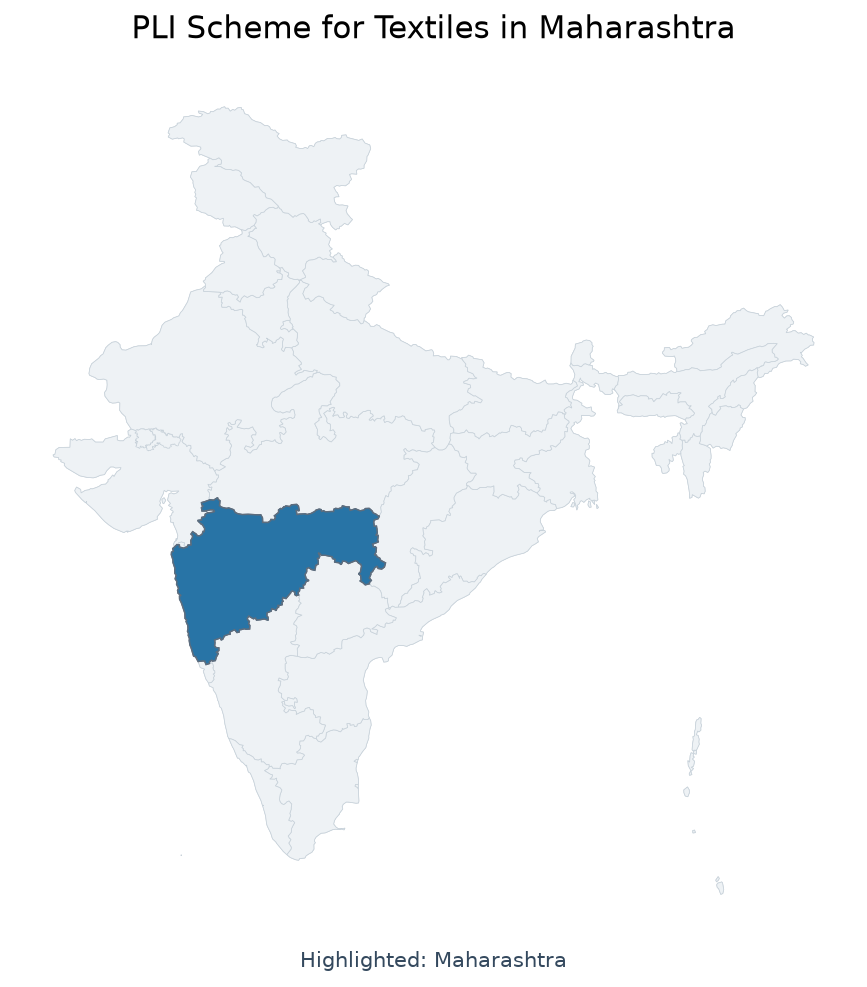
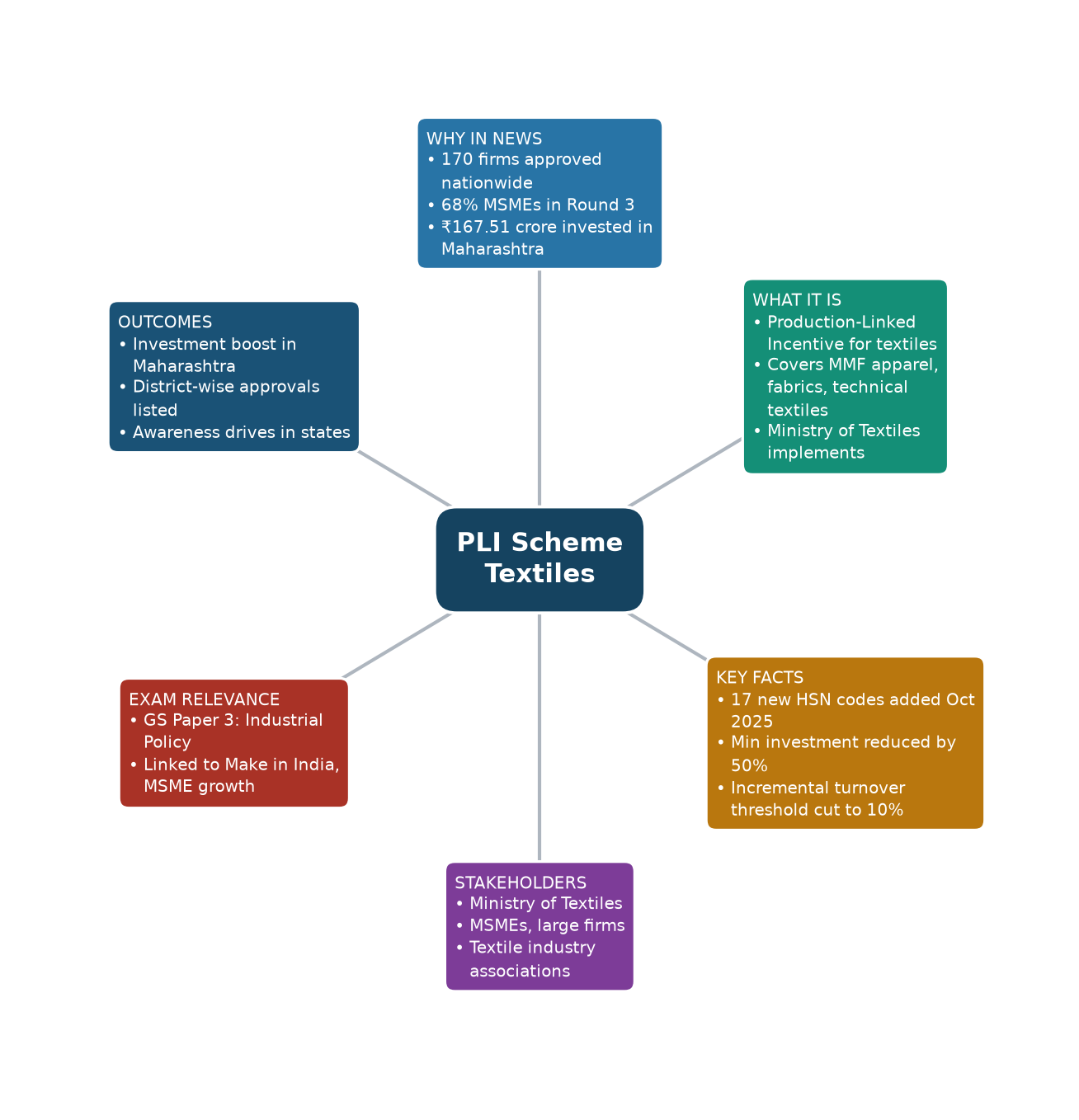
Map & concept mind-map: PLI Scheme for Textiles in Maharashtra
Subject Relevance — Where This Topic Fits
- GS Paper III — Indian Economy: Issues relating to Planning, Mobilization of Resources, Growth, Development and Employment | GS Paper III — Effects of Liberalization on the Economy, Changes in Industrial Policy and their Effects on Industrial Growth
- Prelims: Production-Linked Incentive (PLI) Scheme, Man-Made Fibre (MMF), Technical Textiles, Textile Sector, Fiscal Incentives, Union Budget 2021-22, Atmanirbhar Bharat, Ministry of Textiles, HSN Code, Incremental Turnover
- Essay: India’s Manufacturing Renaissance: The Role of PLI Schemes in Achieving Self-Reliance, Balancing Industrial Growth with Inclusive Development: Lessons from the Textiles Sector
Quick Revision: The PLI Scheme for textiles incentivises incremental production and investment in MMF, technical textiles, and apparel, with recent amendments reducing entry barriers and significantly boosting MSME participation.
Why is this in the news?
The Ministry of Textiles has expanded the scope of the Production-Linked Incentive (PLI) Scheme for textiles to include Man-Made Fibre (MMF) apparel, fabrics, and technical textiles, aiming to boost investment, enhance manufacturing capacity, and improve global competitiveness. Recent amendments in October 2025 have reduced entry barriers, expanded eligible product categories, and significantly enhanced participation from MSMEs, marking a pivotal evolution in India’s industrial policy for the textiles sector.
Background
- The PLI Scheme was introduced in 2020 as part of the Atmanirbhar Bharat initiative to incentivise domestic manufacturing and reduce import dependence across critical sectors.
- The textiles sector was identified as a key focus area due to its employment-intensive nature, export potential, and strategic importance in global supply chains.
- MMF and technical textiles are high-growth sub-sectors with rising global demand, particularly in automotive, healthcare, and infrastructure applications.
- Prior to the 2025 amendments, the PLI Scheme for textiles primarily targeted man-made fibre and technical textiles, with limited coverage of apparel and fabrics.
- India’s share in global textile trade remains below 5%, despite being the world’s second-largest producer of textiles and garments.
What is the Production-Linked Incentive (PLI) Scheme for Textiles?
- The PLI Scheme for textiles is a performance-based incentive mechanism designed to promote large-scale investments in MMF apparel, MMF fabrics, and technical textiles by offering financial incentives linked to incremental production and sales.
- The scheme is implemented by the Ministry of Textiles and operates under the broader framework of the PLI Scheme for 14 key sectors, notified by the Department for Promotion of Industry and Internal Trade (DPIIT).
- Incentives are disbursed over a five-year period post-commissioning of the manufacturing plant, with the quantum of support determined by the incremental sales and investment made by the applicant firm.
- The scheme covers 170 companies nationwide, with 24 based in Maharashtra, and has catalysed investments of ₹167.51 crore in the state alone as of March 2026.
- Key eligible product categories include MMF yarns, fabrics, garments, and a wide range of technical textiles such as medical textiles, agro-textiles, protective textiles, and composites.
- The scheme incentivises both new and existing units, with relaxed eligibility norms for MSMEs, including a 50% reduction in minimum investment thresholds and a lowered incremental turnover requirement from 25% to 10%.
- The Ministry conducts regular monitoring through open-house sessions, monthly workshops, and district-wise outreach programmes to address implementation challenges and enhance stakeholder engagement.
- Recent amendments in October 2025 expanded the scope by adding 17 new HSN codes for MMF apparel and fabrics, thereby broadening the ambit of eligible products and attracting fresh investments.
Key Features
| Feature | Significance |
|---|---|
| Expansion of eligible products via 17 new HSN codes in MMF apparel and fabrics | Broadens the scope of the PLI scheme, enabling more textile products to qualify for incentives and attracting diversified investments. |
| Reduction in minimum investment threshold by 50% | Lowers entry barriers for MSMEs and new enterprises, fostering wider participation in the textile manufacturing ecosystem. |
| Decrease in incremental turnover requirement for incentives from 25% to 10% | Makes the scheme more accessible to smaller players, enhancing competitiveness and scalability in the sector. |
| Reopening of the PLI application portal until 31 March 2026 | Provides a second window for fresh applications, allowing stakeholders additional time to benefit from the revised scheme. |
| Active outreach through weekly ‘Open House’ sessions and monthly workshops | Ensures real-time resolution of implementation challenges and facilitates stakeholder engagement for smoother project execution. |
Why it Matters
Economic Impact
- Stimulates investment in the textile sector, particularly in MMF (Man-Made Fibre) fabrics, apparel, and technical textiles, aligning with India’s goal of becoming a global manufacturing hub.
- Enhances manufacturing capacity in Maharashtra and other states, contributing to regional industrial growth and employment generation.
- Promotes self-reliance in critical textile segments, reducing import dependence and strengthening the domestic value chain.
Strategic Importance
- Supports the ‘Make in India’ initiative by incentivising domestic production of high-value textile products, including technical textiles used in healthcare, automotive, and industrial applications.
- Aligns with the National Technical Textiles Mission (NTTM) to boost innovation and competitiveness in niche textile segments.
Sectoral Development
- Encourages MSME participation, as evidenced by 68% of Round 3 applications originating from this segment, thereby democratising industrial growth.
- Facilitates technology upgradation and adoption of advanced manufacturing processes in the textile industry.
Policy and Governance
- Demonstrates the government’s commitment to sector-specific reforms through periodic revisions of the PLI scheme to address implementation bottlenecks.
- Strengthens public-private collaboration via structured engagement mechanisms like ‘Open House’ sessions and state-level outreach programmes.
Challenges
1. Implementation Bottlenecks
- Delays in disbursement of incentives due to bureaucratic processes, which may deter investor confidence.
- Limited awareness among potential beneficiaries, particularly in Tier-II and Tier-III cities, despite outreach efforts.
UPSC Link: GS-III: Industrial Policy
2. MSME Accessibility Constraints
- High initial capital requirements for compliance with minimum investment thresholds, even after reduction.
- Competitive disadvantage vis-à-vis large enterprises in availing incentives due to resource constraints.
UPSC Link: GS-III: MSME Development
3. Market Competitiveness
- Risk of overcapacity in certain textile segments, leading to price wars and reduced profitability for manufacturers.
- Dependence on global demand for MMF products, which is subject to fluctuations in international trade policies.
UPSC Link: GS-III: Trade and Industry
4. Technological Lag
- Inadequate adoption of advanced manufacturing technologies in the textile sector, particularly among MSMEs.
- Limited R&D investment in technical textiles, constraining innovation and product diversification.
UPSC Link: GS-III: Science and Technology
Challenges — UPSC Perspective
| Issue | Concern |
|---|---|
| Bureaucratic delays in incentive disbursement | Undermines investor trust and hampers timely project execution. |
| Low awareness among MSMEs in non-metro regions | Results in suboptimal participation and missed opportunities for regional development. |
| High compliance costs for MSMEs despite threshold reductions | Discourages smaller players from leveraging the scheme. |
| Over-reliance on global demand for MMF products | Exposes the sector to external economic shocks and trade policy uncertainties. |
| Limited R&D focus in technical textiles | Restricts India’s ability to compete in high-value, niche segments. |
Government Initiatives — Must-Memorise for Prelims
- Production-Linked Incentive (PLI) Scheme for Textiles
- National Technical Textiles Mission (NTTM)
- Scheme for Integrated Textile Parks (SITP)
Way Forward
- Strengthen institutional mechanisms for faster disbursement of incentives to enhance investor confidence.
- Expand state-level outreach programmes to Tier-II and Tier-III cities, focusing on MSMEs and new entrepreneurs.
- Introduce targeted subsidies or credit guarantees to further reduce the financial burden on MSMEs.
- Promote public-private partnerships (PPPs) for R&D in technical textiles to drive innovation and product diversification.
- Simplify compliance procedures and reduce documentation requirements to streamline scheme participation.
- Encourage collaboration between textile manufacturers and academic institutions for skill development and technology transfer.
- Monitor and evaluate the scheme’s impact on employment generation and regional industrial growth to inform future policy adjustments.
UPSC Value Addition
Keywords for Mains Answer-Writing
Production Linked Incentive (PLI) Scheme · Ministry of Textiles · MMF (Man-Made Fibre) Apparel · Technical Textiles · Investment Promotion · Manufacturing Capacity Enhancement · Competitiveness of Textile Sector · MSME Participation · Incremental Turnover Criteria · HSN Code Expansion · Textile Industry Reforms · Outreach and Awareness Programs · Incremental Investment Threshold · Employment Generation in Textiles
Concept Flow
Expansion of PLI scheme for MMF textiles → Incentivises domestic manufacturing → Attracts investment and enhances competitiveness. → Reduction in investment thresholds and turnover requirements → Facilitates MSME participation → Broadens sectoral inclusivity. → Active outreach and engagement mechanisms → Improves stakeholder awareness and resolves implementation challenges. → Increased investment in Maharashtra and other states → Drives regional industrial growth and employment generation. → Alignment with National Technical Textiles Mission → Promotes innovation and self-reliance in high-value textile segments. → Policy revisions and periodic reviews → Ensures adaptability and responsiveness to sectoral dynamics.
Prelims Practice Questions
Q1. Which of the following is NOT a key objective of the PLI Scheme for the Textile Sector as notified by the Ministry of Textiles?
- To promote investment in the textile sector
- To enhance manufacturing capacities
- To reduce the minimum investment threshold by 50%
- To improve the competitiveness of the textile sector
Answer: To reduce the minimum investment threshold by 50% — The reduction in the minimum investment threshold by 50% is a recent modification to the scheme, not an original objective. The primary objectives include promoting investment, enhancing manufacturing capacities, and improving competitiveness.
Q2. Under the PLI Scheme for Textiles, which of the following product categories is explicitly mentioned as eligible for incentives?
- Cotton-based apparel only
- Man-Made Fibre (MMF) apparel, fabrics, and technical textiles
- Handloom products exclusively
- Silk and jute textiles
Answer: Man-Made Fibre (MMF) apparel, fabrics, and technical textiles — The scheme explicitly targets Man-Made Fibre (MMF) apparel, fabrics, and technical textiles for incentive eligibility, as stated in the official notification.
Q3. The recent amendment to the PLI Scheme for Textiles introduced in October 2025 includes which of the following changes?
- Inclusion of 17 new HSN codes for MMF apparel and fabrics
- Mandatory minimum investment threshold increased to ₹500 crore
- Reduction of incremental turnover criteria from 25% to 5%
- Exclusion of MSMEs from the scheme
Answer: Inclusion of 17 new HSN codes for MMF apparel and fabrics — The amendment included the addition of 17 new HSN codes for MMF apparel and fabrics, making more products eligible under the scheme. The incremental turnover criteria was reduced from 25% to 10%, and the minimum investment threshold was reduced by 50%.
Mains Practice Question
✍ Critically examine the role of the Production Linked Incentive (PLI) Scheme in revitalising India’s textile sector. Assess its impact on investment, employment generation, and global competitiveness, with reference to recent amendments and stakeholder engagement strategies.
Approach: Begin by outlining the objectives and scope of the PLI Scheme for the textile sector, highlighting its focus on MMF apparel, fabrics, and technical textiles. Discuss the recent amendments (October 2025) such as the expansion of HSN codes, reduction in minimum investment thresholds, and incremental turnover criteria, and their implications for MSME participation. Evaluate the scheme’s impact on investment flows (e.g., ₹167.51 crore in Maharashtra by March 2026) and employment generation (e.g., 904 jobs in Maharashtra). Critically analyse the scheme’s effectiveness in enhancing the global competitiveness of India’s textile sector, considering challenges like infrastructure gaps, global competition, and sustainability. Conclude with suggestions for further reforms, such as strengthening R&D in technical textiles and improving ease of doing business.
Source: PIB (Press Information Bureau)
Generated by AanyaAi for educational purpose.

- सुप्रीम कोर्ट ने चुनाव आयोग को दिल्ली में ‘यांत्रिक’ SIR नोटिस पर सावधानियां बरतने को कहा - September 22, 2026
- ‘स्वच्छता ही सेवा-2026’ अभियान: सरकारी विभागों में स्वच्छता क्रांति, जानिए मुख्य बिंदु - September 22, 2026
- DFPD Launches ‘Swachhata Hi Seva-2026’ Campaign for Clean India Mission - September 22, 2026

No Comments