


07 Aug PLI Scheme for Bulk Drugs: Boosting India’s Pharma Self-Reliance in 2026
✎ The PLI Scheme for Bulk Drugs is a ₹6,940 crore incentive mechanism to boost domestic production of 41 critical APIs/KSMs/DIs, with incentives disbursed based on incremental sales over five years, aiming to reduce India’s import…
Subject Relevance — Where This Topic Fits
- GS Paper II — Government Policies and Interventions for Development in various sectors | GS Paper III — Indian Economy and Issues Relating to Planning, Mobilisation of Resources, Growth, Development and Employment
- Prelims: Production-Linked Incentive (PLI) Scheme, Active Pharmaceutical Ingredients (APIs), Key Starting Materials (KSMs), Drug Intermediates (DI), Pharmaceutical Promotion and Development Scheme (PPDS), Atmanirbhar Bharat, Import substitution, Union Budget 2021-22
- Essay: Self-reliance in critical sectors: The case of India’s pharmaceutical industry, Balancing globalisation and domestic industrialisation: Lessons from PLI schemes
Quick Revision: The PLI Scheme for Bulk Drugs is a ₹6,940 crore incentive mechanism to boost domestic production of 41 critical APIs/KSMs/DIs, with incentives disbursed based on incremental sales over five years, aiming to reduce India’s import dependence in pharmaceuticals.
Why is this in the news?
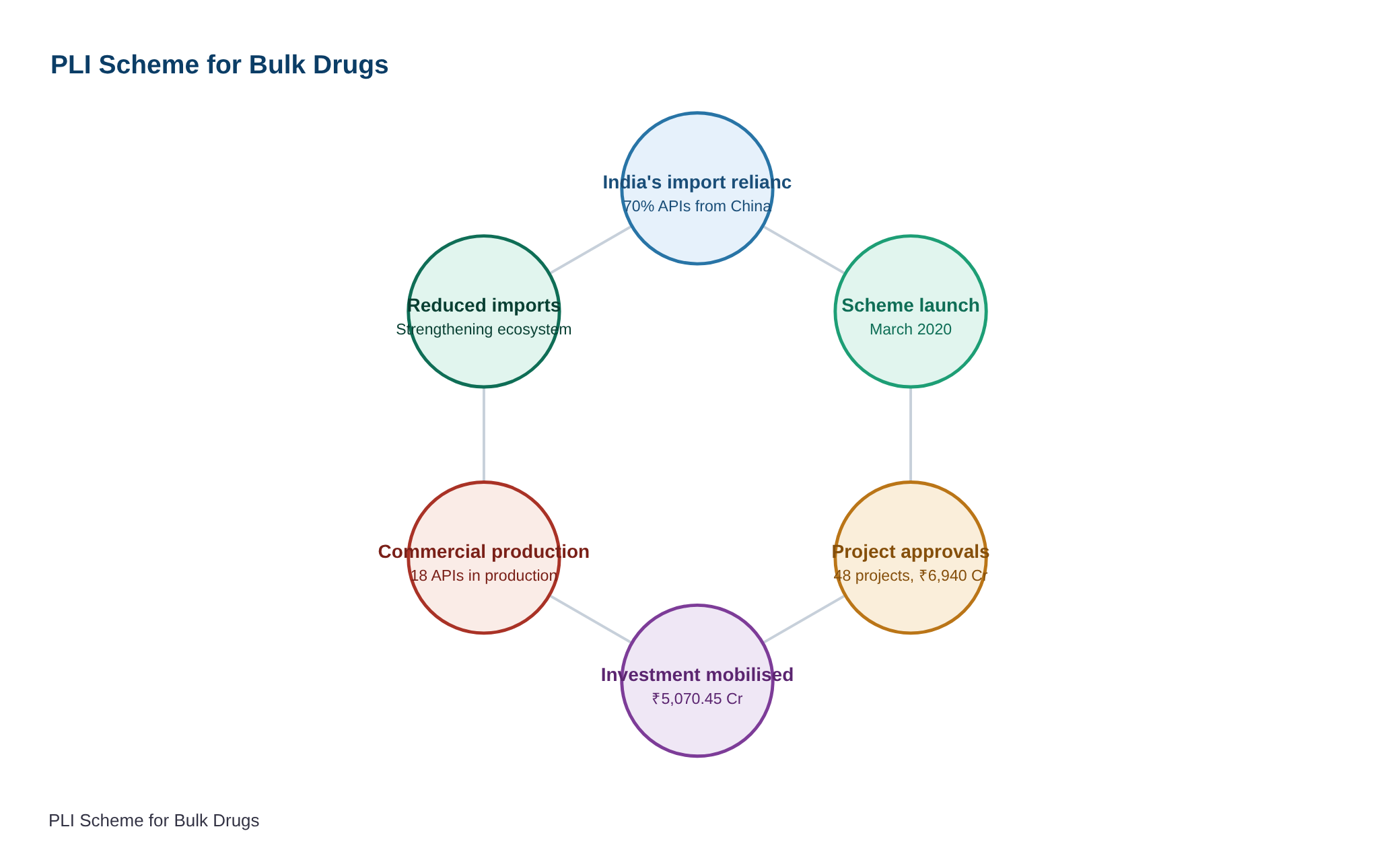
The Union Ministry of Chemicals and Fertilizers, through the Department of Pharmaceuticals, has approved 48 projects under the Production-Linked Incentive (PLI) Scheme for Bulk Drugs (also referred to as the PLI Scheme for Key Starting Materials/Drug Intermediates/Active Pharmaceutical Ingredients) with a sanctioned outlay of ₹6,940 crore. As of March 2026, ₹87.70 crore in incentives has been disbursed, and investments totalling ₹5,070.45 crore have been mobilised against a committed ₹4,329.95 crore. The scheme aims to enhance domestic production of 41 critical APIs/KSMs/DIs, with 18 already in commercial production, thereby reducing reliance on imports and strengthening India’s pharmaceutical manufacturing ecosystem.
Background
- India is the world’s third-largest pharmaceutical market by volume and the 14th largest by value, yet remains heavily dependent on imports for critical raw materials such as APIs, KSMs, and DIs, with over 70% of these being sourced from China.
- The COVID-19 pandemic exposed vulnerabilities in global supply chains, prompting the Government of India to prioritise self-reliance in essential pharmaceutical inputs through schemes like the PLI for Bulk Drugs.
- The PLI Scheme for Bulk Drugs was launched in March 2020 as part of the broader ₹1.97 lakh crore PLI scheme for 13 sectors to boost domestic manufacturing and reduce import dependence.
- As of March 2026, 28 APIs/KSMs/DIs have seen capacity creation, with 10 projects yet to commence commercial production, indicating a phased rollout and gradual scaling up.
- The scheme aligns with the government’s ‘Atmanirbhar Bharat’ initiative and the National Pharmaceutical Policy, which aims to position India as a global leader in pharmaceutical manufacturing.
What is the Production-Linked Incentive (PLI) Scheme for Bulk Drugs?
- The PLI Scheme for Bulk Drugs is a financial incentive mechanism introduced by the Government of India to promote domestic production of critical pharmaceutical inputs, including APIs, KSMs, and DIs.
- The scheme offers performance-linked incentives to eligible manufacturers based on their incremental sales of domestically produced bulk drugs over a five-year period, with the incentive rate ranging from 5% to 20% depending on the product and investment threshold.
- The scheme has a total outlay of ₹6,940 crore, with incentives disbursed over a period of six years (FY 2021-22 to FY 2026-27), subject to achievement of production milestones.
- The scheme covers 41 identified products, including fermentation-based APIs (e.g., penicillin G, erythromycin), chemical synthesis-based APIs (e.g., dexamethasone), and drug intermediates (e.g., 7-ACA, clavulanic acid).
- Eligible applicants include existing manufacturers of bulk drugs and new investors who commit to setting up greenfield projects for the production of specified APIs/KSMs/DIs.
- The scheme mandates that applicants must achieve a minimum investment threshold (e.g., ₹100 crore for fermentation-based projects and ₹50 crore for chemical synthesis-based projects) to qualify for incentives.
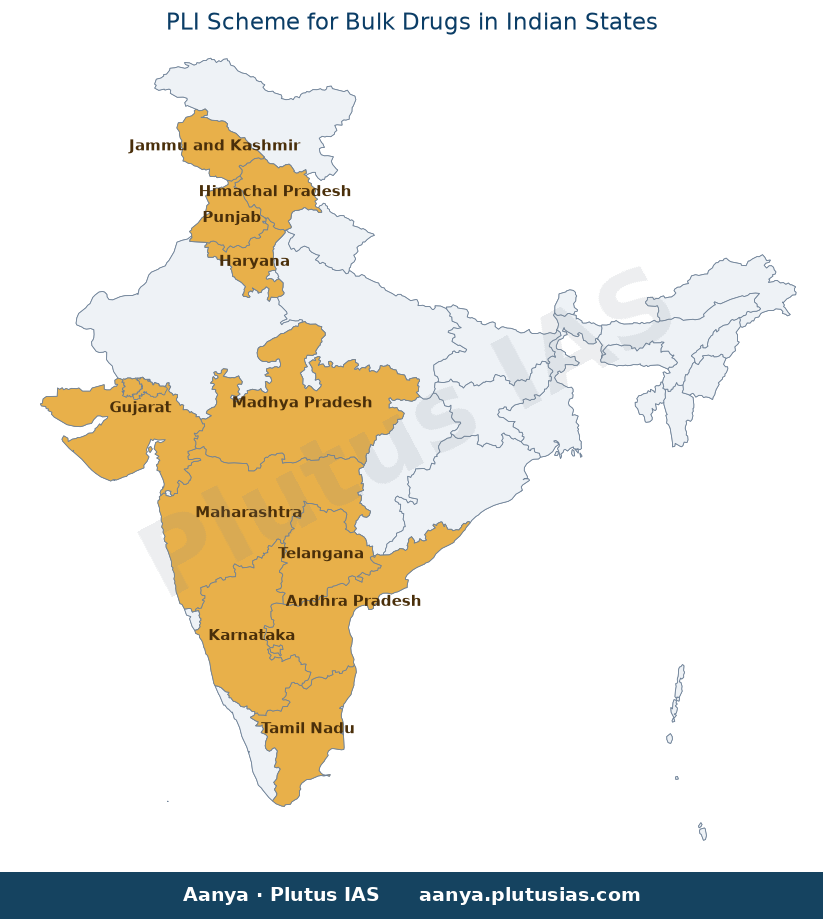
- As of March 2026, 48 projects have been approved across 11 states/UTs, with investments totalling ₹5,070.45 crore and incentives amounting to ₹87.70 crore disbursed, indicating early-stage progress in scaling domestic production.
- The scheme is administered by the Department of Pharmaceuticals under the Ministry of Chemicals and Fertilizers.
Key Features
| Feature | Significance |
|---|---|
| Domestic Production of Bulk Drugs (APIs/KSMs/DIs) | Reduces import dependency on essential pharmaceutical ingredients, enhancing self-reliance in critical healthcare inputs. |
| Production-Linked Incentive (PLI) Scheme for Bulk Drugs | A strategic intervention to incentivize domestic manufacturing of bulk drugs, aligning with the ‘Atmanirbhar Bharat’ vision. |
| Investment Mobilization (₹5,070.45 Crore) | Demonstrates robust private sector participation, validating the scheme’s attractiveness for high-capital industries. |
| State-wise Distribution (e.g., Andhra Pradesh, Gujarat, Maharashtra) | Highlights regional industrial capabilities and policy-driven economic dispersion across states. |
| Commercial Production of 18 APIs (e.g., Penicillin G, Dexamethasone, Atorvastatin) | Direct impact on reducing import bills for these life-saving and high-demand pharmaceuticals. |
Why it Matters
Economic
- Boosts domestic pharmaceutical manufacturing, reducing foreign exchange outflows on bulk drug imports.
- Enhances value addition in the pharmaceutical value chain, improving export competitiveness.
- Stimulates ancillary industries (e.g., packaging, logistics, and chemical intermediates) through backward linkages.
- Promotes job creation in high-skilled and semi-skilled sectors within pharmaceutical manufacturing hubs.
Strategic
- Strengthens India’s position as a global pharmacy by reducing reliance on China and other nations for critical APIs.
- Ensures uninterrupted supply of essential drugs during geopolitical or supply chain disruptions.
- Supports India’s commitment to the WHO’s global health security agenda by localizing production of essential medicines.
Healthcare
- Improves affordability and accessibility of life-saving drugs by reducing dependency on imported intermediates.
- Enhances India’s preparedness for pandemics or health emergencies by securing domestic API production.
- Facilitates the production of generic drugs, aligning with India’s role as the ‘pharmacy of the world’.
Industrial Policy
- Demonstrates the efficacy of production-linked incentives in achieving sectoral growth and self-sufficiency.
- Serves as a model for other sectors (e.g., medical devices, electronics) to replicate for import substitution.
- Encourages R&D and innovation in pharmaceutical manufacturing through targeted incentives.
Challenges
1. High Capital Intensity and Risk
- Bulk drug manufacturing requires substantial upfront investment in plant, machinery, and compliance with stringent regulatory standards (e.g., WHO-GMP, USFDA).
- Long gestation periods for ROI, deterring risk-averse investors despite PLI incentives.
UPSC Link: Economic Survey: Capital Intensity in Pharma
2. Regulatory and Compliance Burden
- Stringent environmental norms (e.g., effluent treatment, emissions control) increase operational costs.
- Frequent changes in drug pricing policies (e.g., NPPA interventions) create uncertainty for investors.
UPSC Link: Drugs and Cosmetics Act, 1940
3. Global Competition and Price Pressures
- India competes with low-cost producers like China, which dominate the global API market due to economies of scale.
- Price erosion in generic drug markets (e.g., due to competition from other developing nations) impacts profitability.
UPSC Link: WTO Agreements on TRIPS
4. Skill and Infrastructure Gaps
- Shortage of skilled labor in niche areas (e.g., fermentation technology, advanced chemical synthesis).
- Inadequate infrastructure in certain states (e.g., Himachal Pradesh, Jammu & Kashmir) hampers project execution.
UPSC Link: National Skill Development Mission
5. Supply Chain Vulnerabilities
- Dependence on imported raw materials (e.g., solvents, catalysts) for certain APIs creates exposure to global supply shocks.
- Logistics bottlenecks (e.g., transportation of hazardous chemicals) increase costs and delays.
UPSC Link: Logistics Efficiency in Pharma
Challenges — UPSC Perspective
| Issue | Concern |
|---|---|
| Regulatory Compliance | High costs and complexity due to multiple approvals (e.g., DCGI, state pollution boards). |
| Market Volatility | Price fluctuations in APIs (e.g., Penicillin G) due to global demand-supply imbalances. |
| Technology Adoption | Lag in adopting advanced manufacturing techniques (e.g., continuous flow chemistry) compared to global peers. |
| Policy Stability | Frequent changes in trade policies (e.g., import duties on key intermediates) disrupt long-term planning. |
| Environmental Sustainability | Challenges in meeting effluent discharge norms while maintaining cost competitiveness. |
| Access to Finance | Difficulty in securing loans for high-risk projects despite government guarantees. |
Government Initiatives — Must-Memorise for Prelims
- Production-Linked Incentive (PLI) Scheme for Pharmaceuticals (Bulk Drugs)
- Pharma Vision 2030 by the Department of Pharmaceuticals
Way Forward
- Streamline regulatory approvals by establishing a single-window clearance mechanism for bulk drug projects.
- Enhance skill development programs in collaboration with industry to address talent shortages in niche areas.
- Expand the PLI scheme to cover more APIs and incentivize R&D for novel drug intermediates.
- Strengthen domestic raw material supply chains by promoting backward integration in the chemical industry.
- Improve logistics infrastructure, particularly for hazardous materials, to reduce transportation costs.
- Encourage public-private partnerships for setting up common effluent treatment plants in pharmaceutical hubs.
- Monitor and address price volatility in global API markets through buffer stock mechanisms.
- Promote export-oriented manufacturing by aligning PLI incentives with global demand trends.
UPSC Value Addition
Keywords for Mains Answer-Writing
Production-Linked Incentive Scheme for Bulk Drugs · Active Pharmaceutical Ingredients (APIs) · Key Starting Materials (KSMs) · Drug Intermediates (DI) · Atmanirbhar Bharat in pharmaceuticals · Import substitution of bulk drugs · Pharmaceutical PLI scheme targets · Domestic pharmaceutical manufacturing · Critical drug components · India’s pharmaceutical self-reliance
Concept Flow
India’s reliance on imported APIs/KSMs → Strategic vulnerability in healthcare supply chains → Launch of PLI scheme for bulk drugs → Approval of 48 projects with ₹5,070.45 Crore investment → Commercial production of 18 APIs → Reduction in import dependency → Strengthening of ‘Atmanirbhar Bharat’ in pharmaceuticals → Enhanced global competitiveness and healthcare resilience.
Prelims Practice Questions
Q1. Consider the following statements regarding the Production-Linked Incentive (PLI) Scheme for Bulk Drugs:
1. The scheme aims to promote domestic production of Active Pharmaceutical Ingredients (APIs), Key Starting Materials (KSMs), and Drug Intermediates (DIs).
2. As of March 2026, 48 projects have been approved under the scheme with a sanctioned outlay of ₹6,940 crore.
3. The scheme has led to the creation of production capacity for 28 APIs/KSMs/DIs, all of which have already achieved commercial production.
4. The scheme is implemented by the Department of Pharmaceuticals under the Ministry of Chemicals and Fertilizers.
How many of the above statements are correct?
- Only one
- Only two
- Only three
- All four
Answer: Only three — Statements 1 and 2 are correct. Statement 3 is incorrect as only 18 out of 28 products have achieved commercial production. Statement 4 is correct as the scheme is implemented by the Department of Pharmaceuticals under the Ministry of Chemicals and Fertilizers.
Q2. Assertion (A): The PLI Scheme for Bulk Drugs is designed to reduce India’s dependence on imported pharmaceutical raw materials.
Reason (R): The scheme provides financial incentives linked to incremental sales of domestically manufactured APIs, KSMs, and DIs.
Options:
A. Both A and R are true, and R is the correct explanation of A.
B. Both A and R are true, but R is not the correct explanation of A.
C. A is true, but R is false.
D. A is false, but R is true.
Answer: ? — Both A and R are true. The scheme incentivizes domestic production of critical pharmaceutical inputs, thereby reducing import dependence. R correctly explains A.
Q3. Match the following pharmaceutical products with their respective categories under the PLI Scheme for Bulk Drugs:
Column I (Product) Column II (Category)
A. Penicillin G 1. Fermentation-based KSM/DI
B. Dexamethasone 2. Chemical synthesis-based API
C. Cyclohexane Diacetic Acid (CDA) 3. Fermentation-based specific KSM/DI/API
D. Atorvastatin 4. Chemical synthesis-based KSM/DI
Options:
A. A-1, B-3, C-4, D-2
B. A-3, B-1, C-2, D-4
C. A-1, B-3, C-2, D-4
D. A-3, B-1, C-4, D-2
Answer: ? — Penicillin G is a fermentation-based KSM/DI (A-1). Dexamethasone is a fermentation-based specific KSM/DI/API (B-3). Cyclohexane Diacetic Acid (CDA) is a chemical synthesis-based KSM/DI (C-4). Atorvastatin is a chemical synthesis-based API (D-2).
Mains Practice Question
✍ The Production-Linked Incentive (PLI) Scheme for Bulk Drugs represents a strategic intervention to enhance India’s pharmaceutical self-reliance. Critically examine its objectives, implementation mechanisms, and the extent to which it has succeeded in reducing import dependence on critical pharmaceutical inputs. Also, discuss the challenges encountered in achieving the scheme’s targets. (15 Marks)
Approach: MODEL-ANSWER SKELETON:
1. **Objectives of the PLI Scheme for Bulk Drugs** (3 points)
– Reduce import dependence on APIs, KSMs, and DIs by promoting domestic manufacturing.
– Enhance India’s self-reliance in critical pharmaceutical inputs, aligning with the Atmanirbhar Bharat initiative.
– Incentivize investment in high-cost, long-gestation projects through production-linked financial support.
– Diversify production base across states to reduce regional imbalances.
2. **Implementation Mechanisms** (4 points)
– **Financial Incentives**: Production-linked incentives (₹6,940 crore outlay) tied to incremental sales of domestically produced APIs/KSMs/DIs.
– **Eligibility Criteria**: Approval of projects based on technical feasibility, financial viability, and alignment with national priorities.
– **State-wise Distribution**: Projects approved across 8 states (e.g., Andhra Pradesh, Gujarat, Maharashtra), with varying investment and capacity creation.
– **Monitoring and Evaluation**: Regular review of progress, including production volumes, investment commitments, and incentive disbursements.
3. **Success in Reducing Import Dependence** (4 points)
– **Quantitative Outcomes**: As of March 2026, 18 out of 28 approved products (e.g., Penicillin G, Dexamethasone, Atorvastatin) have commenced commercial production, reducing reliance on imports for these critical inputs.
– **Investment and Capacity Creation**: ₹5,070.45 crore invested against a committed ₹4,329.95 crore, with 28 products’ production capacity established.
– **State-wise Performance**: Gujarat and Andhra Pradesh lead in investment and capacity creation, demonstrating regional success.
– **Policy Impact**: The scheme has catalyzed private sector participation in bulk drug manufacturing, a sector historically dominated by imports.
4. **Challenges Encountered** (4 points)
– **Delayed Commercialization**: 10 approved products have not yet achieved commercial production, indicating bottlenecks in scaling up.
– **Regional Disparities**: Uneven distribution of projects across states, with some regions (e.g., Haryana, Jammu & Kashmir) yet to see tangible outcomes.
– **High Capital Intensity**: Long gestation periods and high initial costs deter smaller players, limiting participation.
– **Global Competition**: India’s bulk drug sector faces competition from China and other low-cost producers, necessitating continuous policy support.
5. **Conclusion** (2 points)
– The PLI Scheme for Bulk Drugs has made significant strides in promoting domestic manufacturing and reducing import dependence, but challenges in commercialization and regional equity persist.
– Sustained policy interventions, streamlined approvals, and targeted incentives for lagging regions are essential to realize the scheme’s full potential.
Source: PIB (Press Information Bureau)
Generated by AanyaAi for educational purpose.

- बिहार सरकार का बड़ा फैसला: कारोबार शुरू करने में होगी आसानी, जानिए कैसे मिलेगा फायदा - September 23, 2026
- Bihar Launches Single Window Portal for 62 Business Services: UPSC & PCS Guide - September 23, 2026
- ग्रीनलैंड समझौता: अमेरिका को मिले अतिरिक्त रक्षा क्षेत्र, जानिए पूरा मामला - September 23, 2026

No Comments