


07 Aug PLI Scheme for Pharma Sector: Key Facts for UPSC & State PCS 2026
✎ The PLI scheme for pharmaceuticals is a market-linked incentive mechanism aimed at reducing import dependence in critical APIs and formulations by incentivizing domestic production through incremental sales-based disbursements.
Subject Relevance — Where This Topic Fits
- GS Paper II — Government Policies and Interventions for Development in various sectors | GS Paper III — Indian Economy and Issues relating to Planning, Mobilisation of Resources, Growth, Development and Employment | GS Paper III — Effects of Liberalisation on the Economy
- Prelims: Production-Linked Incentive (PLI) Scheme, Pharmaceutical Promotion and Development Scheme (PPDS), Bulk Drugs, Fermentation-based Active Pharmaceutical Ingredients (APIs), Land Acquisition Act, 2013, Environmental Impact Assessment (EIA) Notification 2006, Self-Reliance in Pharmaceuticals (Atmanirbhar Bharat), Union Budget 2021-22
- Essay: The Role of Government Incentives in Fostering Industrial Growth and Innovation, Challenges in Achieving Self-Reliance in Critical Sectors: Lessons from the Pharmaceutical Industry
Quick Revision: The PLI scheme for pharmaceuticals is a market-linked incentive mechanism aimed at reducing import dependence in critical APIs and formulations by incentivizing domestic production through incremental sales-based disbursements.
Why is this in the news?
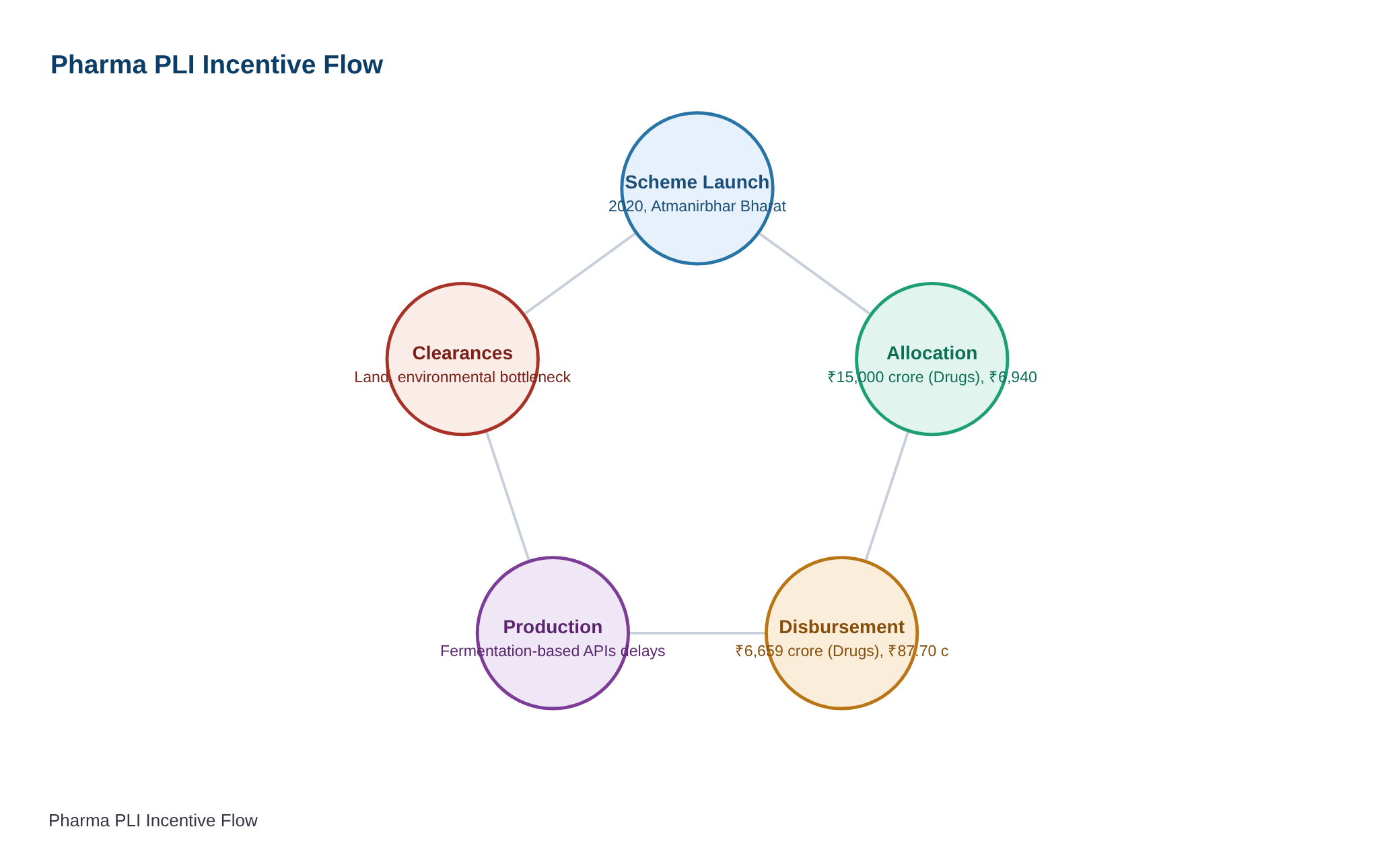
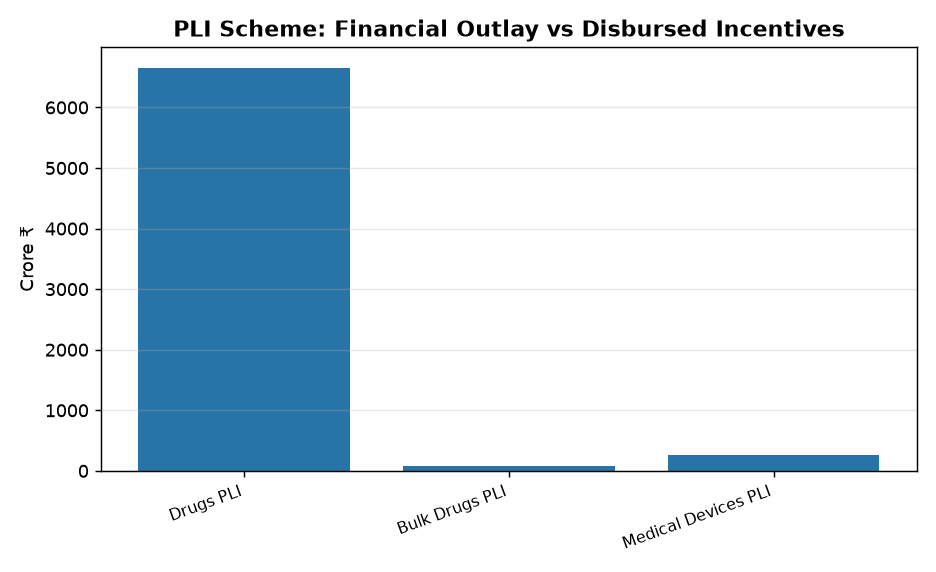
The Press Information Bureau (PIB) released an official update on 7 August 2026 regarding the progress of the Production-Linked Incentive (PLI) schemes for the pharmaceutical sector, including the Drugs PLI Scheme and the Bulk Drugs PLI Scheme. The report highlighted the disbursement of incentives amounting to ₹6,659 crore under the Drugs PLI Scheme and ₹87.70 crore under the Bulk Drugs PLI Scheme up to March 2026. Additionally, it underscored operational bottlenecks such as land acquisition delays, environmental clearances, and the prolonged manufacturing cycles for fermentation-based APIs, which have impeded the timely implementation and disbursement of incentives.
Background
- The PLI scheme was introduced in 2020 as part of the Atmanirbhar Bharat initiative to boost domestic manufacturing and reduce import dependence across critical sectors, including pharmaceuticals.
- The pharmaceutical sector is a key pillar of India’s healthcare ecosystem, contributing significantly to the country’s export earnings and domestic availability of essential medicines.
- India is the world’s largest supplier of generic medicines, accounting for approximately 20% of global generic drug exports, but remains heavily dependent on China for key Active Pharmaceutical Ingredients (APIs) and bulk drugs.
- The Drugs PLI Scheme has a financial outlay of ₹15,000 crore.
- The Bulk Drugs PLI Scheme has a financial outlay of ₹6,940 crore.
- Fermentation-based APIs, such as antibiotics and certain hormones, are inherently more complex to produce due to their reliance on biological processes, which are slower and more sensitive to environmental conditions compared to chemically synthesized drugs.
What are the Production-Linked Incentive (PLI) Schemes for the Pharmaceutical Sector?
- The PLI scheme for pharmaceuticals is a performance-based incentive mechanism designed to encourage domestic manufacturing of high-value and critical drugs, including bulk drugs, formulations, and medical devices.
- The scheme operates on a ‘pay-for-performance’ model, where incentives are disbursed based on incremental sales of eligible products over a base year, ensuring that subsidies are directly linked to actual production and market performance.
- Fermentation-based APIs present unique challenges due to their reliance on microbial or cell cultures, which require controlled environments, longer production cycles, and higher operational costs compared to chemically synthesized alternatives.
- The PLI scheme also includes provisions for medical devices.
Key Features
| Feature | Significance |
|---|---|
| Financial Outlay | Allocated ₹15,000 crore for pharmaceutical PLI scheme, with ₹6,659 crore disbursed by March 2026, indicating substantial fiscal commitment to incentivise domestic production. |
| Dual Scheme Structure | Separate PLI schemes for finished pharmaceuticals and bulk drugs, with distinct financial envelopes (₹15,000 crore vs ₹6,940 crore) to address sector-specific needs. |
| Performance-Linked Disbursement | Incentives released based on sales of manufactured products, ensuring alignment with actual output and market demand. |
| Sectoral Coverage | Includes medical devices PLI, with ₹266.64 crore disbursed, expanding the scope beyond traditional pharmaceuticals to critical healthcare infrastructure. |
| Operational Flexibility | No proposed shift to component-linked incentives in medical devices PLI, maintaining the existing framework for stability and predictability. |
Why it Matters
Economic Growth and Self-Reliance
- Enhances domestic pharmaceutical manufacturing capacity, reducing import dependence for critical drugs and bulk pharmaceutical ingredients (BPIs).
- Promotes ‘Atmanirbhar Bharat’ by fostering a resilient supply chain for essential medicines, particularly post-COVID-19 disruptions.
- Stimulates investment in high-value-added segments such as fermentation-based bulk drugs, aligning with global pharmaceutical trends.
Industrial Policy and Competitiveness
- Aligns with the Production-Linked Incentive (PLI) framework, a cornerstone of India’s industrial policy to boost manufacturing competitiveness.
- Encourages large-scale investments in R&D and advanced manufacturing, positioning India as a global hub for pharmaceutical production.
- Differentiates incentives based on product categories (finished drugs vs bulk drugs), addressing sectoral disparities in production timelines and capital intensity.
Healthcare Infrastructure and Access
- Supports the development of domestic medical device manufacturing, reducing reliance on imports for critical healthcare equipment.
- Potential to lower drug prices through economies of scale and reduced import costs, improving affordability for domestic consumers.
- Strengthens India’s role as a global supplier of affordable generic medicines, reinforcing its position in the pharmaceutical value chain.
Fiscal and Administrative Efficiency
- Demonstrates the government’s commitment to timely disbursement of incentives, with ₹6,659 crore already released, ensuring liquidity for manufacturers.
- Highlights the challenges in disbursement mechanisms, particularly for fermentation-based bulk drugs, where production delays impact incentive flows.
Challenges
1. Production Delays in Fermentation-Based Drugs
- Fermentation processes rely on biological activity of living cells, which have inherently slow and variable growth rates compared to chemical synthesis.
- Extended construction periods for fermentation-based facilities lead to delays in achieving commercial production, impacting incentive disbursement timelines.
- Land acquisition, environmental clearances, and high utility costs exacerbate project execution timelines, particularly in industrial clusters.
UPSC Link: Industrial Policy and Manufacturing
2. Disbursement Mechanism Constraints
- Performance-linked disbursement ties incentives to sales, creating cash-flow challenges for manufacturers during the initial ramp-up phase.
- Delays in project commissioning result in underutilisation of allocated funds, as seen in the bulk drugs PLI scheme (only ₹87.70 crore disbursed vs ₹6,940 crore allocation).
UPSC Link: Public Finance and Budgetary Processes
3. Sectoral Disparities in Incentive Effectiveness
- Finished pharmaceuticals PLI has seen higher disbursement (₹6,659 crore) due to shorter production cycles and clearer market linkages.
- Medical devices PLI, while promising, lags in disbursement (₹266.64 crore), indicating potential structural or operational barriers in implementation.
UPSC Link: Industrial Policy and Manufacturing
4. Regulatory and Compliance Hurdles
- Environmental clearances and land acquisition remain persistent bottlenecks, particularly for large-scale pharmaceutical and medical device projects.
- Stringent regulatory frameworks for fermentation-based production may require streamlining to align with global best practices.
UPSC Link: Environmental Governance and Land Reforms
5. Global Competitiveness Risks
- Competition from countries like China and Vietnam, which offer lower production costs and faster turnaround times, poses a challenge to India’s attractiveness as a manufacturing hub.
- Dependence on imported raw materials for bulk drugs may undermine the self-reliance objective if not addressed through backward integration incentives.
UPSC Link: International Trade and Economic Diplomacy
Challenges — UPSC Perspective
| Issue | Concern |
|---|---|
| Fermentation-Based Production | Slow biological growth rates delay commercialisation, impacting incentive disbursement and investor confidence. |
| Land Acquisition and Clearances | Protracted timelines for environmental and regulatory approvals hinder project execution. |
| Disbursement Lag | Performance-linked incentives create cash-flow constraints for manufacturers during initial production phases. |
| Sectoral Imbalance | Disparities in disbursement between finished drugs and bulk drugs highlight inefficiencies in scheme design or implementation. |
| Global Competition | Lower-cost manufacturing hubs in Asia pose a threat to India’s pharmaceutical export competitiveness. |
| Raw Material Dependence | Import reliance for key inputs may undermine the self-reliance goals of the PLI scheme. |
Government Initiatives — Must-Memorise for Prelims
- Production-Linked Incentive (PLI) Scheme for Pharmaceuticals
- Production-Linked Incentive (PLI) Scheme for Bulk Drugs
- Production-Linked Incentive (PLI) Scheme for Medical Devices
Way Forward
- Streamline environmental clearances and land acquisition processes for pharmaceutical and medical device projects through single-window clearance mechanisms.
- Explore partial upfront disbursement of incentives for fermentation-based bulk drugs to mitigate cash-flow challenges during the ramp-up phase.
- Enhance R&D incentives within the PLI framework to accelerate innovation in fermentation technologies and reduce production timelines.
- Strengthen backward integration by incentivising domestic production of key raw materials for bulk drugs, reducing import dependence.
- Conduct periodic reviews of scheme performance to identify sector-specific bottlenecks and recalibrate incentives for maximum impact.
- Promote cluster-based development for pharmaceutical manufacturing to leverage shared infrastructure and reduce operational costs.
- Facilitate technology transfer and collaboration with global pharmaceutical firms to bridge the competitiveness gap in high-value drug production.
- Expand the scope of medical devices PLI to include component-linked incentives for high-precision equipment, aligning with global manufacturing standards.
UPSC Value Addition
Keywords for Mains Answer-Writing
Production-Linked Incentive Scheme · Pharmaceutical sector PLI · Bulk drugs PLI · Fermentation-based drug manufacturing · Production-linked incentives for medical devices · Land acquisition delays in PLI projects · Environmental clearances for industrial projects · Capital goods and utilities cost escalation · Atmanirbhar Bharat in pharmaceuticals · PLI scheme implementation challenges
Concept Flow
Government announces PLI scheme for pharmaceuticals (2022-23) → Allocates ₹15,000 crore to incentivise domestic production → Separate schemes for finished drugs and bulk drugs → Disbursement tied to sales of manufactured products → Challenges emerge in fermentation-based bulk drug production → Delays in land acquisition, clearances, and high utility costs → Disbursement lags due to production timelines → Sectoral disparities in incentive effectiveness → Calls for streamlined clearances, upfront disbursement, and R&D incentives → Long-term goal: Self-reliance in pharmaceuticals and medical devices.
Prelims Practice Questions
Q1. Consider the following statements regarding the Production-Linked Incentive (PLI) Scheme for the pharmaceutical sector:
1. The PLI Scheme for pharmaceuticals was launched in the financial year 2022-23.
2. The total financial outlay for the PLI Scheme for pharmaceuticals is ₹15,000 crore.
3. The PLI Scheme for bulk drugs has a financial outlay of ₹6,940 crore.
4. The PLI Scheme for medical devices operates under a component-linked incentive framework.
How many of the above statements are correct?
- Only one
- Only two
- Only three
- All four
Answer: All four — Statements 1, 2, and 3 are correct. Statement 4 is incorrect as the PLI Scheme for medical devices does not operate under a component-linked incentive framework; it follows the standard PLI structure.
Q2. Assertion (A): Fermentation-based bulk drug manufacturing relies on the biological activity of living cells, which inherently limits production speed.
Reason (R): Unlike chemical synthesis, fermentation processes are constrained by the natural growth rates of microbial cultures.
Options:
A. Both A and R are true, and R is the correct explanation of A.
B. Both A and R are true, but R is not the correct explanation of A.
C. A is true, but R is false.
D. A is false, but R is true.
- A
- B
- C
- D
Answer: B — Both the assertion and reason are true. Fermentation-based manufacturing is inherently slower due to the biological constraints of microbial growth, making R the correct explanation for A.
Q3. Match the following PLI Schemes with their respective financial outlays:
Column I (PLI Scheme) | Column II (Financial Outlay in ₹ crore)
——————————————-|—————————————-
1. PLI Scheme for Pharmaceuticals | A. 15,000
2. PLI Scheme for Bulk Drugs | B. 6,940
3. PLI Scheme for Medical Devices | C. 6,000
Options:
1. 1-A, 2-B, 3-C
2. 1-A, 2-C, 3-B
3. 1-B, 2-A, 3-C
4. 1-C, 2-B, 3-A
- 1
- 2
- 3
- 4
Answer: 2 — The PLI Scheme for Pharmaceuticals has a financial outlay of ₹15,000 crore, the PLI Scheme for Bulk Drugs has ₹6,940 crore, and the PLI Scheme for Medical Devices has ₹6,000 crore.
Mains Practice Question
✍ The Production-Linked Incentive (PLI) Scheme for the pharmaceutical sector represents a significant policy intervention under the Atmanirbhar Bharat initiative. Critically examine the implementation challenges faced by the scheme, with particular reference to bulk drug manufacturing. Also, assess the implications of these challenges for India’s self-reliance in critical pharmaceutical inputs. (15 Marks)
Approach: MODEL-ANSWER SKELETON:
1. **Introduction (2 Marks)**:
– Briefly define the PLI Scheme and its objectives in the pharmaceutical sector.
– Mention the financial outlays and the scope of the scheme (pharmaceuticals, bulk drugs, medical devices).
2. **Implementation Challenges in Bulk Drug Manufacturing (5 Marks)**:
– **Land Acquisition and Regulatory Delays**: Highlight the procedural bottlenecks in land acquisition and environmental clearances, citing examples from the PIB release.
– **High Utility Costs**: Discuss the impact of elevated costs of utilities (water, electricity) on project viability.
– **Fermentation-Based Manufacturing Constraints**: Explain the inherent biological limitations of fermentation processes, contrasting them with chemical synthesis.
– **Delayed Project Commencement**: Link these challenges to the delay in project implementation and fund disbursement (only ₹87.70 crore disbursed against ₹6,940 crore outlay).
3. **Broader Implications for Self-Reliance (5 Marks)**:
– **Dependence on Imports**: Discuss how delays in bulk drug production exacerbate India’s reliance on imported Active Pharmaceutical Ingredients (APIs).
– **Global Supply Chain Vulnerabilities**: Highlight the risks posed by geopolitical disruptions (e.g., COVID-19, China’s dominance in API production).
– **Economic and Strategic Costs**: Emphasize the long-term economic and strategic costs of failing to achieve self-sufficiency in critical pharmaceutical inputs.
– **Policy Corrections**: Suggest measures such as expedited clearances, subsidies for utilities, and R&D incentives to address these challenges.
4. **Conclusion (3 Marks)**:
– Summarize the critical role of the PLI Scheme in achieving Atmanirbhar Bharat.
– Reiterate the need for systemic reforms to overcome implementation bottlenecks.
– Conclude with a balanced view on the scheme’s potential and the urgency of addressing its challenges.
Source: PIB (Press Information Bureau)
Generated by AanyaAi for educational purpose.

- सुप्रीम कोर्ट ने चुनाव आयोग को दिल्ली में ‘यांत्रिक’ SIR नोटिस पर सावधानियां बरतने को कहा - September 22, 2026
- ‘स्वच्छता ही सेवा-2026’ अभियान: सरकारी विभागों में स्वच्छता क्रांति, जानिए मुख्य बिंदु - September 22, 2026
- DFPD Launches ‘Swachhata Hi Seva-2026’ Campaign for Clean India Mission - September 22, 2026

No Comments