


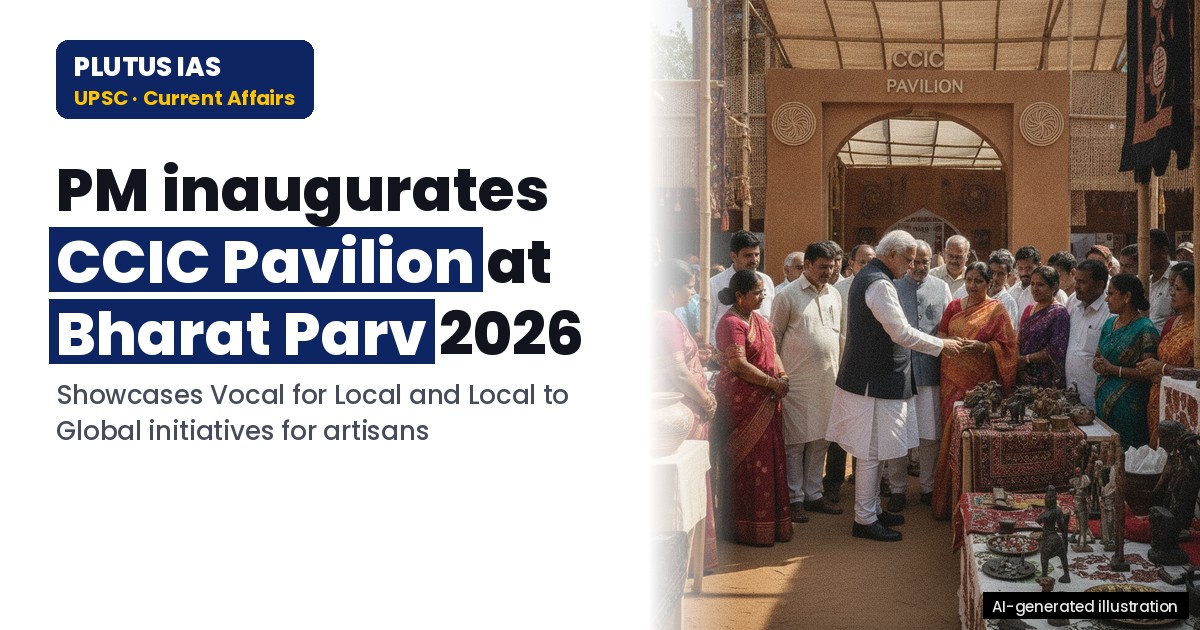
31 Oct PM inaugurates CCIC Pavilion at Bharat Parv 2026 in Kevadia
✎ The Central Cottage Industries Corporation of India Limited (CCIC) is a key institutional mechanism under the Ministry of Textiles, tasked with promoting handloom and handicraft sectors through market access, policy…
Subject Relevance — Where This Topic Fits
- GS Paper II — Government Policies and Interventions for Development in various sectors | GS Paper III — Issues Relating to Development and Management of Social Sector/Services relating to Health, Education, Human Resources | GS Paper III — Indian Economy and issues relating to Planning, Mobilization of Resources, Growth, Development and Employment | GS Paper IV — Ethics and Human Interface: Essence, Determinants and Consequences of Ethics in Human Actions
- Prelims: Central Cottage Industries Corporation of India Limited (CCIC), Bharat Parv, Vocal for Local, Local to Global, Handloom, Handicraft, One District One Product (ODOP), Geographical Indications (GI), Sustainable Livelihoods, Market Access for Artisans
- Essay: The Role of Institutional Mechanisms in Preserving Cultural Heritage and Promoting Sustainable Livelihoods, Balancing Globalisation with Indigenous Artisan Communities: Policy Imperatives
Quick Revision: The Central Cottage Industries Corporation of India Limited (CCIC) is a key institutional mechanism under the Ministry of Textiles, tasked with promoting handloom and handicraft sectors through market access, policy implementation, and artisan empowerment.
Why is this in the news?
The visit of the Prime Minister to the CCIC Pavilion at Bharat Parv 2026 in Ekta Nagar, Gujarat, underscores the institutional efforts of the Central Cottage Industries Corporation of India Limited (CCIC) in promoting India’s handloom and handicraft heritage. This engagement highlights the role of public sector enterprises in empowering artisans through market access, skill preservation, and the implementation of the ‘Vocal for Local’ and ‘Local to Global’ paradigms, aligning with broader national policies for cultural preservation and economic empowerment.
Background
- The Central Cottage Industries Corporation of India Limited (CCIC) is a Government of India undertaking under the Ministry of Textiles, established to promote and develop cottage and small-scale industries, particularly handloom and handicraft sectors.
- Bharat Parv is a national festival organised annually to celebrate India’s cultural diversity, with a focus on promoting local crafts, cuisines, and traditions across the country.
- The ‘Vocal for Local’ and ‘Local to Global’ initiatives are part of India’s broader strategy to enhance the visibility and marketability of indigenous products, thereby supporting local economies and preserving traditional art forms.
- The One District One Product (ODOP) scheme, promoted under the Ministry of Commerce and Industry, aims to identify, brand, and promote one unique product from each district to enhance its global competitiveness.
- Geographical Indications (GI) tags are granted to products that have a specific geographical origin and possess qualities or reputation attributable to that origin, providing legal protection and market exclusivity.
- Sustainable livelihoods for artisans are a key focus of India’s development policies, ensuring that traditional crafts remain economically viable while preserving cultural heritage.
What is the Central Cottage Industries Corporation of India Limited (CCIC)?
- CCIC is a Government of India undertaking under the Ministry of Textiles, established to promote and develop cottage and small-scale industries, particularly in the handloom and handicraft sectors.
- The corporation functions as a nodal agency for the marketing, export promotion, and development of traditional Indian crafts and textiles.
- CCIC operates through a network of emporia, exhibitions, and pavilions to provide artisans with market access and sustainable livelihood opportunities.
- The corporation plays a pivotal role in implementing national policies such as ‘Vocal for Local’ and ‘Local to Global’ by linking traditional crafts with domestic and international markets.
- CCIC collaborates with state governments, district administrations, and artisan cooperatives to identify and promote unique products under schemes like ODOP and GI tags.
- The corporation also facilitates capacity-building programmes for artisans, including skill development, design innovation, and entrepreneurship training.
- CCIC’s pavilions at national events like Bharat Parv serve as platforms to showcase India’s rich handloom and handicraft heritage while providing a direct interface between artisans and consumers.
- The organisation’s initiatives are aligned with the broader objectives of the Ministry of Textiles, including the National Handloom Development Programme (NHDP) and the Handicrafts Mega Cluster Scheme (HMCS).
Key Features
| Feature | Significance |
|---|---|
| CCIC Pavilion at Bharat Parv 2026 | A dedicated platform showcasing India’s cottage industries, including handloom and handicrafts, to a national audience. |
| Prime Minister’s Visit | Highlighting governmental recognition of traditional artisans and the role of public enterprises in promoting indigenous crafts. |
| Vocal for Local & Local to Global Initiatives | Alignment with national policy frameworks to enhance market access for handloom and handicraft sectors. |
| Display of Artisan Skill | Showcasing traditional craftsmanship, such as agate stone carving and appliqué work, to preserve and propagate cultural heritage. |
| Sustainable Livelihood Opportunities | Demonstrating CCIC’s role in providing long-term economic empowerment to artisans and weavers. |
Why it Matters
Economic
- Promotes the handloom and handicraft sector, a significant contributor to India’s GDP and employment in rural areas.
- Facilitates market linkages for artisans, reducing dependency on middlemen and enhancing income sustainability.
- Supports the ‘Make in India’ initiative by positioning traditional crafts as high-value, globally competitive products.
Cultural
- Preserves and propagates India’s intangible cultural heritage through the display of traditional crafts and art forms.
- Provides a platform for cross-regional cultural exchange, fostering national unity and pride in indigenous artistry.
- Encourages intergenerational transmission of craft skills, ensuring continuity of artisanal traditions.
Policy
- Demonstrates the implementation of the ‘Vocal for Local’ and ‘Local to Global’ strategies outlined in national economic policies.
- Showcases the role of public sector enterprises (PSEs) like CCIC in achieving socio-economic objectives through cultural preservation and economic empowerment.
- Aligns with the National Handloom Development Programme (NHDP) and other schemes aimed at reviving and promoting handloom and handicraft sectors.
Social
- Empowers marginalised communities, particularly women artisans, by providing sustainable livelihood opportunities.
- Enhances social mobility for artisans by integrating them into formal market systems and value chains.
- Fosters inclusive growth by ensuring equitable participation of artisans from diverse geographical and socio-economic backgrounds.
Challenges
1. Market Access and Middlemen Exploitation
- Artisans often face barriers in accessing direct markets due to the dominance of middlemen who control pricing and supply chains.
- Limited digital literacy and infrastructure in rural areas restrict artisans’ ability to leverage e-commerce platforms for broader market reach.
UPSC Link: GS3: MSMEs and employment
2. Sustainable Livelihoods and Income Stability
- Fluctuations in demand for traditional crafts lead to seasonal unemployment and financial insecurity for artisans.
- Lack of financial literacy and access to credit hinders artisans’ ability to invest in skill upgradation or business expansion.
UPSC Link: GS3: Rural development and livelihoods
3. Preservation of Traditional Crafts
- Globalisation and mass production threaten the survival of traditional crafts by reducing their market relevance.
- Inadequate documentation and transmission of craft techniques to younger generations risk the loss of indigenous knowledge systems.
UPSC Link: GS1: Indian culture
4. Infrastructure and Logistics
- Poor transportation and storage facilities in rural areas affect the quality and timely delivery of handloom and handicraft products.
- Limited access to modern tools and technology restricts the scalability and quality enhancement of traditional crafts.
UPSC Link: GS3: Infrastructure
5. Policy Implementation Gaps
- Fragmented implementation of schemes like NHDP and other handloom development programmes due to bureaucratic inefficiencies.
- Insufficient coordination between central and state governments, leading to duplication of efforts or gaps in coverage.
UPSC Link: GS2: Government policies and interventions
Challenges — UPSC Perspective
| Issue | Concern |
|---|---|
| Middlemen Dominance | Artisans receive only a fraction of the final market price due to exploitative intermediaries. |
| Digital Divide | Limited internet connectivity and digital literacy impede artisans’ ability to participate in e-commerce. |
| Seasonal Employment | Demand fluctuations lead to irregular income, pushing artisans toward alternative livelihoods. |
| Skill Erosion | Lack of formal training and mentorship programs results in declining craftsmanship quality. |
| Logistics Bottlenecks | Poor road and storage infrastructure delays product delivery and increases costs. |
| Policy Fragmentation | Overlapping schemes and lack of convergence reduce the effectiveness of handloom development initiatives. |
Government Initiatives — Must-Memorise for Prelims
- National Handloom Development Programme (NHDP)
- Handicrafts Mega Cluster Scheme (HMCS)
- Ambedkar Hastshilp Vikas Yojana (AHVY)
- Pradhan Mantri Kaushal Vikas Yojana (PMKVY) for skill upgradation in traditional crafts
Way Forward
- Strengthen direct market linkages for artisans through e-commerce platforms and curated exhibitions like Bharat Parv.
- Expand digital literacy and financial inclusion programmes to empower artisans with market access and credit facilities.
- Establish artisan cooperatives and self-help groups (SHGs) to reduce dependency on middlemen and enhance bargaining power.
- Integrate traditional crafts into school and university curricula to foster intergenerational skill transmission and cultural continuity.
- Invest in rural infrastructure, including transportation and storage facilities, to improve supply chain efficiency.
- Promote public-private partnerships (PPPs) to scale up production and marketing of handloom and handicraft products.
- Enhance documentation and archiving of traditional craft techniques to preserve indigenous knowledge systems.
- Implement outcome-based monitoring of handloom and handicraft schemes to ensure effective implementation and address gaps.
UPSC Value Addition
Keywords for Mains Answer-Writing
Central Cottage Industries Corporation of India Limited (CCIC) · Handloom and Handicraft Sector · Vocal for Local · Local to Global · Artisan Empowerment · Sustainable Livelihoods · Ministry of Textiles · India Pavilion 2026 · Ekta Nagar · Kevadiya · Cultural Heritage Preservation · Market Access for Artisans · Public Sector Undertakings in India · Government Initiatives for Traditional Crafts · Promotion of Indigenous Art Forms
Concept Flow
Traditional crafts and handloom industries → Economic empowerment of artisans → Alignment with ‘Vocal for Local’ and ‘Local to Global’ policies → Market access and sustainable livelihoods → Preservation of cultural heritage → National pride and socio-economic development
Prelims Practice Questions
Q1. Consider the following statements regarding the Central Cottage Industries Corporation of India Limited (CCIC):
1. CCIC is a government-owned enterprise under the Ministry of Textiles.
2. It primarily focuses on promoting handloom and handicraft sectors in India.
3. CCIC operates exclusively within the state of Gujarat.
4. The corporation aims to connect traditional craftsmanship with domestic and international markets.
How many of the above statements are correct?
- Only one
- Only two
- Only three
- All
Answer: Only three — Statements 1, 2, and 4 are correct as CCIC is indeed a government-owned enterprise under the Ministry of Textiles, focuses on handloom and handicraft sectors, and aims to connect traditional craftsmanship with markets. Statement 3 is incorrect as CCIC operates across India, not exclusively in Gujarat.
Q2. Assertion (A): The ‘Vocal for Local’ initiative aims to promote indigenous art forms and crafts within India.
Reason (R): The CCIC pavilion at Ekta Nagar during India Pavilion 2026 showcased traditional craftsmanship to enhance market access for artisans.
Options:
A. Both A and R are true, and R is the correct explanation of A.
B. Both A and R are true, but R is not the correct explanation of A.
C. A is true, but R is false.
D. A is false, but R is true.
Answer: ? — ‘Vocal for Local’ is a national initiative to promote indigenous products and crafts, aligning with CCIC’s efforts to empower artisans and connect them with markets. Both the assertion and reason are true, and the reason correctly explains the assertion.
Q3. Match the following initiatives with their respective objectives:
Column I (Initiative) | Column II (Objective)
—————————————————|—————————————————
A. Vocal for Local | 1. Promoting traditional crafts and artisans
B. Local to Global | 2. Connecting local products to global markets
C. Skill India Mission | 3. Enhancing skill development for youth
D. Stand-Up India | 4. Supporting entrepreneurship among marginalized communities
Options:
A. A-1, B-2, C-3, D-4
B. A-2, B-1, C-3, D-4
C. A-1, B-3, C-2, D-4
D. A-4, B-2, C-1, D-3
- A
- B
- C
- D
Answer: A — A-1: Vocal for Local promotes traditional crafts and artisans. B-2: Local to Global connects local products to global markets. C-3: Skill India Mission focuses on skill development for youth. D-4: Stand-Up India supports entrepreneurship among marginalized communities.
Mains Practice Question
✍ The promotion of traditional crafts and handicrafts in India is increasingly being viewed through the dual lenses of cultural heritage preservation and economic empowerment. In this context, critically examine the role of the Central Cottage Industries Corporation of India Limited (CCIC) in advancing the ‘Vocal for Local’ and ‘Local to Global’ agendas. (15 Marks)
Approach: MODEL-ANSWER SKELETON:
1. Introduction (2 Marks):
– Define CCIC and its statutory/constitutional basis (if any) and its role as a Public Sector Undertaking (PSU) under the Ministry of Textiles.
– Briefly outline the ‘Vocal for Local’ and ‘Local to Global’ initiatives as national policy frameworks.
2. CCIC’s Contribution to ‘Vocal for Local’ (4 Marks):
– Market Access: Explain how CCIC provides platforms (e.g., pavilions, exhibitions) for artisans to showcase products, reducing middlemen dependency.
– Skill and Capacity Building: Reference any training or upskilling programs conducted by CCIC for artisans.
– Financial Support: Mention any credit linkages, subsidies, or market development assistance provided by CCIC.
– Policy Alignment: Link CCIC’s activities with the broader ‘Vocal for Local’ policy under the Atmanirbhar Bharat initiative.
3. CCIC’s Role in ‘Local to Global’ (4 Marks):
– Export Promotion: Highlight CCIC’s efforts in facilitating artisans’ access to international markets (e.g., participation in global fairs, e-commerce platforms).
– Branding and Certification: Discuss initiatives like Geographical Indication (GI) tags or quality certification to enhance product value.
– Collaborations: Mention partnerships with international organizations or export promotion councils.
4. Challenges and Critiques (3 Marks):
– Market Competition: Discuss challenges posed by mass-produced goods and lack of branding.
– Infrastructure Gaps: Highlight issues like inadequate storage, transport, or digital literacy among artisans.
– Sustainability: Address concerns about fair wages, working conditions, and environmental sustainability in craft production.
5. Conclusion (2 Marks):
– Summarize CCIC’s significance as a bridge between tradition and modernity.
– Suggest measures such as enhanced digital integration, policy incentives, and stakeholder collaboration to further strengthen its impact.
Note: Use specific examples from the CCIC pavilion at Ekta Nagar (India Pavilion 2026) to illustrate points.
Source: PIB (Press Information Bureau)
Gujarat PCS (GPSC) — State PCS Practice
Prelims: Which of the following is the primary objective of the ‘CCIC Pavilion’ inaugurated by the Prime Minister during ‘Bharat Parv 2026’ in Ekta Nagar, Gujarat?
- A. To showcase India’s cultural diversity through state-specific pavilions
- B. To promote Gujarat’s industrial and economic growth under the ‘Vibrant Gujarat’ initiative
- C. To highlight the contributions of tribal communities in Gujarat’s development
- D. To display India’s defense capabilities and achievements in space technology
Answer: B. To promote Gujarat’s industrial and economic growth under the ‘Vibrant Gujarat’ initiative — The CCIC Pavilion is aimed at promoting Gujarat’s industrial and economic growth, aligning with the ‘Vibrant Gujarat’ initiative.
Mains: Discuss the significance of the ‘CCIC Pavilion’ in the context of Gujarat’s economic and industrial development, with a focus on its role in attracting investments and fostering innovation. (250 words)
Generated by AanyaAi for educational purpose.

- राष्ट्रीय साधन-सह-योग्यता छात्रवृत्ति योजना 2026-27: आवेदन की अंतिम तिथि बढ़ी - October 31, 2026
- PM inaugurates CCIC Pavilion at Bharat Parv 2026 in Kevadia - October 31, 2026
- ग्राम पंचायतों में ईवी चार्जिंग और बैटरी स्वैपिंग स्टेशन: सीईएसएल की पहल - October 31, 2026

No Comments