


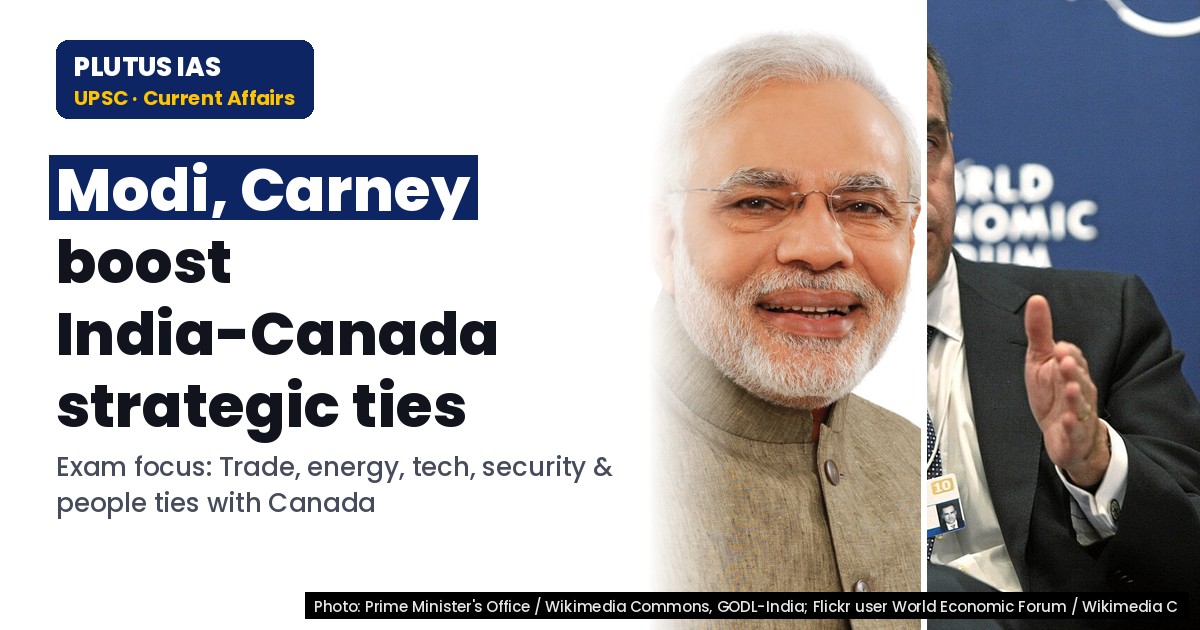
14 Oct PM Modi, Canada PM Carney discuss strengthening India-Canada strategic partnership
✎ The India-Canada Strategic Partnership is a high-level framework to deepen cooperation across trade, energy, technology, security, and people-to-people ties, aiming for mutually beneficial outcomes in a multipolar world.
Subject Relevance — Where This Topic Fits
- GS Paper II — International Relations: India’s Foreign Policy, Bilateral and Multilateral Agreements, Regional Cooperation, and Strategic Partnerships | GS Paper II — International Relations: India and its Neighbourhood
- Prelims: Strategic Partnership, Comprehensive Economic Partnership Agreement (CEPA), People-to-People Ties, Indo-Pacific Strategy, Clean Energy Transition, Critical Minerals, Quadrilateral Security Dialogue (Quad), BRICS, G20, Foreign Direct Investment (FDI) in India
- Essay: The evolving dynamics of India’s foreign policy in a multipolar world, The role of strategic partnerships in India’s quest for global stability and prosperity
Quick Revision: The India-Canada Strategic Partnership is a high-level framework to deepen cooperation across trade, energy, technology, security, and people-to-people ties, aiming for mutually beneficial outcomes in a multipolar world.
Why is this in the news?
On 13 October 2026, the Prime Minister of India held a warm and productive conversation with the Prime Minister of Canada, Mark Carney, which was announced in a post on X. The discussions underscored the need to consolidate positive momentum in bilateral relations across key domains such as trade, energy, technology, security, and people-to-people ties, with an emphasis on achieving tangible outcomes. This high-level engagement reflects the growing importance of India-Canada cooperation in addressing global challenges and advancing shared interests.
Background
- India and Canada share a long-standing relationship rooted in historical, cultural, and economic ties, with a significant Indian diaspora in Canada contributing to people-to-people linkages.
- Bilateral trade between India and Canada has witnessed steady growth, with key sectors including information technology, pharmaceuticals, agriculture, and clean energy.
- Energy cooperation has gained prominence due to Canada’s rich endowment of natural resources, including uranium, crude oil, and critical minerals essential for India’s energy transition.
- Technology and innovation have emerged as critical areas of collaboration, particularly in areas such as artificial intelligence, quantum computing, and space technology.
- Security cooperation has expanded to include counter-terrorism, cybersecurity, and maritime security, aligning with India’s broader Indo-Pacific strategy.
What is the India-Canada Strategic Partnership?
- The India-Canada Strategic Partnership is a high-level framework established to deepen bilateral cooperation across multiple domains, including trade, energy, technology, security, and people-to-people ties.
- It aims to foster mutually beneficial outcomes by leveraging each country’s strengths—India’s demographic dividend and technological prowess, and Canada’s resource endowments and innovation ecosystem.
- Trade and economic cooperation are central to the partnership, with both countries working towards enhancing market access and investment flows.
- Energy cooperation focuses on diversifying India’s energy mix, including clean energy sources, and securing critical minerals for renewable energy technologies.
- Technology collaboration spans sectors such as artificial intelligence, quantum computing, and space technology, with joint research and development initiatives.
- Security cooperation includes counter-terrorism, cybersecurity, and maritime security, aligning with India’s Indo-Pacific strategy and Canada’s engagement in the region.
- People-to-people ties are strengthened through educational exchanges, cultural programs, and the contributions of the Indian diaspora in Canada.
Key Features
| Feature | Significance |
|---|---|
| Trade and Economic Cooperation | Enhances bilateral trade flows, reduces tariff barriers, and promotes investment synergies between India and Canada, leveraging complementary economic strengths. |
| Energy Partnership | Facilitates collaboration in clean energy, nuclear energy, and renewable energy sectors, aligning with global decarbonisation goals and energy security imperatives. |
| Technology and Innovation | Promotes joint research, development, and transfer of technology in critical sectors such as AI, quantum computing, and space technology. |
| Security and Defence | Strengthens counter-terrorism cooperation, maritime security, and defence industrial collaboration, including joint exercises and technology sharing. |
| People-to-People Ties | Bolsters educational exchanges, diaspora engagement, and cultural diplomacy, fostering long-term trust and mutual understanding. |
Why it Matters
Bilateral Relations
- Reinforces the strategic partnership between India and Canada, a key relationship in the Indo-Pacific region amid evolving geopolitical dynamics.
- Demonstrates high-level diplomatic engagement, signalling mutual commitment to deepening cooperation despite occasional bilateral frictions.
- Provides a platform for addressing shared challenges such as climate change, terrorism, and supply chain resilience.
Global Governance
- Contributes to the formulation of a rules-based international order by aligning on issues like trade liberalisation, climate action, and technological governance.
- Enhances the collective voice of like-minded democracies in multilateral forums, including the UN, WTO, and G20.
- Supports the realisation of Sustainable Development Goals (SDGs) through joint initiatives in energy transition and social development.
Economic Diplomacy
- Expands market access for Indian and Canadian businesses, particularly in sectors like IT, pharmaceuticals, agriculture, and clean energy.
- Encourages foreign direct investment (FDI) flows, reducing dependency on volatile global markets.
- Promotes innovation ecosystems through joint ventures and startup collaborations.
Energy Security
- Strengthens energy supply chains, particularly for critical minerals and nuclear fuel, ensuring energy transition pathways remain uninterrupted.
- Facilitates technology transfer in carbon capture, hydrogen energy, and smart grid systems.
- Aligns with India’s goal of achieving 500 GW of non-fossil fuel capacity by 2030.
Challenges
1. Trade Protectionism
- Risk of non-tariff barriers (NTBs) such as technical regulations and sanitary/phytosanitary measures disrupting market access.
- Potential disputes over intellectual property rights (IPR) in sectors like pharmaceuticals and software.
UPSC Link: WTO dispute settlement
2. Geopolitical Tensions
- Divergent stances on global issues (e.g., Ukraine conflict, Indo-Pacific security) may strain diplomatic alignment.
- Impact of third-country pressures (e.g., US-China competition) on bilateral engagement.
UPSC Link: Indo-Pacific geopolitics
3. Energy Transition Disparities
- Differences in pace and approach to decarbonisation, particularly in fossil fuel-dependent sectors.
- Regulatory hurdles in cross-border energy infrastructure projects.
UPSC Link: Paris Agreement commitments
4. People-to-People Barriers
- Visa and immigration policies may restrict mobility of professionals, students, and diaspora communities.
- Cultural and linguistic differences requiring sustained diplomatic and institutional bridging.
UPSC Link: Migration and diaspora policies
5. Security Concerns
- Asymmetric threats such as terrorism, cybercrime, and maritime piracy necessitating robust cooperation frameworks.
- Dual-use technology transfers requiring stringent safeguards.
UPSC Link: Counter-terrorism cooperation
Challenges — UPSC Perspective
| Issue | Concern |
|---|---|
| Trade Imbalances | Persistent deficits in bilateral trade, particularly in sectors like agriculture and textiles. |
| Regulatory Divergence | Mismatch in standards and compliance requirements across jurisdictions. |
| Climate Policy Alignment | Differences in carbon pricing mechanisms and renewable energy subsidies. |
| Diaspora Integration | Challenges in social cohesion and economic participation of immigrant communities. |
| Defence Industrial Collaboration | Limited progress in joint defence production due to sensitivity of technologies. |
Way Forward
- Establish a high-level joint working group to monitor progress on trade, energy, and technology cooperation.
- Expand the scope of the India-Canada Comprehensive Economic Partnership Agreement (CEPA) to include critical minerals and renewable energy.
- Launch a dedicated fund for joint research and development in clean energy and AI, with matching contributions from both governments.
- Strengthen counter-terrorism and cybersecurity dialogues through regular intelligence-sharing mechanisms.
- Facilitate greater mobility of skilled professionals and students via streamlined visa regimes and mutual recognition of qualifications.
- Promote cultural exchanges through scholarships, festivals, and digital platforms to deepen people-to-people ties.
- Develop a framework for joint disaster resilience and climate adaptation projects in vulnerable regions.
- Enhance defence industrial collaboration by identifying non-sensitive areas for co-development and co-production.
UPSC Value Addition
Keywords for Mains Answer-Writing
India-Canada Strategic Partnership · Bilateral Diplomacy · Economic Diplomacy · Trade and Investment · Energy Security · Technology Collaboration · People-to-People Ties · International Relations · Multilateralism · Geopolitical Alliances
Concept Flow
Bilateral diplomatic engagement → Identification of shared strategic priorities → Formation of joint working groups → Negotiation of agreements → Implementation and monitoring → Review and recalibration of cooperation frameworks.
Prelims Practice Questions
Q1. Consider the following statements regarding the India-Canada Strategic Partnership:
1. The partnership includes cooperation in trade, energy, technology, and security.
2. The partnership is legally binding under a treaty ratified by both Houses of Parliament.
3. The partnership emphasizes people-to-people ties as a key component.
How many of the above statements are correct?
- Only one
- Only two
- All three
- None
Answer: All three — Statements 1 and 3 are correct as per the press release. Statement 2 is incorrect because the partnership is not legally binding under a treaty; it is a strategic framework for cooperation.
Q2. Assertion (A): The India-Canada Strategic Partnership is primarily focused on military alliances.
Reason (R): The partnership includes cooperation in trade, energy, technology, and security, with an emphasis on people-to-people ties.
In the context of the above statements, which of the following is correct?
- Both A and R are true, and R is the correct explanation of A.
- Both A and R are true, but R is not the correct explanation of A.
- A is true, but R is false.
- A is false, but R is true.
Answer: ? — Assertion (A) is false because the partnership is not primarily focused on military alliances. Reason (R) is true as it correctly outlines the key areas of cooperation.
Q3. Which of the following is NOT a stated area of cooperation under the India-Canada Strategic Partnership as per the recent bilateral discussion?
- Trade
- Energy
- Healthcare
- Technology
Answer: Healthcare — Healthcare is not mentioned as a key area of cooperation in the press release. The stated areas are trade, energy, technology, security, and people-to-people ties.
Mains Practice Question
✍ The India-Canada Strategic Partnership represents a significant dimension of India’s foreign policy in the contemporary geopolitical landscape. Critically examine the pillars and significance of this partnership, with reference to its key areas of cooperation and the broader objectives of India’s Act East Policy. (15 Marks)
Approach: MODEL-ANSWER SKELETON:
1. **Introduction (2 Marks)**
– Define the India-Canada Strategic Partnership and its evolution.
– Contextualise within India’s Act East Policy and broader foreign policy objectives.
2. **Key Pillars of the Partnership (5 Marks)**
– **Trade and Investment**: Highlight the economic dimension, including sectors like IT, agriculture, and renewable energy.
– **Energy Security**: Discuss cooperation in clean energy, nuclear energy (e.g., Canada’s uranium supply), and sustainable development.
– **Technology Collaboration**: Emphasise areas like AI, space technology, and digital infrastructure.
– **Security Cooperation**: Outline counter-terrorism, cybersecurity, and maritime security initiatives.
– **People-to-People Ties**: Reference the Indian diaspora in Canada, educational exchanges, and cultural diplomacy.
3. **Significance of the Partnership (5 Marks)**
– **Geopolitical Balance**: Discuss how the partnership aligns with India’s efforts to diversify strategic alliances amid global power shifts.
– **Economic Growth**: Highlight potential benefits such as job creation, technology transfer, and market access.
– **Soft Power and Diaspora Diplomacy**: Explain the role of the Indian diaspora in fostering bilateral relations.
– **Multilateral Engagement**: Link to shared objectives in forums like the UN, G20, and Quad.
4. **Challenges and Critique (3 Marks)**
– **Trade Barriers**: Mention tariffs, regulatory hurdles, or historical trade disputes.
– **Geopolitical Constraints**: Discuss sensitivities related to Canada’s stance on certain issues (e.g., Khalistan movement).
– **Implementation Gaps**: Highlight the need for concrete deliverables beyond diplomatic statements.
5. **Conclusion (2 Marks)**
– Summarise the strategic importance of the partnership.
– Emphasise the need for sustained engagement and institutional mechanisms to translate dialogue into tangible outcomes.
Source: PIB (Press Information Bureau)
Generated by AanyaAi for educational purpose.
Related guides on our sites
- Best PSIR optional coaching for upsc
- Best PSIR optional teacher for upsc
- Best teacher of PSIR optional for upsc
- Best PSIR optional coaching in delhi for UPSC

- लोकसभा अध्यक्ष ने गायत्री परिवार के आध्यात्मिक योगदान की सराहना की - October 31, 2026
- Himachal Villages Adapt to Climate Change: CEEW Report Insights for UPSC & State PCS - October 31, 2026
- मद्रास हाईकोर्ट का फैसला: ‘संगीता’ और ‘संगेथा’ में अंतर नहीं कर पाएंगे ग्राहक - October 31, 2026

No Comments