


08 Sep PM Modi lays foundation of ₹35,000 cr infra projects in Vadodara for UPSC 2026
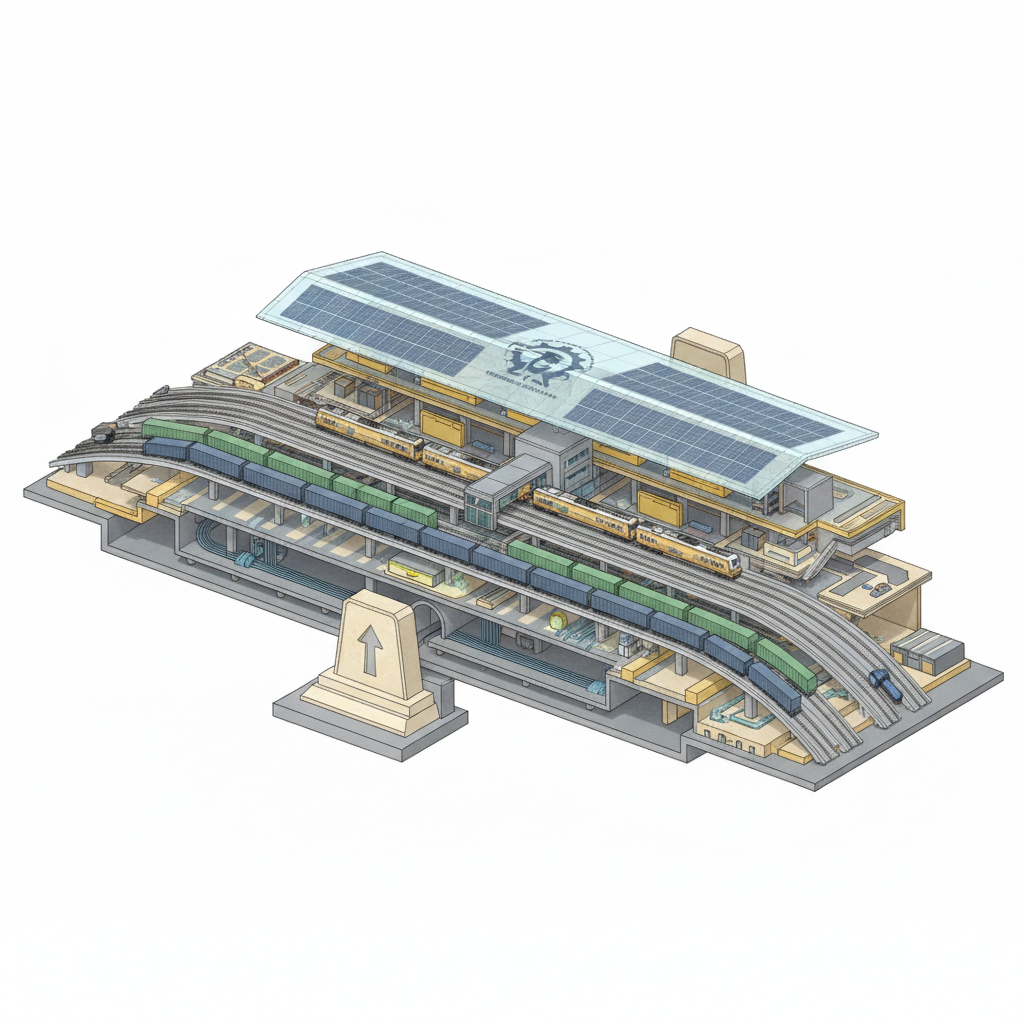
✎ Dedicated Freight Corridors (DFCs) are rail networks exclusively for freight, reducing transit times by up to 60% and integrating with ports and industrial hubs to enhance logistics efficiency under the Gati Shakti National…
Subject Relevance — Where This Topic Fits
- GS Paper II — Government Policies and Interventions for Development in various sectors | GS Paper III — Infrastructure: Energy, Ports, Roads, Airports, Railways; Investment Models
- Prelims: Dedicated Freight Corridors (DFC), Gati Shakti National Master Plan, Logistics Efficiency, Double-Stack Container Trains, Eastern and Western DFCs
- Essay: Infrastructure as the backbone of economic growth, Sustainable development through efficient logistics
Quick Revision: Dedicated Freight Corridors (DFCs) are rail networks exclusively for freight, reducing transit times by up to 60% and integrating with ports and industrial hubs to enhance logistics efficiency under the Gati Shakti National Master Plan.
Why is this in the news?
The Prime Minister, on 8 September 2026, dedicated to the nation multiple infrastructure projects worth over ₹35,000 crore in Vadodara, Gujarat. These initiatives, including the completion of the 2,800 km Dedicated Freight Corridors (DFCs), underscore India’s strategic focus on enhancing logistics efficiency, reducing transit times, and fostering economic integration. The event highlights the transformative impact of the Gati Shakti National Master Plan in accelerating infrastructure-led growth.
Background
- The Dedicated Freight Corridors (DFCs) are a flagship infrastructure initiative under the National Infrastructure Pipeline (NIP), aimed at decongesting rail networks and improving freight logistics.
- The Eastern and Western DFCs span approximately 2,800 km, connecting key industrial hubs, ports, and agricultural regions, thereby reducing dependency on road transport.
- The Gati Shakti National Master Plan, launched in 2021, integrates 16 ministries to synchronise infrastructure planning and execution, ensuring multi-modal connectivity and reducing logistics costs.
- India’s logistics sector contributes ~14% to GDP, with inefficiencies in transport and warehousing adding to costs; the DFCs aim to reduce these by 20-30%.
- The success of the DFCs is exemplified by the operation of double-stack container trains, which significantly enhance cargo capacity and reduce transit times.
What are Dedicated Freight Corridors (DFCs)?
- DFCs are rail corridors exclusively dedicated to freight movement, segregating passenger and goods traffic to improve efficiency and safety.
- These corridors utilise advanced technologies such as automatic train protection systems, high-capacity freight wagons, and electrified tracks for sustainable operations.
- The DFCs reduce transit times for goods by up to 60% compared to conventional rail routes, enabling faster delivery to markets and ports.
- By integrating with major ports (e.g., JNPT, Mundra) and industrial clusters, DFCs enhance export competitiveness and reduce logistics costs for industries.
- The corridors support double-stack container trains, which can carry twice the cargo volume of single-stack trains, thereby optimising rail freight capacity.
Key Features
| Feature | Significance |
|---|---|
| Dedicated Freight Corridors (DFCs) | Provides segregated rail infrastructure for freight, reducing congestion on passenger routes and enhancing logistics efficiency. |
| Double-Stack Container Operations | Doubles cargo capacity per train, reducing logistics costs and carbon footprint through efficient rail transport. |
| Gati Shakti National Master Plan | Integrates infrastructure planning across modes (rail, road, ports) to ensure multi-modal connectivity and reduce transit time. |
| Logistics Cost Reduction | Estimated 20-30% reduction in logistics costs due to faster transit, lower fuel consumption, and improved supply chain efficiency. |
| Multi-Modal Connectivity | Links hinterland to ports (e.g., JNPT to Vadodara) via rail, enabling bulk cargo movement and reducing road dependency. |
| Agricultural Supply Chain Integration | Enables perishable goods (fruits, vegetables, dairy) to reach markets faster, reducing wastage and improving farmer incomes. |
Why it Matters
Economic Growth and Competitiveness
- Reduces India’s logistics costs from ~14% of GDP to global benchmarks (~8-10%), enhancing export competitiveness.
- Accelerates industrialization by ensuring reliable input supply chains for manufacturing hubs (e.g., Gujarat’s petrochemical and engineering sectors).
- Boosts GDP growth by 0.5-1% annually through improved trade facilitation and reduced transaction costs.
Strategic Infrastructure Development
- Creates resilient supply chains resilient to geopolitical disruptions (e.g., Suez Canal blockages) by enhancing domestic connectivity.
- Supports India’s ‘Make in India’ and ‘Atmanirbhar Bharat’ initiatives by enabling large-scale manufacturing integration.
- Enhances regional connectivity, particularly in eastern and western corridors, linking industrial hubs to ports.
Sustainability and Climate Resilience
- Reduces carbon emissions by ~15-20 million tonnes annually through modal shift from road to rail (energy-efficient transport).
- Promotes circular economy by enabling efficient movement of recyclable materials and waste-to-energy feedstock.
- Supports India’s NDC commitments under the Paris Agreement by lowering logistics-related emissions.
Agrarian Transformation
- Cuts post-harvest losses for perishables from ~30% to <10% by ensuring faster, temperature-controlled transit.
- Expands market access for small and marginal farmers by connecting remote districts to national supply chains.
- Enables contract farming and agri-exports through reliable logistics, aligning with PM-KISAN and PM-FME schemes.
Urban and Regional Development
- Stimulates economic activity in tier-2/3 cities (e.g., Vadodara, Ahmedabad) by positioning them as logistics nodes.
- Reduces urban congestion by diverting freight traffic from highways to dedicated rail corridors.
- Supports ‘Smart Cities Mission’ by integrating logistics hubs with urban planning frameworks.
Challenges
1. Land Acquisition and Right-of-Way
- Delays in land acquisition under the Right to Fair Compensation and Transparency in Land Acquisition Act (RFCTLARR), 2013, hinder corridor completion.
- Disputes over compensation and rehabilitation of affected communities prolong project timelines.
UPSC Link: RFCTLARR Act 2013, Part VII
2. Multi-Modal Integration Bottlenecks
- Lack of seamless last-mile connectivity between DFCs and minor ports/industrial clusters increases turnaround time.
- Inadequate warehousing and cold-chain infrastructure at origin/destination points limits full utilization of DFC capacity.
UPSC Link: National Logistics Policy 2022, Section 3.2
3. Operational and Financial Viability
- High initial capital expenditure (₹1.57 lakh crore for DFCs) requires long-term revenue streams to ensure financial sustainability.
- Underutilization of capacity in initial phases due to low cargo volumes and competition from road transport.
UPSC Link: Economic Survey 2023-24, Chapter 7
4. Technology and Skill Gaps
- Limited adoption of advanced logistics technologies (e.g., IoT, AI for demand forecasting) among SMEs and small logistics firms.
- Shortage of skilled manpower for operating double-stack container trains and maintaining DFC infrastructure.
UPSC Link: Logistics Efficiency Enhancement Program (LEEP), NITI Aayog
5. Environmental and Social Concerns
- Potential ecological disruption in fragile ecosystems (e.g., Western Ghats) due to corridor construction.
- Community resistance to land acquisition and displacement, particularly in tribal-dominated regions.
UPSC Link: Environment Impact Assessment (EIA) Notification 2006, Schedule I
6. Regulatory and Policy Fragmentation
- Overlapping jurisdictions between central (DFCs), state (land use), and local (urban planning) authorities create coordination gaps.
- Inconsistent implementation of GST and e-way bill systems across states increases compliance costs for logistics firms.
UPSC Link: GST Council, Article 279A
Challenges — UPSC Perspective
| Issue | Concern |
|---|---|
| Land Acquisition Delays | Prolongs project timelines, increases costs, and risks project viability. |
| Multi-Modal Integration Gaps | Reduces efficiency gains from DFCs by limiting seamless cargo movement. |
| Financial Sustainability | High capex requires long-term revenue models; underutilization threatens ROI. |
| Technology Adoption Lag | Hinders optimization of DFC capacity and reduces competitiveness. |
| Environmental Clearances | Delays in EIA approvals and wildlife clearances stall construction. |
| Inter-State Coordination | Fragmented policies and bureaucratic silos impede holistic logistics planning. |
Government Initiatives — Must-Memorise for Prelims
- Gati Shakti National Master Plan (2021)
Way Forward
- Accelerate land acquisition under RFCTLARR by leveraging digital land records (e.g., SVAMITVA scheme) and expedited dispute resolution mechanisms.
- Develop last-mile connectivity infrastructure (e.g., freight terminals, cold chains) via Public-Private Partnerships (PPPs) to maximize DFC utilization.
- Enhance financial viability through viability gap funding, user charges, and cross-subsidization from passenger rail operations.
- Promote adoption of logistics technologies via subsidies for SMEs, skill development programs (e.g., PM Kaushal Vikas Yojana), and digital platforms for cargo tracking.
- Strengthen inter-state coordination through the Gati Shakti portal, integrating state-level logistics plans with the national master plan.
- Streamline environmental clearances by adopting digital EIA processes and pre-approved corridors for low-impact projects.
- Expand cargo volumes by incentivizing bulk commodity movement (e.g., coal, cement) and integrating DFCs with port-led industrialization (e.g., Sagarmala initiative).
- Monitor and evaluate project performance using standardized KPIs (e.g., transit time reduction, cost savings) to ensure accountability and continuous improvement.
UPSC Value Addition
Keywords for Mains Answer-Writing
Dedicated Freight Corridors (DFC) · PM Gati Shakti National Master Plan · Multimodal connectivity · Logistics efficiency · Infrastructure-led growth · Eastern and Western DFC · Double-stack container trains · Port-led development · Economic corridors · Supply chain optimization · National Infrastructure Pipeline · Logistics cost reduction · Railway modernization · Jawaharlal Nehru Port Trust (JNPT) · Vadodara logistics hub
Concept Flow
Gati Shakti National Master Plan → Multi-Modal Integration → Dedicated Freight Corridors (DFCs) → Segregated Rail Infrastructure → Double-Stack Container Operations → Logistics Cost Reduction → Enhanced Supply Chain Efficiency → Agricultural & Industrial Growth → Economic Competitiveness → Sustainable Development
Prelims Practice Questions
Q1. Consider the following statements regarding the Dedicated Freight Corridors (DFC) in India:
1. The Eastern and Western DFCs are part of the PM Gati Shakti National Master Plan.
2. The DFCs aim to segregate passenger and freight trains to enhance logistics efficiency.
3. The DFCs are designed to operate exclusively as single-stack container trains.
4. The DFCs reduce the transit time for goods between major ports and hinterlands by approximately 50%.
How many of the above statements are correct?
- Only one
- Only two
- Only three
- All
Answer: All — Statements 1, 2, and 4 are correct. Statement 3 is incorrect as the DFCs are designed to operate double-stack container trains, significantly increasing cargo capacity. The Eastern and Western DFCs are flagship projects under the PM Gati Shakti initiative, and their segregation of passenger and freight trains reduces transit times and logistics costs.
Q2. Assertion (A): The Dedicated Freight Corridors (DFC) in India are primarily aimed at reducing the operational costs of the Indian Railways.
Reason (R): By segregating passenger and freight trains, the DFCs enable faster and more efficient movement of goods, thereby reducing fuel consumption and wear-and-tear on tracks.
Options:
A. Both A and R are true, and R is the correct explanation of A.
B. Both A and R are true, but R is NOT the correct explanation of A.
C. A is true, but R is false.
D. A is false, but R is true.
Answer: ? — Both Assertion (A) and Reason (R) are true, and Reason (R) correctly explains Assertion (A). The primary objective of the DFCs is to enhance the efficiency of freight movement, which directly reduces operational costs for the Indian Railways by optimizing track usage and reducing transit times.
Q3. Match the following pairs related to infrastructure projects in India:
Column I (Project) | Column II (Feature)
——————-|——————-
A. Eastern Dedicated Freight Corridor | 1. Connects Jawaharlal Nehru Port Trust (JNPT) to Vadodara
B. Western Dedicated Freight Corridor | 2. Runs from Ludhiana to Dankuni
C. PM Gati Shakti National Master Plan | 3. Aims to integrate 16 ministries for multimodal connectivity
D. Sagarmala Programme | 4. Focuses on port-led development and coastal connectivity
Choose the correct match:
Options:
A. A-2, B-1, C-3, D-4
B. A-1, B-2, C-3, D-4
C. A-2, B-1, C-4, D-3
D. A-4, B-3, C-2, D-1
- A
- B
- C
- D
Answer: A — The correct match is: A-2 (Eastern DFC runs from Ludhiana to Dankuni), B-1 (Western DFC connects JNPT to Vadodara), C-3 (PM Gati Shakti integrates 16 ministries for multimodal connectivity), and D-4 (Sagarmala focuses on port-led development).
Mains Practice Question
✍ The inauguration of the Dedicated Freight Corridors (DFC) and the PM Gati Shakti National Master Plan represents a paradigm shift in India’s infrastructure-led growth strategy. Critically examine the role of these initiatives in transforming India’s logistics and supply chain ecosystem. Also, assess their potential to address the challenges of high logistics costs and inefficiencies in the Indian economy. (15 Marks)
Approach: MODEL-ANSWER SKELETON:
1. **Introduction (2 Marks)**
– Define Dedicated Freight Corridors (DFC) and PM Gati Shakti National Master Plan.
– Contextualize their launch within India’s broader infrastructure development goals (e.g., National Infrastructure Pipeline, Atmanirbhar Bharat).
2. **Role of DFCs in Transforming Logistics (5 Marks)**
– Segregation of passenger and freight trains: reduction in transit times (e.g., 30 hours to 10-12 hours for 100 km), increased frequency (430+ freight trains daily).
– Double-stack container trains: doubling of cargo capacity per train, cost efficiency (fuel savings, reduced wear-and-tear).
– Integration with major ports (e.g., JNPT) and hinterlands: faster movement of perishable goods (e.g., horticulture produce) and industrial raw materials.
– Reduction in logistics costs: India’s logistics cost as a percentage of GDP (currently ~13-14%) vs. global averages (~8-10%).
3. **PM Gati Shakti National Master Plan: Multimodal Connectivity (5 Marks)**
– Integration of 16 ministries: Railways, Road Transport, Shipping, Civil Aviation, etc., for coordinated infrastructure development.
– Focus on last-mile connectivity: addressing bottlenecks in urban and rural areas.
– Use of GIS-based planning tools: data-driven decision-making for infrastructure projects.
– Alignment with global best practices: inspired by models like China’s Belt and Road Initiative and the EU’s Trans-European Transport Network.
4. **Challenges and Limitations (3 Marks)**
– Land acquisition and environmental clearances: delays in project implementation.
– Coordination challenges among multiple stakeholders: federalism dynamics (Centre-State relations).
– High initial capital expenditure: reliance on public-private partnerships (PPPs) and multilateral funding (e.g., World Bank, ADB).
– Need for complementary reforms: GST, digitalization of logistics, and skill development in the logistics sector.
5. **Conclusion (2 Marks)**
– Summarize the transformative potential of DFCs and PM Gati Shakti in reducing logistics costs and enhancing India’s global competitiveness.
– Emphasize the need for sustained investment, technological adoption, and policy coherence to realize long-term benefits.
Source: PIB (Press Information Bureau)
Gujarat PCS (GPSC) — State PCS Practice
Prelims: Recently, Prime Minister Narendra Modi laid the foundation stone, inaugurated, and dedicated to the nation development projects worth over ₹35,000 crore in which city of Gujarat?
- A. Ahmedabad
- B. Gandhinagar
- C. Vadodara
- D. Surat
Answer: C. Vadodara — The event was held in Vadodara, Gujarat, as part of the Prime Minister’s initiatives for infrastructure and development in the state.
Mains: Discuss the significance of Prime Minister Narendra Modi’s recent initiatives in Vadodara for Gujarat’s socio-economic development, highlighting key sectors addressed and their potential impact on the state’s growth trajectory.
Generated by AanyaAi for educational purpose.
Related guides on our sites
- Best PSIR optional coaching for upsc
- Best PSIR optional teacher for upsc
- Best teacher of PSIR optional for upsc
- Best PSIR optional coaching in delhi for UPSC

- उत्तर-पूर्वी मानसून: तमिलनाडु सरकार की तैयारी एवं सावधानियाँ - September 8, 2026
- Vijay reviews Northeast Monsoon preparedness: Key steps for Tamil Nadu - September 8, 2026
- AI से बाढ़ और जल संकट का पूर्वानुमान: यूपीएससी के लिए महत्वपूर्ण - September 8, 2026

No Comments