


23 Jul PM Vishwakarma Scheme Launch in West Bengal: Key Facts for UPSC & State PCS
Subject Relevance — Where This Topic Fits
- GS Paper II — Government Policies and Interventions for Development in various sectors | GS Paper III — Role of MSME Sector in Indian Economy, Government Schemes for Employment Generation and Skill Development
- Prelims: PM Vishwakarma Scheme, MSME Innovation Scheme, MUDRA Scheme, Credit Guarantee Scheme for MSMEs (CGTMSE), Public Procurement Policy for MSMEs, Skill India Mission, Sundarbans, West Bengal State Monitoring Committee
- Essay: The Role of Government in Empowering Traditional Artisans: A Case Study of PM Vishwakarma Scheme, Balancing Economic Growth and Inclusive Development: Lessons from MSME Schemes in India
Quick Revision: The PM Vishwakarma Scheme provides collateral-free loans up to ₹3 lakh, toolkit incentives of ₹15,000, and skill training stipends of ₹500/day to artisans in 18 traditional occupations, with West Bengal emerging as a key state for its implementation through state-government collaboration.
Why is this in the news?
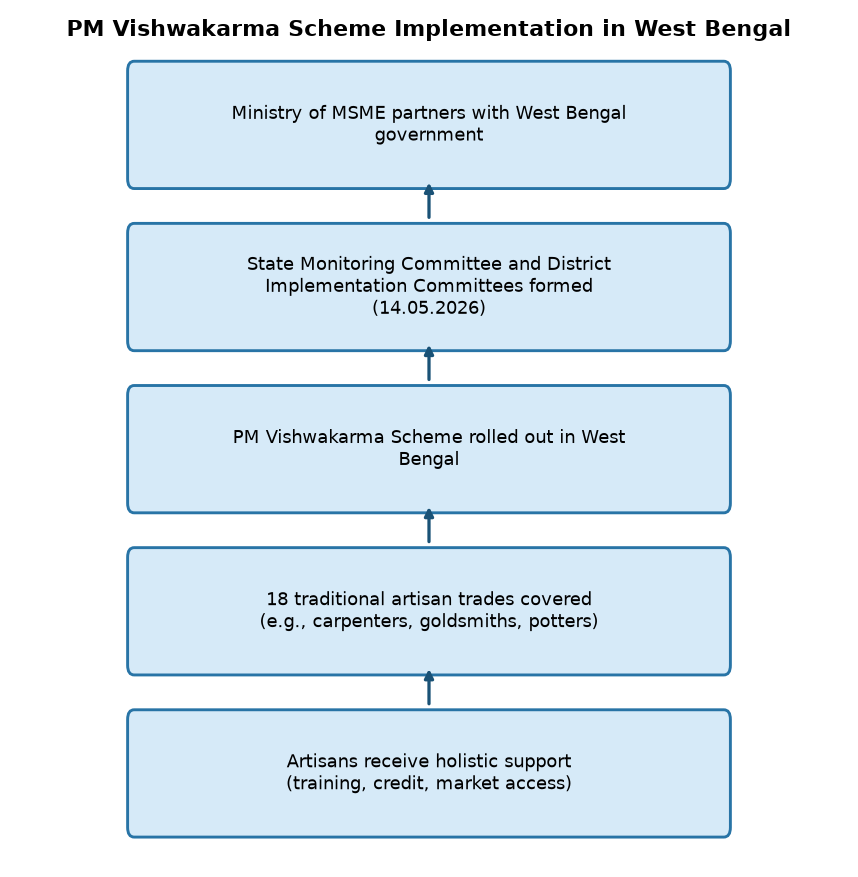
The Ministry of Micro, Small and Medium Enterprises (MSME) has initiated the implementation of the PM Vishwakarma Scheme in West Bengal in collaboration with the state government, marking a significant step toward empowering traditional artisans and craftspeople in the region. This initiative aligns with broader efforts to integrate artisans into the formal economy, enhance their livelihoods, and foster entrepreneurship through targeted financial, skill, and market access support. The scheme’s launch in West Bengal follows the state’s establishment of a monitoring framework, including district-level committees, to ensure effective execution.
Background
- The PM Vishwakarma Scheme was launched on 17 September 2023 to provide comprehensive support to artisans and craftspeople engaged in 18 traditional occupations, including carpenters, goldsmiths, potters, and tailors.
- West Bengal has a rich heritage of traditional crafts and artisanal practices, with a significant population dependent on these livelihoods, particularly in rural and semi-urban areas.
- The state has historically been a hub for MSMEs, with the sector contributing substantially to employment and economic output, necessitating targeted interventions for skill upgradation and financial inclusion.
- The MSME Innovation Scheme, with its incubation component, aims to nurture innovative ideas and transform them into viable business enterprises, thereby strengthening the startup ecosystem in the state.
- The state government’s proactive role in establishing a monitoring framework for the PM Vishwakarma Scheme underscores its commitment to decentralised implementation and grassroots-level impact.
What is the PM Vishwakarma Scheme?
- The PM Vishwakarma Scheme is a centrally sponsored initiative launched to provide holistic support to artisans and craftspeople engaged in 18 traditional occupations, including carpenters, blacksmiths, potters, and tailors.
- The scheme aims to enhance the skills, productivity, and economic viability of artisans by offering financial assistance, toolkit incentives, skill training, and market access support.
- Eligible beneficiaries receive a toolkit incentive of up to ₹15,000 and can access collateral-free loans of up to ₹3 lakh with subsidised interest rates.
- The scheme includes a stipend of ₹500 per day for skill training, which ranges from 15 days to 30 days, depending on the trade, to ensure continuous income support during the training period.
- Digital empowerment is a key component, with beneficiaries receiving incentives for digital transactions and access to e-commerce platforms for marketing their products.
- The scheme is implemented through a network of nodal agencies, including state governments, district-level committees, and recognised institutions, ensuring grassroots-level reach.
- West Bengal, with its 23 host institutions under the MSME Innovation Scheme, is leveraging the scheme to integrate artisans into the formal economy and promote sustainable livelihoods.
- The PM Vishwakarma Scheme is part of a broader ecosystem of MSME support schemes, including the PM Mudra Yojana, CGTMSE, and Public Procurement Policy, which collectively aim to foster entrepreneurship and employment generation.
Key Features
| Feature | Significance |
|---|---|
| Coverage of 18 traditional trades | Ensures formal recognition and support for artisans in indigenous crafts, aligning with India’s cultural heritage preservation and employment generation. |
| Toolkit incentive of ₹15,000 | Directly enhances productivity and quality of output for artisans by providing modern tools, reducing dependence on outdated equipment. |
| Collateral-free credit up to ₹3 lakh | Removes financial barriers for micro-entrepreneurs, particularly women and marginalised groups, fostering inclusive growth. |
| Skill upgradation and digital incentives | Bridges skill gaps and promotes financial inclusion through digital transaction bonuses, critical for MSME competitiveness. |
| State-level implementation via nodal committees | Ensures decentralised governance, faster disbursement, and tailored outreach in West Bengal’s diverse districts. |
Why it Matters
Economic Empowerment
- Directly targets the informal sector, transforming traditional artisans into formal MSMEs, thereby expanding tax base and formal employment.
- Enhances rural and semi-urban economic resilience by providing stable income streams to skilled workers in heritage-based trades.
- Supports West Bengal’s economic diversification beyond agriculture, leveraging its rich artisanal traditions for export and tourism.
Social Inclusion
- Prioritises women artisans and marginalised communities (e.g., SC/ST, OBC) through gender-sensitive credit guarantees and skill training.
- Includes Scheduled Castes and Scheduled Tribes in the 18 notified trades, addressing historical socio-economic disparities.
- Promotes inter-generational skill transfer by incentivising youth participation in traditional crafts.
Policy Synergy
- Integrates with PM Mudra Yojana (₹3.55 lakh crore disbursed in West Bengal) and MSME Innovative Scheme, creating a multi-layered support ecosystem.
- Aligns with Public Procurement Policy for MSEs (3% mandatory procurement from women-owned enterprises), ensuring market access.
- Complements existing schemes like CGTMSE (90% guarantee for women) and PMEGP (35% margin money for women), reducing credit risk.
Geographical Focus
- West Bengal’s selection underscores the Centre’s focus on eastern India, where MSME density remains lower than national averages.
- Inclusion of Sundarbans highlights adaptation to ecological and livelihood challenges in coastal regions.
- Leverages state’s 23 host institutions for incubation, ensuring grassroots-level implementation and monitoring.
Challenges
1. Low Awareness Among Artisans
- Many traditional artisans lack digital literacy or access to information, leading to underutilisation of scheme benefits.
- Language barriers and limited outreach in rural areas exacerbate exclusion, particularly among elderly artisans.
UPSC Link: GS 2: Welfare schemes
2. Credit Disbursement Bottlenecks
- Delays in sanctioning loans due to bureaucratic hurdles or incomplete documentation, especially for first-time borrowers.
- Risk of diversion of funds for non-business purposes, given the absence of collateral requirements.
UPSC Link: GS 3: Financial inclusion
3. Skill Mismatch and Market Linkages
- Traditional training may not align with modern market demands, reducing commercial viability of products.
- Limited access to e-commerce platforms and branding support hinders scalability for artisans.
UPSC Link: GS 3: MSMEs and entrepreneurship
4. State-Level Coordination Gaps
- Potential delays in forming district implementation committees or nodal agencies, delaying rollout.
- Divergent priorities between Centre and state governments may lead to implementation inconsistencies.
UPSC Link: GS 2: Centre-state relations
5. Climate and Ecological Vulnerabilities
- Artisans in Sundarbans face climate-induced livelihood threats, requiring adaptive strategies for long-term sustainability.
- Dependence on natural resources (e.g., bamboo, clay) may be disrupted by environmental degradation.
UPSC Link: GS 3: Environment and sustainability
Challenges — UPSC Perspective
| Issue | Concern |
|---|---|
| Digital divide | Limited internet access and smartphone penetration among rural artisans impedes registration and training. |
| Gender-specific barriers | Social norms may restrict women’s mobility or decision-making power in availing scheme benefits. |
| Quality certification | Lack of standardised certification for handmade products limits market access and premium pricing. |
| Supply chain disruptions | Dependence on local raw material suppliers may lead to cost fluctuations or shortages. |
| Monitoring and evaluation | Absence of real-time tracking systems for loan utilisation and skill upgradation outcomes. |
Government Initiatives — Must-Memorise for Prelims
- Pradhan Mantri Mudra Yojana (PMMY)
- Pradhan Mantri Vishwakarma Yojana (PMVY)
- Credit Guarantee Scheme for Micro and Small Enterprises (CGTMSE)
- Prime Minister’s Employment Generation Programme (PMEGP)
- MSME Innovative Scheme (Incubation Component)
- Public Procurement Policy for MSEs
Way Forward
- Strengthen grassroots awareness campaigns through local self-help groups (SHGs) and panchayati raj institutions (PRIs) to ensure last-mile delivery.
- Leverage digital public infrastructure (e.g., Aadhaar, UPI) to streamline registration, disbursement, and monitoring of scheme benefits.
- Establish dedicated incubation hubs in West Bengal’s host institutions to provide end-to-end support, including design, marketing, and export linkages.
- Introduce climate-resilient training modules for artisans in vulnerable regions like Sundarbans, integrating traditional knowledge with modern adaptation techniques.
- Mandate periodic skill audits and market linkage fairs to align artisan training with evolving consumer preferences and e-commerce trends.
- Enhance convergence with state-level schemes (e.g., West Bengal MSME Policy 2023) to avoid duplication and maximise resource utilisation.
- Promote women-led cooperatives to aggregate supply, improve bargaining power, and ensure equitable access to credit and markets.
UPSC Value Addition
Keywords for Mains Answer-Writing
PM Vishwakarma Yojana · MSME sector · Artisan and craftsmen welfare · Credit Guarantee Scheme for MSMEs · Women entrepreneurship · Skill upgradation · Incubation support for MSMEs · Public procurement policy for MSMEs · PMEGP scheme · CGTMSE scheme · State-level implementation of central schemes · West Bengal MSME ecosystem · Traditional occupations and livelihoods · Financial inclusion of artisans · Innovation and entrepreneurship in MSMEs
Concept Flow
Traditional artisans in West Bengal lack formal recognition and financial access → Government launches PM Vishwakarma Yojana to integrate them into MSME ecosystem → Scheme provides toolkits, credit, and skill training → Enhanced productivity and income for artisans → Integration with PM Mudra Yojana and MSME Innovative Scheme amplifies impact → State-level implementation ensures decentralised governance → Long-term outcome: formalisation of informal sector, cultural preservation, and rural economic resilience.
Prelims Practice Questions
Q1. Which of the following is NOT a traditional occupation covered under the PM Vishwakarma Yojana?
- A. Goldsmith
- B. Potter
- C. Software Developer
- D. Barber
Answer: C. Software Developer — The PM Vishwakarma Yojana covers 18 traditional occupations, including goldsmith, potter, and barber, but not software development, which is a modern, technology-driven profession.
Q2. Under the CGTMSE scheme, what is the maximum guarantee coverage provided to women-owned micro and small enterprises?
- A. 75%
- B. 80%
- C. 85%
- D. 90%
Answer: D. 90% — The Credit Guarantee Scheme for MSMEs (CGTMSE) provides an enhanced guarantee coverage of up to 90% for women-owned micro and small enterprises, compared to 75% for others.
Q3. Which of the following initiatives aims to promote innovation and entrepreneurship in the MSME sector by supporting early-stage ideas?
- A. PM Mudra Yojana
- B. MSME Innovative Scheme
- C. PM Vishwakarma Yojana
- D. Stand-Up India Scheme
Answer: B. MSME Innovative Scheme — The MSME Innovative Scheme is designed to foster innovation by supporting early-stage ideas and transforming them into viable business enterprises through incubation support.
Mains Practice Question
✍ Critically examine the significance of the PM Vishwakarma Yojana in addressing the challenges faced by artisans and craftsmen in India. How does this scheme integrate with other government initiatives to promote sustainable livelihoods and economic empowerment in the MSME sector?
Approach: The answer should begin by outlining the key features of the PM Vishwakarma Yojana, including its target beneficiaries, financial and non-financial support mechanisms, and its focus on traditional occupations. Next, analyze the challenges faced by artisans and craftsmen, such as lack of access to credit, inadequate skill development, and limited market access. Then, discuss how the scheme complements other government initiatives like the CGTMSE, PMEGP, and public procurement policies to address these challenges. Finally, evaluate the potential impact of the scheme on sustainable livelihoods and economic empowerment, while also highlighting any gaps or areas for improvement, such as scalability, awareness, and effective implementation at the grassroots level.
Source: PIB (Press Information Bureau)
Generated by AanyaAi for educational purpose.

- Shivraj Singh Chouhan launches ‘Khet Bachao Abhiyan’ to save farmland - October 23, 2026
- उत्तराखंड राज्यपाल की पीएम मोदी से महत्वपूर्ण बैठक: जानिए मुख्य बिंदु - October 23, 2026
- How India’s Rs 20,000 Cr CCUS Budget Can Drive Net-Zero Goals - October 23, 2026

No Comments