


21 Jul PMAY-U 2.0: 1 Crore New Homes by 2029 – Key Updates for UPSC & State PCS
Subject Relevance — Where This Topic Fits
- GS Paper II — Governance, Transparency and Accountability | GS Paper III — Inclusive Growth, Infrastructure and Urban Development
- Prelims: Pradhan Mantri Awas Yojana-Urban (PMAY-U), PMAY-U 2.0 Mission ‘Housing for All’, Affordable Housing in Partnership (AHP), Beneficiary-Led Construction (BLC), Interest Subsidy Scheme (ISS), Affordable Rental Housing Complexes (ARHC), Urban Local Bodies (ULBs), Detailed Project Report (DPR), Central Sector Scheme, Demand-driven scheme
- Essay: Urbanisation and its challenges in India: Housing deficit and policy responses, Inclusive growth through targeted welfare schemes: A case study of PMAY-U
Why is this in the news?
The Ministry of Housing and Urban Affairs (MoHUA) issued a press release on 20 July 2026 detailing the implementation status of the Pradhan Mantri Awas Yojana-Urban (PMAY-U), including the extension of the scheme until 30 September 2026 to complete sanctioned houses and the launch of PMAY-U 2.0 on 1 September 2024. The release highlights progress in house construction, approvals, and disbursements, with Tamil Nadu as a key state in the scheme’s execution. This update is significant for UPSC aspirants as it reflects the government’s sustained commitment to addressing urban housing deficits through structured policy interventions and multi-tiered implementation mechanisms.
Background
- PMAY-U was launched on 25 June 2015 under the Ministry of Housing and Urban Affairs (MoHUA) to provide pucca houses with basic civic amenities to eligible urban beneficiaries across India, including Tamil Nadu.
- PMAY-U 2.0, launched on 1 September 2024, is an evolution of the original scheme, with a renewed focus on scalability, sustainability, and inclusivity over the next five years.
- The extension of PMAY-U until 30 September 2026 was necessitated to ensure completion of sanctioned houses without altering funding mechanisms or implementation modalities.
What is Pradhan Mantri Awas Yojana-Urban (PMAY-U) and PMAY-U 2.0?
- The scheme is demand-driven, with proposals submitted by state governments/UTs based on local housing deficits and beneficiary demand, ensuring alignment with ground realities.
- PMAY-U 2.0, launched on 1 September 2024, is an upgraded version of the original scheme, aiming to provide housing assistance to 1 crore additional beneficiaries over the next five years.
- The implementation of PMAY-U 2.0 is structured around the same four verticals as PMAY-U, with enhanced focus on sustainability, technology adoption (e.g., prefabricated construction), and integration with other urban development schemes such as Smart Cities Mission and AMRUT.
- The scheme mandates adherence to technical and quality standards prescribed in the Detailed Project Reports (DPRs), including compliance with building bye-laws, environmental norms, and disaster-resilient construction practices.
- Monitoring and evaluation of PMAY-U are conducted through a multi-layered mechanism, including periodic reviews by MoHUA, video conferences with state/UT officials, field visits, and real-time progress tracking via the PMAY-U portal.
Key Features
| Feature | Significance |
|---|---|
| Objective | Ensures universal access to pucca housing with basic civic amenities in urban areas, addressing housing shortages for economically weaker sections (EWS), low-income groups (LIG), and middle-income groups (MIG). |
| Implementation Framework | Demand-driven model where states/UTs propose projects based on local housing deficits; central assistance is released post-approval of Detailed Project Reports (DPRs). |
| Funding Mechanism | Central assistance of ₹1.5 lakh per EWS/LIG beneficiary and ₹1.0 lakh per MIG beneficiary under Credit Linked Subsidy Scheme (CLSS); additional funding for Affordable Housing in Partnership (AHP) and Beneficiary-Led Construction (BLC) categories. |
| Quality Assurance | Mandatory adherence to National Building Code (NBC) and Urban Local Body (ULB) bye-laws; third-party inspections and geo-tagging of houses to ensure compliance with technical standards. |
| Monitoring and Review | Real-time progress tracking via PMIS (Project Management Information System), monthly reviews, and field visits by MoHUA; time-bound completion targets (12–36 months) aligned with DPRs. |
Why it Matters
Social Equity
- Directly contributes to Sustainable Development Goal 11 (Sustainable Cities and Communities) by reducing homelessness and slum proliferation in urban India.
- Prioritises marginalised groups (SC/ST, women-headed households, and physically challenged individuals) through mandatory inclusion in beneficiary lists.
- Enhances social mobility by providing secure tenure and access to basic services (water, sanitation, electricity), thereby reducing urban poverty.
Economic Multiplier
- Stimulates employment in construction, allied industries (cement, steel, bricks), and local services, particularly in labour-intensive sectors with high backward linkages.
- Boosts demand for affordable housing finance, thereby strengthening the housing finance ecosystem and reducing informality in urban housing markets.
- Indirectly supports urban infrastructure development through integrated planning, as housing projects are linked with water supply, sanitation, and road connectivity.
Urban Governance
- Strengthens decentralisation by empowering ULBs and state governments in project formulation, approval, and implementation, aligning with the 74th Constitutional Amendment Act (1992).
- Promotes participatory planning through community engagement in site selection, design, and beneficiary identification, fostering local ownership.
- Enhances transparency via geo-tagging, direct benefit transfer (DBT), and public dashboards for real-time monitoring of project progress.
Policy Continuity
- Demonstrates long-term policy commitment to housing for all, with PMAY-U 2.0 extending the mission to 2029 and scaling up target to 1 crore additional houses.
- Serves as a model for convergence with other schemes (e.g., AMRUT, Smart Cities Mission) to ensure holistic urban development.
- Provides a replicable framework for state-level housing schemes, reducing duplication and improving resource utilisation.
Challenges
1. Land Acquisition and Titling Disputes
- Urban land records are often fragmented, leading to legal disputes over ownership, encroachments, and unclear titles, delaying project implementation.
- High land prices in metropolitan areas inflate project costs, making it difficult to meet affordability targets without compromising quality or location.
- State-specific land ceiling acts and tenancy laws (e.g., in Tamil Nadu) create regulatory bottlenecks, necessitating amendments for faster clearances.
UPSC Link: Land Reforms and Urban Land Ceiling Acts
2. Construction Delays and Cost Overruns
- Delays in obtaining statutory approvals (environmental clearance, building permits) and utility connections (water, electricity) extend project timelines beyond the 12–36 month window.
- Fluctuations in material prices (steel, cement) and labour shortages post-pandemic increase project costs, straining the financial viability of affordable housing projects.
- Poor project management and lack of skilled labour in certain states lead to substandard construction, necessitating rework and additional expenditure.
UPSC Link: Infrastructure Development and Project Management
3. Beneficiary Identification and Targeting Errors
- Inclusion and exclusion errors in beneficiary lists (e.g., duplication, ineligible beneficiaries) undermine the scheme’s equity objectives and lead to leakages.
- Lack of updated socio-economic surveys in many states results in incorrect identification of EWS/LIG households, particularly in informal settlements.
- Delayed disbursement of central assistance to states due to procedural bottlenecks affects timely completion of houses.
UPSC Link: Poverty Alleviation and Targeted Delivery
4. Quality Control and Post-Occupancy Issues
- Inadequate enforcement of building bye-laws and NBC standards leads to substandard construction, posing safety risks to residents.
- Post-occupancy problems (e.g., waterlogging, poor drainage, structural defects) erode public trust in the scheme and require costly retrofitting.
- Limited capacity of ULBs to conduct regular inspections and audits hampers quality assurance, especially in smaller towns.
UPSC Link: Urban Governance and Municipal Reforms
5. Convergence with Urban Infrastructure
- Housing projects often fail to integrate with existing urban infrastructure (e.g., water supply, sanitation, public transport), leading to operational inefficiencies.
- Lack of coordination between MoHUA, state governments, and ULBs delays the provision of civic amenities, reducing the scheme’s livability outcomes.
- Inadequate planning for post-occupancy maintenance of infrastructure (e.g., roads, drainage) shifts the burden to municipal bodies.
UPSC Link: Urban Planning and Smart Cities Mission
6. Financial Sustainability
- Dependence on central assistance makes states vulnerable to fiscal constraints, particularly in resource-constrained regions.
- Limited participation from private developers in AHP and ARH categories due to low profit margins and regulatory hurdles.
- Need for innovative financing mechanisms (e.g., municipal bonds, land value capture) to supplement central funds and ensure long-term viability.
UPSC Link: Public Finance and Fiscal Federalism
Challenges — UPSC Perspective
| Issue | Concern |
|---|---|
| Statutory Approvals | Delays in environmental clearances, building permits, and utility connections hinder timely project execution. |
| Land Titling | Fragmented and disputed land records in urban areas lead to legal challenges and project delays. |
| Beneficiary Targeting | Errors in identification and inclusion of ineligible beneficiaries reduce scheme effectiveness and increase leakages. |
| Quality Assurance | Inadequate enforcement of building standards and lack of post-construction audits compromise structural integrity and safety. |
| Infrastructure Integration | Poor convergence with urban infrastructure (water, sanitation, transport) limits the scheme’s impact on urban livability. |
| Financial Viability | High land costs and low profit margins deter private sector participation, straining state budgets. |
Government Initiatives — Must-Memorise for Prelims
- Pradhan Mantri Awas Yojana-Urban (PMAY-U) and PMAY-U 2.0
- Atal Mission for Rejuvenation and Urban Transformation (AMRUT)
- Smart Cities Mission
- Swachh Bharat Mission-Urban (SBM-U)
- Deendayal Antyodaya Yojana-National Urban Livelihoods Mission (DAY-NULM)
Way Forward
- Accelerate land titling reforms and digitisation of urban land records to resolve ownership disputes and expedite clearances.
- Strengthen ULB capacities for project management, quality control, and post-occupancy maintenance through capacity-building programmes.
- Enhance convergence between PMAY-U and AMRUT/Smart Cities Mission to ensure integrated provision of water, sanitation, and transport infrastructure.
- Introduce performance-based incentives for states/UTs to meet time-bound completion targets and penalise delays.
- Expand public-private partnerships (PPPs) in Affordable Housing in Partnership (AHP) and Affordable Rental Housing (ARH) categories through viability gap funding and tax incentives.
- Leverage technology (e.g., GIS mapping, blockchain for land records) to improve transparency, reduce leakages, and streamline beneficiary identification.
- Establish a dedicated urban housing fund with contributions from centre, states, and private sector to supplement central assistance and address fiscal constraints.
- Mandate third-party quality audits and geo-tagging of all completed houses to ensure adherence to NBC standards and facilitate post-occupancy monitoring.
UPSC Value Addition
Keywords for Mains Answer-Writing
Pradhan Mantri Awas Yojana-Urban (PMAY-U) · PMAY-U 2.0 Mission ‘Housing for All’ · Affordable Housing in Partnership (AHP) · Beneficiary-Led Construction (BLC) · Affordable Rental Housing Complexes (ARHC) · Interest Subsidy Scheme (ISS) · Urban Housing Shortage · Housing for Economically Weaker Sections (EWS) · Central Sector Scheme · Housing Infrastructure · Urban Local Bodies (ULBs) · Demand-driven Scheme · Housing Quality Standards · Mission Extension till 2026 · Tamil Nadu Housing Progress
Constitutional & Policy Linkages
- Article 243W (Powers, authority, and responsibilities of Municipalities)
- Article 243ZD (Committee for Metropolitan Planning)
- 74th Constitutional Amendment Act, 1992 (Urban Local Bodies)
Concept Flow
Urban Housing Shortage → Policy Response (PMAY-U) → Demand-Driven Implementation → Approval of DPRs → Release of Central Assistance → Land Acquisition and Titling → Statutory Approvals → Construction → Quality Assurance → Handover to Beneficiaries → Post-Occupancy Maintenance → Economic Growth → Urbanisation → Migration to Cities → Increased Housing Demand → PMAY-U Targets → Construction Boom → Employment Generation → Economic Multiplier Effect → Decentralisation → 74th Amendment Act → Empowerment of ULBs → State-Led Implementation → Convergence with AMRUT/Smart Cities → Integrated Urban Development → Social Equity → Inclusion of EWS/LIG → Targeted Beneficiary Identification → Direct Benefit Transfer → Equitable Access → Reduction in Urban Poverty → Policy Continuity → PMAY-U to PMAY-U 2.0 → Extended Timeline (2026–2029) → Scaling Targets (1 crore houses) → Long-Term Housing Security
Prelims Practice Questions
Q1. Which of the following is NOT a component of Pradhan Mantri Awas Yojana-Urban (PMAY-U) 2.0?
- A. Beneficiary-Led Construction (BLC)
- B. Affordable Housing in Partnership (AHP)
- C. Direct Cash Transfer to Beneficiaries
- D. Interest Subsidy Scheme (ISS)
Answer: C. Direct Cash Transfer to Beneficiaries — PMAY-U 2.0 includes BLC, AHP, ARHC, and ISS as its four implementation components. Direct Cash Transfer is not a listed component under the scheme’s operational guidelines.
Q2. As per the latest status report of PMAY-U, which of the following is correct regarding the approval and completion of houses?
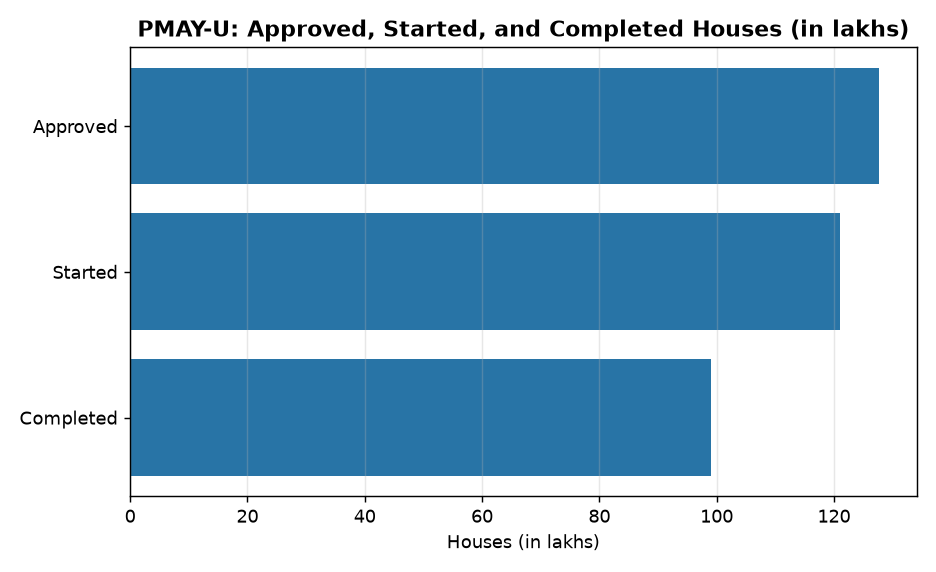
- A. 127.68 lakh houses approved, 99.07 lakh completed
- B. 127.68 lakh houses approved, 121.02 lakh completed
- C. 100 lakh houses approved, 80 lakh completed
- D. 150 lakh houses approved, 100 lakh completed
Answer: A. 127.68 lakh houses approved, 99.07 lakh completed — As of 13.07.2026, 127.68 lakh houses have been approved under PMAY-U, of which 99.07 lakh have been completed and handed over to beneficiaries.
Q3. The Pradhan Mantri Awas Yojana-Urban (PMAY-U) was launched to address housing shortages in:
- A. Rural areas only
- B. Urban areas only
- C. Both rural and urban areas
- D. Coastal areas exclusively
Answer: B. Urban areas only — PMAY-U is specifically designed to address housing shortages in urban areas, as indicated in its official mandate and implementation framework.
Mains Practice Question
✍ Critically evaluate the implementation challenges faced by the Pradhan Mantri Awas Yojana-Urban (PMAY-U) in ensuring housing for all in urban India. Discuss the structural reforms introduced in PMAY-U 2.0 to address these challenges.
Approach: Begin by outlining the objectives and scope of PMAY-U, highlighting its demand-driven nature and the four components of PMAY-U 2.0. Analyse key implementation challenges such as land acquisition, regulatory approvals, financial constraints, and quality assurance. Discuss how PMAY-U 2.0 addresses these through mission extension, enhanced monitoring, and integration with urban infrastructure development. Conclude with a balanced assessment of whether these reforms are sufficient to achieve the goal of ‘Housing for All’ by 2026.
Source: PIB (Press Information Bureau)
Generated by AanyaAi for educational purpose.

- पशुपालन विभाग ‘विशेष अभियान 6’ में करेगा शामिल, जानिए लक्ष्य और तैयारी - September 16, 2026
- UPSC Alert: DAHD’s Success in Special Campaign 5.0 & Special Campaign 6.0 Prep - September 16, 2026
- पीएम विश्वकर्मा योजना के तीन वर्ष: 30 लाख कारीगरों को मिला लाभ, जानें प्रमुख उपलब्धियां - September 16, 2026

No Comments