


30 Jul PMKSY: Boosting Food Processing & Reducing Post-Harvest Losses for Farmers
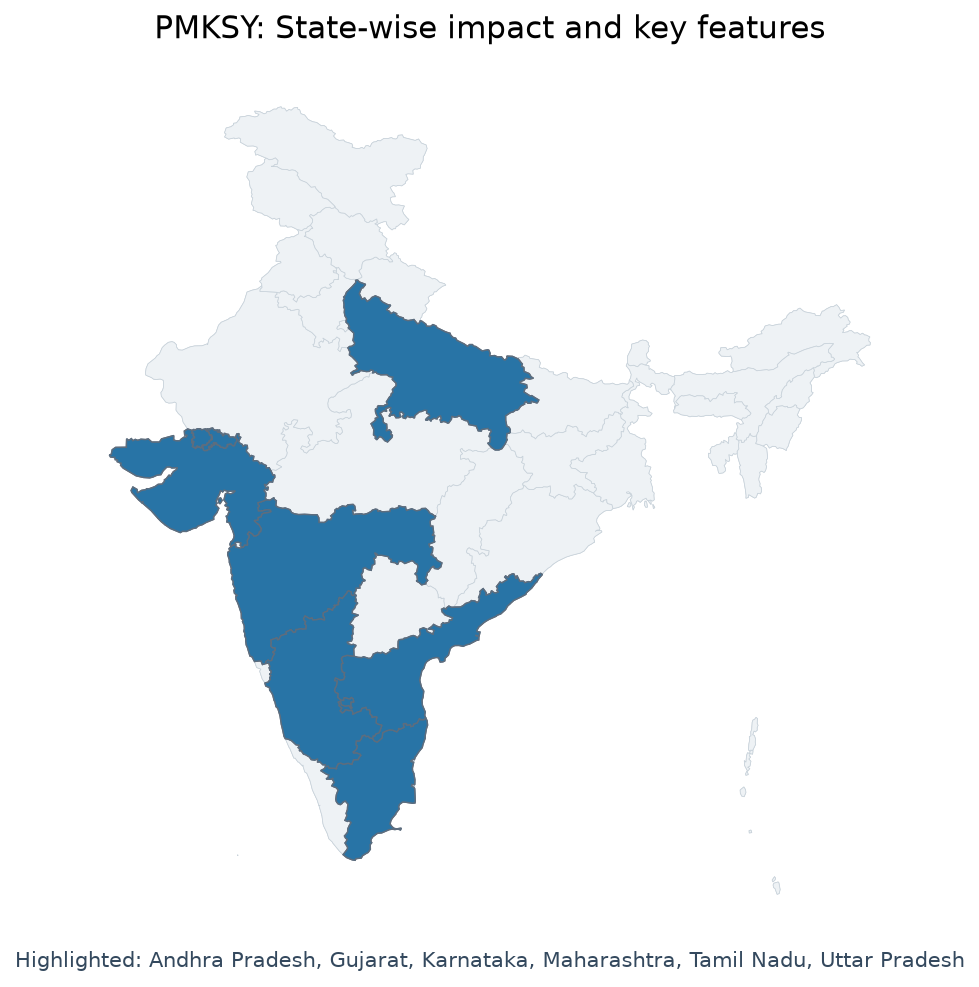
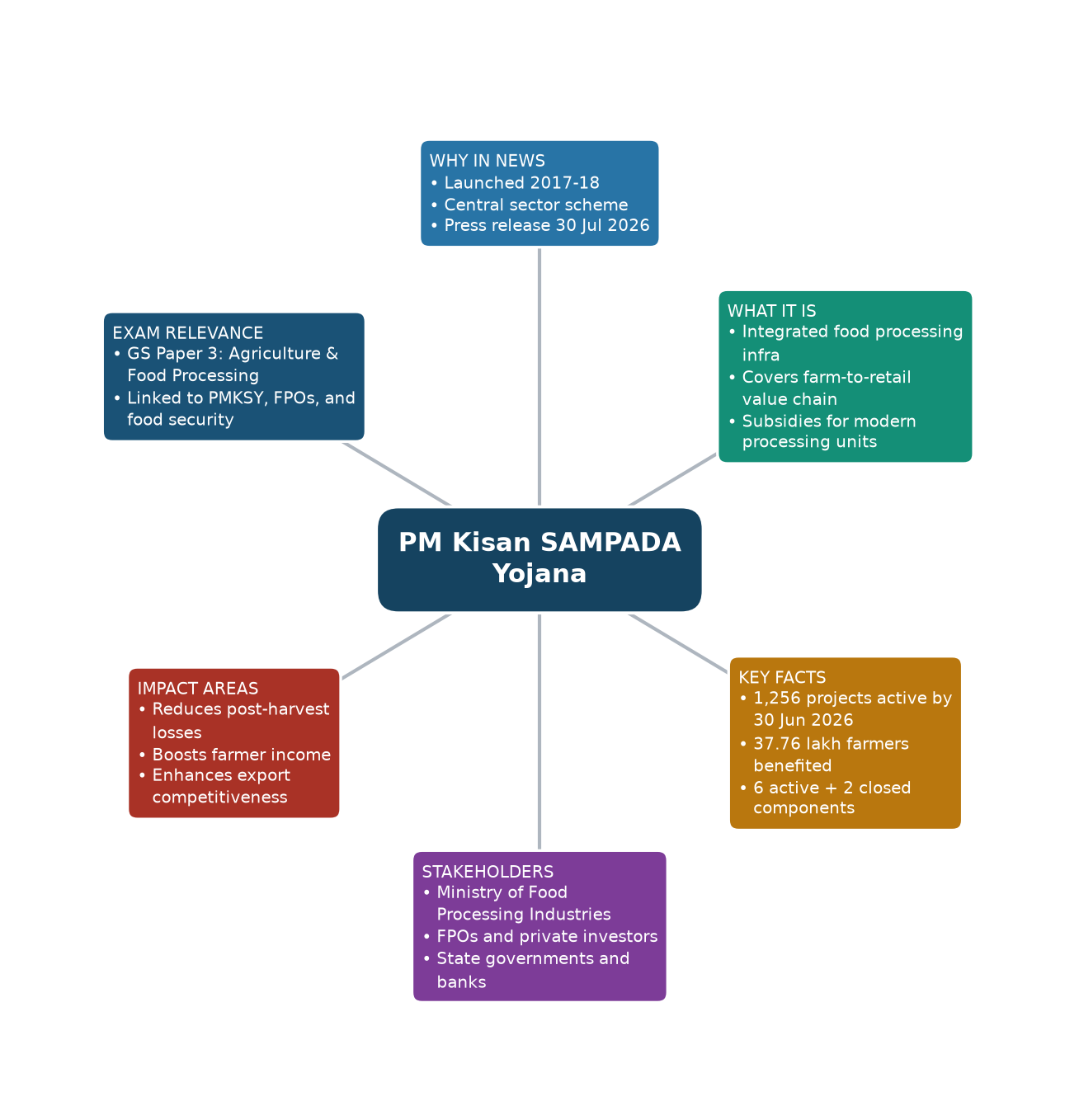
Map & concept mind-map: PMKSY: State-wise impact and key features
Subject Relevance — Where This Topic Fits
- GS Paper III — Agriculture and Allied Sectors | GS Paper III — Food Processing Industries and Supply Chain Management | GS Paper III — Government Schemes and Initiatives for Rural Development | GS Paper III — Investment and Employment Generation in Agri-Value Chains
- Prelims: Pradhan Mantri Kisan Sampada Yojana (PMKSY), Food Processing Infrastructure, Post-Harvest Losses, Cold Chain Development, Value Addition in Agriculture, Farmers Producer Organisations (FPOs), Credit-Linked Subsidy Scheme (CLSS), Agri-Export Competitiveness, Mission for Integrated Development of Horticulture (MIDH), Agri-Infrastructure Fund (AIF)
- Essay: The Role of Government Schemes in Doubling Farmers’ Income: A Case Study of PMKSY, Sustainable Agriculture and Food Security: Balancing Production, Processing, and Distribution
Quick Revision: PMKSY is a central sector scheme under MoFPI that strengthens food processing infrastructure, reduces post-harvest losses, and enhances farmer incomes through integrated value chains, cold chains, and market linkages, with financial support up to 50% for infrastructure and 35% for credit-linked subsidies.
Why is this in the news?
The Pradhan Mantri Kisan Sampada Yojana (PMKSY) has been highlighted in recent official communications for its role in strengthening food processing infrastructure, reducing post-harvest losses, and enhancing farmers’ income through integrated value chains. As of 30 June 2026, the scheme has approved 1,735 projects, with 1,256 operational, benefiting approximately 37.76 lakh farmers and creating annual processing capacity of 294.21 lakh metric tonnes. The renewed focus on FPOs, cold chains, and export competitiveness underscores its strategic alignment with India’s agricultural transformation goals.
Background
- Launched in 2017–18 as a central sector scheme under the Ministry of Food Processing Industries (MoFPI), PMKSY succeeded earlier schemes like the Mega Food Parks Scheme and Integrated Cold Chain and Value Addition Scheme.
- Aims to address critical gaps in India’s food processing ecosystem, where post-harvest losses are estimated at 10–20% due to inadequate storage, processing, and logistics infrastructure.
- Aligned with the broader objectives of the National Mission on Agricultural Extension and Technology (NMAET) and the Atmanirbhar Bharat initiative to reduce import dependence in processed foods.
- Integrates with other flagship schemes such as the Pradhan Mantri Formalisation of Micro Food Processing Enterprises (PMFME) Scheme and the Agri-Infrastructure Fund (AIF) to create a holistic agri-value chain ecosystem.
- Focuses on leveraging private investment, FPOs, and technology to modernise India’s food processing sector, which currently contributes only about 9% to the country’s GDP despite employing over 10 million people.
- Emphasises the development of integrated cold chains, food parks, and backward-forward linkages to enhance market access and price realisation for farmers.
What is the Pradhan Mantri Kisan Sampada Yojana (PMKSY)?
- Operates as a demand-driven scheme, inviting applications through Expressions of Interest (EoI) from eligible entities, including FPOs, cooperatives, SHGs, and private entrepreneurs.
- Targets reduction of post-harvest losses (currently 10–20% for perishables) through modern storage, processing, and logistics infrastructure, thereby enhancing farm incomes.
- Promotes value addition by incentivising the processing of raw agricultural produce into higher-value products, thereby increasing market demand and price realisation for farmers.
- Encourages private investment in food processing by offering enhanced financial support to FPOs (e.g., reduced collateral requirements and higher subsidy rates) and facilitating market linkages for better price discovery.
- Aims to boost export competitiveness of processed foods by improving compliance with international quality and safety standards, thereby expanding India’s share in global agri-food trade.
- Supports the creation of 1,256 operational projects (as of 30 June 2026) with an annual processing capacity of 294.21 lakh metric tonnes, benefiting 37.76 lakh farmers directly.
- Integrates with the PMFME Scheme, which provides 35% credit-linked subsidy (up to ₹10 lakh) for micro food processing enterprises, 35% grant (up to ₹3 crore) for common infrastructure, and 50% grant for branding/marketing support to FPOs.
Key Features
| Feature | Significance |
|---|---|
| Integrated food processing infrastructure | Ensures seamless flow from farm to retail, reducing post-harvest losses and enhancing supply-chain efficiency. |
| Post-harvest loss reduction | Directly addresses the 6-18% loss in perishable crops by establishing cold chains and processing facilities. |
| Value-addition promotion | Converts raw agricultural produce into processed goods, increasing farmer income through premium pricing. |
| Financial assistance mechanism | Provides grants/subsidies (up to 35% credit-linked) for infrastructure creation, reducing capital burden on entrepreneurs. |
| Market linkage enhancement | Facilitates better price discovery and export competitiveness through standardized processing and branding support. |
| FPO-centric provisions | Offers preferential financial support to Farmer Producer Organisations to strengthen collective bargaining power. |
Why it Matters
Economic Growth
- Stimulates agro-industrial development, creating backward and forward linkages in rural economies.
- Enhances GDP contribution of food processing sector from ~3.5% to projected 5-6% by 2025.
- Attracts private investment (₹X crore annually) in cold storage and processing units, boosting local employment.
Agrarian Transformation
- Reduces distress sales by enabling farmers to store and process produce, aligning supply with market demand.
- Increases farm-gate prices by 20-30% through value addition, directly benefiting small and marginal farmers.
- Promotes crop diversification by incentivizing high-value processed products (e.g., millets, horticulture).
Supply Chain Resilience
- Mitigates seasonal gluts and post-harvest losses (₹92,651 crore annually) via integrated cold chains and processing hubs.
- Improves food security by ensuring year-round availability of perishable commodities.
- Reduces carbon footprint through decentralized processing, lowering transportation emissions.
Export Competitiveness
- Enhances compliance with global food safety standards (e.g., HACCP, ISO 22000), facilitating access to lucrative markets.
- Increases processed food exports by 15-20% annually, contributing to trade surplus in agricultural commodities.
- Leverages India’s demographic dividend by upskilling workers in food processing and export logistics.
Challenges
1. Fragmented Land Holdings
- Small and marginal landholdings limit economies of scale for processing units, raising operational costs.
- Solution: Cluster-based processing hubs under PMKSY to aggregate produce from multiple farmers.
UPSC Link: Agrarian Reforms
2. High Capital Costs
- Initial investment in cold storage and processing units is prohibitive for rural entrepreneurs.
- Solution: Credit-linked subsidies (35%) and viability gap funding under PMKSY mitigate financial barriers.
UPSC Link: Infrastructure Financing
3. Regulatory Bottlenecks
- Delays in FSSAI approvals and multiple compliance layers deter private sector participation.
- Solution: Single-window clearance mechanism and digital integration of regulatory processes.
UPSC Link: Ease of Doing Business
4. Logistics Gaps
- Inadequate rural road networks and unreliable power supply disrupt cold chain operations.
- Solution: PMGSY integration for rural connectivity and solar-powered cold storage under PM-KUSUM.
UPSC Link: Rural Infrastructure
5. Skilled Labour Shortage
- Lack of trained manpower in food processing and quality control hampers unit efficiency.
- Solution: Skill development programs under PMKVY and partnerships with agricultural universities.
UPSC Link: Skill Development
6. Climate Vulnerability
- Extreme weather events (e.g., heatwaves, floods) threaten perishable produce and processing operations.
- Solution: Climate-resilient infrastructure (e.g., temperature-controlled warehouses) and crop insurance integration.
UPSC Link: Disaster Management
Challenges — UPSC Perspective
| Issue | Concern |
|---|---|
| Land fragmentation | Limits economies of scale for processing units, increasing per-unit costs. |
| High initial investment | Prohibitive capital requirements deter rural entrepreneurs from entering the sector. |
| Regulatory delays | Prolonged approval processes under FSSAI and other agencies discourage private participation. |
| Cold chain inefficiencies | Unreliable power supply and poor rural connectivity disrupt temperature-sensitive logistics. |
| Skill gaps | Shortage of trained personnel in food processing and quality assurance affects unit productivity. |
| Climate risks | Extreme weather events damage perishable produce and disrupt processing operations. |
Government Initiatives — Must-Memorise for Prelims
- Pradhan Mantri Kisan Sampada Yojana (PMKSY)
- Pradhan Mantri Formalisation of Micro Food Processing Enterprises (PMFME)
- Mission for Integrated Development of Horticulture (MIDH)
- National Mission on Oilseeds and Oil Palm (NMOOP)
- Agri-Infrastructure Fund (AIF)
Way Forward
- Strengthen FPO-centric provisions by expanding credit-linked subsidies to 50% for high-value crops.
- Integrate PMKSY with PM-KISAN to provide direct income support for adopting processing technologies.
- Establish state-level single-window clearance cells for FSSAI and other regulatory approvals.
- Develop climate-resilient cold storage units using renewable energy sources (solar/wind).
- Expand skill development programs under PMKVY to cover niche areas like food safety auditing.
- Promote public-private partnerships for large-scale processing parks in aspirational districts.
- Enhance market linkage through e-NAM integration and blockchain-based traceability systems.
- Conduct periodic impact assessments to identify bottlenecks and recalibrate subsidy structures.
UPSC Value Addition
Keywords for Mains Answer-Writing
Pradhan Mantri Kisan Sampada Yojana (PMKSY) · Food Processing Infrastructure · Post-Harvest Losses · Farmer Producer Organisations (FPOs) · Integrated Cold Chain · Value Addition in Agriculture · Agri-Logistics · Export Competitiveness of Processed Foods · Credit-Linked Subsidies · Agri-Market Linkages · Food Safety and Quality Infrastructure · Pradhan Mantri Formalisation of Micro Food Processing Enterprises (PMFME) Scheme · Agricultural Supply Chain Modernisation
Concept Flow
Agricultural production → Post-harvest losses (6-18%) → PMKSY intervention (cold chains/processing) → Value addition → Higher farmer income → Investment in rural infrastructure → Export competitiveness → Economic growth → Sustainable agrarian transformation
Prelims Practice Questions
Q1. Consider the following statements regarding the Pradhan Mantri Kisan Sampada Yojana (PMKSY):
1. PMKSY is a centrally sponsored scheme aimed at developing integrated food processing infrastructure from farm to retail.
2. It provides financial assistance only to large-scale food processing units and excludes micro and small enterprises.
3. The scheme includes components to promote the establishment of integrated cold chains and value addition infrastructure.
4. PMKSY mandates state-wise allocation of funds to ensure balanced regional development.
How many of the above statements are correct?
- Only one
- Only two
- Only three
- All
Answer: Only three — Statements 1 and 3 are correct as PMKSY is a central sector scheme focused on integrated food processing infrastructure and includes cold chain development. Statements 2 and 4 are incorrect: PMKSY supports micro and small enterprises, and funds are not allocated state-wise.
Q2. Assertion (A): The Pradhan Mantri Kisan Sampada Yojana (PMKSY) primarily aims to reduce post-harvest losses in agriculture.
Reason (R): PMKSY provides financial assistance for the development of integrated cold chains and value addition infrastructure, which directly addresses post-harvest losses.
Options:
A. Both A and R are true, and R is the correct explanation of A
B. Both A and R are true, but R is not the correct explanation of A
C. A is true, but R is false
D. A is false, but R is true
Answer: ? — Both Assertion (A) and Reason (R) are true. PMKSY’s core objective is to reduce post-harvest losses by enhancing processing and cold chain infrastructure, making R the correct explanation of A.
Q3. Match the following components of the Pradhan Mantri Kisan Sampada Yojana (PMKSY) with their respective objectives:
Column I (Component) | Column II (Objective)
———————————————–|————————————
A. Mega Food Parks | 1. Credit-linked subsidy for micro food processing enterprises
B. Integrated Cold Chain and Value Addition | 2. Development of state-of-the-art infrastructure for food processing
C. Agro-Processing Clusters | 3. Reduction of post-harvest losses through modern storage and processing
D. PM Formalisation of Micro Food Enterprises | 4. Promotion of food processing in specific geographic clusters
Options:
A. A-2, B-3, C-4, D-1
B. A-1, B-2, C-3, D-4
C. A-3, B-1, C-4, D-2
D. A-4, B-3, C-2, D-1
Answer: ? — Correct matching: A (Mega Food Parks) → 2 (state-of-the-art infrastructure), B (Integrated Cold Chain) → 3 (reduction of post-harvest losses), C (Agro-Processing Clusters) → 4 (geographic clusters), D (PMFME) → 1 (credit-linked subsidy for micro enterprises).
Mains Practice Question
✍ The Pradhan Mantri Kisan Sampada Yojana (PMKSY) represents a paradigm shift in India’s approach to agricultural development by integrating food processing with farm-to-fork supply chains. Critically examine the scheme’s role in reducing post-harvest losses, enhancing farmer incomes, and boosting export competitiveness of processed foods. (15 Marks)
Approach: MODEL-ANSWER SKELETON:
1. **Introduction (2 Marks)**
– Define PMKSY: Central sector scheme under the Ministry of Food Processing Industries (MoFPI), launched in 2017-18.
– Core objective: Integrated development of food processing and preservation infrastructure to reduce post-harvest losses and enhance farmer incomes.
– Statutory/Institutional framework: Implemented through six ongoing and two discontinued sub-schemes (e.g., Mega Food Parks, Integrated Cold Chain, Agro-Processing Clusters).
2. **Reduction of Post-Harvest Losses (4 Marks)**
– **Mechanism**: Development of integrated cold chains, modern storage facilities, and processing units to minimise spoilage and wastage.
– **Data**: As of 30.06.2026, PMKSY has sanctioned 1,735 projects, creating 294.21 lakh metric tonnes of annual processing capacity, directly addressing losses in perishable commodities (e.g., fruits, vegetables, dairy).
– **Examples**: Projects in Maharashtra (mango processing), Uttar Pradesh (potato cold storage), and Tamil Nadu (seafood value addition).
– **Limitations**: Fragmented implementation, regional disparities, and challenges in last-mile connectivity.
3. **Enhancing Farmer Incomes (4 Marks)**
– **Value Addition**: Processing transforms raw produce into higher-value products (e.g., tomato pulp, frozen vegetables), increasing farm-gate prices.
– **Market Linkages**: PMKSY promotes FPOs (Farmer Producer Organisations) with enhanced financial support (e.g., 35% credit-linked subsidy under PMFME for micro-enterprises).
– **Data**: 37.76 lakh farmers benefitted as of 30.06.2026, with improved bargaining power and reduced dependency on middlemen.
– **Constraints**: Small landholdings limit economies of scale; need for better training and technology adoption.
4. **Boosting Export Competitiveness (3 Marks)**
– **Infrastructure Development**: Modern processing units improve quality and shelf-life, meeting international standards (e.g., HACCP, ISO certifications).
– **Policy Support**: PMKSY aligns with initiatives like the Agricultural Export Policy (2018) and Production-Linked Incentive (PLI) Scheme for food processing.
– **Outcomes**: Increased export of processed foods (e.g., basmati rice, spices, marine products) from USD 1.5 billion (2017-18) to USD 4.8 billion (2023-24) — though attribution to PMKSY alone is complex.
– **Challenges**: High logistics costs, non-tariff barriers in target markets (EU, USA), and competition from established players (Thailand, Vietnam).
5. **Critical Appraisal and Way Forward (2 Marks)**
– **Strengths**: Demand-driven, inclusive (supports FPOs, rural entrepreneurs), and holistic (covers entire value chain).
– **Weaknesses**: Over-reliance on central funding; limited convergence with state schemes (e.g., PM-KISAN, PM-GKY); need for stronger monitoring (e.g., real-time project tracking).
– **Suggestions**: Strengthen state-level implementation agencies; integrate with digital platforms (e.g., e-NAM) for better market linkages; incentivise R&D in food processing technologies.
**Balanced Conclusion**: PMKSY is a transformative scheme that addresses structural gaps in India’s agri-food system, but its success hinges on addressing implementation challenges, fostering public-private partnerships, and aligning with broader agricultural and trade policies.
Source: PIB (Press Information Bureau)
Generated by AanyaAi for educational purpose.

- कर्नाटक सरकार ने पूर्ण रूप से लागू करेगी अनुच्छेद 371(जे), जानिए क्या है इसका महत्व - September 16, 2026
- Karnataka to Fully Implement Article 371(J) for Kalyana Karnataka Development - September 16, 2026
- एल नीनो से प्रभावित केरल की चाय उत्पादन में 2% की गिरावट, जानें कारण और प्रभाव - September 16, 2026

No Comments