


29 Jul PMKVY 4.0: Key Features & Impact on Skill Development for UPSC 2026
Subject Relevance — Where This Topic Fits
- GS Paper II — Governance, Welfare Schemes for Vulnerable Sections | GS Paper III — Employment, Skill Development, Industrial Policy, Digital Public Infrastructure
- Prelims: National Skill Development Mission, National Skill Qualification Framework (NSQF), Skill India Digital Hub (SIDH), Recognition of Prior Learning (RPL), Sector Skill Councils (SSCs), Artificial Intelligence, Robotics, Green Energy, Semiconductors
- Essay: Skill Development as a Catalyst for India’s Demographic Dividend, Bridging the Skill-Employment Gap: The Role of Public-Private Partnerships
Quick Revision: PMKVY 4.0 transforms India’s skill ecosystem by aligning training with futuristic job roles (AI, robotics, green energy), leveraging the Skill India Digital Hub for real-time monitoring, and fostering industry partnerships to bridge the skill-employment gap.
Why is this in the news?
The implementation of Pradhan Mantri Kaushal Vikas Yojana (PMKVY) 4.0, as announced by the Ministry of Skill Development and Entrepreneurship, marks a significant evolution in India’s flagship skill development initiative. Launched in 2015 and recalibrated for the fiscal year 2022–23, PMKVY 4.0 introduces demand-driven, technology-enabled, and candidate-centric reforms, including over 600 futuristic job roles aligned with emerging sectors such as AI, robotics, green energy, and semiconductors. The scheme’s integration with the Skill India Digital Hub (SIDH) and strategic partnerships with leading industry bodies underscores its role in transforming India’s skill ecosystem to meet global and domestic labour market demands.
Background
- The scheme operates under the National Skill Development Corporation (NSDC), a not-for-profit public limited company, and is aligned with the National Skill Qualification Framework (NSQF) to ensure standardised, outcome-based skill certification.
- India faces a critical skill gap, with the World Economic Forum estimating that 50% of all employees will need reskilling by 2025, necessitating proactive measures to align education and training with industry needs.
- The 2022–23 Economic Survey highlighted the urgent need for skill development to harness the demographic dividend, with youth unemployment remaining a persistent challenge despite economic growth.
- The Skill India Digital Hub (SIDH) was conceptualised as a unified digital platform to integrate skill development, education, and employment services, leveraging Aadhaar-based authentication and real-time monitoring.
- The scheme’s evolution reflects India’s commitment to the Sustainable Development Goals (SDG 4 and SDG 8), particularly targets related to equitable and quality education and decent work for all.
What is Pradhan Mantri Kaushal Vikas Yojana (PMKVY) 4.0?
- PMKVY 4.0 is the fourth iteration of India’s flagship skill development scheme, recalibrated in 2022–23 to address emerging labour market demands and technological disruptions.
- The scheme is demand-driven, technology-enabled, and candidate-centric, focusing on standardised training, industry alignment, and digital integration to enhance employability and entrepreneurship.
- Over 600 futuristic job roles have been developed under PMKVY 4.0, including domains such as Artificial Intelligence, Robotics, Drone Technology, Green Energy, and Semiconductor Manufacturing, ensuring relevance to future industry needs.
- Training programmes are aligned with the National Skill Qualification Framework (NSQF), ensuring standardised curriculum, assessment, and certification across all sectors and regions.
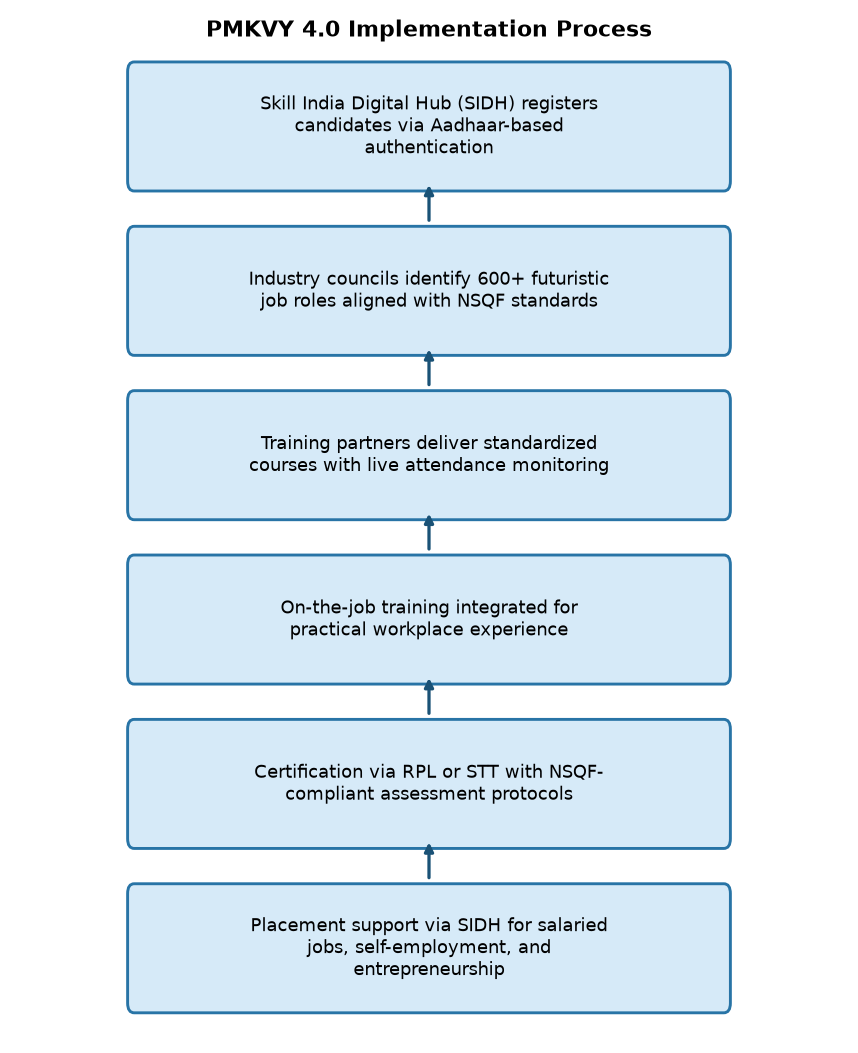
- The Skill India Digital Hub (SIDH) serves as a centralised platform for candidate lifecycle management, offering services such as Aadhaar-based authentication, real-time attendance monitoring, and access to employment opportunities.
- Industry partnerships are a cornerstone of PMKVY 4.0, with Sector Skill Councils (SSCs) and leading companies like HCL Technologies, IBM, Bajaj Finserv, and Microsoft designated as awarding bodies to ensure industry-relevant training and certification.
- The scheme integrates Recognition of Prior Learning (RPL) to validate and upskill existing workers, enabling them to adapt to changing job requirements and secure sustainable livelihoods.
Key Features
| Feature | Significance |
|---|---|
| Standardised Training under NSQF | Ensures uniformity and quality in skill development by aligning training, assessment, and certification with the National Skill Qualification Framework (NSQF), enhancing credibility and portability of skills. |
| Demand-Driven Curriculum | Incorporates 600+ futuristic job roles (e.g., AI, Drone Technology, Robotics, Green Energy, Semiconductor Manufacturing) developed in consultation with industry, ensuring relevance to evolving labour market needs. |
| Digital Integration via Skill India Digital Hub (SIDH) | Uses a unified digital platform for end-to-end management of candidates’ skill journeys, including Aadhaar-based authentication, real-time attendance monitoring, and integration with institutions like CIPET and NIELIT for infrastructure support. |
| Industry-Academia Collaboration | Strengthens partnerships with leading companies (e.g., HCL Technologies, IBM, Microsoft) designated as awarding bodies, ensuring curriculum alignment with industry requirements and facilitating job placements. |
| Recognition of Prior Learning (RPL) | Acknowledges and certifies existing skills of informal workers, enabling upskilling/reskilling to meet formal sector demands, thereby bridging the gap between unorganised and organised sectors. |
| Employment Integration | Mandates on-the-job training (OJT) components in select courses and provides a unified platform for lifelong learning, career guidance, and employment opportunities, enhancing employability and entrepreneurship. |
Why it Matters
Economic Growth and Labour Market
- Addresses structural unemployment by aligning skill development with emerging sectors such as green energy, semiconductors, and AI, reducing skill mismatches in the labour market.
- Enhances productivity and global competitiveness by fostering a skilled workforce capable of driving innovation and high-value manufacturing.
- Supports the formalisation of the informal sector by recognising prior learning and integrating informal workers into formal employment ecosystems.
Social Inclusion and Equity
- Provides equitable access to skill development across socio-economic strata, including marginalised groups, through targeted training programmes and digital platforms like SIDH.
- Facilitates gender-inclusive skilling by designing courses that cater to diverse career aspirations, including entrepreneurship and self-employment.
- Promotes regional balance by leveraging local industry partnerships and infrastructure, ensuring inclusive growth across states and districts.
Technological and Industrial Transformation
- Supports India’s strategic initiatives in emerging technologies (e.g., AI, Robotics, Semiconductors) by creating a talent pool aligned with Industry 4.0 requirements.
- Enhances the adoption of green technologies by integrating sustainability-focused courses, aligning with national goals like net-zero emissions and circular economy.
- Strengthens India’s position as a global hub for high-skilled manufacturing and services, attracting foreign direct investment (FDI) and boosting export competitiveness.
Governance and Institutional Strengthening
- Demonstrates a shift towards outcome-based governance in skill development, with third-party impact assessments (e.g., by Arun Jaitley National Institute of Financial Management) ensuring accountability and transparency.
- Fosters public-private partnerships (PPPs) by involving industry in curriculum design, training delivery, and certification, reducing the burden on public exchequer.
- Leverages digital public infrastructure (e.g., Aadhaar, SIDH) to streamline service delivery, reduce leakages, and enhance traceability of beneficiaries.
Challenges
1. Quality Assurance and Standardisation
- Risk of dilution in quality due to decentralised training delivery by multiple agencies, despite NSQF alignment.
- Need for robust monitoring mechanisms to ensure adherence to standard operating procedures (SOPs) across all training partners.
UPSC Link: GS3: Skill Development
2. Industry-Academia Gap
- Persistent disconnect between academic curricula and industry needs, despite industry consultations, leading to skill mismatches in certain sectors.
- Limited participation of small and medium enterprises (SMEs) in curriculum design and training delivery, especially in tier-2 and tier-3 cities.
UPSC Link: GS3: Industrial Policy
3. Digital Divide and Accessibility
- Unequal access to digital tools (e.g., SIDH, Aadhaar-based authentication) among rural and marginalised populations, exacerbating existing inequalities.
- Dependence on internet connectivity and digital literacy, which may hinder participation in remote areas.
UPSC Link: GS2: Digital Divide
4. Sustainability and Scalability
- Ensuring long-term funding and resource allocation for PMKVY 4.0, given its ambitious scale and the need for continuous curriculum updates.
- Balancing the demand for futuristic skills (e.g., AI, Semiconductors) with the immediate employment needs of the existing workforce.
UPSC Link: GS3: Resource Allocation
5. Placement and Outcome Tracking
- Limited post-training employment data and tracking mechanisms to measure the actual placement rates and career progression of beneficiaries.
- Need for stronger linkages with placement agencies, career counselling services, and entrepreneurship support systems.
UPSC Link: GS3: Employment Generation
Challenges — UPSC Perspective
| Issue | Concern |
|---|---|
| Decentralised Training Delivery | Risk of inconsistent quality across training partners despite NSQF alignment. |
| Industry Participation | Limited engagement of SMEs and informal sector in curriculum design and training. |
| Digital Literacy Gaps | Barriers to access for rural and marginalised populations due to digital divide. |
| Funding Sustainability | Long-term financial viability of the scheme amid competing priorities and resource constraints. |
| Placement Tracking | Lack of robust mechanisms to track employment outcomes and career progression of trainees. |
| Curriculum Relevance | Challenge of keeping pace with rapidly evolving technological advancements and industry demands. |
Government Initiatives — Must-Memorise for Prelims
- Pradhan Mantri Kaushal Vikas Yojana (PMKVY) 4.0
- Skill India Mission (SIM)
- National Skill Qualification Framework (NSQF)
- Skill India Digital Hub (SIDH)
- Recognition of Prior Learning (RPL) under NSDC
Way Forward
- Strengthen third-party audits and real-time monitoring of training partners to ensure adherence to NSQF standards and SOPs.
- Expand industry partnerships to include more SMEs and informal sector entities, particularly in emerging sectors like semiconductors and green energy.
- Enhance digital literacy and accessibility initiatives to bridge the divide, including offline modules and localised digital hubs in rural areas.
- Establish a robust placement tracking system linked to SIDH, with mandatory reporting of employment outcomes for all trainees.
- Align PMKVY 4.0 with other skilling initiatives (e.g., Skill Hubs, Jan Shikshan Sansthans) to create a seamless ecosystem for lifelong learning.
- Promote entrepreneurship and self-employment by integrating microfinance, mentorship, and market linkages for trainees.
- Incorporate sustainability and green skills into all futuristic job roles to align with India’s climate commitments and circular economy goals.
- Leverage global best practices in skill development, such as Germany’s dual education system, to enhance apprenticeship opportunities.
UPSC Value Addition
Keywords for Mains Answer-Writing
Pradhan Mantri Kaushal Vikas Yojana (PMKVY) 4.0 · National Skill Qualification Framework (NSQF) · Skill India Digital Hub (SIDH) · Industry-Aligned Curricula · Future-Ready Job Roles · Recognition of Prior Learning (RPL) · Skill Ecosystem Integration · Demand-Based Skill Development · Technical and Vocational Education and Training (TVET) · Employability Enhancement
Concept Flow
Demand-Supply Mismatch in Labour Market → Structural Unemployment → PMKVY 4.0 Launched to Align Skills with Emerging Sectors → Standardised Training via NSQF → Industry-Academia Collaboration → Digital Integration via SIDH → Enhanced Employability and Entrepreneurship → Economic Growth and Social Inclusion → Informal Sector Dominance → Recognition of Prior Learning (RPL) → Formalisation of Skills → Integration into Organised Sector → Higher Productivity and Formal Employment → Inclusive Economic Growth → Technological Disruption (AI, Robotics, Semiconductors) → Skill Gaps in Workforce → PMKVY 4.0’s Futuristic Curriculum → Talent Pool Creation → Industrial Transformation and Global Competitiveness → Export-Led Growth → Digital Public Infrastructure (Aadhaar, SIDH) → Transparent and Efficient Service Delivery → Reduced Leakages and Enhanced Traceability → Improved Governance and Accountability → Trust in Skill Development Ecosystem
Prelims Practice Questions
Q1. Consider the following statements regarding the Pradhan Mantri Kaushal Vikas Yojana (PMKVY) 4.0:
1. It is implemented by the Ministry of Skill Development and Entrepreneurship.
2. The scheme mandates that all training must be aligned with the National Skill Qualification Framework (NSQF).
3. PMKVY 4.0 includes only traditional job roles and excludes future-oriented sectors like AI and Robotics.
4. The Skill India Digital Hub (SIDH) is used for digital management of candidate lifecycle.
How many of the above statements are correct?
- Only one
- Only two
- Only three
- All
Answer: Only three — Statements 1, 2, and 4 are correct. Statement 3 is incorrect as PMKVY 4.0 includes future-oriented sectors like AI, Robotics, and Green Energy.
Q2. Assertion (A): The Pradhan Mantri Kaushal Vikas Yojana (PMKVY) 4.0 emphasizes industry-aligned curricula and future-ready job roles.
Reason (R): The scheme aims to enhance employability by integrating practical workplace experience and aligning training with evolving industry demands.
Options:
A. Both A and R are true, and R is the correct explanation of A.
B. Both A and R are true, but R is not the correct explanation of A.
C. A is true, but R is false.
D. A is false, but R is true.
Answer: ? — Both A and R are true, and R correctly explains A. The scheme’s focus on industry-aligned curricula and future-ready job roles is directly linked to enhancing employability through practical experience.
Q3. Match the following columns related to Pradhan Mantri Kaushal Vikas Yojana (PMKVY) 4.0:
Column I (Feature) | Column II (Description)
——————-|———————–
A. Recognition of Prior Learning (RPL) | 1. Digital management of candidate lifecycle
B. Skill India Digital Hub (SIDH) | 2. Certification of existing skills without formal training
C. National Skill Qualification Framework (NSQF) | 3. Standardized training aligned with industry needs
D. Industry-Aligned Curricula | 4. Flexible courses developed in consultation with industry
Options:
A-2, B-1, C-3, D-4
A-1, B-2, C-3, D-4
A-3, B-4, C-1, D-2
A-4, B-3, C-2, D-1
Answer: ? — A matches with 2 (RPL certifies existing skills), B matches with 1 (SIDH manages candidate lifecycle digitally), C matches with 3 (NSQF standardizes training), and D matches with 4 (Industry-aligned curricula are flexible and industry-consulted).
Mains Practice Question
✍ Critically analyse the structural and operational reforms introduced in Pradhan Mantri Kaushal Vikas Yojana (PMKVY) 4.0 to enhance its effectiveness in addressing the skill gap in India. Also, examine the role of the Skill India Digital Hub (SIDH) in achieving the scheme’s objectives. (15 Marks)
Approach: MODEL-ANSWER SKELETON:
1. **Introduction (2 Marks)**:
– Brief background of PMKVY and its evolution to PMKVY 4.0.
– Objective: Bridging the skill gap and aligning with industry demands.
2. **Structural Reforms in PMKVY 4.0 (6 Marks)**:
– **Demand-Based and Technology-Enabled Approach**:
– Shift from supply-driven to demand-driven skill development.
– Integration of future-ready job roles (AI, Robotics, Green Energy, Semiconductors).
– Data: 600+ future-oriented job roles developed.
– **Industry Alignment**:
– Collaboration with Industry Skill Councils (ISCs) for curriculum design.
– Flexible and updatable courses based on industry feedback.
– Strategic partnerships with leading companies (e.g., HCL, IBM, Microsoft) as awarding bodies.
– **Standardization and Quality Assurance**:
– Alignment with National Skill Qualification Framework (NSQF).
– Standard Operating Procedures (SOPs) for assessment and certification.
– Third-party impact evaluation (e.g., by Arun Jaitley National Institute of Financial Management).
3. **Operational Reforms and Implementation (4 Marks)**:
– **Skill India Digital Hub (SIDH)**:
– Digital management of candidate lifecycle (registration, training, assessment, certification).
– Aadhaar-based authentication and real-time attendance monitoring.
– Integration with academic and government institutions (e.g., CIPET, NIELIT).
– **Employability Enhancement**:
– On-the-job training (OJT) integration for practical experience.
– Recognition of Prior Learning (RPL) for upskilling and reskilling.
– Focus on wage employment, self-employment, entrepreneurship, and sustainable livelihoods.
4. **Challenges and Critique (3 Marks)**:
– **Implementation Gaps**:
– Disparities in training quality across states/regions.
– Limited industry participation in remote areas.
– **Sustainability**:
– Ensuring long-term employability post-certification.
– Addressing mismatch between training and local job markets.
– **Digital Divide**:
– Accessibility of SIDH for marginalized groups (e.g., rural youth, women).
5. **Conclusion (2 Marks)**:
– PMKVY 4.0 represents a paradigm shift towards a demand-driven, technology-enabled, and industry-aligned skill ecosystem.
– SIDH is a critical enabler for achieving scale, transparency, and accountability.
– Future roadmap: Strengthening grassroots implementation, fostering public-private partnerships, and ensuring equitable access.
Source: PIB (Press Information Bureau)
Generated by AanyaAi for educational purpose.

- गृह मंत्री ने मध्य प्रदेश में गौपालक सम्मेलन का किया उद्घाटन, नए अपराध कानूनों पर प्रदर्शनी का किया शुभारंभ - October 3, 2026
- Jal Arpan: 1850+ Gram Panchayats Join Hands for Rural Water Supply - October 3, 2026
- भारत ने किया 5.56 किमी मुक्त अंतरिक्ष क्वांटम की वितरण लिंक का सफल परीक्षण - October 3, 2026

No Comments