


16 Sep PoK Internet Shutdown: Human Rights Violation & Governance Failure
✎ Internet shutdowns, when imposed arbitrarily or without transparent legal safeguards, violate international human rights obligations, particularly the right to freedom of expression and access to information, as enshrined in the…
Subject Relevance — Where This Topic Fits
- GS Paper II — International Relations — Human Rights and Fundamental Freedoms | GS Paper II — International Relations — Regional Organisations and Bilateral Relations (South Asia) | GS Paper III — Internal Security — Role of State and Non-State Actors
- Prelims: PoK (Pakistan-occupied Kashmir), Universal Declaration of Human Rights (UDHR), International Covenant on Civil and Political Rights (ICCPR), Article 21 (ICCPR), National Crisis Management Cell (NCMC), Pakistan Telecommunication Authority (PTA), Joint Awami Action Committee (JAAC), Digital rights, Internet shutdowns, Freedom of expression
- Essay: The balance between national security and fundamental rights in democratic governance, The role of technology in modern statecraft and human rights
Quick Revision: Internet shutdowns, when imposed arbitrarily or without transparent legal safeguards, violate international human rights obligations, particularly the right to freedom of expression and access to information, as enshrined in the UDHR and ICCPR.
Why is this in the news?
The indefinite and blanket internet shutdown imposed by Pakistani authorities in Pakistan-occupied Kashmir (PoK) since June 5, 2026, following protests over electoral reforms and socio-economic grievances, has drawn international condemnation for violating fundamental human rights, including the right to peaceful assembly and freedom of expression. The shutdown, executed through a flawed domestic legal and institutional framework, highlights systemic issues in Pakistan’s governance of digital rights and the lack of transparency in restricting internet access, raising concerns under international human rights law.
Background
- The protests in PoK began over rising electricity and essential commodity prices but escalated into a broader movement demanding political reforms, accountability, and representative governance.
- The Pakistani government responded by imposing an indefinite internet shutdown, severely restricting digital communication and access to information in the region.
- Digital rights organisations and legal scholars have argued that such shutdowns violate Pakistan’s international obligations under the Universal Declaration of Human Rights (UDHR) and the International Covenant on Civil and Political Rights (ICCPR), particularly the right to freedom of expression and peaceful assembly.
- The shutdown orders are issued through a multi-layered process involving military and police agencies, the National Crisis Management Cell (NCMC), and the Pakistan Telecommunication Authority (PTA), with limited transparency or legal scrutiny.
- The legal architecture governing internet shutdowns in Pakistan is criticised for being arbitrary, non-transparent, and lacking adequate safeguards against abuse.
- The situation in PoK reflects broader tensions between state authority and civil liberties in Pakistan, with internet shutdowns increasingly used as a tool to suppress dissent and control information flows.
What are internet shutdowns and their governance frameworks?
- An internet shutdown is a deliberate disruption of internet services by a state or non-state actor, either partially or entirely, to control information flow, suppress dissent, or maintain public order.
- Internet shutdowns can take various forms, including complete blackouts, throttling of internet speeds, blocking of specific platforms (e.g., social media), or targeted disruptions to certain regions or user groups.
- In Pakistan, internet shutdowns are governed by a multi-institutional framework, including the National Crisis Management Cell (NCMC) and the Pakistan Telecommunication Authority (PTA), with the NCMC playing a central role in issuing shutdown orders.
- The legal basis for internet shutdowns in Pakistan is often derived from laws such as the Pakistan Telecommunication (Re-organization) Act, 1996, and the Prevention of Electronic Crimes Act, 2016, though these laws are criticised for lacking clarity and transparency.
- The process of imposing internet shutdowns in Pakistan is criticised for being non-transparent, with orders frequently originating from military or police agencies and rarely challenged by regulatory bodies like the NCMC.
- International human rights law, including the Universal Declaration of Human Rights (UDHR) and the International Covenant on Civil and Political Rights (ICCPR), recognises the right to freedom of expression and access to information as fundamental rights, subject to limited and justified restrictions.
- The United Nations Human Rights Council has condemned internet shutdowns as a violation of human rights, emphasising that such measures must be lawful, necessary, and proportionate, and should not be used to suppress dissent or control information.
- The lack of judicial oversight and independent review mechanisms in Pakistan’s internet shutdown framework undermines accountability and increases the risk of arbitrary or excessive restrictions on digital rights.
Key Features
| Feature | Significance |
|---|---|
| Indefinite internet shutdown in PoK | Violates fundamental rights to freedom of expression and assembly as guaranteed under UDHR and ICCPR |
| Legal architecture of internet shutdowns in Pakistan | Lacks transparency and independent judicial oversight; orders issued by military/police agencies bypass constitutional checks |
| Role of NCMC and NACTA | Centralised decision-making by non-judicial bodies undermines rule of law and democratic accountability |
| Implementation via PTA and ISPs | Regulatory compliance enforced through coercive measures, restricting citizens’ access to information |
| Protests in PoK over socio-political demands | Highlights systemic governance failures and erosion of democratic institutions in the region |
Why it Matters
Human Rights Dimension
- Internet shutdowns in PoK constitute a violation of Article 19 of the UDHR (freedom of expression) and Article 21 of the ICCPR (right to peaceful assembly)
- Arbitrary restrictions on digital communication impede citizens’ ability to organise, access information, and participate in democratic processes
- Systemic opacity in shutdown orders contravenes principles of natural justice and due process
Governance and Rule of Law
- Centralised decision-making by military and police agencies bypasses constitutional and judicial oversight mechanisms
- Lack of legal safeguards enables executive overreach, normalising internet shutdowns as a tool of state control
- Regulatory bodies like PTA function as instruments of implementation rather than guardians of rights
Regional Stability and Diplomacy
- Persistent internet shutdowns exacerbate socio-political grievances, risking escalation of unrest in PoK
- Violations of international human rights norms may strain Pakistan’s diplomatic relations and global standing
- Such measures undermine confidence in Pakistan’s commitment to democratic governance and human rights
Digital Rights and Civil Society
- Internet shutdowns represent a broader global trend of digital authoritarianism, threatening civic freedoms
- Civil society organisations and digital rights groups face heightened risks in monitoring and reporting state violations
- Technological solutions (e.g., VPNs, mesh networks) are often insufficient against state-level censorship
Challenges
1. LACK OF TRANSPARENT LEGAL FRAMEWORK
- Internet shutdown orders are issued by non-judicial bodies (NCMC, NACTA) without independent scrutiny
- Procedural compliance is reduced to a mechanical exercise, devoid of checks and balances
- No mechanism exists for public disclosure of shutdown orders or their legal justification
UPSC Link: GS II: Fundamental Rights & DPSP
2. MILITARISATION OF GOVERNANCE
- Military and police agencies dominate decision-making on internet shutdowns, sidelining civilian institutions
- Such militarisation erodes democratic norms and institutional accountability
- Orders are rarely challenged, reinforcing a culture of impunity
UPSC Link: GS II: Role of Civil Services in a Democracy
3. REGULATORY COMPLIANCE VERSUS RIGHTS PROTECTION
- PTA and ISPs are compelled to implement shutdown orders under threat of punitive action
- Regulatory bodies lack the mandate or capacity to assess the legality of shutdowns
- Compliance mechanisms prioritise state control over citizens’ rights
UPSC Link: GS II: Statutory Bodies & Regulatory Authorities
4. EROSION OF DIGITAL CIVIC SPACE
- Internet shutdowns disrupt economic activities, education, and access to essential services
- Citizens are denied the right to information and digital participation in governance
- Long-term impact includes reduced trust in digital platforms and state institutions
UPSC Link: GS II: Digital Governance & E-Governance
5. INTERNATIONAL HUMAN RIGHTS OBLIGATIONS
- Pakistan’s actions contravene its commitments under UDHR and ICCPR, which it has ratified
- Failure to uphold these obligations may trigger international scrutiny or sanctions
- Such violations undermine global efforts to promote digital rights and free expression
UPSC Link: GS II: International Treaties & Conventions
Challenges — UPSC Perspective
| Issue | Concern |
|---|---|
| Non-judicial issuance of shutdown orders | Lack of independent oversight and legal scrutiny |
| Centralised decision-making by NCMC/NACTA | Bypasses constitutional and institutional checks |
| Opacity in shutdown procedures | No public disclosure or justification for restrictions |
| Coercive implementation via PTA/ISPs | Regulatory bodies lack rights-protective mandate |
| Militarisation of governance | Erosion of democratic norms and accountability |
Way Forward
- Strengthen the legal framework governing internet shutdowns by introducing mandatory judicial review of orders
- Establish an independent oversight body to scrutinise shutdown decisions and ensure transparency
- Mandate public disclosure of shutdown orders, including duration, rationale, and responsible authority
- Enhance the capacity of regulatory bodies like PTA to assess the legality and proportionality of shutdowns
- Promote digital rights through awareness campaigns and support for civil society monitoring mechanisms
- Encourage the use of technological safeguards (e.g., decentralised networks) to mitigate state censorship
- Urge Pakistan to ratify and domestically implement the ICCPR to align with international human rights standards
- Facilitate dialogue between PoK stakeholders and the Pakistani government to address socio-political grievances
UPSC Value Addition
Keywords for Mains Answer-Writing
Right to freedom of expression · Right to peaceful assembly · Internet shutdowns · Article 19 of the ICCPR · Article 19(1)(a) of the Indian Constitution · Universal Declaration of Human Rights · Digital rights · Transparency in governance · Rule of law · Procedural legitimacy · Human rights obligations · International Covenant on Civil and Political Rights · Freedom of speech and expression · State accountability · Constitutional safeguards
Constitutional & Policy Linkages
- Article 19 (Freedom of Speech and Expression) — UDHR alignment
- Article 14 (Equality before Law) — Procedural fairness in shutdown orders
Concept Flow
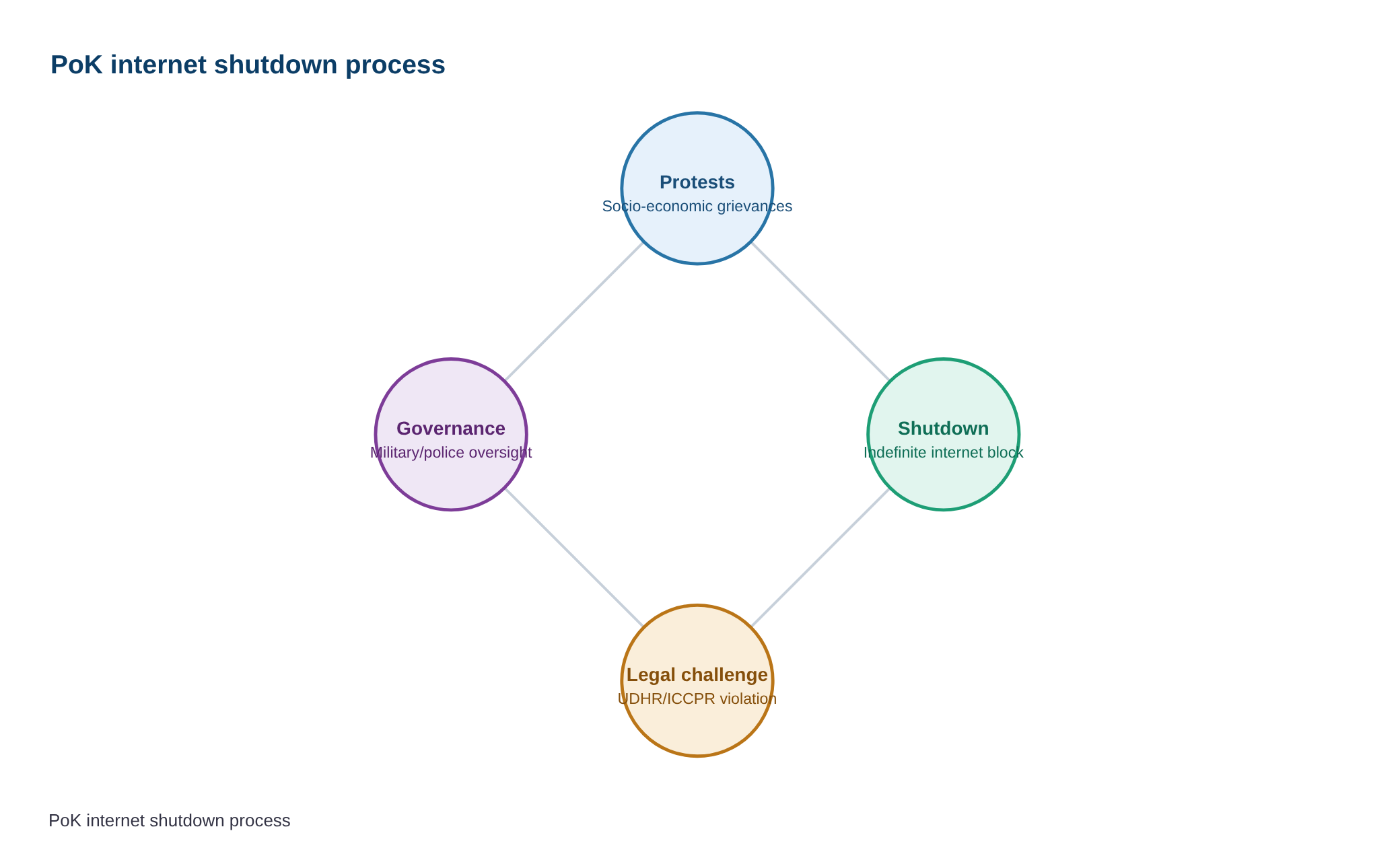
Protests in PoK over socio-economic and political demands → Mobilisation by JAAC and citizens → State response via military/police-led crackdown → Imposition of internet shutdowns → Violation of digital rights and freedoms → Escalation of unrest and repression → International scrutiny of human rights violations → Calls for legal and institutional reforms
Prelims Practice Questions
Q1. Consider the following statements regarding the International Covenant on Civil and Political Rights (ICCPR):
1. The ICCPR is a multilateral treaty adopted by the United Nations General Assembly in 1966.
2. Article 19 of the ICCPR guarantees the right to freedom of expression.
3. Article 21 of the ICCPR guarantees the right to peaceful assembly.
4. The ICCPR is legally binding on all member states of the United Nations.
How many of the above statements are correct?
- Only one
- Only two
- Only three
- All
Answer: All — Statements 1, 2, and 3 are correct. The ICCPR was adopted in 1966 and entered into force in 1976. Article 19 guarantees freedom of expression, and Article 21 guarantees the right to peaceful assembly. However, the ICCPR is binding only on states that have ratified it, not all UN member states.
Q2. Assertion (A): Internet shutdowns imposed by states are always justified under international human rights law if they are temporary and for public order.
Reason (R): The International Covenant on Civil and Political Rights (ICCPR) permits restrictions on freedom of expression if they are provided by law and necessary for national security or public order.
Options:
A. Both A and R are true, and R is the correct explanation of A.
B. Both A and R are true, but R is not the correct explanation of A.
C. A is true, but R is false.
D. A is false, but R is true.
Answer: ? — Assertion (A) is false because internet shutdowns are not automatically justified even if temporary; they must meet the strict criteria of legality, necessity, and proportionality under international law. Reason (R) is correct as it accurately states the conditions under Article 19(3) of the ICCPR.
Q3. Match the following constitutional provisions with their corresponding rights guaranteed under the Indian Constitution:
Column I (Provision) | Column II (Right Guaranteed)
———————————————–|————————————
1. Article 19(1)(a) | A. Right to freedom of speech and expression
2. Article 21 | B. Right to life and personal liberty
3. Article 19(1)(b) | C. Right to assemble peacefully
4. Article 22 | D. Right to protection against arbitrary arrest and detention
Options:
A. 1-A, 2-B, 3-C, 4-D
B. 1-B, 2-A, 3-D, 4-C
C. 1-C, 2-D, 3-A, 4-B
D. 1-D, 2-C, 3-B, 4-A
Answer: ? — The correct match is: 1-A (Article 19(1)(a) guarantees freedom of speech and expression), 2-B (Article 21 guarantees right to life and personal liberty), 3-C (Article 19(1)(b) guarantees right to assemble peacefully), and 4-D (Article 22 guarantees protection against arbitrary arrest and detention).
Mains Practice Question
✍ Critically examine the constitutional and international legal framework governing internet shutdowns in India and Pakistan, with particular reference to their compliance with the right to freedom of expression and peaceful assembly. (15 Marks)
Approach: MODEL-ANSWER SKELETON:
1. **Constitutional Framework in India**:
– Article 19(1)(a) of the Indian Constitution guarantees freedom of speech and expression.
– Landmark judgments: *Anuradha Bhasin v. Union of India* (2020) and *Foundation for Media Professionals v. Union Territory of Jammu and Kashmir* (2020) upholding the right to internet access as part of Article 19(1)(a).
– The Supreme Court held that internet shutdowns must be proportionate, temporary, and grounded in law.
2. **Constitutional and Legal Framework in Pakistan**:
– Pakistan’s legal architecture for internet shutdowns involves the National Crisis Management Cell (NCMC), National Counter Terrorism Authority (NACTA), and Pakistan Telecommunication Authority (PTA).
– The process lacks transparency, with orders often originating from the army and implemented mechanically by the PTA.
– The report highlights systemic flaws, including the absence of judicial oversight and the use of shutdowns as a tool to suppress dissent.
3. **International Legal Obligations**:
– Article 19 of the International Covenant on Civil and Political Rights (ICCPR) and Article 19 of the Universal Declaration of Human Rights (UDHR) protect freedom of expression.
– Article 21 of the ICCPR guarantees the right to peaceful assembly.
– Restrictions on these rights must be provided by law, necessary, and proportionate (Article 19(3) of the ICCPR).
4. **Comparative Analysis**:
– India’s framework, though not perfect, includes judicial scrutiny and procedural safeguards absent in Pakistan’s system.
– Pakistan’s use of internet shutdowns violates its international obligations due to arbitrary imposition and lack of transparency.
5. **Conclusion**:
– Both countries must align their legal frameworks with constitutional and international standards.
– Judicial oversight, legislative clarity, and adherence to proportionality are essential to prevent abuse of power.
Source: orissapost.com
Generated by AanyaAi for educational purpose.
Related guides on our sites
- Current affairs for upsc 2026
- Best PSIR optional coaching for upsc
- Best economics optional coaching for upsc
- Best PSIR optional teacher for upsc

- PoK Internet Shutdown: Human Rights Violation & Governance Failure - September 16, 2026
- कर्नाटक सरकार ने पूर्ण रूप से लागू करेगी अनुच्छेद 371(जे), जानिए क्या है इसका महत्व - September 16, 2026
- Karnataka to Fully Implement Article 371(J) for Kalyana Karnataka Development - September 16, 2026

No Comments