


12 Nov PRELIMS BITs: Presidential Elections in the United States
This article covers “ prelims related topic of Presidential Elections in the United States
SYLLABUS MAPPING:
GS: Current events of national and international importance.
FOR PRELIMS:
What is the constitutional mandate, qualification, eligibility, and method of election of the President in India and the US?
Why in the news?
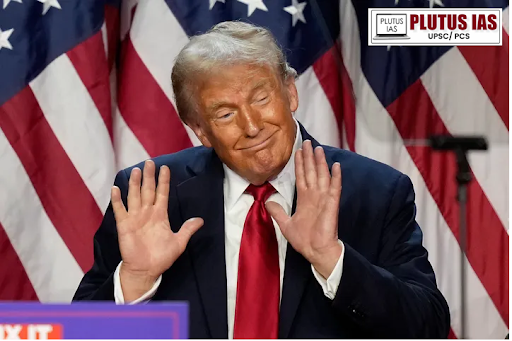
In the 2024 presidential election, Donald Trump emerged victorious against Kamala Harris, marking a significant political event. Trump won several key swing states that were previously held by Biden in 2020. Notably, he flipped states such as Wisconsin, Michigan, and Pennsylvania, which were critical to his success.
Presidential Elections in India and the United States:
| Aspect | India | United States |
| Electoral Body | Election Commission of India | Concerned State authorities |
| Mode of Election | Indirect election | Indirect election |
| Electoral System | Proportional Representation through a Single Transferable Vote (STV) | Electoral College system (winner-takes-all in most states) |
| Voters Involved | Elected members of Parliament (MPs) and Legislative Assemblies (MLAs) | Electors chosen by voters in each state |
| Representation | Votes are weighted based on the population of states and Union Territories | Each state’s electors are equal to the total of its Congressional representation (Senators + House members) |
| Total Number of Voters | Approx. 4,896 (Elected MPs & MLAs) | 538 electors in the Electoral College |
| Method of Voting | Single transferable vote (STV) | A plurality (winner-takes-all system in most states) |
| Term Length | 5 years | 4 years |
| Eligibility Criteria | Must be a citizen of India, at least 35 years old, eligible to be a member of Lok Sabha | Must be a natural-born citizen, at least 35 years old, resident for 14 years |
| Role of Voter | Voters cast a vote for one candidate; the value of votes differs by state population | Voters choose electors who then vote for the president |
| Candidates | Nominated by political parties, but independent candidates can also stand | Nominated by political parties; Independent candidates are also possible |
| Election Frequency | Every 5 years | Every 4 years |
| Result Declaration | After counting the votes and declaring the winner based on majority (after transfer) | After the Electoral College vote, officially certified by Congress |
| Involvement of Popular Vote | No direct role of public votes | Indirectly through electors, though popular vote may influence the outcome |
| Constitutional Reference | Articles 54 to 67 of the Indian Constitution | Article II of the U.S. Constitution and the 12th Amendment |
Download plutus ias current affairs ENG 12th Nov 2024 pdf
Prelims Question:
Q. With reference to the constitutional qualifications for the President of India, consider the following statements:
1. The President is elected by a direct popular vote.
2. The Electoral College consists of electors from each state based on its congressional representation.
3. The President serves a term of six years without the possibility of re-election.
How many of the above-given statements are correct?
A. Only one
B. Only two
C. All three
D. None
ANSWER: D

- United Nations in the 21st Century: Relevance, Crisis, and Way Forward - September 22, 2025
- Election Commission of India: Strengthening the Democratic Backbone - September 20, 2025
- India’s Renewable Energy Journey: Towards Energy Self-Reliance and Climate Leadership - September 19, 2025

No Comments