


03 Jan Project PRAGATI and Land Acquisition: Accelerating Infrastructure with Cooperative Governance
This article covers “Daily Current Affairs” and From Project PRAGATI and Land Acquisition: Accelerating Infrastructure with Cooperative Governance
SYLLABUS MAPPING
GS- 2 – Polity & Governance –Project PRAGATI and Land Acquisition: Accelerating Infrastructure with Cooperative Governance
FOR PRELIMS
Explain how Project PRAGATI helps in balancing development needs with the rights of landowners.
FOR MAINS
Briefly explain the connection between Project PRAGATI and the LARR Act, 2013.
Why in the News?
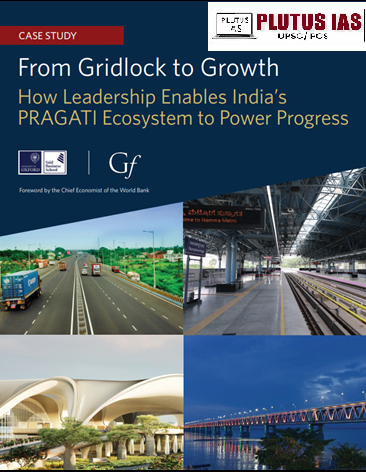
Project PRAGATI has recently been in the news following a Prime Minister–chaired review meeting where several long-pending infrastructure projects were discussed. A significant number of these projects were delayed due to land acquisition hurdles under the LARR Act, 2013, including issues related to compensation, consent, rehabilitation, and forest land clearances. The meeting focused on time-bound resolution of these bottlenecks within the legal framework.
Project PRAGATI: An Overview
Pro-Active Governance Model : PRAGATI (Pro-Active Governance and Timely Implementation) represents a shift from reactive administration to anticipatory and solution-oriented governance. Instead of waiting for delays to escalate, bottlenecks are identified early and resolved through coordinated action among the Centre, States, and implementing agencies. This aligns with the principles of minimum government, maximum governance.
PMO-Led High-Level Monitoring : The platform is chaired by the Prime Minister through monthly video-conference reviews, ensuring direct political and administrative oversight. Senior officials from the Union Ministries, State Governments, and District Administrations participate, enabling inter-ministerial coordination and quick escalation of issues such as land acquisition, forest clearances, or inter-state disputes. This top-down monitoring enhances accountability and reduces bureaucratic inertia.
Multi-Sectoral Coverage : PRAGATI reviews critical infrastructure and social sector projects across sectors like highways, railways, power transmission, coal mining, irrigation, urban development, ports, and logistics. These sectors have high multiplier effects on economic growth, employment generation, and regional connectivity, making PRAGATI a key instrument in supporting initiatives such as Gati Shakti, Make in India, and National Infrastructure Pipeline (NIP).
Digital Integration : The platform leverages GIS mapping, satellite imagery, geotagging, and real-time dashboards to track physical and financial progress. Digital integration minimizes data manipulation, improves evidence-based decision-making, and allows the Prime Minister and senior officials to monitor ground realities remotely. It also supports paperless governance and data-driven reviews.
Outcome-Oriented Approach : Unlike traditional review mechanisms that focus on compliance and reporting, PRAGATI adopts an outcome-centric approach. Emphasis is placed on removing structural bottlenecks—such as land acquisition delays, environmental clearances, funding gaps, and contractor inefficiencies—so that projects deliver tangible public outcomes like improved connectivity, energy availability, and service delivery. This strengthens execution capacity of the Indian state.
Land Acquisition as a Critical Bottleneck in Infrastructure Projects
| Dimension | Explanation |
|---|---|
| Delays in Infrastructure Projects | Land acquisition is the most significant cause of delays in infrastructure projects, often stalling execution at the initial stage. Prolonged acquisition leads to time overruns, cost escalation, and underutilisation of capital, affecting overall project viability and economic growth. |
| Complex Legal Procedures | The Right to Fair Compensation and Transparency in Land Acquisition, Rehabilitation and Resettlement (LARR) Act, 2013 mandates Social Impact Assessment (SIA), consent clauses, and detailed R&R provisions. While ensuring fairness and social justice, these procedures significantly extend project timelines. |
| Compensation Disputes | Disputes arise due to differences between government-assessed land values and owners’ expectations. Issues related to solatium, livelihood loss, and classification of land frequently result in litigation, delaying possession and increasing project uncertainty. |
| Forest and Environmental Clearances | Projects involving forest land face a dual bottleneck—land acquisition under LARR and environmental approvals under the Forest Conservation Act and Environmental Impact Assessment norms. Sequential clearances further slow down strategic and linear projects like highways and railways. |
| Federal Complexity | Land is a State subject under the Constitution, requiring coordination between State governments and Union ministries for nationally important projects. Differences in political priorities, administrative capacity, and local resistance often complicate Centre–State cooperation. |
LARR Act, 2013: A Rights-Based Framework
The Right to Fair Compensation and Transparency in Land Acquisition, Rehabilitation and Resettlement (LARR) Act, 2013 represents a fundamental shift from the colonial Land Acquisition Act of 1894. It reorients land acquisition from a State-dominated exercise to a rights-based, people-centric framework that balances development needs with social justice and constitutional values.
Fair Compensation : The LARR Act ensures fair and just compensation by linking it to the prevailing market value of land, thereby correcting historical undervaluation. It provides enhanced compensation through multipliers—up to two times the market value in urban areas and up to four times in rural areas—along with a 100 percent solatium to account for the involuntary nature of acquisition. Importantly, the Act expands the beneficiary base to include tenants, sharecroppers, and livelihood dependents, thereby addressing economic vulnerability and ensuring distributive justice.
Rehabilitation and Resettlement : Rehabilitation and Resettlement under the LARR Act is recognized as a statutory right rather than an administrative welfare measure. The Act mandates comprehensive support including housing, employment or annuity options, subsistence allowance, and resettlement grants. Special safeguards are provided for Scheduled Castes and Scheduled Tribes, such as resettlement within Scheduled Areas. This approach ensures livelihood security and prevents long-term social dislocation arising from development-induced displacement.
Consent and Participation : The Act institutionalizes democratic participation by mandating consent of affected families in specific categories of projects. It requires 70 percent consent for Public-Private Partnership projects and 80 percent consent for private projects. Gram Sabhas play a key role, especially in rural and tribal areas, ensuring transparency and public consultation. This participatory framework reduces conflict, enhances legitimacy, and aligns development with local aspirations.
Social Impact Assessment : Social Impact Assessment (SIA) is a core feature of the LARR Act, designed to evaluate the social, economic, and environmental consequences of land acquisition prior to project approval. It assesses impacts on livelihoods, social structures, cultural heritage, and vulnerable groups while determining whether the proposed acquisition serves a genuine public purpose. Through public hearings and expert review, SIA promotes evidence-based decision-making and prevents unjustified or excessive land acquisition.
Constitutional Alignment : The LARR Act is closely aligned with constitutional principles and values. It operationalizes Article 300A by ensuring that deprivation of property occurs only through lawful, fair, and transparent procedures. The Act advances the Directive Principles of State Policy, particularly Articles 38 and 39, by promoting social justice and equitable distribution of resources. It also complements protections under the Fifth Schedule and the PESA Act, reinforcing the constitutional commitment to dignity, equity, and inclusive development.
Role of PRAGATI in Addressing Land Acquisition Challenges
PRAGATI (Pro-Active Governance and Timely Implementation) serves as a high-level institutional mechanism to address chronic delays in infrastructure projects, with land acquisition emerging as a recurring bottleneck. By integrating technology, inter-governmental coordination, and executive accountability, PRAGATI plays a critical role in mitigating land-related challenges without undermining the rights-based framework of the LARR Act, 2013.
Coordination Platform : PRAGATI functions as a centralized coordination platform that brings together the Prime Minister’s Office, Union Ministries, State Governments, and district-level authorities on a single digital interface. Land acquisition issues—such as delayed consent, compensation disputes, and inter-departmental clearances—are jointly reviewed, enabling faster resolution. This multi-tier coordination reduces administrative silos and ensures alignment between policy intent and on-ground implementation.
Monitoring Legal Compliance : PRAGATI emphasizes compliance with statutory requirements under the LARR Act, including compensation norms, consent provisions, and rehabilitation and resettlement obligations. Rather than bypassing legal safeguards, the platform tracks procedural progress and flags deviations in real time. This ensures that acceleration of infrastructure projects does not come at the cost of landowners’ rights, thereby reinforcing rule of law and procedural fairness.
Time-Bound Resolution : A defining feature of PRAGATI is its focus on time-bound decision-making. Land acquisition milestones—such as completion of Social Impact Assessment, disbursement of compensation, and implementation of R&R packages—are assigned clear timelines and monitored at the highest executive level. This reduces bureaucratic inertia, prevents cost overruns, and enhances investor confidence while maintaining social accountability.
Reducing Litigation : By enabling early identification of legal and social grievances, PRAGATI helps prevent escalation into prolonged litigation. Transparent review of compensation disputes, rehabilitation gaps, and consent-related concerns reduces mistrust among affected communities. As a result, disputes are more likely to be resolved administratively rather than through courts, easing judicial burden and ensuring smoother project execution.
Strengthening Cooperative Federalism : PRAGATI reinforces the spirit of cooperative federalism by fostering shared responsibility between the Centre and States. While land acquisition remains a State subject, PRAGATI facilitates constructive Centre–State engagement through dialogue, capacity support, and best-practice sharing. This collaborative approach respects federal autonomy while ensuring national infrastructure priorities are achieved efficiently and equitably.
Balancing Development and Social Justice
The challenge of land acquisition in India lies in reconciling the imperatives of rapid infrastructure development with the constitutional commitment to social justice. The combined operation of the LARR Act, 2013 and governance platforms like PRAGATI seeks to strike this balance by ensuring that growth is both efficient and equitable.
Infrastructure as a Growth Engine : Timely execution of infrastructure projects is critical for accelerating economic growth, improving logistics efficiency, and generating employment. Sectors such as transport, energy, and urban infrastructure enhance productivity, reduce regional disparities, and strengthen India’s global competitiveness. Mechanisms like PRAGATI help unlock stalled projects, thereby translating public investment into tangible economic outcomes.
Protection of Landowners’ Rights : The LARR Act safeguards landowners and livelihood dependents through fair compensation, consent provisions, and rehabilitation and resettlement obligations. These protections prevent forced displacement, distress migration, and loss of socio-economic security, ensuring that development does not disproportionately burden vulnerable rural and tribal communities.
Avoiding Development-Induced Inequality : Inadequate compensation and poor rehabilitation have historically led to social unrest, protests, and long-term inequality. Proper implementation of R&R provisions reduces resentment, preserves social cohesion, and promotes inclusive growth. By addressing grievances early, the State can prevent conflict-driven project delays and uneven development outcomes.
Ethical Governance : PRAGATI promotes ethical and accountable governance by emphasizing coordination, transparency, and legal compliance rather than arbitrary land acquisition. High-level monitoring ensures that administrative efficiency does not override constitutional rights, reinforcing the principle that the State’s developmental authority must be exercised responsibly and proportionately.
Sustainable Development Goals : The balanced approach to land acquisition aligns with global commitments under the Sustainable Development Goals. It supports SDG 9 by facilitating resilient and inclusive infrastructure development, while advancing SDG 10 by reducing inequalities arising from displacement and uneven resource distribution. This convergence underscores the link between national development priorities and global sustainability norms.
Challenges and Criticisms
Despite the complementary roles of the LARR Act, 2013 and PRAGATI in addressing land acquisition challenges, several structural and operational issues limit their effectiveness. These concerns highlight the tension between administrative efficiency, federal autonomy, and social legitimacy.
Risk of Over-Centralisation : PRAGATI is anchored in PMO-led monitoring, which, while enhancing accountability, may inadvertently weaken the autonomy of States in matters such as land acquisition that constitutionally fall within the State List. Excessive central oversight can lead to uniform solutions that overlook regional socio-economic variations, thereby straining the spirit of cooperative federalism.
Administrative Capacity Gaps : Effective land acquisition depends heavily on district-level administration, including revenue officials, local bodies, and implementing agencies. However, shortages of trained personnel, weak institutional capacity, and lack of legal and social expertise often result in procedural delays, improper implementation of R&R provisions, and inadequate grievance redressal. This undermines both project timelines and public trust.
Data Reliability Issues : PRAGATI’s digital monitoring framework relies on timely and accurate data inputs from multiple departments and States. Inconsistent reporting, outdated land records, and poor integration of databases can distort project assessments. Decisions based on incomplete or inaccurate data risk masking ground-level issues, leading to premature clearances or ineffective interventions.
Social Trust Deficit : Despite legal safeguards and monitoring mechanisms, affected communities may continue to perceive infrastructure projects as top-down impositions. Limited awareness of rights, inadequate consultation, and historical experiences of displacement contribute to mistrust. Without sustained community engagement, even legally compliant acquisitions may face resistance, protests, and legitimacy challenges.
Legal Rigidities : The stringent procedural requirements of the LARR Act—such as Social Impact Assessment, consent thresholds, and extensive R&R obligations—can slow down strategic infrastructure projects if not managed efficiently. While these provisions are essential for protecting rights, delays arising from weak implementation capacity or lack of flexibility may affect time-sensitive projects of national importance.
Way Forward
Digitisation of Land Records : Complete integration of cadastral maps, ownership records, and land-use data under programmes like DILRMP can reduce disputes, enhance transparency, and accelerate land acquisition processes.
Strengthening District Administration : Capacity building of district officials through training in land laws, social impact assessment, and grievance redressal is essential for effective and timely implementation of the LARR Act.
Pre-Acquisition Consultations : Institutionalised dialogue with affected communities before formal acquisition can build trust, improve consent outcomes, and reduce resistance and litigation.
Institutionalising PRAGATI Best Practices : Replicating PRAGATI’s coordination, real-time monitoring, and accountability mechanisms at State and district levels can decentralise efficiency while preserving federal balance.
Balancing Speed with Justice : Ensuring that compensation and rehabilitation measures are completed prior to displacement can reconcile infrastructure timelines with constitutional and social justice obligations.
Conclusion
Project PRAGATI represents a new governance paradigm where political leadership, technology, and cooperative federalism converge to accelerate development. Its engagement with land acquisition issues under the LARR Act, 2013 highlights the state’s effort to balance rapid infrastructure growth with social justice and legal safeguards. If implemented sensitively, PRAGATI can transform land acquisition from a bottleneck into a credible, rights-based enabler of sustainable development.
Q. Evaluate the role of PMO-led digital governance platforms like PRAGATI in resolving Centre–State coordination issues related to land acquisition.

- PRAGATI: A Decade of Cooperative, Outcome-Driven Governance - January 15, 2026
- Iran’s Large-Scale Protests: Political Stability, Public Dissent and Regional Implications - January 14, 2026
- India–Oman CEPA: A Strategic Trade Pact for Jobs, Exports and Regional Integration - January 10, 2026

No Comments