


14 Nov Rajputisation: Process, Dynamics, and Historical Interpretations
Rajputisation refers to the long, multi-layered historical process through which diverse social, occupational, and tribal groups of northern and central India gradually consolidated into the community now identified as Rajputs. Rather than being a single, uniform caste of ancient origin, the Rajput identity emerged over centuries through mobility, political negotiation, military service, and ritual validation.
Origins and Early Formation
Modern scholarship agrees that most Rajput clans originally arose from peasant, pastoral, or tribal backgrounds. Early Rajput social formation involved processes of upward mobility, alliances with Brahmins, and the adoption of elite customs. Communities aspiring for higher status embraced symbols of Kshatriyahood—genealogies, martial traditions, clan histories, and rituals—and were eventually accepted as Rajput within a few generations.
Sivaji Koyal emphasises that Rajputisation strengthened Brahmanical influence. He defines it as a process through which a tribal or local chief sought recognition as a Kshatriya by adopting Brahmanical customs, performing legitimising rituals, and projecting political prestige.
The Old Kshatriyas and the Rise of New Lineages
Sociologists such as Sarah Farris and Reinhard Bendix differentiate between the ancient Kshatriyas—cultured, educated, politically articulate rulers of the early historic northwest—and the later medieval Rajputs, many of whom emerged from groups with limited literacy and modest origins. Max Weber notes that early Kshatriyas were not religiously subordinate to Brahmins, but their power declined over time.
With the rise of medieval military lineages, Brahmins faced no ideological challenge from these newer groups. Their genealogical expertise enabled them to create or validate Rajput descent stories, facilitating the transformation of non-elite clans into Kshatriya Rajputs.
Mechanisms of Social Mobility
Rajput identity was historically an open and flexible category. Groups aspiring to upward mobility could:
- employ Brahmins to invent or embellish genealogies
- adopt martial symbols and elite customs
- practise hypergamous marriages
- end widow remarriage, adopt strict clan exogamy, and assume Rajput dress codes
- display military service to imperial states, especially Mughal and regional armies
This combination of ritual status enhancement and service in political-military structures accelerated Rajputisation across regions.

Hypergamy, Lineage, and Clan Consolidation
The process resulted in the widespread practice of hypergamy, where upward-moving groups sought marital ties with recognised Rajput families to strengthen claims of status. Over time, anxieties about lineage and “purity” encouraged practices like female infanticide in some Rajput clans, documented in colonial ethnography and socio-historical literature.
Hermann Kulke introduced the concept of Secondary Rajputisation, where tribes that had risen to Rajput status earlier became reference points for related groups who sought similar elevation by affiliating with their former chiefs.
Rajputisation Under the Mughals
Stewart Gordon highlights how Mughal administrative structures created new pathways for status change. Service in the imperial army, combined with strategic marital alliances, enabled tribal families to gain recognition as Rajput. This period saw Rajput identity becoming closely tied to horse-based military service, landholding, and territorial authority.
20th-Century Examples of Rajputisation
Historical mobility did not end in the premodern era. Scholars record several 19th–20th century cases:
- The Noniyas, a Shudra community across UP–MP–Bihar, transformed into Chauhan Rajputs by adopting Rajput customs, forming caste sabhas, and institutionalising the sacred thread. By 1936, the community collectively asserted Rajput origins.
- A shepherd caste in north India adopted Rajput identity and sacred thread during the colonial era, becoming known as Sagar Rajputs (distinct from the Bundela-associated Sagar Rajputs of central India).
These examples illustrate that Rajput status remained fluid and socially negotiable well into modern times.
Regional Variants and Identity Boundaries
Rajput identity varies across regions.
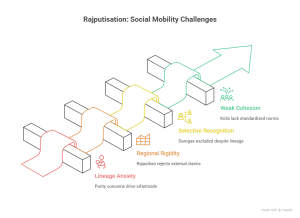
- Rajasthan developed the most rigid version of Rajputhood, emphasising lineage purity, martial ethos, bardic genealogies, and social exclusiveness.
- Rajputs of Rajasthan often rejected claims of Rajput status from outside Rajputana, though exceptions existed, such as the Ujjainiya Rajputs of Bihar, who were accepted into Rajasthani bardic tradition by the 17th century.
- Eastern Rajput groups, frequently identified as Purbiyas, served as soldiers in north Indian armies and often fought alongside western Rajputs. Dirk Kolff uses terms like “Rajput” and “pseudo-Rajput” to describe these eastern military groups, demonstrating the flexible and service-based nature of the identity.
Rajputisation: Steps, Examples, and Comparisons
Rajputisation was a complex socio-political and cultural process by which diverse groups across North India—ranging from peasants and lower-caste Shudras to warriors and even recently converted local rulers—assimilated into the Rajput community. The process was not restricted to tribal chiefs but involved entire communities seeking social mobility, political legitimacy, and martial prestige.
Seven Steps of Rajputisation
Sivaji Koyal outlines the process of Rajputisation of a tribal chief in seven sequential steps, which exemplify how ritual, political, and marital strategies reinforced the emergence of Rajput identity:
- Invitation to Brahmins: A tribal or emerging Raja invited Brahmins to establish a royal court, offering them land and gifts.
- Genealogical Construction: Brahmins traced the Raja’s lineage to a prominent Kshatriya dynasty, declaring him a Rajput.
- Social Distancing: The newly proclaimed Rajput distanced himself from his former tribe, asserting separation of bloodlines.
- Religious and Cultural Consolidation: Brahmins were employed as priests to construct temples and enforce Brahmanical rituals.
- Marriage Alliances: The Raja established alliances with recognized Rajput families to incorporate “Rajput blood” into his lineage.
- Replication by Sub-Chiefs: Lesser chiefs and subordinates adopted the same behavioural patterns and rituals as their king.
- Internal Marriages: Intermarriages among nobles and the lesser sons and daughters of the Raja consolidated the Rajput identity across generations.
Koyal also notes that the Huns, followed by Scythians, Gurjaras, and Maitrakas, were among the earliest groups to undergo Rajputisation in India. The later phenomenon of Secondary Rajputisation involved former tribal members attempting to re-associate with already Rajputised chiefs, thereby claiming Rajput status themselves. Scholars argue that this process is unparalleled in Indian society for its inventiveness in legitimising social mobility.
Rajputisation vs Sanskritisation
While Rajputisation shares similarities with Sanskritisation, the two processes differ in their social, religious, and cultural criteria:
|
Criteria |
Sanskritisation |
Rajputisation |
|
End Goal |
Attain upper-caste (twice-born) status |
Attain Rajput status |
|
Religious Code |
Belief in Karma, Dharma, rebirth, Moksha |
Worship of Shiva and Shakti |
|
Priestly Supervision |
Guidance over rites of passage |
Employment of Brahmins for legitimisation |
|
Dietary Practices |
Prohibition of beef, teetotalism |
Meat-eating, consumption of alcohol and opium |
|
Dressing Code |
Traditional caste attire |
Wearing of sword for men, purdah for women |
|
Social Interaction |
Patronage from dominant castes, cultural assimilation |
Right to political positions, aggrandisement of land, adoption of martial codes, compilation of genealogies |
|
Marriage Rules |
Prohibition of widow remarriage |
Hypergamous marriage to integrate Rajput blood |
Case Studies in Rajputisation
1. Rajputisation among the Gonds
During the late British Raj, Western education and colonial policies intersected with Hinduisation and Rajputisation in central India. The Gond chiefs began adopting caste-Hindu practices, claiming Rajput/Kshatriya status. The British often supported these claims, seeing adivasis as “less civilised” and believing that integration into caste society would make governance easier.
Bhangya Bhukya notes that Raj Gond families had already begun adopting Rajput rituals, matrimonial alliances, and social customs even before the British era. Colonial incentives, such as zamindari rights and village headships, further accelerated Rajputisation. Patit Paban Mishra emphasizes that this “kshatriyaisation” also contributed to the broader Hinduisation of tribal regions.
2. Rajputisation of the Khasa (Khasi)
The Khasa/Khasi of Kumaon and Garhwal, originally indigenous landholding and peasant groups, underwent Rajputisation to elevate ritual and social status. Scarcity of women among immigrant Thuljat Rajputs and Brahmins led to intermarriages with Khasi women, whose descendants gradually adopted Rajput identity. Over time, Khasa groups embraced:
- Wearing the sacred thread
- Worship of clan goddesses
- Adoption of Rajput gotras
- Integration of landholding Khasi Jimdars into Rajput society
By the medieval period, many were known as Khasi Rajputs, distinct from immigrant Thuljat Rajputs (Chand, Chauhan, Negi, Rawat, Rautela, Bisht). This case represents clear caste mobility in the central Himalayas.
3. Attempted Rajputisation of Darogas
The Darogas were descendants of Rajput men and Gujjar women who were initially excluded from Rajput identity. To improve social status, some Daroga groups began calling themselves Ravana Rajputs. Lindsey Harlan highlights that children born from such unions often remained outside Rajput recognition, illustrating the selective and ritualistic boundaries of Rajputisation.
Attempts at Rajputisation Among Different Communities
The process of Rajputisation extended beyond tribal chiefs to include peasant communities, lower-caste groups, and even local rulers who had converted to Islam. Over time, several communities across northern and central India attempted to adopt Rajput identity, often using strategies such as genealogical fabrication, martial emulation, and hypergamous marriage to claim social and political prestige.
Rajputisation of Jats
Some historians argue that the Sikhs’ adoption of Rajput surnames, such as Singh, Kanwar, and Kaur, represented an attempt to Rajputise their identity. This was particularly visible among the Jat Sikhs, who were considered socially lower among the Sikh community.
The Phulkian Jats, who rose to prominence by supporting Babur during his invasion of India, continued claiming Rajput descent from the Bhati Rajputs of Jaisalmer into the 20th century. Similarly, the Jats of Bharatpur and Dholpur attempted Rajputisation to elevate their social status. However, historical accounts suggest that Bharatpur lost recognition as Rajput when an ancestor, Balchand, was unable to have sons with a Rajput wife and instead fathered children with a Jat woman.
British-era ethnographer Denzil Ibbetson observed that in Punjab, terms like “Rajput” or “Jat” functioned more as social titles than ethnological markers. Tribes that gained royal rank could subsequently claim Rajput status.
Rajputisation of Yadavs
The Yadav identity was another avenue for caste mobility. Cowherding communities such as Ahir, Goala, and Gopa, considered above untouchables but low in the caste hierarchy, began adopting the Yadav surname in 1931. Many claimed descent from Krishna, linking themselves to a Kshatriya-Rajput lineage.
In regions such as Ahirwal, Ahirs practiced martial traditions similar to Rajputs and integrated into Rajput networks through strategic marriage alliances. By the 19th century, some Ahir clans, particularly around Rewari, established matrimonial ties with Rajput dynasties like Bikaner, thereby legitimizing their claim to aristocratic and Rajput status.
Rajputisation of Kolis
The Koli community had records dating back to the 15th century in Gujarat, where they were often described as marauding robbers, pirates, or local chieftains. Over centuries, a small elite subset of Kolis established petty chiefdoms and sought upward mobility by claiming Rajput identity.
They adopted Rajput clan names, genealogies, and customs, often employing Barots (genealogists) to fabricate ancestral claims. Hypergamous marriage with lower-status Rajput families also served to consolidate their claims. However, social cohesion remained weak across the Koli community, with significant variation in status, geographical dispersion, and lack of standardized endogamous norms.
Rajputisation of Jadejas
The Jadeja clan presents a notable example of Rajputisation. Sociologist Lyla Mehta notes that the Jadejas were originally Hindu descendants of a Muslim tribe migrating from Sindh to Kutch. They were primarily pastoralists who gradually claimed Rajput identity through marriage alliances with Sodha Rajput women, adoption of Rajput customs, and alignment with Kshatriya social codes.
This pattern reflects a broader trend in which upward mobility was achieved through strategic integration into existing Rajput networks, combining marital alliances, ritual adoption, and political authority.
Key Patterns Across Communities
|
Community |
Method of Rajputisation |
Outcome |
|
Jats |
Adoption of Rajput surnames, genealogical claims, service to rulers |
Phulkian Jats, Bharatpur Jats claimed Rajput status |
|
Yadavs |
Surname adoption, claiming descent from Krishna, martial traditions, marriages with Rajputs |
Emergence of Yaduvanshi identity, integration into Rajput lineage |
|
Kolis |
Fabrication of genealogy, hypergamous marriages, adoption of Rajput clan names and customs |
Small elite claimed Rajput status, limited social cohesion |
|
Jadejas |
Marriage with Sodha Rajput women, adoption of Rajput symbols and rituals |
Recognition as Rajput clan, integration into Kshatriya social hierarchy |
- Alauddin Khalji’s Revolutionary Price Control Policy: How One Sultan Reinvented the Medieval Indian Economy - November 24, 2025
- From Chains to Crown: The Rise of the Mamluk Sovereigns in Delhi - November 20, 2025
- Reconstructing Medieval India: Chronicles, Narratives, and the People’s Perspective - November 19, 2025

No Comments