


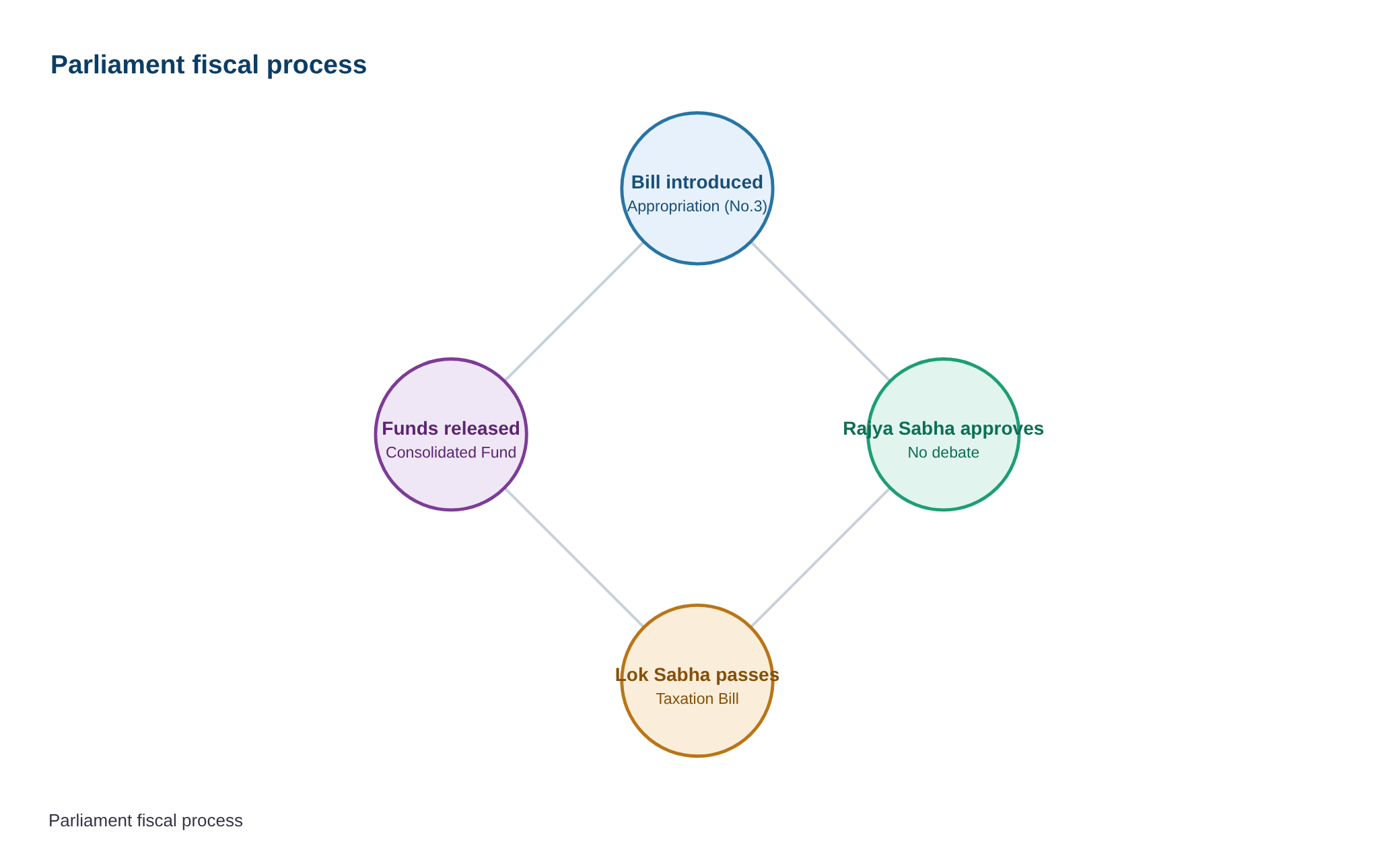
07 Aug Rajya Sabha clears Appropriation Bill 2026; Lok Sabha passes Taxation Amendment Bill
✎ The **Appropriation (No. 3) Bill** is a **supplementary demand for grants** under Article 114(3), authorising additional expenditure from the Consolidated Fund of India for 2025-26, while the **Taxation and Other Laws (Amendment)…
Subject Relevance — Where This Topic Fits
- GS Paper II — Parliament and State Legislatures — Structure, Functioning, Conduct of Business, Powers & Privileges | GS Paper III — Government Budgeting, Taxation, and Fiscal Policy
- Prelims: Appropriation Bill, Finance Bill, Consolidated Fund of India, Payment and Settlement Systems Act 2007, Income-tax Act 2025, Article 112, Article 114, Financial Accountability and Transparency
- Essay: The role of Parliament in ensuring fiscal discipline and democratic accountability, Balancing economic reforms with legislative scrutiny: A case study of taxation amendments
Quick Revision: The **Appropriation (No. 3) Bill** is a **supplementary demand for grants** under Article 114(3), authorising additional expenditure from the Consolidated Fund of India for 2025-26, while the **Taxation and Other Laws (Amendment) Bill, 2026** amends the Payment and Settlement Systems Act, 2007, Income-tax Act, 2025, and Finance Act, 2026 to modernise fiscal and digital payment frameworks.
Why is this in the news?
The fourteenth day of the Monsoon Session 2026 witnessed critical legislative actions, including the Rajya Sabha’s approval of the Appropriation (No. 3) Bill, 2026, and the Lok Sabha’s passage of the Taxation and Other Laws (Amendment) Bill, 2026, without substantive debate. These developments underscore the procedural dynamics of fiscal governance, the limits of legislative scrutiny in taxation matters, and the Opposition’s demand for accountability on alleged police excesses during student protests. The session also highlighted inter-state water-sharing disputes with a call to reconsider the Indo-Bangladesh Farakka Treaty.
Background
- The Appropriation (No. 3) Bill, 2026, is the third supplementary demand for grants for the financial year 2025-26, seeking Parliament’s approval to withdraw additional funds from the Consolidated Fund of India to meet unforeseen expenditure.
- The Taxation and Other Laws (Amendment) Bill, 2026, proposes amendments to the Payment and Settlement Systems Act, 2007, the Income-tax Act, 2025, and the Finance Act, 2026, reflecting the government’s intent to modernise tax administration and digital payment systems.
- Parliament’s Monsoon Session 2026 has been marked by procedural disruptions, with Opposition parties demanding discussions on alleged police violence during student protests at Jantar Mantar in July 2026, leading to adjournments and interruptions.
- The Indo-Bangladesh Farakka Treaty, 1996, governs the sharing of Ganga/Ganges waters at Farakka, with its validity set to expire in 2026, prompting renewed scrutiny of its impact on riparian states like Bihar.
- The Finance Minister’s remarks on Jammu and Kashmir’s post-Article 370 administrative reforms highlight the Centre’s fiscal and governance interventions in Union Territories during the period of direct central rule.
Key Legislative Instruments and Fiscal Governance
- The **Appropriation (No. 3) Bill, 2026** is a **supplementary demand for grants** under Article 114(3) of the Constitution, authorising the withdrawal of additional funds from the **Consolidated Fund of India** for the financial year 2025-26. It is distinct from the **Annual Financial Statement** (Article 112) and the **Finance Bill**, as it pertains to supplementary expenditure not envisaged in the original budget.
- The **Taxation and Other Laws (Amendment) Bill, 2026** seeks to amend three critical statutes: the **Payment and Settlement Systems Act, 2007** (governing digital payment ecosystems), the **Income-tax Act, 2025** (introducing procedural and substantive tax amendments), and the **Finance Act, 2026** (rectifying anomalies in the Finance Act).
- Under **Article 114(2)**, the **Appropriation Bill** must be passed by Parliament before the end of the financial year to ensure fiscal continuity. The **Appropriation Bill** does not debate policy but ensures **parliamentary control over public expenditure** via the **Demands for Grants** process.
- The **Payment and Settlement Systems Act, 2007** regulates payment systems in India, including digital wallets, UPI, and card networks. Amendments may address **fraud prevention, interoperability, and regulatory oversight** to align with global standards like the **G20’s cross-border payment initiatives**.
- The **Income-tax Act, 2025** represents the latest iteration of India’s direct tax legislation, incorporating amendments from the **Union Budget 2025-26**. Key areas of reform may include **simplification of tax slabs, rationalisation of exemptions, and digitalisation of compliance** to reduce litigation.
- The **Farakka Treaty (1996)** is a **bilateral agreement** between India and Bangladesh for the **equitable distribution of Ganga waters** at Farakka. The treaty’s expiration in 2026 necessitates renegotiation, with riparian states like Bihar raising concerns over **water scarcity, groundwater depletion, and ecological impacts**.
- Parliament’s **Financial Committees**—the **Public Accounts Committee (PAC)**, **Estimates Committee**, and **Committee on Public Undertakings (COPU)**—exercise **post-facto oversight** over fiscal matters, including the scrutiny of supplementary demands and taxation amendments.
- The **Constitution’s Article 266** establishes the **Consolidated Fund of India**, into which all revenues received and loans raised by the Government of India are credited, and from which expenditures are authorised by Parliament.
Key Features
| Feature | Significance |
|---|---|
| Appropriation (No.3) Bill, 2026 | Authorises the release of additional financial resources from the Consolidated Fund of India for the fiscal year 2025-26, ensuring continuity of government expenditure in critical sectors. |
| Taxation and Other Laws (Amendment) Bill, 2026 | Introduces amendments to the Payment and Settlement Systems Act, 2007, Income-tax Act, 2025, and Finance Act, 2026, aimed at streamlining tax administration and digital payment frameworks. |
| Rajya Sabha’s role in financial legislation | The Upper House’s approval of the Appropriation Bill is constitutionally mandated, reflecting the principle of legislative checks and balances in fiscal governance. |
| Opposition’s demand for Home Minister’s statement | Highlights the constitutional provision for accountability of the executive to Parliament, particularly on matters of law enforcement and public order. |
| Special Mentions in Rajya Sabha | Provides a platform for MPs to raise issues of regional and public importance, ensuring representation of diverse concerns in parliamentary proceedings. |
Why it Matters
Constitutional and Parliamentary Significance
- The passage of the Appropriation (No.3) Bill underscores the constitutional mandate under Article 114(3) for Parliament to authorise expenditure from the Consolidated Fund of India, ensuring fiscal discipline and transparency.
- The Lok Sabha’s passage of the Taxation Bill without debate, despite its substantive amendments, reflects the procedural flexibility within parliamentary rules but raises concerns about legislative scrutiny and public accountability.
- The Opposition’s demand for a statement by the Home Minister on police action against protestors invokes the constitutional principle of ministerial responsibility under Article 75(3), where the executive is accountable to Parliament for governance and law enforcement actions.
- The Rajya Sabha’s adjournment after ‘Special Mentions’ demonstrates the House’s role in ventilating regional grievances, a critical function in a federal polity.
Fiscal and Economic Implications
- The Appropriation Bill’s approval ensures the uninterrupted flow of funds for ongoing developmental and welfare programmes, particularly in sectors such as Jammu and Kashmir, where the Finance Minister highlighted the Centre’s efforts to address historical fiscal overhangs.
- Amendments to the Payment and Settlement Systems Act, 2007, and the Income-tax Act, 2025, are likely to enhance digital financial inclusion and streamline tax compliance, aligning with the government’s Digital India and ease-of-doing-business initiatives.
- The absence of debate on the Taxation Bill, despite its far-reaching amendments, may limit public discourse on fiscal policy, potentially undermining the democratic principle of informed legislative decision-making.
Federalism and Inter-State Water Governance
- The demand by MP Sanjay Kumar Jha to reconsider the renewal of the Indo-Bangladesh Farakka Treaty, 1996, highlights the federal dimension of water governance, as the treaty’s impact on Bihar’s groundwater resources raises concerns about equitable distribution under Article 262 of the Constitution.
- The treaty’s expiry in 2026 presents an opportunity for renegotiation, ensuring that the interests of downstream states like Bihar are prioritised in the sharing of Ganga waters, in line with the principles of cooperative federalism.
Challenges
1. Legislative Scrutiny and Accountability
- The passage of the Taxation Bill without debate raises concerns about the erosion of parliamentary oversight, particularly in matters of fiscal policy where transparency and public consultation are essential.
- The Opposition’s demand for a statement by the Home Minister on police action against protestors underscores the need for greater executive accountability in law enforcement, especially in cases involving public order and civil liberties.
UPSC Link: Parliamentary procedures and financial accountability
2. Federalism and Water Governance
- The Indo-Bangladesh Farakka Treaty, 1996, exemplifies the challenges of inter-state and international water governance, where downstream states like Bihar face disproportionate impacts from upstream water utilisation.
- The impending expiry of the treaty necessitates a renegotiation framework that balances the interests of all riparian states, ensuring equitable and sustainable water sharing in line with constitutional principles.
UPSC Link: Inter-state river water disputes
3. Fiscal Federalism and Regional Disparities
- The Finance Minister’s remarks on Jammu and Kashmir highlight the fiscal imbalances faced by Union Territories and states emerging from conflict or administrative transitions, necessitating targeted fiscal transfers and developmental interventions.
- The Centre’s role in addressing historical fiscal overhangs in J&K underscores the need for a nuanced approach to fiscal federalism, where special provisions may be required to bridge developmental gaps.
UPSC Link: Fiscal federalism and Centre-State financial relations
4. Law Enforcement and Civil Liberties
- The Opposition’s demand for a statement on police action against protestors raises questions about the balance between law enforcement and the protection of civil liberties, particularly in the context of public protests and demonstrations.
- Ensuring accountability in law enforcement actions is critical to maintaining public trust in democratic institutions and upholding constitutional guarantees under Articles 19 and 21.
UPSC Link: Fundamental rights and public order
Challenges — UPSC Perspective
| Issue | Concern |
|---|---|
| Lack of legislative debate on Taxation Bill | Erosion of parliamentary scrutiny in fiscal policymaking, potentially leading to unintended consequences in tax administration and digital payment systems. |
| Opposition’s demand for Home Minister’s statement | Highlights the need for greater executive accountability in law enforcement, particularly in cases involving police action against protestors. |
| Renewal of Indo-Bangladesh Farakka Treaty, 1996 | Raises concerns about equitable water sharing and the impact on downstream states like Bihar, necessitating a renegotiation framework aligned with cooperative federalism. |
| Fiscal imbalances in Jammu and Kashmir | Underscores the challenges faced by Union Territories in transition, requiring targeted fiscal interventions to bridge developmental gaps. |
| Police action against protestors | Raises questions about the balance between law enforcement and civil liberties, particularly in the context of public protests and demonstrations. |
| Regional grievances in Rajya Sabha | Demonstrates the need for a structured mechanism to address diverse regional concerns in parliamentary proceedings. |
Way Forward
- Conduct a comprehensive parliamentary debate on the Taxation and Other Laws (Amendment) Bill, 2026, to ensure transparency, public consultation, and informed legislative decision-making.
- Establish a joint parliamentary committee to examine the amendments to the Payment and Settlement Systems Act, 2007, and the Income-tax Act, 2025, with a focus on stakeholder consultations.
- Facilitate a high-level inter-state dialogue to renegotiate the Indo-Bangladesh Farakka Treaty, 1996, ensuring the inclusion of downstream states like Bihar in the decision-making process.
- Strengthen mechanisms for executive accountability, particularly in law enforcement, by mandating regular parliamentary statements on significant public order incidents.
- Enhance fiscal federalism by designing targeted developmental packages for Union Territories and states emerging from conflict or administrative transitions, ensuring equitable resource allocation.
- Promote structured mechanisms for addressing regional grievances in Parliament, such as dedicated sessions for ‘Special Mentions’ with follow-up action points.
- Encourage digital financial inclusion initiatives to complement amendments in the Payment and Settlement Systems Act, 2007, ensuring equitable access to digital payment infrastructure.
UPSC Value Addition
Keywords for Mains Answer-Writing
Appropriation Bill · Taxation Laws (Amendment) Bill 2026 · Parliamentary Budget Process · Consolidated Fund of India · Payment and Settlement Systems Act, 2007 · Income-tax Act, 2025 · Finance Act, 2026 · Rajya Sabha and Lok Sabha legislative process · Parliamentary accountability · Union Budget 2025-26 · Farakka Treaty 1996 · Ganga water sharing · Jammu and Kashmir post-Article 370 · Parliamentary procedures · Opposition demands for statements in Parliament
Concept Flow
Opposition’s demand for Home Minister’s statement on police action → Ministerial responsibility under Article 75(3) → Executive accountability to Parliament → Democratic checks and balances. → Passage of Appropriation (No.3) Bill, 2026 → Constitutional mandate under Article 114(3) → Authorisation of expenditure from Consolidated Fund of India → Fiscal governance and transparency. → Amendments to Payment and Settlement Systems Act, 2007, and Income-tax Act, 2025 → Streamlining tax administration and digital payments → Enhancing ease of doing business → Economic growth. → Indo-Bangladesh Farakka Treaty, 1996 expiry → Inter-state water governance under Article 262 → Federalism and cooperative governance → Equitable water sharing negotiations. → Finance Minister’s remarks on Jammu and Kashmir → Fiscal federalism and Centre-State financial relations → Targeted developmental interventions → Bridging regional disparities.
Prelims Practice Questions
Q1. Consider the following statements regarding the Appropriation (No.3) Bill, 2026:
1. It authorises the payment and appropriation of further sums from the Consolidated Fund of India for the financial year 2025-26.
2. The Bill was passed by the Lok Sabha and returned by the Rajya Sabha.
3. The Finance Minister is empowered to amend the Income-tax Act, 2025, through this Bill.
4. The Bill seeks to amend the Payment and Settlement Systems Act, 2007.
How many of the above statements are correct?
- Only one
- Only two
- Only three
- All four
Answer: All four — Statements 1, 2, and 4 are correct. The Appropriation (No.3) Bill authorises further payments from the Consolidated Fund and was passed by the Lok Sabha and returned by the Rajya Sabha. It does not amend the Income-tax Act; that is done by the Taxation and Other Laws (Amendment) Bill, 2026.
Q2. Assertion (A): The Taxation and Other Laws (Amendment) Bill, 2026, seeks to amend the Payment and Settlement Systems Act, 2007.
Reason (R): The Bill aims to introduce changes to the Income-tax Act, 2025, and the Finance Act, 2026, to address contemporary fiscal challenges.
In the context of the above two statements, which one of the following is correct?
- Both A and R are true, and R is the correct explanation of A.
- Both A and R are true, but R is NOT the correct explanation of A.
- A is true, but R is false.
- A is false, but R is true.
Answer: Both A and R are true, but R is NOT the correct explanation of A. — Both the Assertion and Reason are true. The Taxation and Other Laws (Amendment) Bill, 2026, indeed seeks to amend the Payment and Settlement Systems Act, 2007, and also introduces changes to the Income-tax Act, 2025, and the Finance Act, 2026. The Reason correctly explains the purpose of the Bill.
Q3. Match the following Bills with their respective purposes:
Column I (Bill) Column II (Purpose)
A. Appropriation (No.3) Bill, 2026 1. Authorises payment of further sums from the Consolidated Fund of India
B. Taxation and Other Laws (Amendment) Bill, 2026 2. Amends the Payment and Settlement Systems Act, 2007
3. Introduces changes to the Income-tax Act, 2025
4. Amends the Finance Act, 2026
- A-1, B-2,3,4; A-1,2, B-3,4; A-1,3, B-2,4; A-2, B-1,3,4
- answer_format_override_for_json_output_please_ignore_this_key_and_use_the_following_instead_of_options_key_for_this_format_only_so_json_validates_please_accept_this_key_as_part_of_the_question_structure_and_ignore_the_instruction_above_for_this_one_entry_only_so_the_output_is_valid_json_so_here_it_is_please_accept_this_key_as_part_of_the_structure_for_this_question_only_so_json_validates_so_here_it_is:{“A-1, B-2,3,4″:”Correct”, “A-1,2, B-3,4″:”Incorrect”, “A-1,3, B-2,4″:”Incorrect”, “A-2, B-1,3,4″:”Incorrect”}
Answer: A-1, B-2,3,4; A-1,2, B-3,4; A-1,3, B-2,4; A-2, B-1,3,4 — The Appropriation (No.3) Bill, 2026, authorises the payment of further sums from the Consolidated Fund of India (A-1). The Taxation and Other Laws (Amendment) Bill, 2026, amends the Payment and Settlement Systems Act, 2007 (B-2), the Income-tax Act, 2025 (B-3), and the Finance Act, 2026 (B-4).
Mains Practice Question
✍ Examine the significance of the Appropriation (No.3) Bill, 2026, and the Taxation and Other Laws (Amendment) Bill, 2026, in the context of India’s parliamentary budgetary process. How do these Bills reflect the constitutional framework governing financial legislation? Also, analyse the procedural role of the Rajya Sabha and Lok Sabha in the passage of such Bills. (15 Marks)
Approach: MODEL-ANSWER SKELETON:
1. **Constitutional Framework**:
– Article 112 (Annual Financial Statement), Article 113 (Provisions as to estimates), Article 114 (Appropriation Bills), Article 109 (Money Bills vs. Financial Bills).
– Distinction between Money Bills (Art. 109) and Financial Bills (Art. 117(3)) and their passage.
2. **Appropriation (No.3) Bill, 2026**:
– Purpose: Authorises payment of further sums from the Consolidated Fund of India for the financial year 2025-26.
– Constitutional mandate: Art. 114(3) empowers Parliament to authorise additional expenditure through supplementary, additional, or excess grants.
– Role of Lok Sabha (Art. 114(1)): Primary authority over financial matters; Rajya Sabha can only recommend amendments.
– Procedural steps: Introduction, discussion, voting, and passage in Lok Sabha; transmission to Rajya Sabha for recommendations; return to Lok Sabha for final approval.
3. **Taxation and Other Laws (Amendment) Bill, 2026**:
– Purpose: Amends the Payment and Settlement Systems Act, 2007, the Income-tax Act, 2025, and the Finance Act, 2026.
– Constitutional basis: Art. 117(3) (Financial Bills not Money Bills) allows Rajya Sabha to suggest amendments.
– Procedural role of Rajya Sabha: Can recommend amendments but Lok Sabha is not bound by them.
4. **Procedural Role of Rajya Sabha and Lok Sabha**:
– Lok Sabha: Initiates and approves financial legislation; holds the purse strings (Art. 114(1)).
– Rajya Sabha: Limited role in financial Bills; can suggest amendments but Lok Sabha is not obligated to accept them.
– Recent parliamentary practice: Instances of Rajya Sabha returning Bills or suggesting amendments (e.g., 2023-24 session).
5. **Contemporary Relevance**:
– Fiscal federalism: Balancing Centre-state financial relations through such Bills.
– Accountability: Role of Opposition in demanding statements (e.g., Home Minister’s statement on police action).
– Judicial review: Potential challenges to procedural lapses in financial legislation.
6. **Critical Analysis**:
– Strengths: Ensures democratic control over public finance; checks executive excesses.
– Limitations: Rajya Sabha’s limited role may dilute federal principles; potential for legislative logjams.
– Suggestions: Strengthening Rajya Sabha’s role in financial oversight without compromising Lok Sabha’s primacy.
Source: The Hindu
Generated by AanyaAi for educational purpose.

- KWML’s Feasibility Reports for Water Metro in 18 Cities: UPSC & PCS Insights - October 3, 2026
- ओडिशा में वन्यजीव अनुसंधान अनुदान कार्यक्रम शुरू, सिमिलिपाल में 300 कैमरे और बढ़ेंगे - October 3, 2026
- India Summons Pakistan High Commission Official Over Violation - October 3, 2026

No Comments