


03 Aug Rajya Sabha Passes MSME Bill 2026: Key Provisions & Opposition Protests
✎ The Micro, Small and Medium Enterprises Development (Amendment) Bill, 2026, replaces the MSMED Act, 2006, and mandates CPSEs to settle MSME invoices via TReDS to enhance liquidity and formalise the sector.
Subject Relevance — Where This Topic Fits
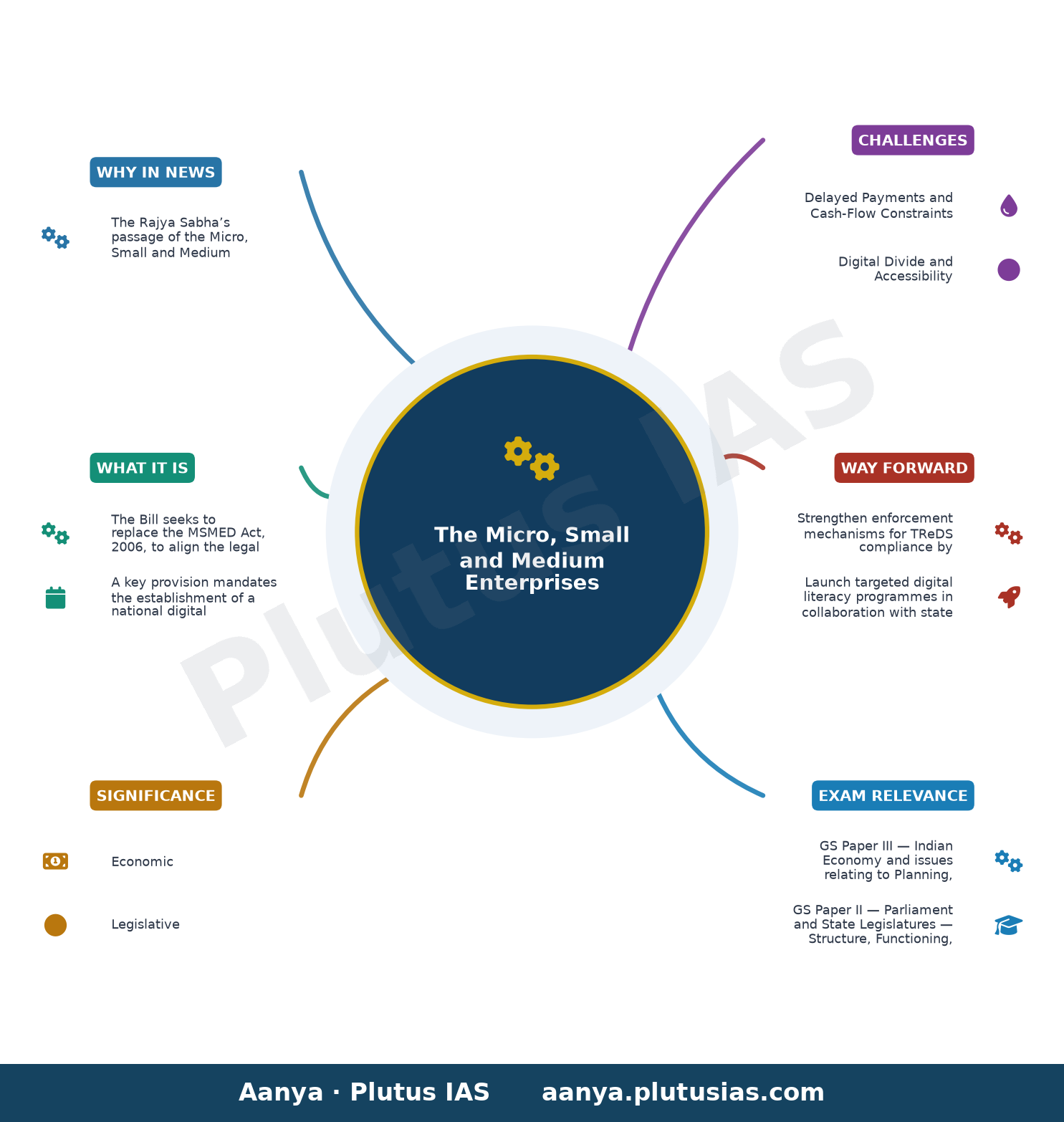
- GS Paper III — Indian Economy and issues relating to Planning, Mobilization of Resources, Growth, Development and Employment | GS Paper II — Parliament and State Legislatures — Structure, Functioning, Conduct of Business, Powers & Privileges and Issues Arising out of these
- Prelims: MSMED Act, 2006, Trade Receivables Discounting System (TReDS), Central Public Sector Enterprises (CPSEs), National Digital Platform for MSME Registration, Udyam Registration Portal, Outstanding credit to MSMEs, GDP contribution of MSMEs, Parliamentary procedures: voice vote, adjournment motion
- Essay: The role of MSMEs in India’s economic transformation: employment generation and export competitiveness, Parliamentary accountability and legislative efficacy in times of political disruption
Quick Revision: The Micro, Small and Medium Enterprises Development (Amendment) Bill, 2026, replaces the MSMED Act, 2006, and mandates CPSEs to settle MSME invoices via TReDS to enhance liquidity and formalise the sector.
Why is this in the news?
The Rajya Sabha’s passage of the Micro, Small and Medium Enterprises Development (Amendment) Bill, 2026, amid Opposition protests, marks a significant legislative development aimed at enhancing liquidity and formalisation in India’s MSME sector. The Bill replaces the MSMED Act, 2006, and introduces provisions for a national digital registration platform and mandatory invoice settlement through TReDS for CPSEs, reflecting the government’s continued focus on addressing systemic challenges faced by MSMEs.
Background
- The Micro, Small and Medium Enterprises Development (MSMED) Act, 2006, was enacted to provide a legal framework for the promotion, development, and enhancement of competitiveness of MSMEs in India.
- MSMEs constitute a critical pillar of India’s economy, contributing approximately 31% to GDP, 36% to manufacturing output, and 41% to exports, while employing over 110 million people.
- The sector has historically faced challenges such as delayed payments, limited access to credit, and low formalisation, exacerbated by the COVID-19 pandemic and subsequent economic disruptions.
- The government has introduced multiple initiatives to support MSMEs, including the Udyam Registration Portal (2020), Emergency Credit Line Guarantee Scheme (ECLGS), and the promotion of digital payment systems like TReDS.
- Outstanding credit disbursed to MSMEs has grown significantly from ₹10 lakh crore in 2014–15 to over ₹38.35 lakh crore, indicating increased financial inclusion but also highlighting persistent liquidity gaps.
- Parliamentary proceedings in the Monsoon Session 2026 were disrupted by Opposition protests, leading to adjournments and limiting substantive discussions on key legislative items.
What is the Micro, Small and Medium Enterprises Development (Amendment) Bill, 2026?
- The Bill seeks to replace the MSMED Act, 2006, to align the legal framework with contemporary economic realities and address systemic inefficiencies in the MSME sector.
- A key provision mandates the establishment of a national digital platform for the free and voluntary registration of MSMEs.
- The Bill introduces a mandatory requirement for all Central Public Sector Enterprises (CPSEs) to route invoice settlements for procurement of goods and services from MSMEs through the Trade Receivables Discounting System (TReDS), aimed at reducing payment delays and improving liquidity.
- TReDS is an electronic platform that facilitates the financing of trade receivables of MSMEs by allowing them to auction their invoices to financiers, thereby unlocking working capital.
- The legislation emphasises the formalisation of MSMEs, reducing informality and enhancing their access to institutional credit and government schemes.
- The Bill seeks to balance the interests of MSMEs, CPSEs, and financial institutions while adhering to constitutional principles of equity and economic justice.
- The government has highlighted the sector’s critical role in employment generation, export competitiveness, and inclusive growth, justifying the need for legislative intervention.
- The Bill was passed in the Rajya Sabha without substantive Opposition participation, reflecting the political dynamics of the Monsoon Session 2026.
Key Features
| Feature | Significance |
|---|---|
| Replacement of the MSME Development Act, 2006 | Modernises the legal framework governing MSMEs, aligning it with contemporary economic realities and technological advancements. |
| National Digital Platform for Voluntary Registration | Facilitates ease of doing business by providing a unified, accessible, and cost-free registration mechanism for MSMEs. |
| Mandate for CPSEs to use TReDS for invoice settlements | Ensures timely and transparent payment cycles for MSMEs, addressing liquidity constraints and reducing delayed payments. |
| Focus on liquidity enhancement for MSMEs | Directs financial institutions and procurement entities to prioritise MSMEs, thereby strengthening their operational sustainability. |
| Statutory recognition of MSME contributions to GDP, manufacturing, and exports | Reinforces the sector’s pivotal role in India’s economic growth and global trade competitiveness. |
Why it Matters
Economic
- The Bill institutionalises measures to mitigate cash-flow challenges faced by MSMEs, a sector critical to employment generation and industrial diversification.
- By mandating CPSEs to utilise TReDS, the legislation curtails the systemic issue of delayed payments, which has historically constrained MSME growth.
- The sector’s contribution—31% to GDP, 36% to manufacturing output, and 41% to exports—underscores its indispensability in achieving India’s $5 trillion economy target.
- Enhanced credit disbursement (₹38.35 lakh crore vs ₹10 lakh crore in 2014-15) reflects improved financial inclusion and policy support for MSMEs.
Legislative
- The Bill replaces the MSME Development Act, 2006, introducing provisions that reflect contemporary economic priorities, including digital integration and payment reforms.
- The legislative process, despite Opposition disruptions, highlights the government’s intent to expedite reforms in critical sectors.
- The defeat of Opposition amendments suggests a bipartisan consensus on the Bill’s objectives, albeit with procedural disagreements.
Administrative
- The national digital platform for MSME registration exemplifies the government’s push towards ‘Minimum Government, Maximum Governance’ through technological intermediation.
- The mandate for CPSEs to route payments through TReDS aligns with the broader objective of formalising MSME transactions and reducing informality.
Social
- MSMEs are the second-largest employers in India after agriculture, and their growth directly impacts rural and semi-urban employment, particularly for marginalised communities.
- The Bill’s provisions indirectly support women-led MSMEs and those in tier-2/3 cities by reducing bureaucratic hurdles and improving access to credit.
Challenges
1. Delayed Payments and Cash-Flow Constraints
- Despite statutory mandates, enforcement of timely payments by CPSEs and private enterprises remains a persistent challenge due to bureaucratic inertia and lack of penalties.
- MSMEs often lack bargaining power to enforce payment terms, exacerbating liquidity crises, especially for micro-enterprises.
- The TReDS mechanism, while beneficial, requires wider adoption among buyers to achieve systemic impact.
UPSC Link: GS-III: MSMEs and their role in inclusive growth
2. Digital Divide and Accessibility
- The national digital platform assumes universal internet access and digital literacy, which may exclude remote and rural MSMEs from availing its benefits.
- Cybersecurity risks and data privacy concerns in a centralised registration system need robust safeguards to prevent misuse of MSME data.
UPSC Link: GS-III: Digital infrastructure and its impact on MSMEs
3. Credit Accessibility Gaps
- Despite increased credit disbursement, MSMEs, particularly in the micro category, face high collateral requirements and stringent lending norms from formal financial institutions.
- The Bill does not address the structural issues in credit appraisal processes, which often favour larger enterprises over smaller ones.
UPSC Link: GS-III: Financial inclusion and MSME credit
4. Policy Implementation and Monitoring
- The effectiveness of the Bill hinges on inter-ministerial coordination, particularly between MSME, Finance, and Corporate Affairs ministries, to ensure seamless execution.
- Lack of a dedicated monitoring mechanism may lead to poor compliance by CPSEs and delayed impact assessment of the reforms.
UPSC Link: GS-II: Centre-state coordination in policy implementation
5. Opposition to Reforms and Legislative Disruptions
- Frequent disruptions in Parliament, as seen during the passage of the Bill, hinder constructive debate and delay critical legislative reforms.
- The Opposition’s protest over unrelated issues (e.g., police action against protesting youth) reflects broader political polarisation, which can overshadow economic reforms.
UPSC Link: GS-II: Role of Parliament in policy-making
Challenges — UPSC Perspective
| Issue | Concern |
|---|---|
| Enforcement of payment timelines | Lack of penalties for non-compliance may render TReDS mandate ineffective. |
| Digital literacy and infrastructure gaps | Excludes marginalised MSMEs from utilising the national digital platform. |
| Credit rationing by banks | MSMEs struggle to meet collateral requirements despite policy incentives. |
| Inter-ministerial coordination | Delays in implementation due to lack of synchronised action between ministries. |
| Parliamentary disruptions | Hinders timely passage and scrutiny of economic reforms. |
Way Forward
- Strengthen enforcement mechanisms for TReDS compliance by introducing penalties for delayed payments by CPSEs and large enterprises.
- Launch targeted digital literacy programmes in collaboration with state governments to ensure MSMEs in rural and remote areas can utilise the national platform.
- Expand the scope of credit guarantee schemes (e.g., CGTMSE) to reduce collateral requirements for micro and small enterprises.
- Establish a dedicated monitoring cell within the MSME ministry to track implementation progress and address bottlenecks in real time.
- Constitute a parliamentary committee to review the Bill’s impact after one year, with recommendations for mid-course corrections.
- Promote awareness campaigns among MSME associations to educate stakeholders on the benefits of voluntary registration and TReDS.
- Integrate the national digital platform with existing portals like Udyam Registration and GSTN to avoid duplication and streamline compliance.
UPSC Value Addition
Keywords for Mains Answer-Writing
Micro, Small and Medium Enterprises (MSME) Development (Amendment) Bill, 2026 · Trade Receivables Discounting System (TReDS) · Central Public Sector Enterprises (CPSEs) · MSME sector contribution to GDP, manufacturing output, and exports · National digital platform for MSME registration · Parliamentary procedures and Rajya Sabha functioning · Opposition protests and parliamentary disruptions · Liquidity challenges for MSMEs · MSME credit disbursement growth · Constitutional principles and legislative processes
Concept Flow
MSMEs face systemic liquidity constraints due to delayed payments from buyers (CPSEs/private enterprises) → Government introduces Bill to mandate TReDS for invoice settlements → National digital platform introduced for voluntary registration → MSMEs gain improved access to credit and formalisation → Sectoral growth contributes to GDP, manufacturing, and exports → Enforcement challenges and digital divide emerge as implementation hurdles → Policy refinements and monitoring mechanisms required for sustainable impact.
Prelims Practice Questions
Q1. Consider the following statements regarding the Micro, Small and Medium Enterprises (MSME) Development (Amendment) Bill, 2026:
1. The Bill replaces the MSME Development Act, 2006.
2. It mandates all Central Public Sector Enterprises (CPSEs) to route invoice settlements through the Trade Receivables Discounting System (TReDS) for procurement from MSMEs.
3. The Bill introduces a mandatory registration system for MSMEs on a national digital platform.
How many of the above statements are correct?
- Only one
- Only two
- All three
- None
Answer: Only two — Statement 1 and 2 are correct as per the Bill’s provisions. Statement 3 is incorrect because the registration on the national digital platform is free and voluntary, not mandatory.
Q2. Assertion (A): The MSME sector contributes approximately 31% to India’s GDP.
Reason (R): The MSME sector is a significant contributor to employment generation in India.
Options:
A. Both A and R are true, and R is the correct explanation of A.
B. Both A and R are true, but R is not the correct explanation of A.
C. A is true, but R is false.
D. A is false, but R is true.
- A
- B
- C
- D
Answer: C — Assertion (A) is true as the MSME sector contributes about 31% to India’s GDP. Reason (R) is also true but does not explain the assertion, as employment generation is a separate contribution of the MSME sector.
Q3. Match the following contributions of the MSME sector with their respective percentages:
Column I (Contribution) | Column II (Percentage)
1. Share in India’s GDP | A. 41%
2. Share in manufacturing output | B. 36%
3. Share in exports | C. 31%
Options:
A. 1-A, 2-B, 3-C
B. 1-C, 2-B, 3-A
C. 1-B, 2-C, 3-A
D. 1-C, 2-A, 3-B
- A
- B
- C
- D
Answer: B — The correct match is: 1-C (31% share in GDP), 2-B (36% share in manufacturing output), and 3-A (41% share in exports).
Mains Practice Question
✍ The Micro, Small and Medium Enterprises (MSME) Development (Amendment) Bill, 2026, seeks to address the liquidity challenges faced by MSMEs through institutional mechanisms like the Trade Receivables Discounting System (TReDS). Critically examine the efficacy of these measures in resolving the structural issues plaguing the MSME sector. Also, discuss the implications of parliamentary disruptions in the legislative process for democratic governance. (15 Marks)
Approach: MODEL-ANSWER SKELETON:
1. **Introduction (2 marks)**
– Define the MSME sector and its economic significance (GDP, manufacturing, exports, employment).
– Briefly outline the key provisions of the MSME Development (Amendment) Bill, 2026: replacement of the 2006 Act, voluntary registration on a national digital platform, and mandatory TReDS routing for CPSEs.
2. **Efficacy of TReDS and institutional mechanisms (5 marks)**
– Explain TReDS: purpose, functioning, and benefits for MSMEs (timely payments, reduced liquidity crunch).
– Analyze the mandate for CPSEs to route invoice settlements through TReDS: potential impact on cash flow for MSMEs.
– Critique: Limitations of TReDS (coverage gaps, awareness deficits among MSMEs, compliance challenges for CPSEs).
– Reference data: Growth in MSME credit disbursement (₹38.35 lakh crore in 2026 vs ₹10 lakh crore in 2014-15) to highlight progress but also the persisting liquidity gap.
3. **Structural issues in the MSME sector (4 marks)**
– Discuss broader challenges: access to credit, regulatory compliances, technological adoption, and market access.
– Evaluate whether the Bill addresses these holistically or only targets symptom relief (e.g., liquidity via TReDS).
– Reference the role of other schemes (e.g., PMEGP, CGTMSE) and their limitations.
4. **Parliamentary disruptions and democratic governance (4 marks)**
– Define parliamentary disruption: causes (opposition protests, sloganeering) and consequences (adjournments, truncated debates).
– Analyze the impact on legislative scrutiny: lack of discussion on the Bill despite its significance.
– Discuss the role of the Chair (e.g., Rajya Sabha Chairman’s remarks) in maintaining decorum vs. opposition demands for accountability.
– Broader implications: erosion of deliberative democracy, trust deficit, and challenges to institutional checks and balances.
5. **Conclusion (2 marks)**
– Summarize: While the Bill introduces progressive measures (TReDS, digital platform), its efficacy depends on implementation and addressing structural gaps.
– Emphasize the need for parliamentary consensus and robust debate to strengthen democratic governance.
Source: The Hindu
Generated by AanyaAi for educational purpose.

- सुप्रीम कोर्ट ने चुनाव आयोग को दिल्ली में ‘यांत्रिक’ SIR नोटिस पर सावधानियां बरतने को कहा - September 22, 2026
- ‘स्वच्छता ही सेवा-2026’ अभियान: सरकारी विभागों में स्वच्छता क्रांति, जानिए मुख्य बिंदु - September 22, 2026
- DFPD Launches ‘Swachhata Hi Seva-2026’ Campaign for Clean India Mission - September 22, 2026

No Comments