


08 Aug Rangarajan on Global Conflicts & Tariffs: Need for India’s Policy Shift
✎ India must balance the imperatives of economic liberalisation with strategic autonomy by prioritising domestic production in critical sectors such as semiconductors, defence, and AI, despite the temporary deviation from…
Subject Relevance — Where This Topic Fits
- GS Paper II — International Relations: Global Economic Order and Geopolitical Fragmentation | GS Paper III — Indian Economy: Trade Policy, Industrial Policy, and Liberalisation Reforms
- Prelims: Tariff wars, deglobalisation, import substitution, semiconductor self-reliance, AI adaptation, 16th Finance Commission, New Economic Policy 1991
- Essay: The paradox of liberalisation in a deglobalising world: Can India balance openness with strategic autonomy?, Geopolitical fragmentation and economic sovereignty: Lessons for India’s developmental trajectory
Quick Revision: India must balance the imperatives of economic liberalisation with strategic autonomy by prioritising domestic production in critical sectors such as semiconductors, defence, and AI, despite the temporary deviation from free-market principles.
Why is this in the news?
Former Reserve Bank of India Governor C. Rangarajan, in a lecture commemorating the 35th anniversary of India’s New Economic Policy (NEP 1991), highlighted the urgent need for India to recalibrate its economic policy framework in response to escalating global tariff wars and geopolitical conflicts. His remarks underscore the tension between India’s historical commitment to liberalisation and the exigencies of contemporary global disorder, particularly in critical sectors such as defence production, semiconductor manufacturing, and artificial intelligence (AI) adaptation.
Background
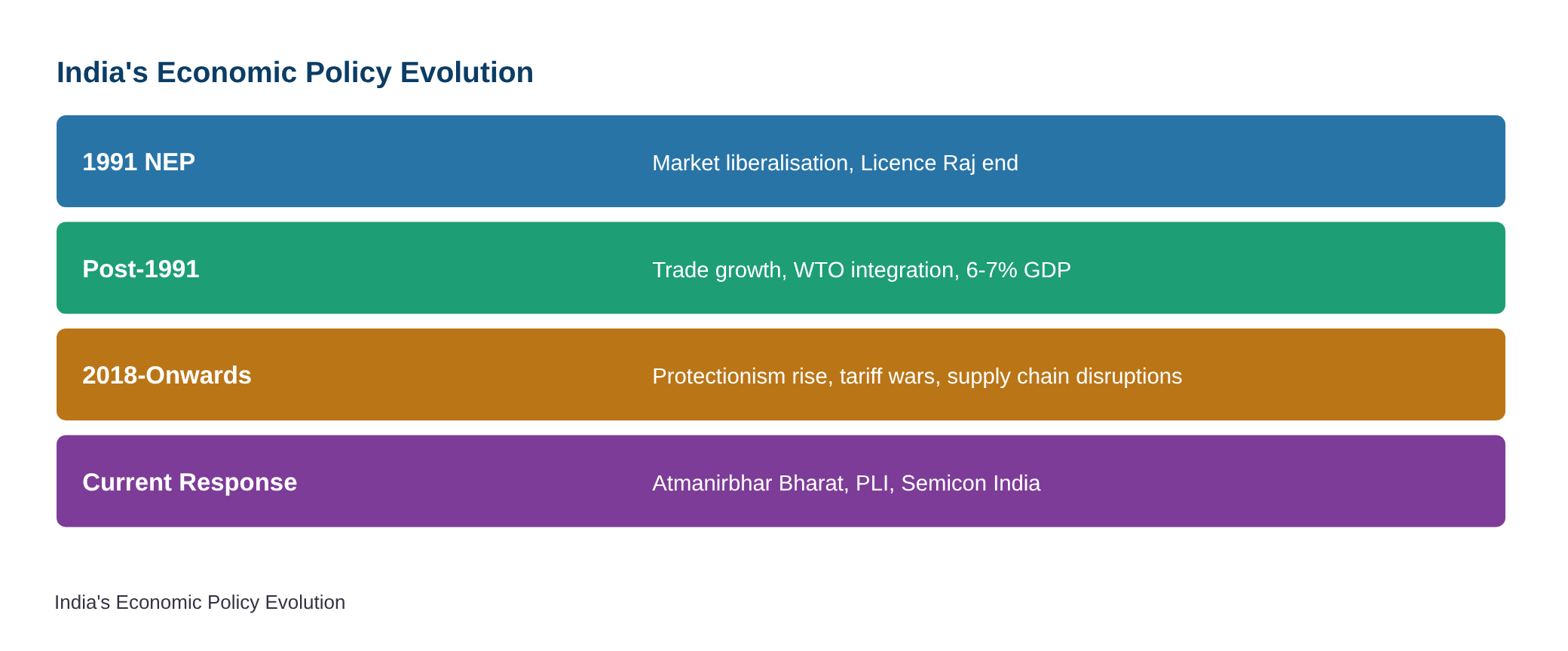
- India’s New Economic Policy (NEP) of 1991 marked a paradigm shift from a state-controlled, import-substitution model to a market-oriented, export-led growth strategy, dismantling the Licence Raj and embracing globalisation.
- The post-1991 era saw India’s integration with the global economy through trade liberalisation, reduction of tariffs, and participation in multilateral institutions such as the WTO, which facilitated sustained GDP growth averaging 6-7% annually.
- The global economic order has undergone significant transformation since 2018, characterised by the rise of protectionist trade policies, particularly under the Trump administration in the US, and subsequent retaliatory measures by other major economies, leading to a tariff war and erosion of multilateral trade rules.
- Geopolitical conflicts, including the Russia-Ukraine war (since 2022) and escalating tensions in the Indo-Pacific, have disrupted global supply chains, exposed vulnerabilities in critical sectors, and necessitated strategic rethinking of economic dependencies.
- India’s response to these challenges has included initiatives such as ‘Atmanirbhar Bharat’ (self-reliance), Production-Linked Incentive (PLI) schemes, and the Semicon India Programme to bolster domestic manufacturing in strategic sectors.
- The 16th Finance Commission, currently deliberating, is expected to address fiscal federalism in this evolving economic landscape, with implications for resource allocation, tax devolution, and Centre-state financial relations.
What is the Policy Reassessment in Response to Tariffs and Geopolitical Conflicts?
- The reassessment refers to India’s strategic recalibration of its economic policy framework to mitigate the adverse impacts of global tariff wars and geopolitical fragmentation, which threaten to undermine the gains of liberalisation.
- Tariff wars, exemplified by the US-China trade conflict and retaliatory measures by the EU and other nations, have disrupted global trade flows, increased input costs, and necessitated policy interventions to protect domestic industries and supply chains.
- Geopolitical conflicts, such as the Russia-Ukraine war, have exposed the fragility of global supply chains, particularly in energy, food, and critical raw materials, compelling countries to prioritise domestic production and strategic stockpiling.
- India’s approach to this reassessment involves a blend of protectionist measures and selective liberalisation, where critical sectors such as defence, semiconductors, and AI are prioritised for domestic production to reduce import dependence and enhance strategic autonomy.
- The ‘Atmanirbhar Bharat’ initiative, launched in 2020, embodies this approach by incentivising domestic manufacturing through PLI schemes, import substitution, and investment in R&D to foster self-reliance in key sectors.
- The Semicon India Programme, with a budgetary outlay of ₹76,000 crore, aims to position India as a global hub for semiconductor manufacturing, reducing reliance on imports from geopolitically unstable regions.
- Adaptation to AI and other emerging technologies is being integrated into industrial and defence policies, recognising their transformative potential and the need to avoid technological dependencies that could be exploited geopolitically.
- This reassessment challenges the traditional tenets of liberalisation, such as unrestricted trade and global supply chain integration, by prioritising national security and economic sovereignty over pure market efficiency.
Key Features
| Feature | Significance |
|---|---|
| Tariff imposition by nations | Erodes gains from trade liberalisation, disrupts global supply chains, and necessitates domestic policy adjustments to mitigate external shocks. |
| Geopolitical conflicts | Disrupts trade routes, increases transaction costs, and compels nations to prioritise strategic sectors like defence and critical technologies over pure market efficiency. |
| Domestic production push in critical sectors | Reduces import dependency, enhances self-reliance, and aligns with long-term economic resilience amid global instability. |
| Adaptation to AI and semiconductor production | Accelerates technological sovereignty, reduces exposure to global supply chain vulnerabilities, and supports high-value manufacturing. |
| Re-evaluation of liberalisation norms | Accepts temporary deviations from free-market principles to safeguard national interests during systemic global disruptions. |
Why it Matters
Economic
- The global shift toward protectionism and trade conflicts undermines the foundational assumptions of India’s 1991 liberalisation reforms, necessitating a recalibration of trade and industrial policies.
- Critical sectors such as semiconductors, defence, and AI require targeted state intervention to reduce import dependency and enhance strategic autonomy.
- The erosion of multilateral trade frameworks (e.g., WTO disputes) forces nations to adopt unilateral measures, complicating India’s export-led growth model.
- Domestic production in strategic sectors can stimulate job creation, technological upgradation, and long-term GDP growth, aligning with the goals of the 16th Finance Commission.
Strategic
- Geopolitical conflicts (e.g., Ukraine war, Red Sea disruptions) highlight the vulnerabilities of global supply chains, reinforcing the need for India to prioritise critical infrastructure and defence production.
- Semiconductor and AI production are not merely economic activities but strategic imperatives to counter coercive trade practices and ensure technological sovereignty.
- India’s stance on liberalisation must balance openness with resilience, particularly in sectors where external dependencies pose existential risks.
Policy
- The 16th Finance Commission’s recommendations must integrate the costs of protectionist measures and strategic investments into fiscal federalism frameworks.
- Tariff adjustments should be calibrated to protect domestic industries without triggering retaliatory measures that harm export competitiveness.
- Public-private partnerships (PPPs) in critical sectors can leverage private capital while ensuring state oversight for strategic objectives.
Challenges
1. Protectionist Trade Policies
- Erodes the benefits of globalisation, leading to higher input costs for domestic industries reliant on imported intermediates.
- Increases uncertainty in trade agreements, discouraging long-term foreign direct investment (FDI) in manufacturing and technology sectors.
- May trigger retaliatory tariffs, harming India’s export-oriented industries such as pharmaceuticals, textiles, and engineering goods.
UPSC Link: GS3: Changes in industrial policy and their effects on growth
2. Geopolitical Instability
- Disrupts critical supply chains (e.g., energy, semiconductors, rare earth metals), increasing costs and reducing availability of essential inputs.
- Forces India to divert resources from developmental priorities to defence and strategic stockpiling, straining fiscal space.
- Complicates India’s role in global trade governance, as alliances shift and multilateral institutions weaken.
UPSC Link: GS2: Effect of policies and politics of developed and developing countries on India’s interests
3. Strategic Sector Vulnerabilities
- Over-dependence on imported semiconductors, defence equipment, and AI tools exposes India to supply chain disruptions and geopolitical leverage.
- Limited domestic capacity in high-tech manufacturing (e.g., chips, AI hardware) constrains India’s ability to compete in the Fourth Industrial Revolution.
- Lack of integrated industrial policy linking R&D, manufacturing, and export promotion hampers sectoral growth.
UPSC Link: GS3: Infrastructure: Energy, Ports, Roads, Railways and Airports
4. Fiscal Federalism and Revenue Adjustments
- Tariff reductions and exemptions for critical sectors may reduce central and state tax revenues, requiring compensatory mechanisms in the 16th Finance Commission’s recommendations.
- State governments may resist fiscal devolution if central schemes for strategic sectors impose additional expenditure burdens on their budgets.
- Need to balance fiscal decentralisation with national priorities in critical sectors like defence and technology.
UPSC Link: GS2: Functions and responsibilities of the Union and the States
5. Technological Lag in AI and Semiconductors
- India’s semiconductor policy (e.g., Semicon India Programme) faces implementation delays, limiting domestic production capabilities.
- AI adoption in governance and industry is constrained by skill gaps, infrastructure deficits, and regulatory ambiguities.
- Competition from China, the US, and South Korea in semiconductor and AI manufacturing threatens India’s long-term competitiveness.
UPSC Link: GS3: Science and Technology- developments and their applications
Challenges — UPSC Perspective
| Issue | Concern |
|---|---|
| Rising tariffs globally | Undermines India’s export competitiveness and disrupts supply chains for intermediate goods. |
| Geopolitical conflicts | Increases transaction costs, diverts resources to defence, and complicates trade negotiations. |
| Limited domestic semiconductor production | Exposes India to supply chain disruptions and geopolitical coercion in critical technology. |
| State resistance to fiscal devolution | May hinder implementation of central schemes for strategic sectors due to revenue-sharing conflicts. |
| Skill gaps in AI and high-tech manufacturing | Delays technological adoption and reduces India’s ability to compete in global value chains. |
| Weak integration of R&D and manufacturing | Limits innovation and industrial upgradation, constraining sectoral growth. |
Government Initiatives — Must-Memorise for Prelims
- Semicon India Programme (2021)
- Production-Linked Incentive (PLI) Scheme for Semiconductors and IT Hardware
Way Forward
- Prioritise domestic production of semiconductors, defence equipment, and AI tools through targeted PLI schemes and fiscal incentives to reduce import dependency.
- Accelerate the Semicon India Programme by streamlining regulatory approvals, enhancing R&D funding, and fostering PPP models for chip fabrication units.
- Develop a National AI Strategy 2.0 that integrates AI adoption across sectors (e.g., healthcare, agriculture, governance) while addressing ethical and regulatory challenges.
- Strengthen fiscal federalism by designing compensatory mechanisms in the 16th Finance Commission to offset revenue losses for states implementing strategic sector policies.
- Enhance trade diplomacy to mitigate the impact of protectionist measures, including bilateral and plurilateral agreements that secure critical supply chains.
- Invest in skill development programmes aligned with high-tech manufacturing and AI, in partnership with industry and academia.
- Establish a National Critical Technology Authority to coordinate R&D, manufacturing, and export policies in strategic sectors.
- Promote export-oriented manufacturing in sectors like pharmaceuticals and textiles to offset losses from retaliatory tariffs in other industries.
UPSC Value Addition
Keywords for Mains Answer-Writing
Economic liberalisation · Tariff imposition · Global trade conflicts · Domestic production of critical goods · Defence production · Semiconductor manufacturing · Artificial Intelligence adaptation · New Economic Policy 1991 · Economic Advisory Council to the Prime Minister · Reserve Bank of India · External economic shocks · Trade policy reorientation · Strategic autonomy in supply chains · Protectionism vs liberalisation · Macroeconomic policy adjustments
Concept Flow
Global shift toward protectionism and geopolitical conflicts → Disruption of trade routes and supply chains → Increase in transaction costs and input prices → Erosion of gains from liberalisation → Need for domestic production in critical sectors → Temporary deviation from free-market norms → Strategic sector prioritisation (e.g., semiconductors, AI, defence) → Policy recalibration to balance openness and resilience → Fiscal federalism adjustments → Long-term economic resilience and technological sovereignty
Prelims Practice Questions
Q1. Consider the following statements regarding India’s economic liberalisation reforms of 1991:
1. The reforms were initiated under the guidance of the International Monetary Fund (IMF) and the World Bank.
2. The New Economic Policy of 1991 included significant reductions in tariffs and import licensing.
3. The reforms led to the establishment of the Reserve Bank of India (RBI) as an autonomous monetary authority.
4. The policy shift included privatisation of public sector undertakings (PSUs).
How many of the above statements are correct?
- Only one
- Only two
- Only three
- All
Answer: All — Statements 1, 2, and 4 are correct. Statement 3 is incorrect as the RBI was already an autonomous monetary authority prior to 1991, though its operational independence was reinforced during the reforms.
Q2. Assertion (A): The imposition of tariffs by countries in recent years is primarily driven by domestic economic weaknesses.
Reason (R): Tariffs are often used as a tool to protect domestic industries from foreign competition and to address trade imbalances.
Options:
A. Both A and R are true, and R is the correct explanation of A.
B. Both A and R are true, but R is NOT the correct explanation of A.
C. A is true, but R is false.
D. A is false, but R is true.
Answer: ? — Assertion (A) is false because C. Rangarajan attributes tariff imposition primarily to external shocks and global conflicts, not domestic weaknesses. Reason (R) is true as tariffs are indeed used to protect domestic industries, but it does not explain the assertion.
Q3. Match the following economic reforms with their respective years of implementation in India:
Column I (Reform) | Column II (Year)
—————————————|——————
A. New Economic Policy | 1. 1999
B. Liberalisation of the insurance sector | 2. 1991
C. Disinvestment of PSUs initiated | 3. 1997
D. Introduction of Goods and Services Tax (GST) | 4. 2017
Options:
A. A-2, B-1, C-3, D-4
B. A-1, B-2, C-3, D-4
C. A-2, B-3, C-1, D-4
D. A-3, B-2, C-1, D-4
Answer: ? — Correct matching: A-2 (New Economic Policy, 1991), B-1 (Liberalisation of the insurance sector, 1999), C-3 (Disinvestment of PSUs initiated, 1997), D-4 (Introduction of GST, 2017).
Mains Practice Question
✍ Critically examine the assertion that the global economic landscape has necessitated a reorientation of India’s trade and industrial policies, moving away from pure liberalisation towards strategic protectionism. Substantiate your arguments with reference to the recent geopolitical conflicts and the need for domestic production of critical goods such as defence equipment, semiconductors, and AI technologies. (15 Marks)
Approach: MODEL-ANSWER SKELETON:
1. **Introduction (2 marks)**: Define liberalisation and strategic protectionism. Briefly state the context of India’s New Economic Policy (1991) and its achievements in integrating India with the global economy.
2. **Geopolitical conflicts and external shocks (3 marks)**:
– Discuss the rise of trade wars, tariff imbalances, and geopolitical tensions (e.g., US-China trade war, Russia-Ukraine conflict).
– Explain how these conflicts disrupt global supply chains and necessitate domestic resilience.
– Reference C. Rangarajan’s observation on the need to adapt to external shocks.
3. **Critical goods and strategic autonomy (4 marks)**:
– **Defence production**: Highlight India’s dependence on imports (e.g., defence equipment) and the push for ‘Make in India’ (e.g., Defence Procurement Procedure 2020, iDEX initiative).
– **Semiconductors**: Discuss the Semiconductor Mission (2021) and its role in reducing import dependence.
– **AI technologies**: Emphasise the National AI Strategy (2018) and the need for indigenous AI capabilities to reduce reliance on foreign technologies.
– Cite examples like the PLI scheme for electronics and semiconductors.
4. **Balancing liberalisation and protectionism (3 marks)**:
– Explain the tension between WTO commitments (e.g., bound tariffs) and the need for protectionism.
– Discuss the role of the 16th Finance Commission in addressing fiscal federalism and resource allocation for such policies.
– Reference Rangarajan’s argument that breaking liberalisation rules may be necessary for strategic autonomy.
5. **Counterarguments and challenges (2 marks)**:
– Critique the potential drawbacks of protectionism (e.g., inefficiencies, higher costs, retaliation from trading partners).
– Discuss the risks of over-reliance on domestic production without global competitiveness.
6. **Conclusion (1 mark)**: Summarise the need for a calibrated approach that balances liberalisation with strategic protectionism to ensure economic resilience and sovereignty.
Source: The Hindu
Generated by AanyaAi for educational purpose.

- KWML’s Feasibility Reports for Water Metro in 18 Cities: UPSC & PCS Insights - October 3, 2026
- ओडिशा में वन्यजीव अनुसंधान अनुदान कार्यक्रम शुरू, सिमिलिपाल में 300 कैमरे और बढ़ेंगे - October 3, 2026
- India Summons Pakistan High Commission Official Over Violation - October 3, 2026

No Comments