


08 Aug Rangarajan on Tariffs & Conflicts: Policy Rethink for UPSC Mains 2026
✎ India must prioritise domestic production in critical sectors—defence, semiconductors, and AI—to mitigate vulnerabilities arising from geopolitical conflicts and tariff wars, even if it entails recalibrating liberalisation…
Subject Relevance — Where This Topic Fits
- GS Paper II — International Relations: Geopolitical conflicts and their economic implications | GS Paper III — Economy: Trade policy, tariffs, industrial policy, and strategic sectors
- Prelims: Tariffs, Geopolitical conflicts, Strategic autonomy, Import substitution, Semiconductor manufacturing, Artificial Intelligence (AI), 16th Finance Commission, New Economic Policy 1991
- Essay: The interplay between economic liberalisation and strategic autonomy in a multipolar world, Can protectionism coexist with globalisation in the 21st century?
Quick Revision: India must prioritise domestic production in critical sectors—defence, semiconductors, and AI—to mitigate vulnerabilities arising from geopolitical conflicts and tariff wars, even if it entails recalibrating liberalisation policies.
Why is this in the news?
Former Reserve Bank of India Governor C. Rangarajan’s remarks at a lecture commemorating the 35th anniversary of India’s New Economic Policy (NEP) 1991 highlight the urgent need for India to recalibrate its economic policy in response to rising geopolitical conflicts and the proliferation of tariff barriers globally. His emphasis on domestic production in critical sectors—defence, semiconductor manufacturing, and AI adaptation—underscores the tension between liberalisation ideals and the exigencies of national security and economic resilience in an era of deglobalisation.
Background
- India’s New Economic Policy (NEP) 1991 marked a paradigm shift from state-led protectionism to market-oriented liberalisation, dismantling the License Raj and integrating India into the global economy.
- The post-1991 era witnessed significant growth in trade, foreign investment, and technological adoption, but also exposed vulnerabilities to external shocks, including the 1997 Asian financial crisis and the 2008 global financial crisis.
- The COVID-19 pandemic and the Russia-Ukraine conflict have exacerbated supply chain disruptions, prompting nations to reassess their trade dependencies and adopt protectionist measures.
- Rising geopolitical tensions, particularly between major powers, have led to the imposition of tariffs and non-tariff barriers, disrupting established trade patterns and forcing countries to prioritise strategic sectors.
- India’s economic growth has been constrained by structural issues such as infrastructure bottlenecks, regulatory complexities, and the need for technological self-reliance in critical sectors like semiconductors and defence.
What are the implications of rising tariffs and geopolitical conflicts for India’s economic policy?
- Tariffs and non-tariff barriers imposed by major economies (e.g., US-China trade war, EU carbon border tax) disrupt global supply chains, necessitating a reassessment of India’s trade strategy to mitigate vulnerabilities.
- Geopolitical conflicts (e.g., Russia-Ukraine war) have highlighted the risks of over-dependence on imported critical inputs, such as energy, fertilizers, and pharmaceutical intermediates, prompting calls for domestic production.
- Strategic sectors like defence manufacturing, semiconductor production, and AI adaptation require targeted policy interventions to reduce import dependence and enhance technological sovereignty.
- India’s liberalisation reforms of 1991 were predicated on the assumption of a stable, rules-based global order; however, the current environment of deglobalisation and strategic competition demands a recalibration of this approach.
- Rangarajan’s advocacy for selective protectionism in critical sectors aligns with the broader discourse on ‘strategic autonomy,’ where economic policy is subservient to national security imperatives.
- The tension between liberalisation and protectionism reflects a global trend, with countries increasingly adopting industrial policies to bolster domestic industries (e.g., US CHIPS Act, EU Green Deal Industrial Plan).
- India’s response must balance the benefits of global integration with the need for resilience, leveraging its demographic dividend and domestic market potential to foster self-reliance in key sectors.
Key Features
| Feature | Significance |
|---|---|
| Tariff imposition as a policy tool | Reflects global protectionist trends, necessitating strategic adjustments in trade policy to safeguard domestic industries and critical sectors. |
| Domestic production in critical sectors | Enhances self-reliance in defence, semiconductor chips, and AI adaptation, reducing vulnerability to external shocks and geopolitical disruptions. |
| Liberalisation recalibration | Indicates a pragmatic shift from pure liberalisation towards selective protectionism to address evolving global and domestic economic challenges. |
| External shocks vs domestic weaknesses | Emphasises that current economic challenges stem primarily from external factors (e.g., conflicts, tariffs) rather than structural domestic inefficiencies. |
| 35th anniversary of NEP 1991 | Provides a historical lens to evaluate the trajectory of India’s economic reforms, achievements, and the need for future-oriented policy adjustments. |
Why it Matters
Economic
- Reaffirms the necessity of strategic trade policy adjustments in response to global protectionist measures and geopolitical conflicts.
- Highlights the importance of domestic production in critical sectors (defence, semiconductors, AI) to mitigate supply chain vulnerabilities.
- Underscores the limitations of unconditional liberalisation in the face of external shocks, necessitating a balanced approach to economic reforms.
- Demonstrates the evolving role of tariffs as a tool for economic security rather than mere revenue generation.
Strategic
- Advocates for self-reliance in defence production to reduce dependence on imports and enhance national security.
- Emphasises the strategic importance of semiconductor and AI production for technological sovereignty and economic resilience.
- Reinforces the need for policy flexibility to adapt to changing global economic and geopolitical realities.
Policy
- Challenges the assumption that liberalisation alone is sufficient for economic growth, advocating for a nuanced and adaptive policy framework.
- Calls for a re-evaluation of the 16th Finance Commission’s recommendations in light of current global economic disruptions.
- Promotes the integration of economic security into broader national policy frameworks, particularly in trade and industrial strategy.
Challenges
1. Geopolitical Conflicts and Trade Disruptions
- Increased frequency of international conflicts disrupts global supply chains, raising costs and reducing availability of critical inputs.
- Tariff wars exacerbate inflationary pressures and reduce export competitiveness for domestic industries.
- Dependence on volatile global markets for essential goods (e.g., semiconductors) poses risks to economic stability.
UPSC Link: GS3: Effects of Liberalisation on Indian Economy
2. Over-reliance on Imported Critical Technologies
- Heavy dependence on foreign semiconductor chips and AI technologies undermines domestic technological sovereignty.
- Supply chain vulnerabilities in critical sectors expose the economy to geopolitical leverage and economic coercion.
- Limited domestic manufacturing capacity in high-tech sectors hampers innovation and economic growth.
UPSC Link: GS3: Science and Technology – Developments and their Applications
3. Balancing Liberalisation with Protectionism
- Risk of policy inconsistency if liberalisation is abandoned without a coherent alternative framework.
- Potential trade-offs between short-term protectionism and long-term gains from global integration.
- Need to avoid slipping into autarky while ensuring strategic sectors remain resilient.
UPSC Link: GS3: Indian Economy and Issues Relating to Planning
4. Policy Adaptation to External Shocks
- Limited fiscal and monetary policy space to address sudden external disruptions (e.g., conflicts, tariff hikes).
- Coordination challenges between central and state governments in implementing adaptive policies.
- Risk of reactive policymaking that may not address underlying structural issues.
UPSC Link: GS3: Indian Economy – Issues and Challenges
5. Domestic Production Capacity Gaps
- Insufficient investment in R&D and infrastructure to support high-tech manufacturing (e.g., semiconductors, AI).
- Skill gaps in critical sectors hinder the scaling of domestic production capabilities.
- Regulatory and bureaucratic hurdles impede the ease of doing business in strategic industries.
UPSC Link: GS3: Industrial Policy and Growth
6. Finance Commission Recommendations and Fiscal Federalism
- Alignment of the 16th Finance Commission’s recommendations with the need for strategic investments in critical sectors.
- Ensuring equitable resource allocation between states to support self-reliance initiatives without exacerbating fiscal imbalances.
- Balancing the Centre’s strategic priorities with state-level developmental needs.
UPSC Link: GS2: Functions and Responsibilities of the Union and the States
Challenges — UPSC Perspective
| Issue | Concern |
|---|---|
| Global protectionism | Erosion of multilateral trade frameworks, leading to higher tariffs and reduced market access for Indian exports. |
| Supply chain vulnerabilities | Over-dependence on foreign sources for critical inputs (e.g., semiconductors) exposes the economy to disruptions. |
| Technological sovereignty | Limited domestic capacity in high-tech sectors (e.g., AI, semiconductors) reduces strategic autonomy. |
| Policy rigidity | Inflexible liberalisation frameworks struggle to adapt to sudden global economic shifts. |
| Fiscal constraints | Limited resources to invest in critical sectors while maintaining social sector commitments. |
| Regulatory bottlenecks | Bureaucratic and procedural delays hinder the scaling of domestic production in strategic industries. |
Way Forward
- Establish a dedicated task force under NITI Aayog to identify critical sectors (defence, semiconductors, AI) requiring immediate domestic production push, with timelines and funding mechanisms.
- Revise the Production-Linked Incentive (PLI) schemes to prioritise high-tech manufacturing, with enhanced outlays and streamlined approval processes for strategic projects.
- Accelerate the Semiconductor Mission by fast-tracking land acquisition, regulatory clearances, and fiscal incentives for domestic and foreign investors in chip fabrication.
- Strengthen public-private partnerships (PPPs) in R&D for AI and semiconductor technologies, leveraging institutions like IITs, DRDO, and CSIR for collaborative innovation.
- Develop a National Logistics Policy with a focus on reducing import dependence for critical inputs, including stockpiling strategies for semiconductors and other essential materials.
- Enhance coordination between the Ministry of Commerce, Ministry of Electronics and IT, and Ministry of Defence to align trade, industrial, and defence policies under a unified strategic framework.
- Invest in skill development programmes aligned with high-tech manufacturing needs, in partnership with industry and academia, to bridge the talent gap in critical sectors.
- Conduct a comprehensive review of tariff structures to identify sectors where temporary protectionism is justified, while ensuring compliance with WTO obligations and avoiding retaliatory measures.
UPSC Value Addition
Keywords for Mains Answer-Writing
Economic liberalisation reforms in India · Tariff imposition and trade conflicts · Globalisation and de-globalisation trends · Domestic production of critical goods · Defence manufacturing and strategic autonomy · Semiconductor and AI technology adoption · 16th Finance Commission recommendations · Economic Advisory Council to the Prime Minister · Reserve Bank of India and monetary policy · New Economic Policy 1991 · External shocks and economic resilience · Strategic sectors and industrial policy
Concept Flow
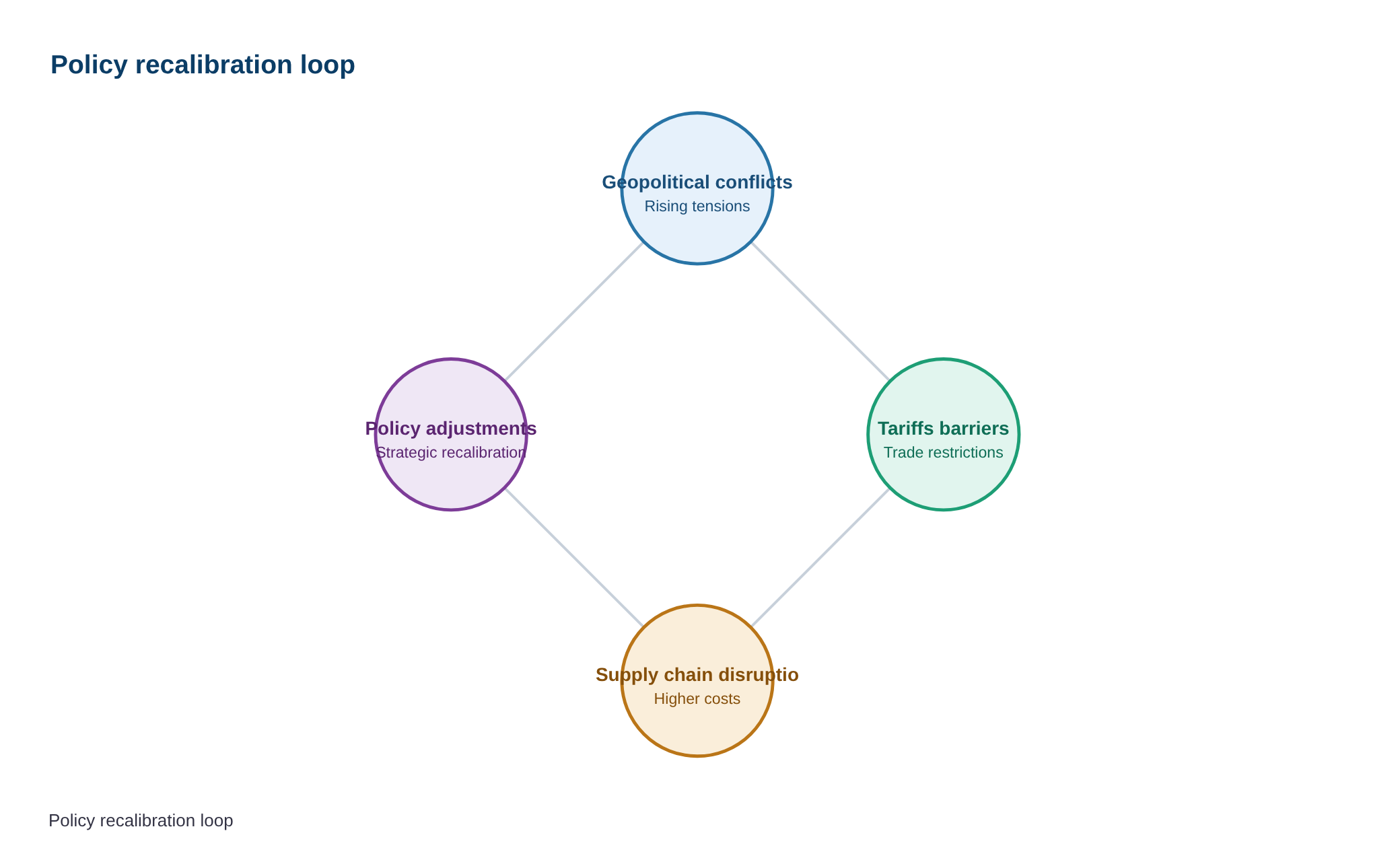
Global geopolitical conflicts and rising protectionism → Increased tariffs and trade barriers → Supply chain disruptions and higher input costs → Reduced export competitiveness and inflationary pressures → Recognition of need for strategic policy adjustments → Over-reliance on imported critical technologies → Vulnerability to geopolitical leverage and economic coercion → Threat to national security and technological sovereignty → Call for domestic production push in critical sectors → 35 years of liberalisation reforms → Mixed outcomes: growth and integration but also new vulnerabilities → Need for recalibration of liberalisation policies → Shift towards selective protectionism in strategic sectors → External shocks (conflicts, tariffs) as primary drivers of current economic challenges → Domestic weaknesses (e.g., supply chain gaps) exacerbated by external factors → Policy response: enhance self-reliance in critical sectors → Implementation challenges: fiscal constraints, regulatory bottlenecks, skill gaps
Prelims Practice Questions
Q1. Consider the following statements regarding India’s economic liberalisation reforms of 1991:
1. The reforms were initiated in response to a balance-of-payments crisis.
2. The New Economic Policy included the liberalisation of industrial licensing.
3. The reforms abolished all tariffs on imported goods to promote global integration.
How many of the above statements are correct?
- Only one
- Only two
- All three
- None
Answer: Only two — Statement 1 is correct as the reforms were triggered by a severe balance-of-payments crisis in 1991. Statement 2 is correct as industrial licensing was liberalised under the New Economic Policy. Statement 3 is incorrect as tariffs were not abolished but rationalised and reduced.
Q2. Assertion (A): The Reserve Bank of India (RBI) plays a pivotal role in managing India’s external sector challenges.
Reason (R): The RBI regulates foreign exchange reserves and implements monetary policies to mitigate the impact of global economic shocks.
Options:
A. Both A and R are true, and R is the correct explanation of A.
B. Both A and R are true, but R is not the correct explanation of A.
C. A is true, but R is false.
D. A is false, but R is true.
Answer: ? — Assertion (A) is true as the RBI manages external sector challenges through its regulatory and monetary tools. Reason (R) is also true and correctly explains A, as the RBI’s role in managing foreign exchange reserves and monetary policy directly addresses external shocks.
Q3. Match the following sectors with their strategic importance in the context of India’s economic policy:
Column I (Sector) Column II (Strategic Importance)
1. Defence manufacturing A. Enhancing AI capabilities
2. Semiconductor production B. Ensuring national security
3. Domestic production of critical goods C. Reducing import dependence
4. Adaptation to AI technology D. Strengthening technological sovereignty
Options:
A. 1-B, 2-D, 3-C, 4-A
B. 1-C, 2-A, 3-D, 4-B
C. 1-A, 2-B, 3-C, 4-D
D. 1-D, 2-C, 3-B, 4-A
- A
- B
- C
- D
Answer: A — 1-B: Defence manufacturing ensures national security. 2-D: Semiconductor production strengthens technological sovereignty. 3-C: Domestic production of critical goods reduces import dependence. 4-A: Adaptation to AI enhances AI capabilities.
Mains Practice Question
✍ Critically examine the assertion that India’s economic liberalisation reforms of 1991 must now be recalibrated in response to global tariff wars and geopolitical conflicts. Substantiate your argument with reference to the need for domestic production in critical sectors such as defence, semiconductors, and AI. (15 Marks)
Approach: MODEL-ANSWER SKELETON:
1. **Contextual Background (2 marks)**
– Briefly outline the 1991 New Economic Policy and its objectives (liberalisation, privatisation, globalisation).
– Highlight the role of C. Rangarajan as former RBI Governor and Chairman of the Economic Advisory Council.
2. **Global Shifts Warranting Recalibration (4 marks)**
– Discuss the rise of tariff wars and geopolitical conflicts (e.g., US-China trade tensions, Russia-Ukraine war) and their impact on global supply chains.
– Explain how these shifts necessitate a rethink of India’s trade and industrial policies.
3. **Critical Sectors Requiring Domestic Production (5 marks)**
– **Defence Manufacturing**: Cite the Make in India initiative, Defence Procurement Procedure (DPP), and the role of Defence Research and Development Organisation (DRDO).
– **Semiconductor Production**: Reference the Semicon India Programme (2021) and the PLI scheme for semiconductors.
– **AI Adaptation**: Discuss the National AI Strategy and the need for indigenous AI capabilities to reduce dependence on foreign technology.
4. **Balancing Liberalisation and Protectionism (4 marks)**
– Argue that recalibration does not imply abandoning liberalisation but adapting it to strategic needs.
– Cite examples of selective protectionism (e.g., tariffs on certain imports) while maintaining openness in other sectors.
– Discuss the role of the 16th Finance Commission in addressing fiscal federalism and resource allocation for these sectors.
Source: The Hindu
Generated by AanyaAi for educational purpose.

- KWML’s Feasibility Reports for Water Metro in 18 Cities: UPSC & PCS Insights - October 3, 2026
- ओडिशा में वन्यजीव अनुसंधान अनुदान कार्यक्रम शुरू, सिमिलिपाल में 300 कैमरे और बढ़ेंगे - October 3, 2026
- India Summons Pakistan High Commission Official Over Violation - October 3, 2026

No Comments