



11 Aug RBI Cancels CoR for 4 NBFCs: Key Implications for UPSC & State PCS Aspirants
✎ The RBI may cancel the Certificate of Registration of an NBFC under Section 45-IA(6) of the RBI Act, 1934, if the entity ceases operations, merges, or fails to comply with regulatory norms, ensuring systemic stability and…
Subject Relevance — Where This Topic Fits
- GS Paper III — Indian Economy and issues relating to Planning, Mobilisation of Resources, Growth, Development and Employment
- Prelims: NBFC, Certificate of Registration (CoR), Section 45-IA of RBI Act 1934, regulatory compliance, financial intermediaries
- Essay: Role of financial regulators in maintaining systemic stability, Balancing innovation and prudential regulation in financial sector
Quick Revision: The RBI may cancel the Certificate of Registration of an NBFC under Section 45-IA(6) of the RBI Act, 1934, if the entity ceases operations, merges, or fails to comply with regulatory norms, ensuring systemic stability and depositor protection.
Why is this in the news?
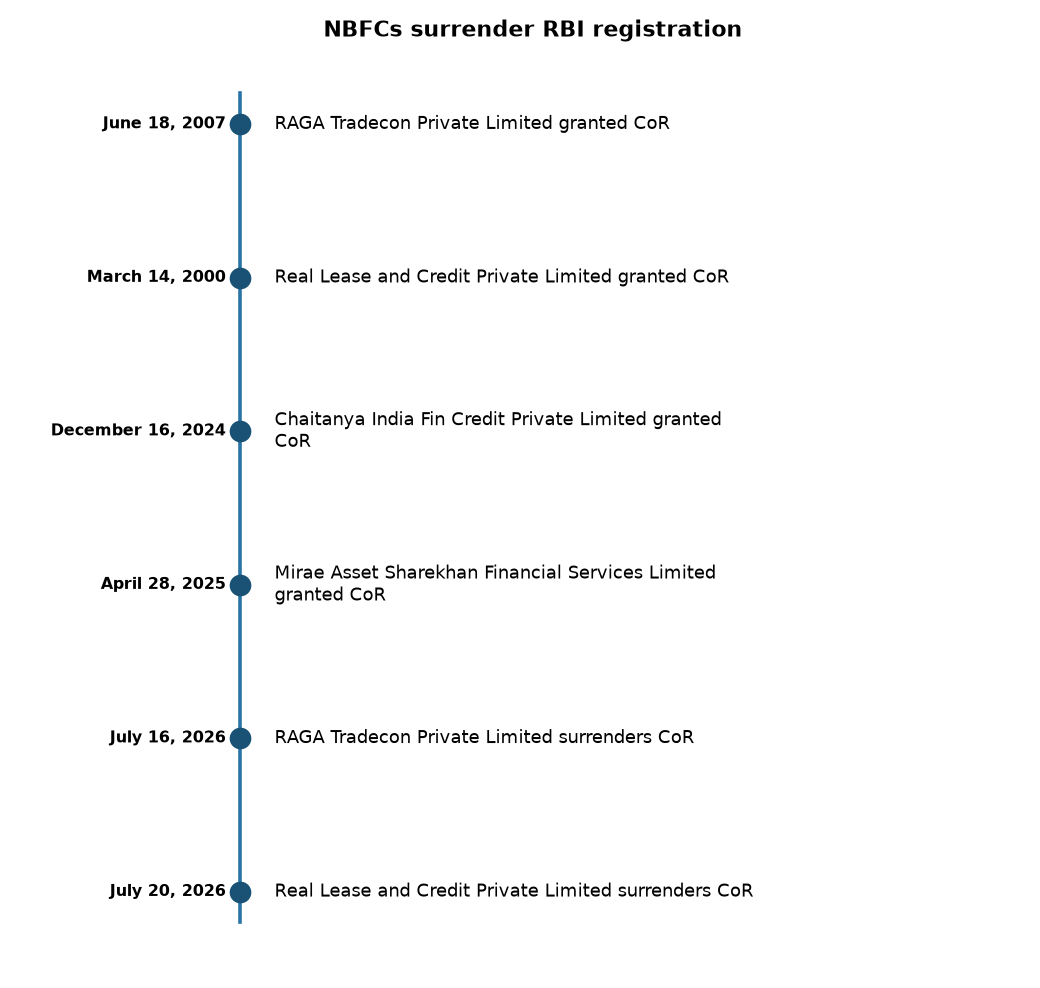
The Reserve Bank of India (RBI) has cancelled the Certificate of Registration (CoR) of four Non-Banking Financial Companies (NBFCs) under Section 45-IA(6) of the RBI Act, 1934, following their surrender of registration or cessation as legal entities. This action underscores the RBI’s ongoing efforts to enforce regulatory compliance, maintain financial stability, and protect depositor interests by ensuring that only duly authorised entities operate in the financial sector.
Background
- The NBFC sector in India has grown significantly, contributing to financial inclusion by providing credit to underserved segments such as MSMEs, retail borrowers, and infrastructure projects.
- NBFCs are regulated by the RBI under the RBI Act, 1934, and the Reserve Bank of India (Non-Banking Financial Company) Directions, 2016, which mandate registration, capital adequacy, and compliance with prudential norms.
- The RBI’s regulatory framework for NBFCs aims to mitigate systemic risks by ensuring that these entities adhere to governance, liquidity, and solvency standards similar to those applicable to banks.
- The cancellation of CoR for NBFCs is a statutory power vested in the RBI under Section 45-IA(6) of the RBI Act, 1934, which empowers the central bank to cancel registrations if an NBFC ceases operations, merges, or fails to comply with regulatory requirements.
- The RBI’s supervisory actions, including the cancellation of registrations, are part of its broader mandate to maintain financial stability and prevent regulatory arbitrage in the financial sector.
- Recent years have seen increased scrutiny of NBFCs due to their systemic importance, with the RBI imposing stricter norms on liquidity coverage, asset classification, and corporate governance.
What are Non-Banking Financial Companies (NBFCs) and their regulatory framework?
- NBFCs are financial institutions engaged in the business of loans and advances, acquisition of shares/stocks/bonds/debentures/securities issued by Government or local authority, leasing, hire-purchase, insurance business, and chit business, but do not include institutions whose principal business is agricultural, industrial activity, or the sale/purchase/construction of immovable property.
- NBFCs are distinct from banks as they do not hold a banking licence and cannot accept demand deposits, issue cheques drawn on themselves, or provide deposit insurance facilities to their depositors.
- Registration with the RBI is mandatory for NBFCs under Section 45-IA of the RBI Act, 1934, and the CoR is a prerequisite for conducting financial activities such as lending, investment, or leasing.
- The RBI’s regulatory framework for NBFCs includes prudential norms on capital adequacy (e.g., minimum net owned funds of ₹2 crore for deposit-taking NBFCs and ₹10 lakh for non-deposit-taking NBFCs), asset classification, income recognition, and provisioning for bad loans.
- NBFCs are categorised into deposit-taking (NBFC-D) and non-deposit-taking (NBFC-ND) entities, with the latter further classified into systemically important (NBFC-ND-SI) and others based on their asset size.
- The RBI monitors NBFCs through on-site inspections, off-site surveillance, and periodic reporting requirements to ensure compliance with regulatory norms and mitigate systemic risks.
- The cancellation of CoR for NBFCs is a regulatory tool used by the RBI to enforce discipline, prevent regulatory arbitrage, and protect the interests of depositors and investors in the financial system.
- Recent regulatory reforms, such as the introduction of the Scale-Based Regulatory (SBR) framework and the adoption of Ind-AS accounting standards, aim to enhance the resilience and transparency of NBFCs.
UPSC Value Addition
Keywords for Mains Answer-Writing
Non-Banking Financial Companies (NBFCs) · Certificate of Registration (CoR) · Reserve Bank of India (RBI) · Regulatory oversight of NBFCs · Section 45-IA of the RBI Act, 1934 · NBFC regulation and supervision · Financial sector governance · Financial stability · Corporate exit from financial services · Amalgamation and dissolution of NBFCs · NBFC compliance and surrender of licenses · RBI powers under the RBI Act, 1934 · Financial sector regulatory architecture · Systemic risk and NBFCs · Corporate governance in NBFCs
Prelims Practice Questions
Q1. Consider the following statements regarding the regulation of Non-Banking Financial Companies (NBFCs) in India:
1. The Reserve Bank of India (RBI) issues the Certificate of Registration (CoR) to NBFCs under the RBI Act, 1934.
2. The RBI can cancel the CoR of an NBFC if it voluntarily surrenders the certificate.
3. The RBI’s regulatory powers over NBFCs are derived solely from the Companies Act, 2013.
4. The cancellation of CoR by the RBI requires prior approval from the Ministry of Finance.
How many of the above statements are correct?
- Only one
- Only two
- Only three
- All four
Answer: Only two — Statements 1 and 2 are correct as the RBI issues and cancels CoR under Section 45-IA of the RBI Act, 1934. Statement 3 is incorrect because the RBI’s powers are primarily derived from the RBI Act, 1934, not the Companies Act, 2013. Statement 4 is incorrect as the RBI’s cancellation powers are exercised independently under the RBI Act.
Q2. Assertion (A): The Reserve Bank of India (RBI) can cancel the Certificate of Registration (CoR) of a Non-Banking Financial Company (NBFC) if it ceases to be a legal entity due to amalgamation or dissolution.
Reason (R): The RBI’s power to cancel the CoR is exercised under Section 45-IA (6) of the RBI Act, 1934, which empowers it to cancel the CoR if the NBFC exits the financial services business or ceases to exist as a legal entity.
In the context of the above two statements, which of the following is correct?
- Both A and R are true, and R is the correct explanation of A
- Both A and R are true, but R is not the correct explanation of A
- A is true, but R is false
- A is false, but R is true
Answer: Both A and R are true, and R is the correct explanation of A — Both the Assertion (A) and Reason (R) are true, and the Reason (R) correctly explains the Assertion (A) as the RBI’s power to cancel the CoR under Section 45-IA (6) of the RBI Act, 1934, includes scenarios where an NBFC ceases to be a legal entity.
Q3. Match the following columns related to the regulatory framework of Non-Banking Financial Companies (NBFCs) in India:
Column I (Provision/Section)
A. Section 45-IA of the RBI Act, 1934
B. Certificate of Registration (CoR)
C. Amalgamation of NBFCs
D. Voluntary surrender of CoR
Column II (Description)
1. Issued by the RBI to NBFCs for conducting financial services
2. Empowers the RBI to cancel the CoR if an NBFC exits the financial services business
3. Requires RBI approval for NBFCs undergoing merger or acquisition
4. Allows NBFCs to voluntarily surrender their CoR to the RBI
Select the correct match from the options below:
- A-2, B-1, C-3, D-4
- A-1, B-2, C-4, D-3
- A-3, B-1, C-2, D-4
- A-4, B-2, C-1, D-3
Answer: A-2, B-1, C-3, D-4 — The correct matches are: A-2 (Section 45-IA empowers RBI to cancel CoR), B-1 (CoR is issued by RBI to NBFCs), C-3 (Amalgamation requires RBI approval), and D-4 (Voluntary surrender is allowed under RBI regulations).
Mains Practice Question
✍ The Reserve Bank of India (RBI) has recently cancelled the Certificate of Registration (CoR) of several Non-Banking Financial Companies (NBFCs) due to their voluntary surrender or cessation as legal entities. Critically examine the regulatory framework governing the issuance and cancellation of CoR for NBFCs in India. Also, analyse the implications of such cancellations for financial stability and the broader NBFC sector. (15 Marks)
Approach: MODEL-ANSWER SKELETON:
1. **Regulatory Framework for NBFC Registration and Cancellation**
– Constitutional and statutory basis: RBI Act, 1934 (Section 45-IA) and RBI (Non-Banking Financial Company) Directions, 2016.
– Role of the RBI as the sole regulator for NBFCs, including deposit-taking and non-deposit-taking NBFCs.
– Process of issuance of Certificate of Registration (CoR): eligibility criteria, due diligence, and compliance with prudential norms.
– Grounds for cancellation of CoR: voluntary surrender, exit from financial services, amalgamation, dissolution, or non-compliance with regulatory norms.
2. **Legal and Procedural Safeguards**
– RBI’s powers under Section 45-IA (6) of the RBI Act, 1934: scope, limitations, and judicial review.
– Procedural fairness: notice, opportunity for hearing, and reasons for cancellation (citing RBI’s Master Direction on NBFCs).
– Role of the Ministry of Corporate Affairs (MCA) in cases of amalgamation or dissolution.
3. **Implications for Financial Stability**
– Systemic risk: potential contagion effects from NBFC failures or voluntary exits.
– Impact on credit intermediation: disruption in credit flow to MSMEs, retail borrowers, and infrastructure sectors.
– Role of the RBI in mitigating systemic risk: use of regulatory tools such as prompt corrective action (PCA), liquidity support, and resolution frameworks.
4. **Broader NBFC Sector Dynamics**
– Consolidation trend: voluntary exits as a response to regulatory pressures, competition, or business model challenges.
– Regulatory arbitrage: comparison with other financial entities (e.g., banks, fintech companies) and the need for level playing field.
– Consumer protection: safeguards for depositors and borrowers in cases of NBFC cancellations.
5. **Critical Analysis and Way Forward**
– Effectiveness of the RBI’s regulatory oversight: strengths and limitations in preventing misconduct or failures.
– Need for proactive supervision: use of technology (e.g., RegTech, SupTech) and data analytics to monitor NBFCs.
– Recommendations: strengthening corporate governance in NBFCs, enhancing transparency in cancellation processes, and aligning with global best practices (e.g., Basel III norms for NBFCs).
6. **Conclusion**
– Summarise the regulatory balance between facilitating business exits and ensuring financial stability.
– Emphasise the RBI’s role as a guardian of financial stability while maintaining a facilitative regulatory environment.
Source: RBI
Generated by AanyaAi for educational purpose.

- KWML’s Feasibility Reports for Water Metro in 18 Cities: UPSC & PCS Insights - October 3, 2026
- ओडिशा में वन्यजीव अनुसंधान अनुदान कार्यक्रम शुरू, सिमिलिपाल में 300 कैमरे और बढ़ेंगे - October 3, 2026
- India Summons Pakistan High Commission Official Over Violation - October 3, 2026

No Comments