


08 Sep RBI Extends Directions for Amanath Co-operative Bank: Key UPSC Polity Insight
✎ The RBI’s powers under Section 35A read with Section 56 of the Banking Regulation Act, 1949, enable it to issue binding directions to co-operative banks to ensure financial stability, depositor protection, and compliance with…
Subject Relevance — Where This Topic Fits
- GS Paper III — Indian Economy and Issues Relating to Planning, Mobilisation of Resources, Growth, Development and Employment
- Prelims: Banking Regulation Act, 1949, Section 35A, Co-operative Banks, RBI Directions, Financial Regulation, Public Interest, Banking Sector Oversight
- Essay: Role of Regulatory Bodies in Ensuring Financial Stability, Balancing Public Interest and Financial Accountability in Banking
Quick Revision: The RBI’s powers under Section 35A read with Section 56 of the Banking Regulation Act, 1949, enable it to issue binding directions to co-operative banks to ensure financial stability, depositor protection, and compliance with regulatory norms.
Why is this in the news?
The Reserve Bank of India (RBI) has extended the period of regulatory directions issued to The Amanath Co-operative Bank Ltd., Bengaluru, under Section 35A read with Section 56 of the Banking Regulation Act, 1949. This extension, effective from September 12, 2026, to December 12, 2026, underscores the RBI’s ongoing supervisory role in addressing concerns related to the bank’s operations, while explicitly clarifying that such measures do not imply satisfaction with the bank’s financial position.
Background
- Co-operative banks in India operate under a dual regulatory framework: the Reserve Bank of India (RBI) for banking functions and state governments for registration and management, as per the Constitution’s Seventh Schedule.
- The Banking Regulation Act, 1949, governs the functioning of co-operative banks, including their registration, management, and liquidation, while the RBI enforces prudential norms and supervisory measures.
- Section 35A of the Banking Regulation Act, 1949, empowers the RBI to issue directions to co-operative banks to ensure compliance with banking norms, safeguard depositors’ interests, and maintain financial stability.
- Section 56 of the Act extends the applicability of Section 35A to co-operative banks, enabling the RBI to regulate their operations and impose restrictions when necessary.
- The RBI’s regulatory powers under these provisions are exercised to address governance failures, financial irregularities, or systemic risks in co-operative banks, as part of its mandate to protect the banking system.
- This is not an isolated instance; the RBI frequently issues such directions to co-operative banks to mitigate risks and ensure adherence to regulatory standards.
What are the RBI’s Powers under Section 35A and Section 56 of the Banking Regulation Act, 1949?
- Section 35A of the Banking Regulation Act, 1949, confers upon the RBI the authority to issue directions to co-operative banks for reasons such as public interest, depositor protection, or to prevent banking malpractices.
- The RBI may impose restrictions on the operations of a co-operative bank, including limits on withdrawals, suspension of business activities, or appointment of an administrator to oversee its functioning.
- Section 56 extends the applicability of Section 35A to co-operative banks, ensuring that the RBI’s regulatory oversight applies uniformly to both commercial and co-operative banking institutions.
- The RBI’s directions are legally binding and must be complied with by the concerned bank, failing which the RBI may initiate further enforcement actions, including cancellation of registration.
- The RBI’s powers under these sections are exercised in a manner that balances the need for regulatory oversight with the operational autonomy of co-operative banks.
- The RBI’s actions are guided by the principles of transparency, accountability, and fairness, with due consideration given to the interests of depositors and the broader financial system.
- The RBI’s regulatory framework for co-operative banks is designed to address risks such as poor governance, financial mismanagement, and non-compliance with prudential norms.
- The RBI’s directions are subject to periodic review, and the central bank may modify or revoke them based on the bank’s compliance with regulatory requirements.
Key Features
| Feature | Significance |
|---|---|
| Section 35A of the Banking Regulation Act, 1949 | Empowers the RBI to issue directions to banking companies for public interest, including supervisory and regulatory actions. |
| Section 56 of the Banking Regulation Act, 1949 | Provides the RBI with powers to apply specific provisions of the Act to co-operative banks, ensuring regulatory oversight. |
| RBI Directions to Co-operative Banks | Enables the RBI to impose restrictions or supervisory measures on co-operative banks to safeguard depositors’ interests and maintain financial stability. |
| Extension of Directions | Allows the RBI to prolong regulatory oversight when necessary, ensuring compliance and addressing systemic risks without abrupt disruptions. |
| Public Interest Criterion | Mandates that any regulatory action by the RBI must be justified on grounds of public interest, balancing depositor protection and financial sector stability. |
Why it Matters
Regulatory Governance
- Demonstrates the RBI’s proactive role in maintaining financial stability by extending supervisory directions to co-operative banks when required.
- Highlights the RBI’s authority under the Banking Regulation Act to intervene in the operations of co-operative banks to prevent systemic risks.
- Reinforces the principle that regulatory actions are not punitive by default but are aimed at safeguarding depositor interests and financial integrity.
Depositor Protection
- Ensures that depositors’ funds in co-operative banks remain secure through continuous regulatory oversight, even when the bank’s financial health is under scrutiny.
- Prevents abrupt withdrawal restrictions or bank failures by allowing the RBI to extend directions until stability is restored.
- Underscores the RBI’s commitment to depositor confidence in the banking system, including the co-operative sector.
Co-operative Banking Sector
- Illustrates the challenges faced by co-operative banks in maintaining compliance with regulatory norms, necessitating RBI intervention.
- Emphasises the need for co-operative banks to align their operations with prudential norms to avoid prolonged regulatory scrutiny.
- Raises awareness about the distinct regulatory framework governing co-operative banks compared to commercial banks.
Financial Sector Stability
- Serves as a case study for how regulatory bodies like the RBI manage risks in niche banking segments to prevent contagion effects.
- Underscores the importance of timely and proportionate regulatory responses to emerging vulnerabilities in the financial system.
Challenges
1. Regulatory Oversight in Co-operative Banks
- Balancing autonomy of co-operative banks with stringent regulatory oversight to prevent mismanagement or financial distress.
- Ensuring that regulatory directions do not stifle the operational flexibility of co-operative banks, which often serve niche communities.
- Addressing the unique governance structures of co-operative banks, which may complicate compliance with standard banking norms.
UPSC Link: Indian Financial System – RBI’s Role
2. Depositor Confidence and Systemic Risk
- Maintaining depositor trust in co-operative banks despite regulatory interventions, which may be perceived as signs of distress.
- Preventing panic withdrawals or bank runs in co-operative banks under RBI directions, which could exacerbate financial instability.
- Ensuring that regulatory actions do not lead to unintended consequences, such as credit crunch or reduced access to finance for vulnerable segments.
UPSC Link: Financial Stability and RBI’s Mandate
3. Legal and Procedural Delays
- Addressing potential delays in implementing regulatory directions due to legal challenges or procedural hurdles.
- Ensuring that extensions of directions are not misinterpreted as approval of the bank’s financial position, which could mislead stakeholders.
UPSC Link: Judicial Review of Regulatory Actions
4. Capacity Building in Co-operative Banks
- Strengthening the governance and risk management frameworks of co-operative banks to reduce reliance on RBI directions.
- Promoting awareness among co-operative bank stakeholders about regulatory expectations and compliance requirements.
UPSC Link: Co-operative Banks – Governance Reforms
Challenges — UPSC Perspective
| Issue | Concern |
|---|---|
| Regulatory Compliance | Ensuring co-operative banks adhere to prudential norms and avoid prolonged RBI interventions. |
| Depositor Protection | Balancing regulatory actions with the need to maintain depositor confidence and prevent panic. |
| Operational Flexibility | Avoiding over-regulation that could hinder the functional autonomy of co-operative banks. |
| Systemic Stability | Preventing regulatory actions from triggering broader financial instability or credit disruptions. |
| Legal and Procedural Hurdles | Addressing delays or challenges in implementing RBI directions due to legal or administrative constraints. |
Way Forward
- Strengthen the governance frameworks of co-operative banks through capacity-building initiatives and training programs for board members and management.
- Enhance transparency in RBI’s regulatory processes, including clear communication of the rationale behind extensions of directions to stakeholders.
- Promote the adoption of digital banking solutions in co-operative banks to improve compliance and operational efficiency.
- Conduct periodic reviews of the regulatory framework governing co-operative banks to align with evolving financial sector dynamics.
- Encourage co-operative banks to diversify their revenue streams and reduce reliance on high-risk lending practices.
- Foster collaboration between RBI, state governments, and co-operative societies to address structural challenges in the co-operative banking sector.
- Develop early warning systems to identify distress in co-operative banks before regulatory intervention becomes necessary.
UPSC Value Addition
Keywords for Mains Answer-Writing
Banking Regulation Act, 1949 · Section 35A of Banking Regulation Act · Section 56 of Banking Regulation Act · Reserve Bank of India (RBI) · Co-operative Banks · Regulatory Directions · Financial Sector Regulation · Public Interest in Banking · Banking Sector Governance · Regulatory Arbitrage · Financial Stability · Banking Sector Reforms · Sustainable Banking Practices
Concept Flow
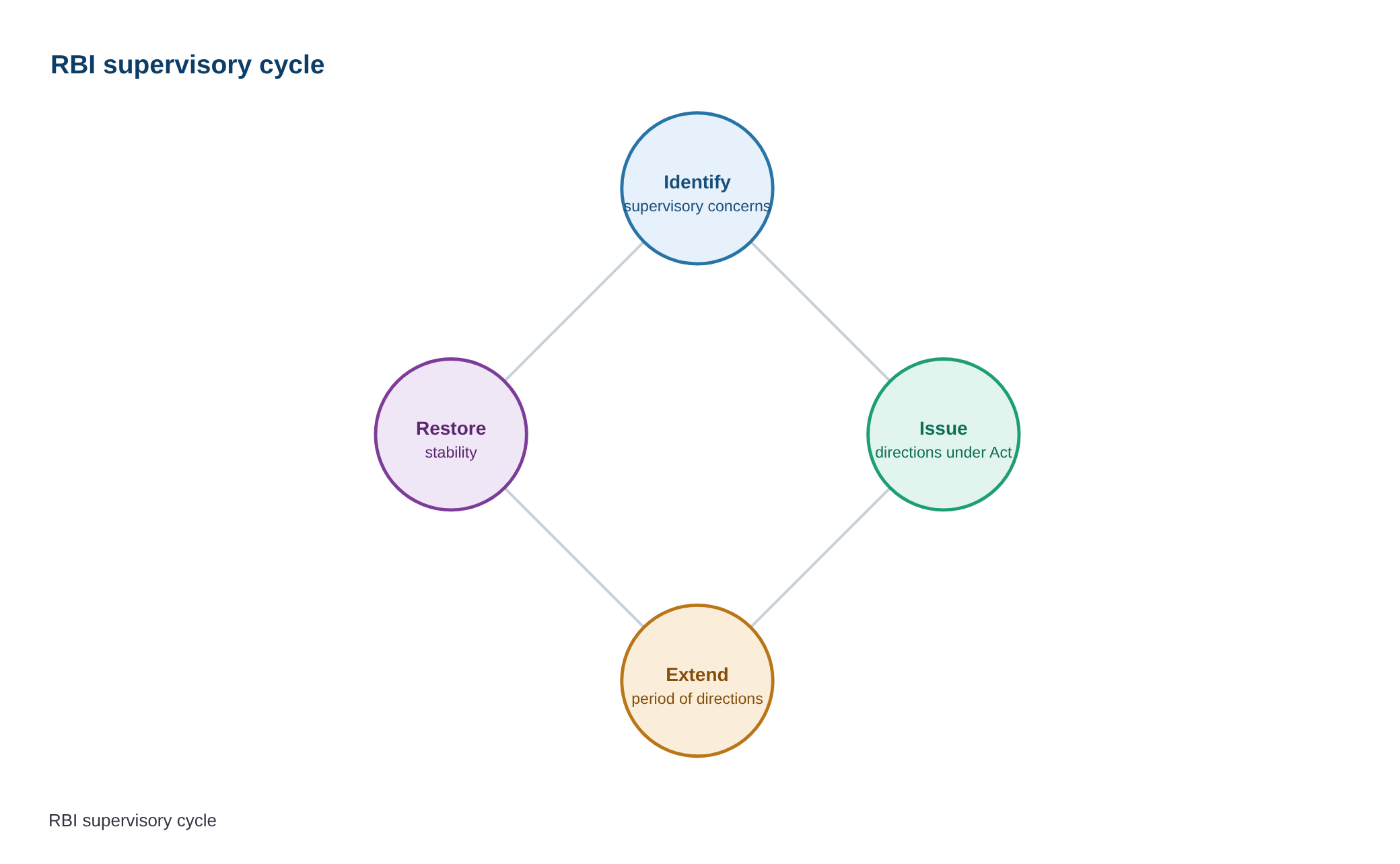
RBI identifies supervisory concerns in a co-operative bank → Issues directions under Section 35A read with Section 56 of the Banking Regulation Act, 1949 → Directions impose restrictions on the bank’s operations → RBI extends the period of directions to ensure stability → Public interest is cited as the justification for the extension → Stakeholders assess the implications of the extension on depositor confidence and financial stability.
Prelims Practice Questions
Q1. Consider the following statements regarding the Reserve Bank of India’s powers under the Banking Regulation Act, 1949:
1. The RBI can issue directions to co-operative banks under Section 35A of the Banking Regulation Act, 1949.
2. Section 56 of the Banking Regulation Act, 1949 empowers the RBI to issue directions to all banks, including co-operative banks.
3. The RBI’s directions under these sections are issued only in the interest of the depositors and not for broader public interest.
4. The RBI’s directions can be extended beyond the initially stipulated period if public interest so requires.
How many of the above statements are correct?
- Only one
- Only two
- Only three
- All four
Answer: Only three — Statements 1, 2, and 4 are correct. Statement 3 is incorrect as the RBI’s directions under Section 35A read with Section 56 are issued in the public interest, which includes depositor interest but is not limited to it.
Q2. Assertion (A): The Reserve Bank of India can extend the period of its directions to a co-operative bank under Section 35A read with Section 56 of the Banking Regulation Act, 1949.
Reason (R): The Banking Regulation Act, 1949 empowers the RBI to issue directions to co-operative banks for a period not exceeding six months at a time, but does not permit extensions beyond the initial period.
In the context of the above two statements, which of the following is correct?
- Both A and R are true, and R is the correct explanation of A.
- Both A and R are true, but R is not the correct explanation of A.
- A is true, but R is false.
- A is false, but R is true.
Answer: A is true, but R is false. — Assertion (A) is true as the RBI can extend the period of its directions under the cited sections. Reason (R) is false because the Act does permit extensions beyond the initial six-month period if public interest requires it.
Q3. Match the following provisions of the Banking Regulation Act, 1949 with their correct descriptions:
Column I
1. Section 35A
2. Section 56
3. Section 35
4. Section 45
Column II
A. Empowers the RBI to issue directions to co-operative banks
B. Empowers the RBI to issue directions to all banks, including co-operative banks
C. Provides for the amalgamation of banking companies
D. Empowers the RBI to impose moratorium on banking companies
Select the correct match:
- 1-A, 2-B, 3-C, 4-D; 1-B, 2-A, 3-D, 4-C; 1-C, 2-D, 3-A, 4-B; 1-D, 2-C, 3-B, 4-A
- answer
- explain
- format
Answer: 1-A, 2-B, 3-C, 4-D; 1-B, 2-A, 3-D, 4-C; 1-C, 2-D, 3-A, 4-B; 1-D, 2-C, 3-B, 4-A —
Mains Practice Question
✍ The Reserve Bank of India, in exercise of its powers under Section 35A read with Section 56 of the Banking Regulation Act, 1949, has extended the period of its directions to The Amanath Co-operative Bank Ltd., Bangalore, citing public interest. Critically examine the constitutional and statutory basis of such regulatory interventions in the banking sector, with particular reference to the balance between regulatory autonomy and the rights of stakeholders. (15 Marks)
Approach: MODEL-ANSWER SKELETON:
1. **Statutory Basis of RBI’s Powers**:
– Section 35A of the Banking Regulation Act, 1949 empowers the RBI to issue directions to co-operative banks for purposes such as safeguarding depositors’ interests or ensuring sound banking practices.
– Section 56 extends these powers to co-operative banks, aligning their regulation with that of commercial banks.
– Cite the **RBI’s regulatory mandate** under the Act and the **objective of financial stability**.
2. **Constitutional and Legal Framework**:
– **Doctrine of Regulatory Autonomy**: RBI’s actions are rooted in the **public trust doctrine** and the **welfare state principle** under the Constitution (Part IV, Directive Principles of State Policy).
– **Judicial Precedents**: Reference **RBI vs. Peerless General Finance & Investment Co. Ltd. (1987)** and **RBI vs. Indian Banks’ Association (2014)** to establish the RBI’s **wide discretionary powers** in banking regulation.
– **Proportionality Principle**: Examine whether the RBI’s intervention is **proportionate** to the risk posed to depositors and the financial system (Article 14 of the Constitution).
3. **Balance with Stakeholder Rights**:
– **Depositors’ Rights**: The RBI’s directions aim to protect depositors, but prolonged restrictions may impact their **right to access funds** (Article 21 of the Constitution).
– **Bank’s Autonomy**: The RBI’s directions restrict the bank’s operational freedom, raising questions about **due process** and **natural justice** (Article 19(1)(g) read with reasonable restrictions).
– **Judicial Scrutiny**: Discuss **judicial review standards** for RBI’s actions (e.g., **Wednesbury unreasonableness** test).
4. **Contemporary Relevance and Challenges**:
– **Co-operative Banks’ Vulnerabilities**: Highlight the risks in co-operative banking (e.g., **PMC Bank crisis, 2019**) and the need for **stronger oversight**.
– **Regulatory Arbitrage**: Examine whether the RBI’s powers under Sections 35A and 56 help **prevent regulatory arbitrage** between commercial and co-operative banks.
– **Sustainable Banking**: Discuss the RBI’s role in promoting **sustainable banking practices** and **financial inclusion** while balancing regulatory strictness.
5. **Conclusion**:
– The RBI’s regulatory interventions under Sections 35A and 56 are **constitutionally valid** and necessary for **financial stability**, but must be **time-bound, transparent, and subject to judicial review** to protect stakeholder rights.
– Suggest measures such as **periodic reviews, depositor compensation mechanisms, and stakeholder consultations** to enhance legitimacy.
Source: RBI
Karnataka PCS (KPSC) — State PCS Practice
Prelims: Under which provision of the Banking Regulation Act, 1949 was the period extended for The Amanath Co-operative Bank Ltd., Bangalore, as per the recent directions issued by the Reserve Bank of India (RBI)?
- Section 35A read with Section 56
- Section 45 read with Section 56
- Section 35 read with Section 45
- Section 56 read with Section 10
Answer: Section 35A read with Section 56 — The extension was granted under Section 35A read with Section 56 of the Banking Regulation Act, 1949, which empowers the RBI to issue directions to banking companies for public interest.
Mains: Examine the significance of the Reserve Bank of India’s (RBI) recent directions under Section 35A read with Section 56 of the Banking Regulation Act, 1949, for The Amanath Co-operative Bank Ltd., Bangalore. Discuss the implications for cooperative banks in Karnataka and the regulatory framework governing them.
Generated by AanyaAi for educational purpose.
Related guides on our sites
- Current affairs for upsc 2026
- Best PSIR optional coaching for upsc
- Best PSIR optional teacher for upsc
- Best teacher of PSIR optional for upsc

- RBI Extends Directions for Amanath Co-operative Bank: Key UPSC Polity Insight - September 8, 2026
- वडोदरा में 35,000 करोड़ रुपये की विकास परियोजनाओं का शुभारंभ: मोदी - September 8, 2026
- PM Modi lays foundation of ₹35,000 cr infra projects in Vadodara for UPSC 2026 - September 8, 2026

No Comments